You want to light your pergola with solar power. Sounds good on paper. Except there's a problem no one clearly tells you before you buy: your pergola roof blocks the sun. And if the solar panel doesn't see the sky, the light won't charge. Simple.
This guide exists to prevent you from ending up with a useless solar light screwed under your awning. We'll explore how solar lighting can truly work under a pergola, when it won't (and we'll be frank about it), and what practical solutions are available based on your patio's configuration.
Why Solar Lighting and Pergolas Don't Always Mix
The pergola is the trickiest case for outdoor solar lighting. Unlike a driveway, gate, or exposed facade, it creates a permanent shaded area. And shade is the number one enemy of photovoltaic panels.
How Solar Charging Works in Practice
A solar panel needs direct or semi-direct sun exposure to efficiently charge its battery. Under a pergola roof—whether polycarbonate, wood, fabric, or aluminum—zero direct light passes through. Charging is therefore nonexistent or insufficient, and the battery gradually drains without ever fully recharging.
The result? A light that works for two or three days after installation, then dies permanently. Not because it's broken, but because it never got the sun it needed.
When Solar Simply Won't Work
Let's be direct: if your pergola is fully covered, enclosed on the sides, and has no access to the sun, solar isn't the right solution. Not because the technology is bad, but because physics doesn't lie. In this case, you're better off with a USB rechargeable LED light bar (see our guide on wireless outdoor lighting solutions) or a traditional electrical setup.
However, if your pergola is open on the sides or its pillars are exposed to the sky, there are solutions that work very well. The key is the panel placement, not the light's position.
Placement: The Real Key to Effective Solar Pergola Lighting
The good news is that most modern solar lights separate the panel from the light source, or can be positioned so the panel extends beyond the roof. This is where it all happens.
Mount the Light on the Outer Pillar, Not Under the Roof
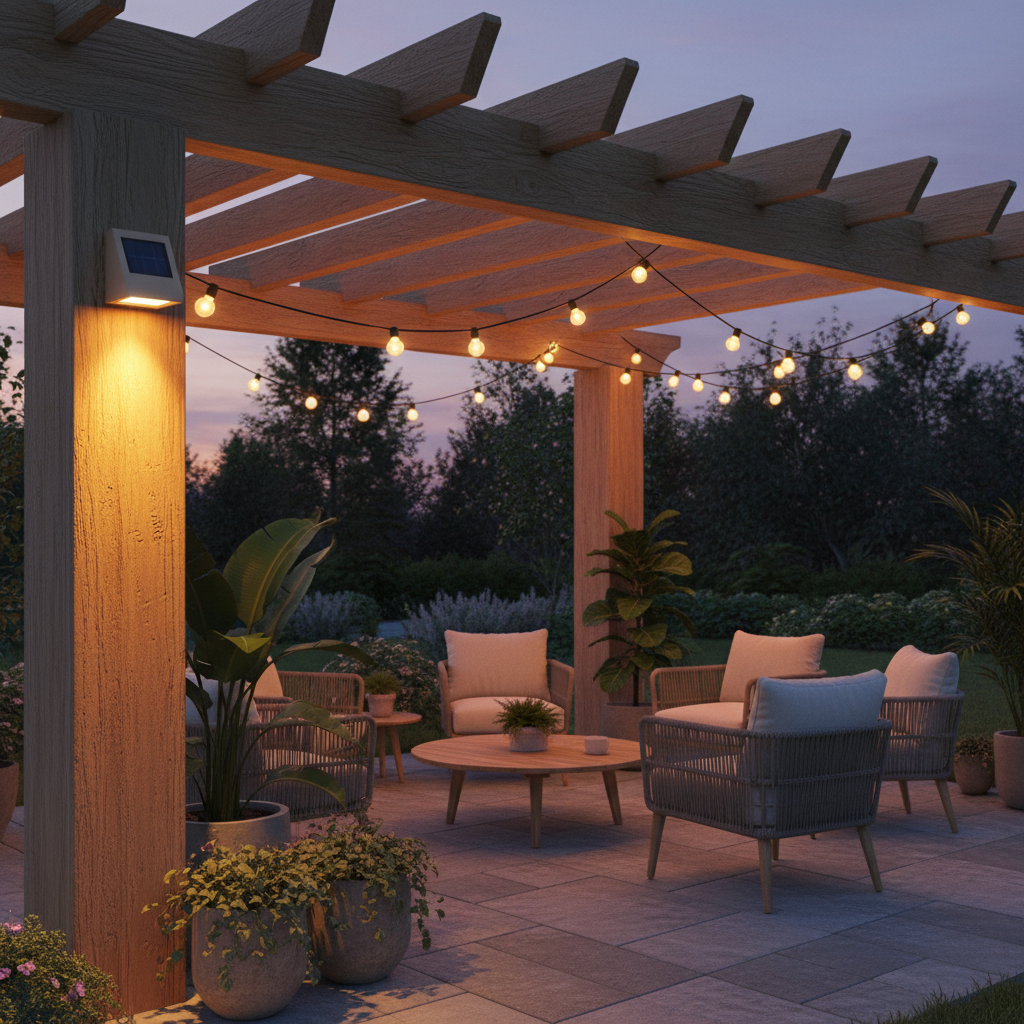
This is the most effective and underestimated solution. Instead of trying to install your solar light directly under the awning, you position it on the outer pillar of the pergola, at a sufficient height. The solar panel points skyward, exposed to the sun, and the light illuminates the area you need: the ground, entrance, or patio.
This is exactly the logic behind Lumic's SolarGlow. It mounts on the outer pillar, not under the roof. The panel faces the sky, the light illuminates the pathway. With its 1200 lumens and two motion sensors covering 180° each (range of about 26 feet), it lights up a patio without ever suffering from roof shade.
Opt for a System with a Remote Panel
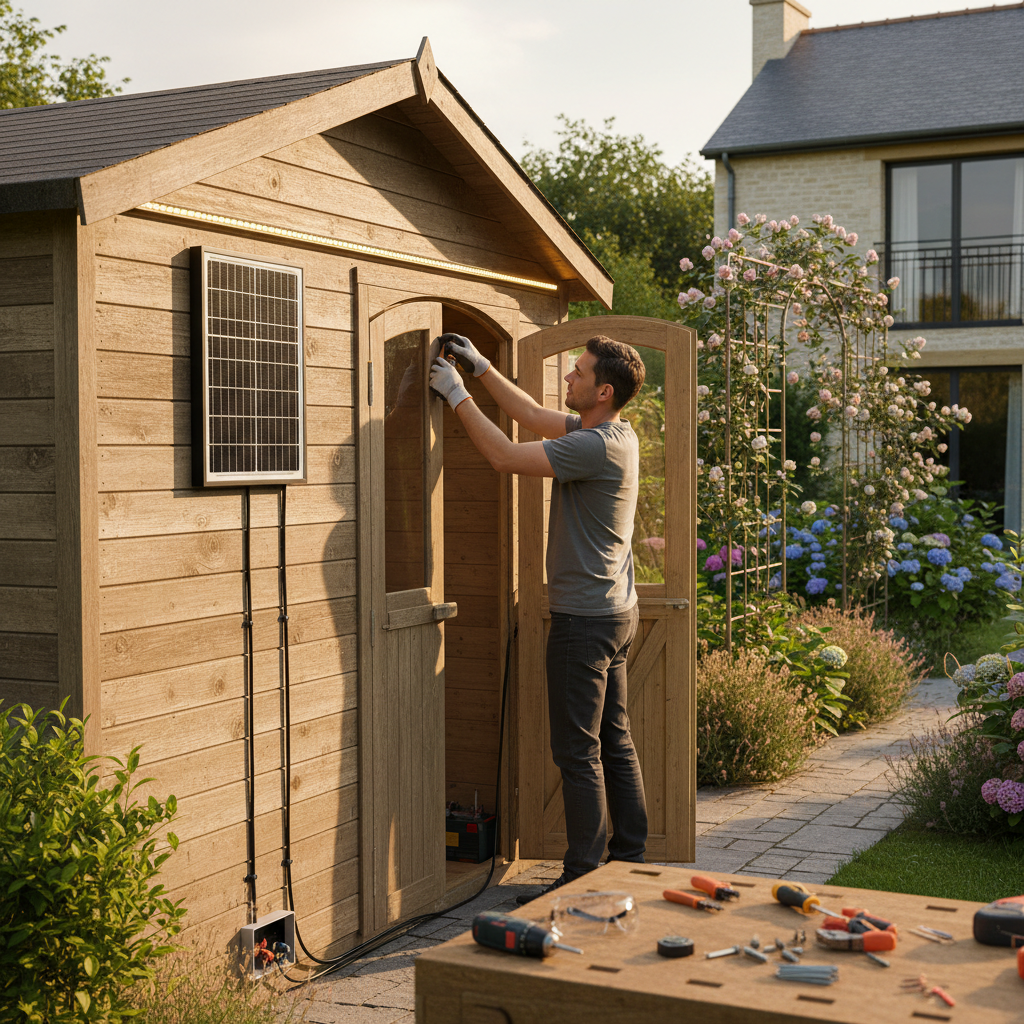
Some solar string lights and spotlights include a separate cable between the panel and the light source. The principle: you place the panel in a sunny spot (on the pergola roof if accessible, on a south-facing facade, or on the ground in the garden) and run the cable to where you want the light.
This is particularly practical for decorative string lights you want to run under your awning. The panel is in the sun, the bulbs are in the comfortable shade of your pergola. To delve deeper into choosing between different product types, our article on outdoor solar spotlight selection reviews available configurations.
The Backup Solution: USB Charging
If your solar exposure is truly insufficient (north-facing pergola, house casting shade most of the day), USB rechargeable lights offer an honest alternative. You charge them at night, and enjoy them in the evening. No solar panel to position, no compromise on power. A shame-free alternative to consider if your patio's configuration isn't suitable.
What Type of Solar Lighting to Choose for Your Pergola?
There are several product families, each with its advantages depending on your intended use. Here's an honest comparison:
| Light Type | Strengths | Weaknesses | Suitable for Pergola? |
|---|---|---|---|
| Pillar-mounted Solar Spotlight | Powerful, autonomous, motion detection | Requires a sun-exposed pillar | ✅ Yes, if pillar is sunny |
| Solar String Lights with Remote Panel | Decorative, easy to install | Low power, decorative use only | ✅ Yes, for ambiance |
| Under-roof Solar Light | Seemingly convenient | Shaded panel = no recharge | ❌ No, unless transparent roof |
| USB Rechargeable | Works anywhere, no solar constraints | Requires an outlet to recharge | ✅ Yes, if pergola lacks sun |
Criteria to Check Before Buying a Solar Light for Your Pergola
Not all solar products are created equal, far from it. The market is flooded with $10-$15 lights that promise wonders and die after two weeks. Here's what truly makes a difference.
Solar Panel Size: Often the Decisive Factor
A small solar panel charges little. In winter or with limited sunlight, an undersized panel will never make up the deficit. When comparing solar lights, look at the panel's surface area: the larger it is, the more energy it captures even on cloudy days. This is often where entry-level models lose out to more serious products.
To learn more on this topic, our guide to choosing the ideal outdoor solar light details the technical points to check before purchase.
Battery Capacity
A larger battery means more energy reserve. This is especially important for pergolas, where solar charging days can be complicated by weather or orientation. A light with a large battery lasts several days without sun, whereas a cheap battery drains after the first cloudy night.
Weather Resistance
An outdoor pergola is exposed to rain, wind, and sometimes frost. Look for at least an IP65 rating on your solar light. This means it's protected against water jets and dust. A product without IP certification is unlikely to survive winter in good condition.
The SolarGlow is IP65 certified and designed to operate in harsh conditions: rain, snow, frost. Its battery allows it to last up to 20 days without solar recharge in motion detection mode.
Motion Detection: A Real Plus for Pergolas
A motion-sensing light only consumes energy when you need it. For a pergola used mainly in the evening, this is essential: the light turns on when you arrive, stays on while you're there, then turns off by itself. The battery thus lasts much longer than in continuous mode.
If you want to understand in detail how these systems work, our guide on motion detection solar lighting systems explains the differences between market sensors.
How to Install Solar Lighting on a Pergola: Practical Steps
Installing a solar light on a pergola usually takes less than fifteen minutes if you have the right products. Here's the method that works.
Step 1: Analyze Your Pillars' Exposure
First, observe for a sunny day (or half-day) which pillars of your pergola receive sun and at what time. The ideal is a south or southwest-facing pillar, which captures the sun from noon until evening. Also note shadows cast by trees, walls, or the house itself. This analysis will dictate your light's placement.
Step 2: Choose Mounting Height
For a security or area spotlight, a height between 6.5 and 10 feet is optimal. Too low, the light cone is too short. Too high, the angle might miss the area you want to illuminate. For a standard pergola pillar at 8 feet, mounting at 7.2 feet generally gives excellent results.
Step 3: Mount and Orient the Solar Panel
The light is mounted, but the panel's orientation is everything. Tilt it slightly towards the open sky, ideally at 30-45° from vertical to maximize capture. If the panel is integrated into the light (monobloc design), ensure the panel's face points towards the sun, even if it means orienting the light slightly differently than you initially planned.
Step 4: Test Before Finalizing
Allow the light to charge for 24 to 48 hours before judging the result. A new battery needs one or two full cycles to reach its full capacity. If after 48 hours in full sun the light doesn't last a night, the panel isn't sufficiently exposed or the product is undersized.
Create a True Ambiance Under Your Pergola with Solar Lighting
Solar lighting isn't just about safety and visibility. A well-lit pergola is also an invitation to extend evenings outdoors, even after sunset. And for that, light quality matters as much as its power.
Mix Light Sources
The best approach for a pergola is often to combine several types of lighting. A powerful spotlight on the pillar for security and pathways, complemented by string lights or decorative fixtures at lower power for ambiance. The first handles functionality, the latter creates atmosphere.
To inspire you on how to combine these different sources for a truly pleasant living result, our article on how to create a warm ambiance with solar patio lighting provides concrete ideas directly applicable to a pergola.
Choose the Right Color Temperature
For a pergola, warm white (2700 to 3000 K) is almost always the best choice for ambiance. It mimics candlelight, creates a cozy atmosphere, and highlights natural materials like wood or rattan. Neutral white (4000 K) is more suitable if you use your pergola for working or outdoor cooking. Cool white (6000 K) should be avoided in a relaxed setting: it gives an outdoor office light impression.
Consider Motion Sensor Range
If you opt for a motion-sensing light, check that the sensor's range matches your use. For a pergola with a main access (stairs, path), a sensor covering 20 to 26 feet is ample. For a large patio with multiple accesses, choose a model with two sensors or a wider range, like the SolarGlow which covers 180° on each side.
What People Say Who've Tried Solar Under Pergolas
On Trustpilot (overall rating of 4.5/5, over 2200 reviews), feedback on solar pergola lighting often converges on the same observation: success or failure depends almost entirely on panel placement. Customers who followed placement advice (light on exposed pillar, panel facing sky) are satisfied. Those who placed their light directly under the roof were disappointed, regardless of product quality.
It's not a matter of brand or budget. It's a matter of physics and common sense. A pergola creates shade, and shade prevents charging. Starting with this understanding is already halfway to a successful installation.
Summary: What to Remember Before Buying
- The pergola roof blocks the sun: never install the solar panel under the cover.
- The key solution: exposed outer pillar, panel facing the sky, light directed towards the area to be illuminated.
- Remote panel: ideal for string lights and decorative systems.
- USB charging: a valid alternative if solar exposure is insufficient.
- Fully enclosed pergola with no sun access: solar won't work, accept it and choose something else.
- Criteria to check: panel size, battery capacity, minimum IP65 rating, motion detection.
- Ambiance: warm white for evenings, multiple light sources for a balanced result.
Solar pergola lighting works very well when you understand its constraints. It's not a capricious technology; it's just a technology with its rules. Respect them, and you'll enjoy your patio even after 11 PM, without touching a single electrical cable.