Looking for a rechargeable LED spotlight for a shelf, display case, or artwork, and finding yourself overwhelmed by tiny button-cell gadgets that barely glow? This is a common problem in this category: the promise is great, but the reality often disappoints.
This guide helps you make the right choice, without selling you a dream. We'll cover what rechargeable LED spotlights do well, their honest limitations, and when an alternative like a strip light provides significantly better illumination.
What "Rechargeable LED Spotlight" Really Means
In the market, rechargeable spotlights fall into two very different families, and that's where the confusion begins.
Miniature Battery-Powered or Integrated Battery Spotlights
These are small discs or cylinders that stick under a shelf or inside a display case. They often run on a button cell battery or a small-capacity lithium battery. The result: a pinpoint light, often dim (under 50 lumens in entry-level models), and a battery life of a few hours of continuous use.
To highlight a single collectible on a white shelf, this might suffice. But for lighting a workspace or an entire closet, you'll be disappointed: the light remains pinpoint, creating harsh shadows and covering only a small area.
Directional Rechargeable Spotlights for Artwork and Display Cases
There are also more serious spotlights, mounted with clamps or wall fixtures, featuring a proper battery and an adjustable beam. These models are specifically designed to highlight artwork, sculptures, or specific objects. If this is your use case, this is the right category.
You can find these products in specialized decor stores or museum supply shops. The price reflects the quality of the beam and battery life.
Key Criteria for Choosing a Rechargeable LED Spotlight
Before buying, four criteria truly make a difference in daily use.
Luminous Flux: How Many Lumens Are Truly Useful?
A wireless LED spotlight under 100 lumens is only useful for decorative ambiance, not for lighting a countertop or finding items in a closet. For functional use, aim for at least 150 to 200 lumens. For a larger room or serious accent lighting, you'll need more.
Most small decorative spotlights sold for around $15-$25 are below this threshold. Always read the product description carefully before buying.
Real Battery Life, Not Just What's Advertised
This is the most debated criterion. Manufacturers often advertise battery life in low-light mode or intermittent use. In practice, a standalone spotlight used continuously at full power rarely lasts more than 3 to 5 hours for entry-level models.
If you want a battery spotlight that lasts an evening without needing a recharge, check the battery capacity (in mAh) and look for user reviews that discuss real-world usage. To learn more about this topic, our article on rechargeable LED spotlight battery life details the factors that truly influence the endurance of these devices.
Color Temperature: Warm, Neutral, or Cool?
For a display case or artwork, color temperature changes everything. A cool white (6000K) will "blue" the warm tones of a painting or photo, resulting in an unflattering look. For highlighting objects or artwork, opt for a warm white around 3000K, which accurately renders warm colors and creates a pleasant ambiance.
For functional use, like a kitchen shelf or closet, a neutral white (4000K) is more versatile.
Mounting: Adhesive, Clamp, Magnetic, or Screw-In?
This is often overlooked and causes problems later. A basic adhesive-mounted spotlight can fall off after a few weeks, especially in a humid environment like near a sink. Magnetic or mechanical mounts (clamp, discreet screw) are generally more reliable long-term.
For renters, the constraint is clear: no drilling. In this case, quality industrial adhesive or a magnetic mount is the only viable option.
When Does a Rechargeable Spotlight Truly Make Sense?
Highlighting Artwork or a Piece of Art
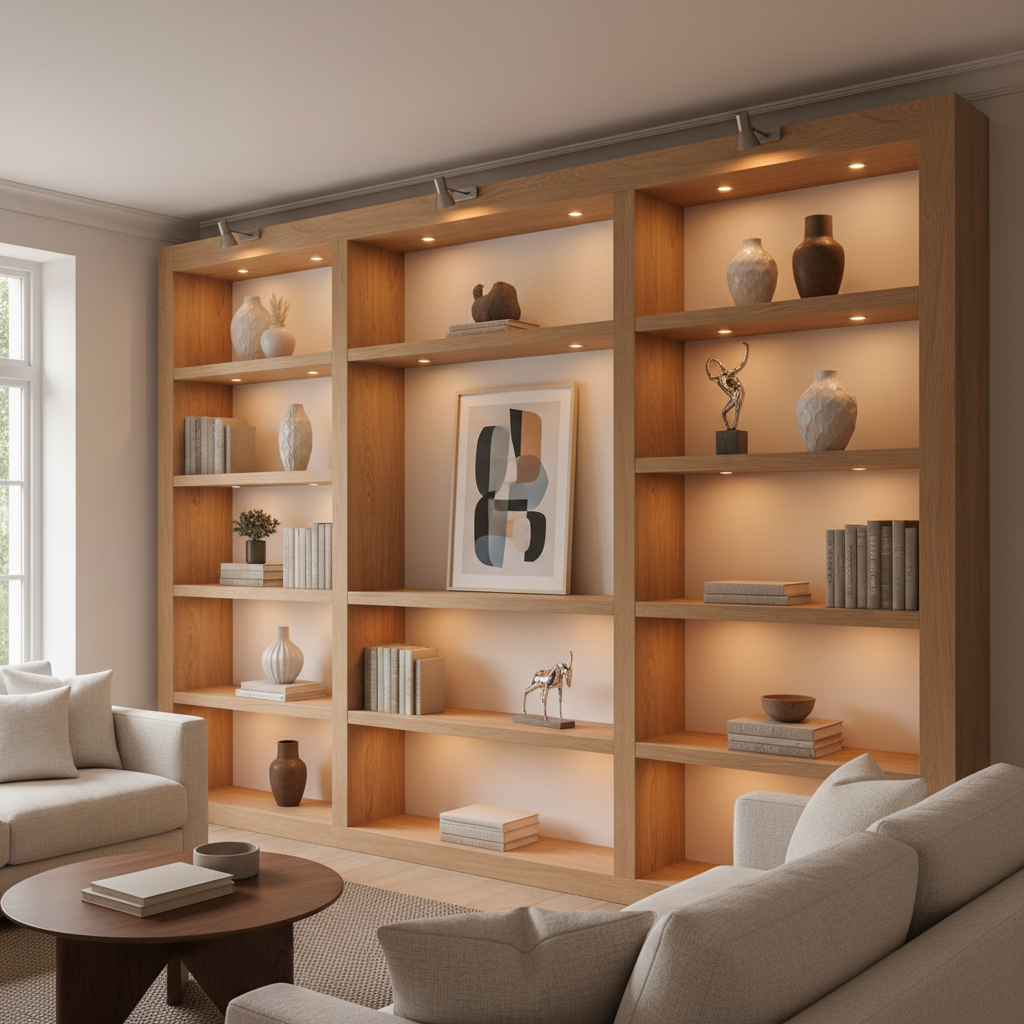
This is the best use case for directional rechargeable spotlights. A concentrated, adjustable beam with a good warm color temperature is what you need. In this specific instance, a strip light is not the right answer, as it diffuses light uniformly instead of directing it to a precise point.
Look for a model with a beam angle between 20 and 45 degrees, sufficient battery life for your needs (evenings, visits), and a mount suitable for your picture rail or wall.
Illuminating a Display Case or Decorative Niche
For a collector's display case or a wall niche with a few objects, one or two small spotlights can be enough to create the desired effect. The challenge here is less about the quantity of light and more about the direction and quality of color rendering.
If your display case is wider than 24 inches (60 cm) or contains many objects, multiple spotlights quickly become complicated to manage (charging, positioning, shadow zones between beams).
Lighting a Closet, Shelf, or Storage Space
Honestly, two or three small pinpoint spotlights in a closet are rarely satisfactory. You'll have well-lit areas and frustrating blind spots. For this type of use, diffused light covers the surface better.
A rechargeable LED light bar installed at the top of the closet will illuminate the entire volume uniformly, without the shadows created by pinpoint spotlights. It's not the same product, but it's often a better solution to the actual problem. For an overview of available options, our comparison of wireless LED light bars will provide useful benchmarks.
Spotlights vs. Light Bars: Which Light for Which Need?
| Criterion | Rechargeable LED Spotlight | Rechargeable LED Light Bar |
|---|---|---|
| Light Type | Pinpoint, directional | Diffused, uniform |
| Ideal For | Artwork, single object, display case | Closet, shelf, countertop |
| Shadow Zones | Frequent if multiple objects | Minimal along the illuminated length |
| Typical Battery Life | Variable (button cell to large battery) | Up to 4-6 weeks in motion sensor mode |
| Installation | Clamp, adhesive, wall mount | Industrial adhesive or magnetic |
| Suitable for Renters | Yes (if no drilling) | Yes (no-drill) |
When a Rechargeable Light Bar Advantageously Replaces Multiple Spotlights
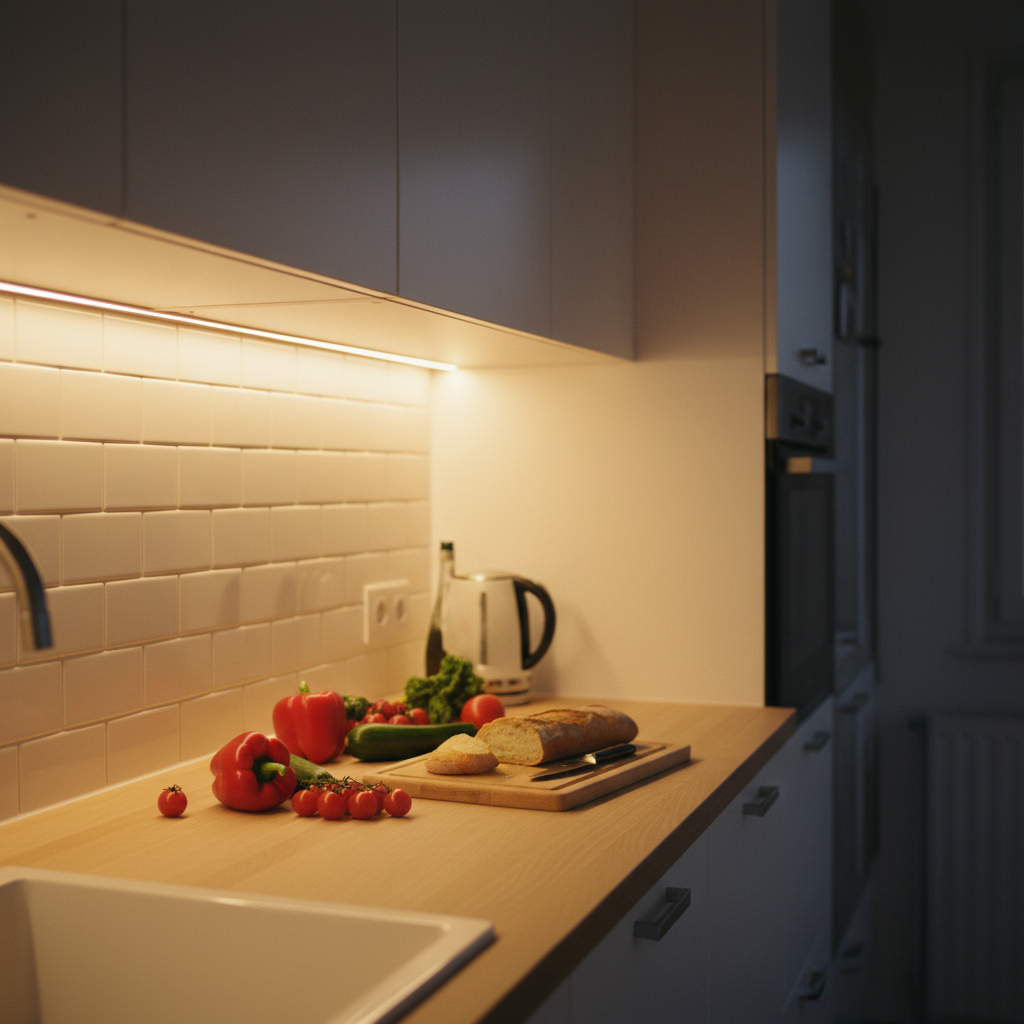
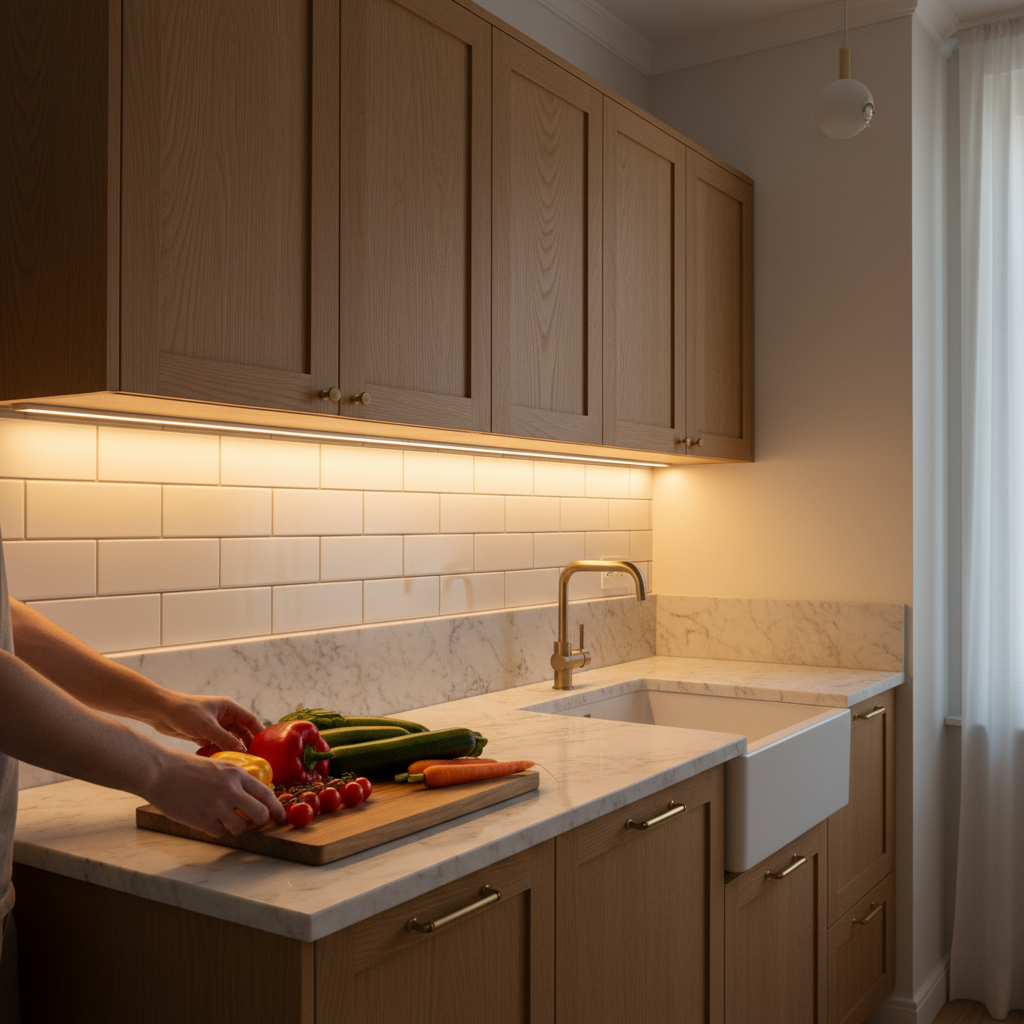
This is a point many people misunderstand initially. Buying three small spotlights to illuminate a kitchen shelf means managing three light sources, recharging them separately, repositioning them, often with inconsistent results.
The Problem of Shadow Zones Between Multiple Pinpoint Spotlights
When you place two spotlights at the ends of a 31-inch (80 cm) shelf, the center often remains in a dimly lit area. To compensate, you add a third in the middle, and you end up with three devices to manage. A light bar of the same length distributes light uniformly across the entire surface from the start.
For wireless countertop lighting, this is especially true: an 31-inch or 39-inch (80 or 100 cm) countertop requires linear coverage, not isolated light points.
The Movement 3.0: A Light Bar, Not a Spotlight, But Sometimes the Best Answer
Lumic's Movement 3.0 is not a spotlight: it's a rechargeable LED light bar with a motion sensor. But if you're looking for a rechargeable spotlight for a dark closet or poorly lit shelf, it deserves to be in your comparison.
It comes in two lengths (9 inches (23 cm) for about 150 lumens, 16 inches (40 cm) for about 320 lumens), with three color temperatures to choose from (3000K, 4000K, or 6000K) and adjustable brightness. Its 3000 mAh battery provides about 4 to 5 weeks of battery life in motion detection mode, which is well beyond most small standalone spotlights. The mounting is magnetic with an industrial adhesive backing, so no drilling is required.
It's suitable for: closets, wardrobes, shelves, under cabinet lighting, hallways at night. It's not suitable for: highlighting artwork or directing light to a precise point, as its light is diffused and linear.
Trustpilot Rating: 4.5/5 based on over 2200 reviews. 5-year warranty, 90-day satisfaction guarantee.
Rechargeable LED Spotlights: Mistakes to Avoid Before Buying
Relying Solely on Low Price
In the wireless LED spotlight category, price is often a strong indicator of quality. Models under $10 (sold in packs on major platforms) almost systematically feature insufficient batteries, inefficient LEDs, and adhesives that fail within weeks. This isn't an absolute rule, but it's what we regularly observe in user feedback.
Better to have one reliable product than a batch of gadgets that end up in a drawer.
Buying Without Checking Surface Compatibility
Not all adhesives stick to all surfaces. A standard adhesive won't properly bond to oiled wood, textured melamine, or a surface painted with satin paint. Before mounting, thoroughly clean the surface with isopropyl alcohol and verify that the manufacturer indicates compatibility with your type of surface.
This applies to both spotlights and light bars. A good surface cleaning takes 30 seconds and prevents you from finding the product on the floor a week later.
Forgetting Accessibility for Recharging
A standalone spotlight placed 6.5 feet (2 meters) high on a picture rail is convenient until it's time to recharge. Think ahead about access: how you'll recharge the product, with what cable, and how often. A product with a large battery (meaning long battery life) recharges less frequently and poses less of this problem.
For use in hard-to-reach areas, consult our guide on solutions for lighting a garage without an outlet or our article on basement lighting without electricity: the constraints are similar.
Recap: How to Choose Your Rechargeable LED Spotlight
Here are the essential points to keep in mind before buying a rechargeable LED spotlight:
- Define your precise use: highlighting an object or artwork? Go for a directional spotlight. Lighting a surface or storage space? Consider a light bar.
- Check lumens: minimum 150 lumens for functional use, less for a purely decorative effect.
- Compare real-world battery life, not just marketing claims. Battery capacity in mAh is a more reliable indicator.
- Choose the right color temperature: 3000K for ambiance and artwork, 4000K for versatile daily use.
- Think about mounting from the start: compatible with your surface, suitable for your situation (renter or homeowner).
- If you're hesitating between multiple spotlights and a light bar for lighting a space, the light bar generally provides better coverage with fewer management hassles.
To further your thinking on lighting without electricity, we've compiled all available solutions based on contexts and constraints. And if you're looking to compare several types of portable rechargeable products, our overview of the best rechargeable portable LED lamps will give you a complete market view.