Solar Lighting Isn't What It Used to Be
For a long time, "solar" meant "cheap plastic that yellows after one summer." Those days are over. Today, a quality solar light fixture is almost indistinguishable from a wired wall sconce installed by an electrician. Aluminum finishes, sleek designs, anodized surfaces that resist weather... the gap with wired fixtures has significantly narrowed.
If you're looking for solar lighting, you probably want something that looks good. Not just a light source screwed into a corner. This guide is for you.
Why Solar Design Took Time to Mature
The challenge with solar is that everything must fit into the housing: photovoltaic panel, battery, electronics. For a long time, this resulted in bulky shapes, thick plastic, and unflattering proportions. Serious manufacturers solved this by working with materials differently. Aluminum allows for slim designs without sacrificing robustness. Tempered glass replaces transparent plastic. Cables disappear. The result is clean, elegant, and functional.
What "Light Fixture" Truly Implies
A lamp illuminates. A light fixture adorns. The difference isn't just semantic. When we talk about outdoor solar light fixtures, we're talking about an object that integrates with the architecture of your patio, gate, or driveway. It must last, resist UV rays, rain, and frost. Most importantly, it must look good after two winters. These are the criteria that separate a true light fixture from a big-box store gadget.
Materials That Make the Difference
This is the first criterion to consider, before any other. Materials define appearance, durability, and resistance to outdoor conditions.
Aluminum vs. Plastic: What's the Real Impact?
Aluminum is the standard for high-end outdoor light fixtures, whether solar or wired. It doesn't rust, warp from heat, or yellow under UV rays. Its surface can be anodized, brushed, or powder-coated — all finishes that age well. Plastic, even good quality, eventually shows its age. After 3-4 years of exposure, the differences become visible to the naked eye.
When you look at a designer solar light fixture, start by identifying the main housing. If it's aluminum, that's a good sign. If it's high-density polycarbonate with a metal finish... look closer.
Water Resistance: What Does IP65 Mean?
The IP rating measures protection against solid objects (first digit) and water (second digit). IP65 means total protection against dust and against water jets from all directions. This is the minimum for an outdoor solar light fixture exposed to the elements. IP44 is suitable for sheltered use (a covered patio, for example), but insufficient for outdoor installation in most climates.
Integrated or Remote Solar Panel
Low-end fixtures have their panel glued on top, small and fixed. More serious models sometimes offer a remote panel connected by cable, allowing it to be oriented towards the sun independently of the fixture. When the panel is integrated, the fixture's design must maximize exposure, even on wall installations. This detail significantly impacts winter performance.
Power and Battery Life: The Real Questions to Ask
A powerful solar light fixture isn't just defined by lumens. The real question is: does it perform well in January, after four days without sun? This is where most low-cost models disappoint.
Why Your Light Turns Off in Winter (and How to Prevent It)
In winter, days are short, the sun is low, and clouds are omnipresent. An undersized solar panel won't recharge the battery enough to power the light all night. Result: the light turns off at 9 PM in December. To avoid this, two parameters matter: panel size (to capture maximum light even in low conditions) and battery capacity (to store enough energy for several days).
Lumic's SolarGlow addresses this issue with a panel three times larger and a battery four times more capacitive than low-end alternatives. Stated result: 20 days of battery life without solar recharge in motion sensor mode. This is the difference between a light that works in July and one that also works in January.
Motion Sensor Mode: Intelligence or Gimmick?
The motion sensor isn't a gadget option on a serious solar light fixture. It's what allows for long battery life. Instead of staying on all night, the light activates when you pass by, stays on for a few seconds or minutes, then turns off. In practice, this multiplies battery life by ten or twenty compared to continuous mode. For a driveway, gate, or garage entrance, it's the most sensible mode.
The SolarGlow has two 180° sensors, each with a range of approximately 26 feet (8 meters). To cover a driveway or house entrance, this is usually sufficient without needing multiple devices.
Continuous Mode: For What Use?
For a patio where you entertain guests in the evening, you want continuous, even lighting, not a light that flickers on and off every time someone moves. Good models offer both modes. The choice depends on the primary use. For security: motion sensor mode. For ambiance: continuous mode. For an entrance or garage: motion sensor mode.
Where to Install an Outdoor Solar Light Fixture
Most people underestimate the importance of placement. A poorly positioned solar light fixture, even a very high-quality one, will deliver mediocre performance. The rule is simple: the solar panel must see the sky (and ideally direct sunlight) for at least a few hours a day.
Patio, Gate, Driveway: Specifics
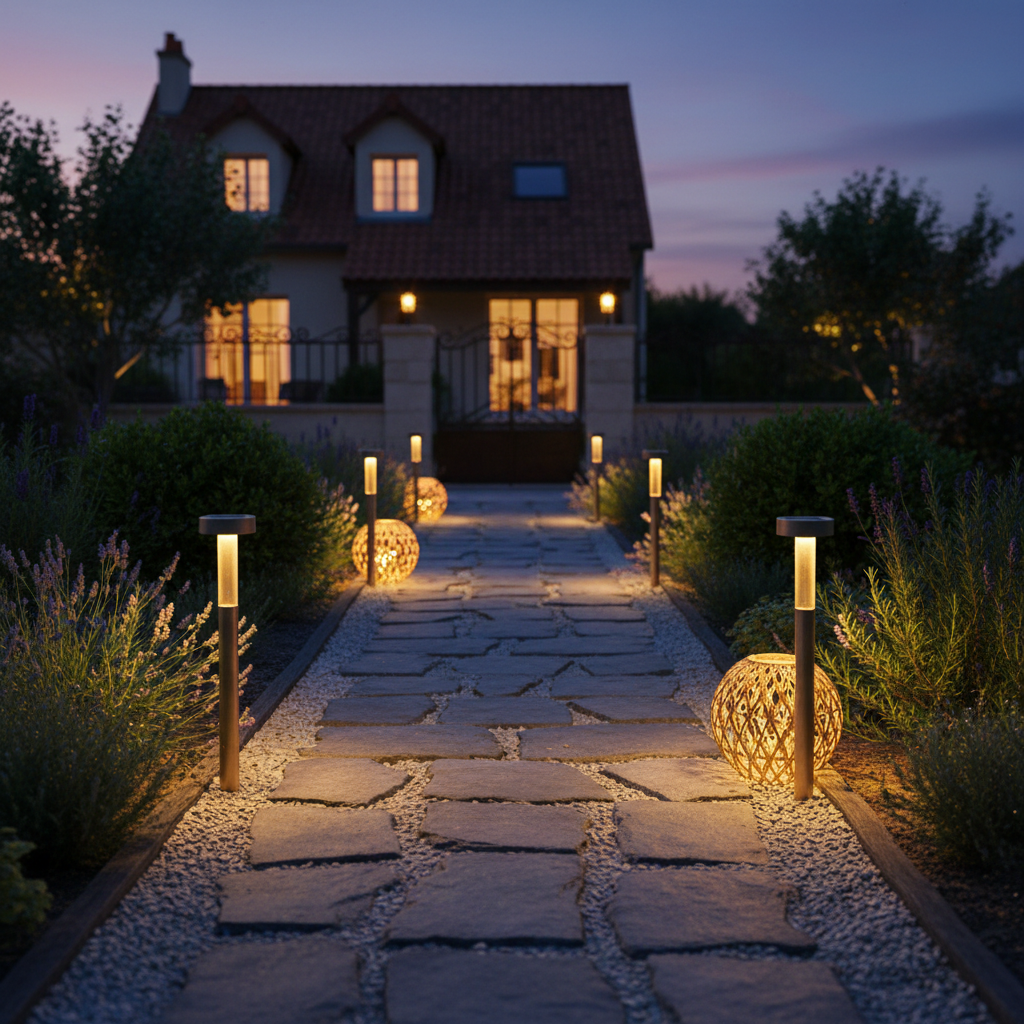
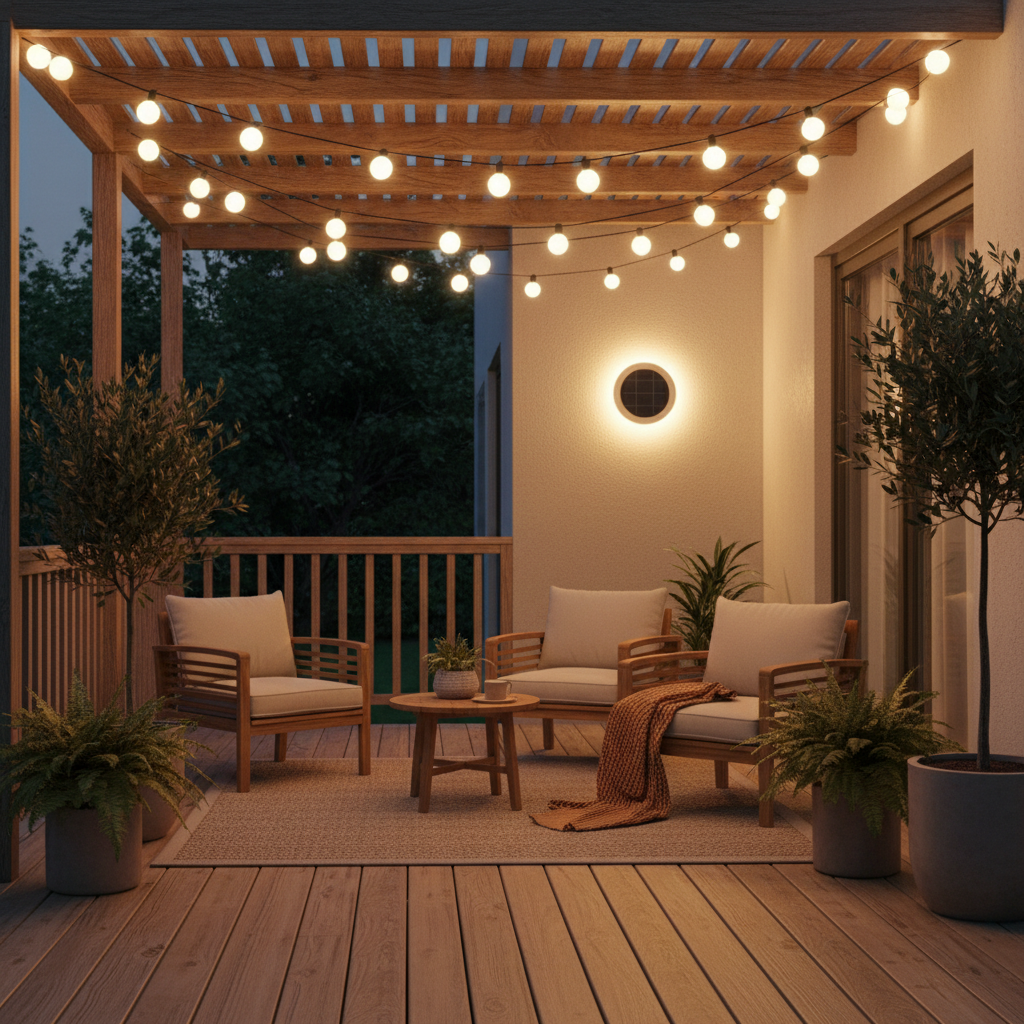
For a patio, the challenge is twofold: illuminate and decorate. Opt for a light fixture with a refined design, warm light (around 3000K), installed at eye level to create ambiance. If the patio is partially covered, ensure the solar panel isn't constantly in the shade. For a gate or entrance, priority goes to power and motion detection. For a driveway, several regularly spaced light fixtures give a better result than a single very powerful model at the end of the path.
To learn more about patio lighting, you can consult our article dedicated to solar lighting for a welcoming, wireless patio.
Angles to Absolutely Avoid
Absolute North: the panel will almost never see direct sunlight. Under a dense awning or pergola: same problem. In the shade of a tree all day: recharging will be insufficient, battery life will drop. If your north wall is the only possible location, orient the panel towards the sky as much as possible and accept reduced battery life. For truly shaded areas, a wired installation remains more reliable.
Ideal Installation Height
For a wall sconce, between 7.2 and 8.2 feet (2.2 and 2.5 meters) from the ground is generally optimal. Too low: risk of glare and vandalism. Too high: light is lost before illuminating the useful area. For a motion-sensing light fixture, installation height directly influences range and detection angle. Most reputable manufacturers indicate the recommended installation height in their documentation.
Solar Design in 2026: What Has Changed
The aesthetics of solar light fixtures have made a considerable leap. The codes that defined high-end wired fixtures (clean lines, matte finishes, metal bodies, compact size) are now accessible in solar. It's no longer an aesthetic compromise; it's a deliberate choice.
Shape and Finish Trends
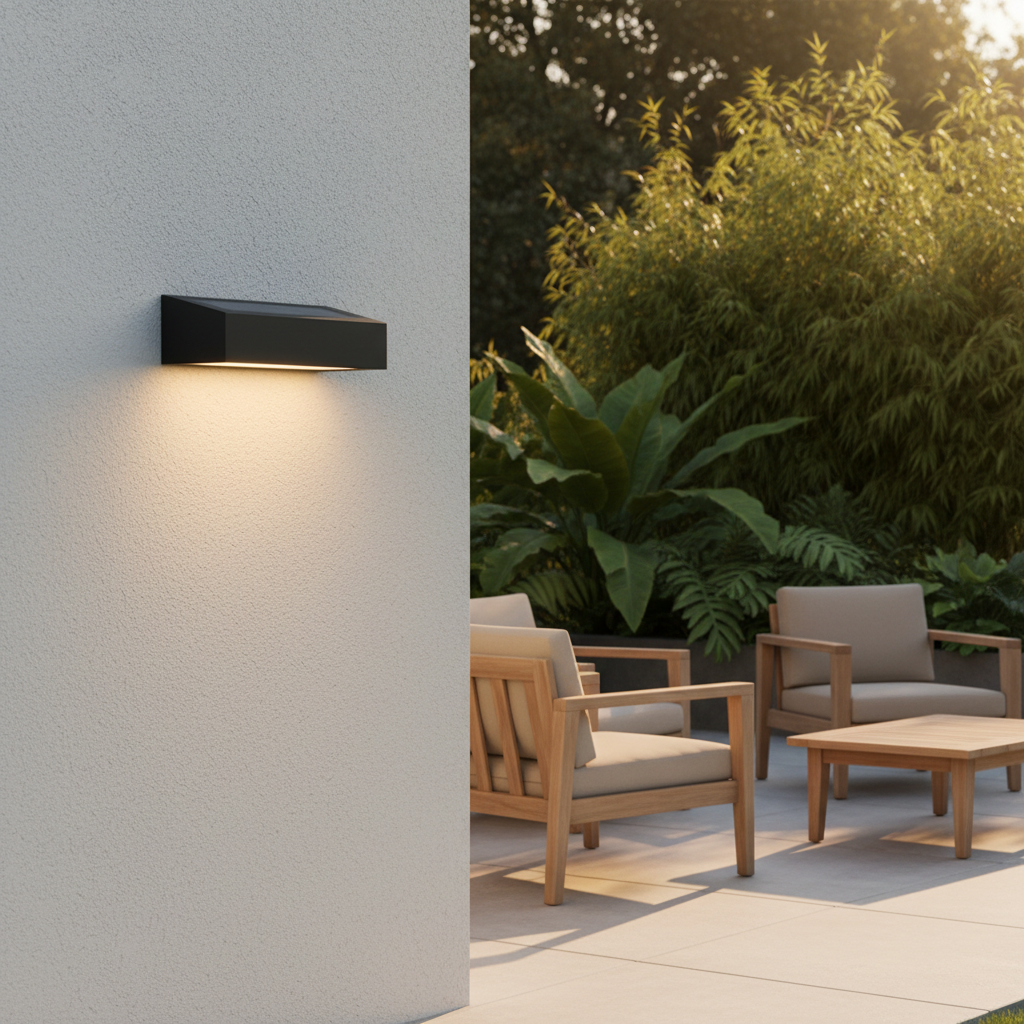
Matte black has become the dominant finish for designer outdoor light fixtures, solar or not. It integrates with all types of facades, contrasts elegantly with vegetation, and hides rain marks better than white or light gray. Brushed aluminum remains a timeless classic. The most popular shapes are flat rectangles (for wall sconces), slender cylinders (for bollards), and discs (for in-ground spotlights). If you're looking for inspiration on current trends, our selection on designer solar wall lights can help you refine your choice.
Coherence with Your Home's Architecture
A designer solar light fixture should be chosen in coherence with the rest of your home. A contemporary house with white stucco calls for black, geometric light fixtures with sharp lines. A stone or brick house pairs better with natural, copper, or anthracite finishes. Solar no longer forces you to make aesthetic compromises. Take the time to compare with wired light fixtures you like, and look for the solar equivalent.
For a broader exploration of available options, our complete guide to different types of outdoor solar lighting provides a useful overview by fixture category.
Wired or Solar: The Real Calculation
When you buy a wired outdoor light fixture, the product price is only part of the total cost. You must add the electrician (for connections), the trench to dig if it's in the middle of the yard, and sometimes administrative procedures if you're touching the electrical panel. This total cost can easily multiply the price of the fixture itself by three or five.
The 5-Year Economic Calculation
A quality wired light fixture, once installed, costs the product price, plus labor (a few hours of an electrician), plus annual electricity consumption. Over five years, the bill can be substantial, especially if you have to dig a trench. A solar light fixture of the same aesthetic quality costs the product price, zero complex installation, zero electricity consumption. The difference is real and lasting.
Flexibility as a Hidden Advantage
Your wired light fixture is fixed. If you sell your house, re-do your yard, or change your mind about the location, it's a whole operation. Your solar light fixture can be removed and reinstalled elsewhere in ten minutes. This freedom has real value, especially if you're a renter or gradually developing your outdoor space.
To delve deeper into this topic and compare your options, our article on wireless outdoor lighting solutions explores the different technologies available.
How to Make a Concrete Choice
If you've made it this far, you probably have a clear idea of what you're looking for. Here's how to refine your decision.
The 4 Criteria That Really Matter
| Criterion | Acceptable | To Avoid |
|---|---|---|
| Main Material | Aluminum, stainless steel | Untreated UV ABS plastic |
| Protection Rating | IP65 minimum | IP44 for outdoor installation |
| Winter Battery Life | Motion sensor mode: 15 days min | No manufacturer info on this point |
| Warranty | 5 years | 1 year or less |
Questions to Ask Before Buying
Does the manufacturer indicate winter battery life or only summer? What is the real warranty (not just "satisfaction guaranteed")? Are parts replaceable if the battery ages? Is there accessible customer support if I encounter a problem? These questions distinguish durable products from cheap gadgets. Lumic's SolarGlow is covered by a 5-year warranty and US-based customer support available within 24 hours. This is the level of reassurance you should expect from a quality solar light fixture.
If light output is a decisive criterion for your project, our article dedicated to how to choose a powerful outdoor solar light fixture will help you calibrate your choice according to the area to be illuminated.
Common Mistakes to Avoid
Choosing solely based on price: a $15 light will be good for two seasons, no more. Neglecting exposure: a poorly oriented light will perform at half its capacity. Ignoring the warranty: for a product exposed to weather, the warranty is a serious indicator of the manufacturer's confidence in their product. Confusing "modes" with "power": a light with five lighting modes but an insufficient battery remains a poor choice for winter.
What a Well-Chosen Solar Light Fixture Is Truly Worth
A quality outdoor solar light fixture is an object that integrates into your space, operates autonomously and durably, and doesn't require constant thought. It's there in the morning, it's there in the evening, and it looks good. This is the minimum requirement when we talk about a light fixture, not just a garden lamp.
The true luxury of solar today is this combination: no cables, no extra electricity bills, a design chosen for its inherent quality, not by default. If you want to explore available options with a more detailed aesthetic angle, our article on designer solar lamp solutions lists the models that make a difference.
And if you want a complete overview of selection criteria for choosing an outdoor solar light fixture that combines design and reliability, we've covered the topic in depth in a dedicated article.