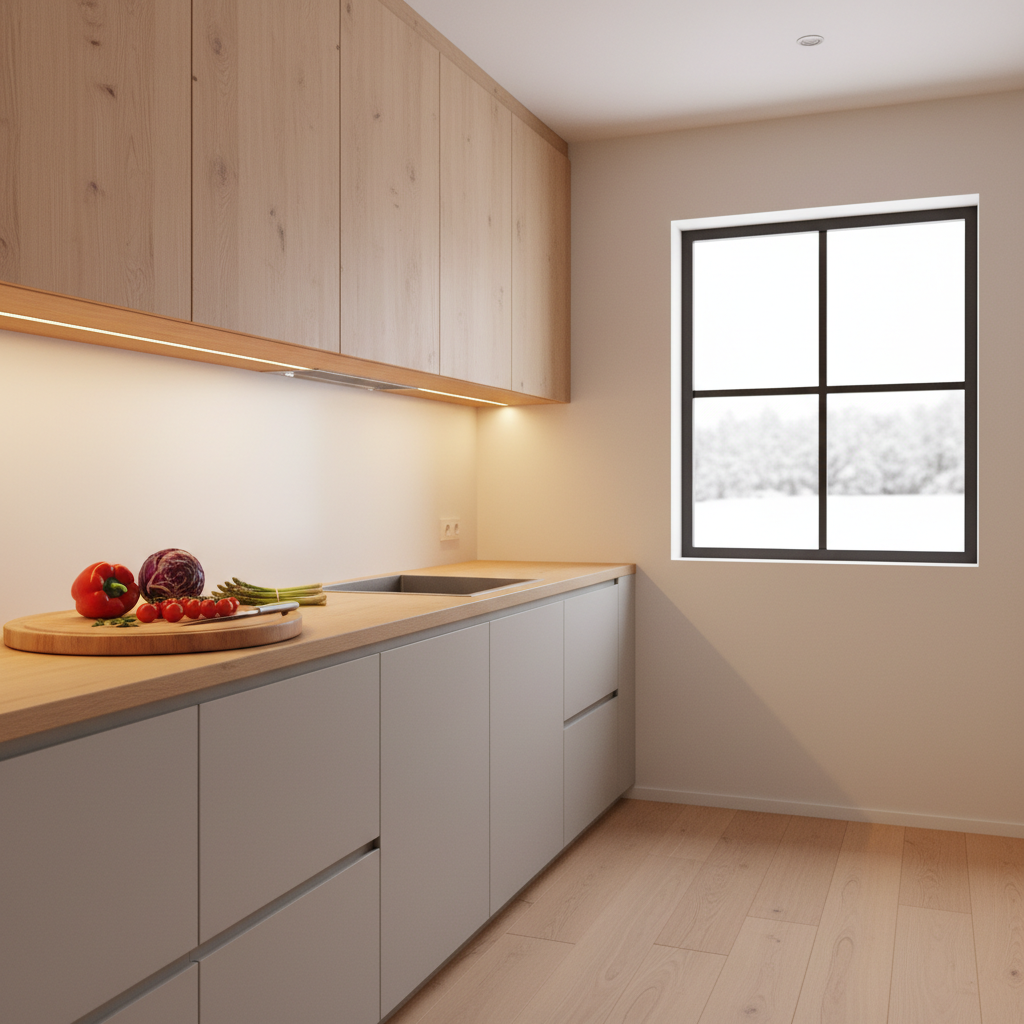
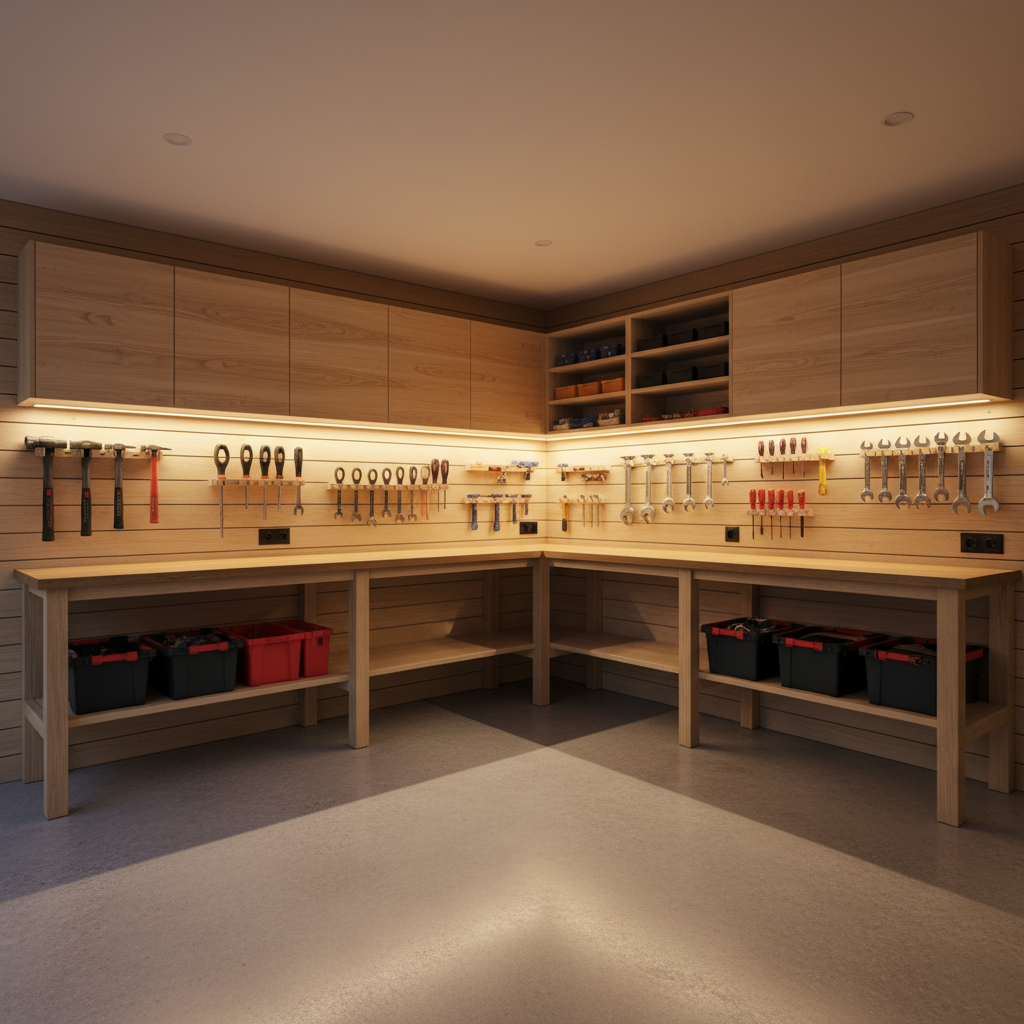
You walk in, arms full of groceries. The garage is dark. You fumble for the light switch, almost knock something over, and curse the non-existent lighting for the hundredth time. Yet, properly lighting a garage isn't complicated or necessarily expensive. You just need to choose the right solution for how you actually use the space.
A simple parking garage, a DIY workshop, a storage area, or a pass-through zone: each has its own constraints, lighting needs, and installation challenges. This guide helps you choose your garage LED lighting without wasting time or money.
Why Your Garage Lighting Often Fails
Most garages come with a single central bulb, sometimes a cheap fluorescent light that flickers. The result: cold light, dark corners, and zero visibility when you're working at a bench or looking for a tool.
The Problem with a Single Central Light Source
A single light source on the ceiling creates shadows everywhere you work. If you're doing DIY, your own silhouette blocks the workbench. If you're parking, blind spots remain dark. It's a light distribution problem, not just a power issue.
A Dark Garage is Also a Safety Hazard
In a space with tools, chemicals, vehicles, and sometimes children, poor lighting isn't just uncomfortable. It's risky. Clearly seeing what you're doing, where you're walking, and what you're grabbing is fundamental.
Not All Garages Have the Same Electrical Constraints
Some garages have a full electrical circuit. Others only have an outlet or a light connected from the house. And some, especially detached garages or remote annexes, simply have no access to electricity. Each case requires a different solution. If you're in the latter situation, our article on garage lighting without an electrical outlet covers alternatives in detail.
The 4 Types of Garage Use and Their Real Demands
Before choosing a light bar, spotlight, or floodlight, you need to consider your actual use. Here's how that translates into lighting requirements.
Simple Parking: Essential Lighting, No Fuss
You park your car, drop off items, and pass through quickly. You don't need stadium-level power. One or two LED light bars on the ceiling, well-positioned, are plenty. The main thing: they should turn on easily and cover the main pathway.
If your garage is already wired, good quality wired LED light bars are sufficient. They can replace an existing fluorescent light in minutes, no electrician needed if the mounting is already in place.
For parking without an accessible outlet, a rechargeable light bar with a motion sensor truly changes daily life: you enter, it turns on; you leave, it turns off. No effort required.
DIY Workshop: You Need to See What You're Doing
This is where demands increase. Sanding, painting, cutting wood, assembling parts: all require good brightness and well-distributed light at workbench level, not just overhead.
For a workshop where you regularly spend several hours, wired lighting remains the best option. A rechargeable light bar can last 5 to 8 hours continuously, depending on the model, which is enough for a DIY session. But if you work daily, relying on recharging quickly becomes inconvenient.
What you need for a workshop: multiple light sources (not just one central one), ideally light bars positioned above or along the edge of the workbench. Light should come from the right direction to avoid casting shadows.
For all technical selection criteria, you can consult our guide on how to choose the best LED light bar for your needs.
Storage and Organization: Light the Zones, Not the Whole Space
A storage garage doesn't need to be fully lit all the time. The idea: identify specific areas (shelves, cabinets, bike corner) and light them selectively. Under-shelf lighting, inside a built-in cabinet, or in a nook makes much more sense than a single central light.
This is where wireless light bars with motion sensors truly shine: you open a cabinet, it lights up. You approach a shelf, you see what you're looking for. No installation, no cables to manage.
Pass-Through Zone and Entryway: Daily Convenience
Passing through your garage daily to enter or leave your home is common. But fumbling for a switch with arms full, at night, quickly becomes annoying. This is the easiest use case to improve, and often the most impactful on a daily basis.
A motion sensor at the garage entrance solves this cleanly: you approach, it automatically lights up. No switch, no extra effort. The integrated ambient light sensor ensures the light only activates when it's truly dark, preventing unnecessary power consumption during the day.
Wired or Wireless: How to Honestly Decide
This is the real question. And the honest answer is, it depends. Not on your budget, not on your aesthetic preference. It depends on what you use it for.
When Wired is Essential
If you use your garage as a workshop for several hours a day, multiple times a week, wired is more suitable. Recharging a battery becomes a hassle with intensive use. And if your garage is already wired with a dedicated circuit, adding a wired light bar is often more logical.
Another case: if you need very high light output over a large area. Wired LED floodlights offer power that rechargeable solutions cannot yet match.
When Wireless Truly Makes a Difference
If your garage isn't wired, or if electrical access is complicated (no nearby outlet, saturated circuit, rental property), a rechargeable light bar is a real alternative. For pass-through areas, storage corners, cabinet entries: installation takes less than a minute, no drilling, no electrician.
To better understand the concrete differences between these two approaches, our comparison of wireless vs. wired LED light bars details the criteria objectively.
And if your garage has no electrical access at all, lighting solutions for garages without electricity will give you all available options, from the simplest to the most powerful.
Comparison Table: Which Lighting for Which Garage
| Usage | Recommended Solution | Wired or Wireless | Installation Level | Priority |
|---|---|---|---|---|
| Simple Parking | 1-2 ceiling light bars | Wired or Wireless | Low | General Coverage |
| Intensive DIY Workshop | Powerful wired light bars + workbench lighting | Wired Recommended | Medium to High | Brightness and Distribution |
| Storage and Shelving | Targeted LED light bars per zone | Wireless Ideal | Very Low | Zone Lighting |
| Pass-Through Zone / Entryway | Light bar with motion sensor | Wireless Optimal | Very Low (less than 1 min) | Convenience and Automation |
| Garage Without Electricity | USB rechargeable or solar light bar | Wireless Mandatory | Very Low | Battery Life and Ease |
Choosing the Right Brightness for Your Garage
Lumens measure the amount of light produced. This is what truly matters, not wattage.
How Many Lumens for a Garage?
For a standard garage of about 160 to 215 sq ft (15 to 20 m²), a total brightness of 1500 to 3000 lumens is generally sufficient for parking or storage. For a workshop, more is preferred, especially if the light is concentrated on a specific work surface.
As a concrete benchmark: Lumic's Movement 3.0 offers approximately 150 lumens for the 9-inch (23 cm) model and up to 320 lumens for the 16-inch (40 cm) model. This is calibrated for targeted uses (under cabinets, closet entry, pass-through areas) and not for solely lighting a large space. For a garage corner or entryway, it's perfectly adequate. For an entire workshop, you'll need multiple sources or a more powerful wired solution.
What Color Temperature to Choose for a Garage?
This is often the forgotten question. Yet, it truly impacts visual comfort.
- Warm White (3000K): Suitable for an entryway or pass-through hallway. Soft light, less harsh at night.
- Neutral White (4000K): The best compromise for a versatile garage. Neither too cool nor too warm. Pleasant for moderate DIY work.
- Cool White (6000K): Very good contrast for an active workshop. Useful when looking for fine details, but can be tiring over long periods in a space where you spend a lot of time.
Motion Sensors in a Garage: Is It Really Useful?
Yes, and not just for convenience. Automatic garage lighting offers concrete benefits.
Immediate Comfort Upon Entry
Entering a garage that lights up automatically as soon as you cross the threshold is a convenience you underestimate until you have it. No switch to search for, no waiting in the dark. The motion sensor combined with the ambient light sensor ensures the light only turns on at night or when the space is truly dark. This prevents unnecessary activation during the day.
Real Energy Savings
Turning on a garage light and forgetting to turn it off happens. With a sensor, the light automatically turns off after a delay. This is passive savings, without thinking about it. To learn more about how these systems work, our article on how motion sensors for lighting really work answers all technical questions.
The Movement 3.0 for Garage Pass-Through Areas
For a garage entry, a hallway to the house, a stairwell corner, or a storage area you access occasionally, Lumic's Movement 3.0 is a direct option. Magnetic mounting and industrial adhesive included, installation in under 30 seconds with no tools. 3000 mAh USB-rechargeable battery, battery life up to 4 to 6 weeks in motion detection mode depending on the model. Three color temperatures available and adjustable brightness. 5-year warranty. It's a light bar designed for daily use without installation constraints. Not to replace wired workshop lighting, but for all cases where you don't want to call an electrician to add a simple light point.
To go further on installing this type of solution, our guide on LED light bars with motion sensors covers all installation and adjustment steps.
What's Often Overlooked When Choosing Garage Lighting
A few practical points that make a difference once installed.
Consider Component Lifespan
Good LED lighting is supposed to last. No need to replace it every two years if you choose well from the start. Criteria to look for: quality of heat dissipation (aluminum does a good job), consistency of advertised specs, and the manufacturer's warranty. To understand what truly influences the lifespan of LED light bars, our article covers it completely.
Don't Underestimate Light Position
Height and installation angle change everything. A light bar mounted too high in a low-ceiling garage loses effectiveness. A poorly oriented light bar creates glare or shadows. As a general rule: for a workbench, the light should be in front or slightly above you, not behind. For a hallway, central overhead or on the side at an intermediate height.
Water Resistance, Useful Even Indoors
A garage is not a standard living space. Dust, winter humidity, splashes from car washing: the environment is harsher than a living room. For directly exposed areas, choosing a light bar with an appropriate Ingress Protection (IP) rating is a detail that matters over time.
Summary: Where to Start Based on Your Garage
Here's a quick read to get to the essentials.
- Wired Garage + Simple Daily Use: Replace existing fluorescent light with a wired LED light bar. Immediate results, no unnecessary expense.
- Wired Garage + Frequent DIY Workshop: Multiple wired light sources, dedicated workbench lighting. May require an electrician if you add outlets or circuits.
- Wired Garage + Daily Entry/Pass-Through: Add a rechargeable light bar with a motion sensor at the entry. No cables, no switch to manage.
- Garage Without Electricity or Detached Unit: USB rechargeable or solar solution. No other option without major work.
- Targeted Storage Zones: Wireless light bars positioned by zone. Flexible, repositionable, no installation.
Garage LED lighting isn't a complex technical subject. It's mostly common sense: start with actual use, choose the right technology for that need, and don't over-spec unnecessarily. A pass-through garage deserves good automatic entry lighting. A workshop deserves a proper setup. And both can coexist without costing a fortune.