You've seen solar lights at Action for under $10. The packaging looks good, the price is tempting, and you're wondering if they're worth it. The short answer: it depends on your expectations. And that's exactly what we'll break down here.
The most common mistake is buying five $10 lights, thinking it's a great deal—only to find five dead lights by January. This guide helps you make an informed decision.
What Action Solar Lights Really Offer
Action is a Dutch discount store with locations across the US and Canada. Their outdoor lighting section regularly features solar lights at incredibly low prices: between $5 and $15, depending on the model.
What types of solar lights does Action carry?
You'll mainly find two formats: decorative solar path lights (small, stake-in-the-ground lights for pathways) and entry-level motion sensor spotlights. Both categories share similar technical limitations due to their price point.
Generally, Action solar lights include:
- A 400 to 800 mAh battery (often a single low-grade NiMH or Li-ion cell)
- A small solar panel integrated into the housing, sometimes adjustable
- Low-power LED lighting (around 30 to 100 lumens)
- A plastic casing with no certified IP rating or IP44 at best
- No serious manufacturer warranty, or even no customer support
This isn't a criticism; it's the reality of what an $8 to $12 budget allows for an electronic product exposed to the elements year-round.
Is Action solar lighting sufficient for real-world use?
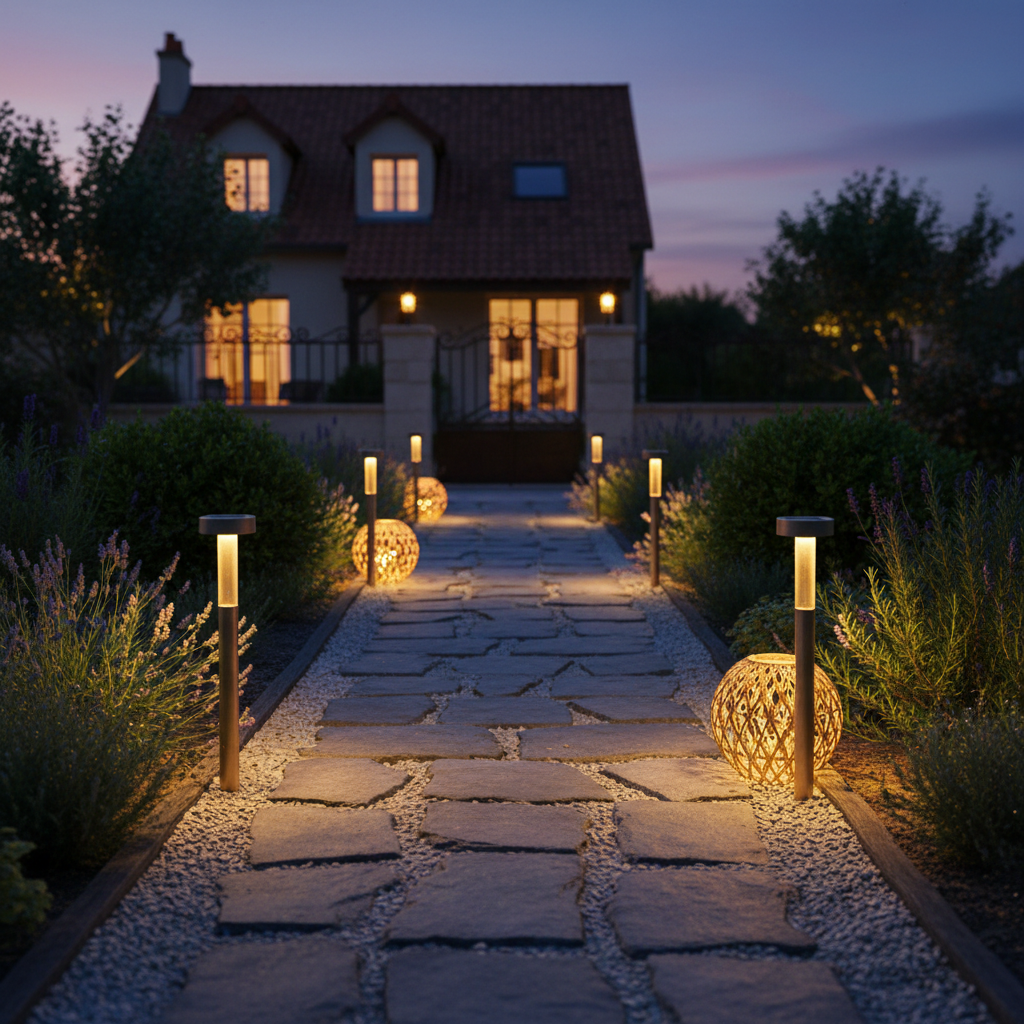
For decorative path lighting along a walkway or on a patio, yes, it's sufficient. 50 lumens are enough to define a path at night or create ambiance, but not to functionally illuminate an area.
However, if you're looking to:
- Illuminate a gate or entrance for security
- Light up a garage or shed
- Ensure reliable lighting in fall and winter
...an Action solar light probably won't cut it. Not because it's poorly made, but because its components aren't designed for such demands.
Action Solar Light Reviews: What Users Say
Feedback on Action solar lights is quite consistent across DIY forums, Google reviews, and gardening Facebook groups.
Most common positive feedback
The majority of positive reviews for Action solar lights revolve around three points:
- Unbeatable price: For garden decor or testing solar lighting without much risk, it's hard to beat the value.
- Easy installation: Staking a light into the ground or screwing on a wall mount is simple for anyone.
- Satisfactory visual output in summer: When days are long, batteries recharge well, and the lights work properly at night.
Most common negative feedback
Disappointments are almost always the same:
- Short lifespan: Many report failure after one to two seasons.
- Disappointing winter performance: With less sunlight, a small battery doesn't recharge enough. The light turns off after 1 to 2 hours, or doesn't work at all in December-January.
- Fragile plastic: Frost, hail, or a simple fall can crack the casing.
- Irreplaceable parts: When the battery dies, it's not replaceable. The entire light goes into the trash.
These reviews aren't isolated incidents. This is the inherent logic of a $10 product: margins are very tight, and components are minimal. Nothing abnormal here.
Technical Limitations Not Visible on the Packaging
To understand why these lights struggle in winter, you need to grasp a few simple mechanisms. Our complete guide to autonomous solar lighting delves into these details, but here's the essential part.
Why the battery is the weak link
A 400 to 800 mAh battery is very small. In summer, 6 to 8 hours of direct sun are enough to fully recharge it. In December, with 2 to 3 hours of actual (often cloudy) sunlight, it's a different story. The battery doesn't fully charge, and the light turns off long before dawn.
Furthermore, lithium batteries lose a significant portion of their capacity when exposed to freezing temperatures. A light installed in a cold region takes an additional hit.
The solar panel is too small: a real problem
The larger the solar panel surface, the more energy it captures, even on cloudy days. Low-end lights often have very small panels—sometimes integrated directly into the product's casing for aesthetic reasons—which drastically limits recharging capacity.
In comparison, a light designed for year-round operation has a significantly larger panel and a proportionally sized battery. If you want to explore this point specifically, we've written a dedicated guide on solar lights that work in winter—with concrete criteria to check before buying.
Lack of warranty: a real financial risk
At Action, products are often sold without structured customer support. If your light breaks down after 8 months, there's usually no simple recourse. In theory, the legal warranty applies (2 years), but enforcing it for an $8 item bought at a discount store is a lengthy process with little result.
Practical Test: When They Work Well
Let's be clear: there are situations where an Action solar light is perfectly suitable. It would be dishonest not to acknowledge them.
Uses where an Action solar light is perfectly adequate
- Decorative garden path lighting: 4 to 6 path lights at $8 each to define a path is a typical use where performance isn't critical. If one light fails, it doesn't disrupt daily life.
- Summer patio decor: For ambient lighting from June to September, Action solar lights work very well.
- Testing the concept before investing: If you've never used outdoor solar lights, Action is a low-risk way to see if the use suits you before investing in something more powerful.
Uses where an Action solar light will be disappointing
- Security lighting (gate, entrance, main pathway)
- Year-round use in less sunny regions (Northern US, Canada, high altitudes)
- Functional lighting for an outdoor workspace
- Replacing faulty wired lighting
For these uses, Action solar lights aren't bad—they're simply unsuitable. It's not the same thing. If you're looking to compare all available options, our comparison of the best solar lights will help clarify things.
The True Cost Over 2 Years: What the Purchase Price Doesn't Tell You
This is where many people get caught. You think you're saving money, but you end up buying replacements every winter.
The honest calculation over time
If you buy 3 Action solar lights at $15 each, that's $45. But if you have to replace them every winter because the batteries are dead or the plastic is broken, the total cost over 2 years can easily climb to $90 or more if you buy more to cover your area.
Over the same period, a more robust light with a 5-year warranty, a larger solar panel, and a well-sized battery represents a higher initial investment—but often costs less in the long run. And most importantly, you won't spend your springs buying new lights.
You can apply this exact reasoning by checking out our article on how to choose an autonomous outdoor light without the hassle of frequent replacements.
The real question: what is your actual need?
Before any purchase, ask yourself two simple questions:
- What for? Ambient decor or functional lighting?
- For how long? Just this summer or year-round for several years?
If it's for occasional summer decor: Action is an excellent option. If it's for permanent, reliable lighting: it's worth looking at alternatives designed to last.
Alternatives to Action Solar Lights
When you start looking beyond Action, you'll find several product categories, from Home Depot/Lowe's to Amazon and specialized brands.
Home Depot/Lowe's, Amazon, specialized brands: concrete differences
Home Depot/Lowe's offers solar lights in a wider price range, with more technically documented models. Our comparison of solar lights at Home Depot/Lowe's gives you an idea of what you'll actually find there.
On Amazon, the choice is vast, but selection is complex: hundreds of visually similar references that differ greatly in practice. We've analyzed this market specifically in our article on solar lights on Amazon.
When a premium solar light makes sense
If you need reliable year-round lighting—for a gate, entrance, or main pathway—a light like Lumic's SolarGlow addresses a different need than what Action offers.
Specifically, what the SolarGlow provides:
- 1200 lumens: truly functional lighting, not just decorative.
- Solar panel and battery sized for winter: 3 times larger panel and 4 times larger battery than low-end alternatives, allowing it to last even in December.
- 2 x 180° motion sensors, ~26 feet (8 meters) range: covers a real entrance area.
- IP65 rated: resistant to rain, snow, and frost without issue.
- 20 days of autonomy without solar recharge in motion detection mode.
- 5-year warranty + 90-day satisfaction guarantee.
This isn't the same product as a $9 decorative path light. Nor is it for the same use. But if you've reached the end of this article thinking you need something that truly works and lasts, this is likely the direction you should take.
Key Takeaways on Action Outdoor Solar Lights
The Action outdoor solar light is a good product for what it is: a low-budget decorative lighting solution. It's not a scam, and for summer decor, the value is hard to beat.
But it has clear limitations:
- Battery too small to last all winter.
- Insufficient solar panel on cloudy days.
- Plastic weakened by frost and impacts.
- No real customer support in case of failure.
The classic trap: buying 5 Action lights to compensate for failures. You end up spending more and feeling more frustrated than with a single, well-chosen light from the start. Do the math over 2 years, and you'll often find the price difference disappears.
If you're just testing solar lighting, Action is a low-risk entry point. If you already know you want something that lasts: invest in a product designed for durability.