Looking for an outdoor solar panel and finding dozens of results that mix everything: photovoltaic panels for homes, garden lights, camping kits, wall spotlights? It's normal. The term "outdoor solar panel" covers very different realities. This article helps you navigate them, and most importantly, choose the right solution for your actual needs.
We'll focus on one topic: the solar panel for outdoor lighting. Not for powering your home, not for camping. Just to light your driveway, patio, gate, or garden without running an electrical cable.
Outdoor Solar Panel: What Are We Really Talking About?
Before going further, we need to make a distinction many people overlook. An outdoor solar panel for lighting can be two very different things.
What is a Solar Panel Integrated into a Light?
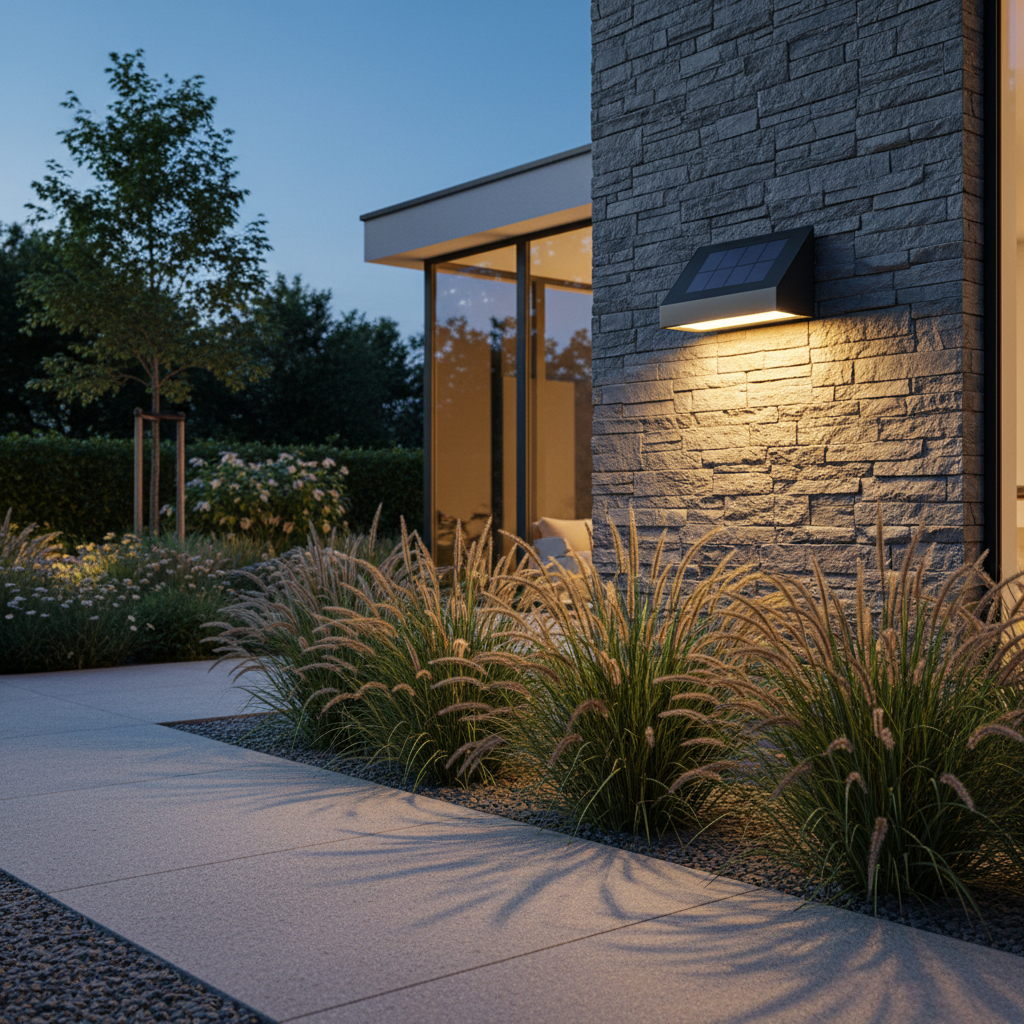
This is the most common setup. The solar panel is directly integrated into the light fixture: the light captures sunlight during the day, stores energy in its internal battery, and automatically turns on at night or upon motion detection. Everything is compact, in a single housing. No cables, no connections, installation in minutes.
This is the solution found in the vast majority of solar wall lights, garden spotlights, or path markers. Simple, practical, maintenance-free. The only caveat: if you place the light in the shade, it won't charge well. Since the panel and light source are integrated, you must choose a sunny location.
What is a Remote Solar Panel?
Here, the architecture is different. The solar panel is separate from the light, connected by a cable. You place the panel where there's sun (on a roof, a well-oriented wall, a stake in the middle of the garden) and the light where you need it, even in a shaded corner.
This configuration is well-suited for installations under an awning, under a dense tree, or in a covered entrance. On the downside, it's more complex to install, more expensive, and requires managing the cable between the two elements.
For common household use, the integrated solution is sufficient in 80% of cases. A remote panel is mainly justified when you truly have no sunny spot near the area to be lit.
What Many Forget: Panel Size Changes Everything
Here's a simple but underestimated rule: the larger the solar panel, the less you depend on orientation and weather conditions.
Why a Small Panel Causes Problems in Practice
Low-end solar lights use tiny cells, often just a few square inches (cm²). On a very sunny day, they work. But as soon as the sky is overcast, the panel is slightly in the shade of a wall, or oriented east instead of south, the charge becomes insufficient. Result: the battery never fully recharges, autonomy drops, and the light turns off after a few minutes of illumination.
This is the main reason for disappointment with solar lights bought at big-box stores or general retailers. The problem isn't the battery, or the motion sensor: it's the panel being too small for real-world conditions in many regions, where the sky is often cloudy for a good part of the year.
What is an Oversized Panel?
An oversized panel is one whose capture surface is significantly larger than what the battery needs under ideal conditions. In practice, this allows it to collect energy even on cloudy days, even with imperfect orientation, and even in winter when days are short.
A solar light with a large panel can therefore be placed facing east or on a wall slightly shaded in the late afternoon, and still function correctly. This is what solar lighting professionals call the charging margin: the ability to recharge properly even under degraded conditions.
For solar garden lighting, this makes a real difference in daily reliability, especially from November to March.
Integrated or Remote Panel: How to Choose Based on Your Situation
Here's a table to help you quickly decide based on your context:
| Criterion | Integrated Panel | Remote Panel |
|---|---|---|
| Installation | Very simple (minutes) | More complex (cable management) |
| Sunny lighting area | Ideal | Not necessary |
| Shaded lighting area | Problematic if panel is small | Ideal |
| Cost | More affordable | Higher |
| Maintenance | Minimal | Check cable |
| Aesthetics | Discrete, all-in-one | Separate visible panel |
| Recommended for | Driveway, patio, sunny wall | Awning, wooded area, north-facing corner |
For most homes, an integrated panel with a good capture surface works perfectly. Remote panels are a niche, not the norm.
Outdoor Solar Lighting: The Criteria That Truly Matter
You've decided on a light with an integrated panel. Here's what to look for beyond design and price.
The Surface Area of the Integrated Solar Panel
Manufacturers don't always clearly state it, but it's the number one criterion. A light with a small rectangular panel of 2x3 inches (5x8 cm) will be largely insufficient for winter conditions. Look for models with a visibly larger panel relative to the light's body. Some manufacturers explicitly state their panel is oversized compared to the battery capacity: that's a good sign.
Battery Capacity
The battery determines continuous mode autonomy and the number of illumination cycles in detection mode. A good capacity battery also allows for several days without sun without completely draining. Again, entry-level products often sacrifice the battery to reduce cost, leading to degraded reliability after a few months.
Weather Resistance
For any equipment intended to stay outdoors year-round, the IP rating is essential. A minimum IP65 rating guarantees the light resists water jets from all directions, rain, and can operate in freezing temperatures. Below that, you risk failure as early as the first rainy fall. Check that this rating applies to both the light body and the solar panel itself.
Actual Brightness
Lumens advertised by manufacturers are often measured under ideal conditions: full battery, optimal temperature. For security or ambient lighting on a driveway, 400 to 600 lumens is reasonable. For functional lighting covering a large area (patio, facade, parking), aim for 800 lumens or more. If you want to delve deeper into this, our guide on powerful wireless outdoor lighting details levels according to use.
Motion Detector and Ambient Light Sensor
A good outdoor solar LED panel almost always comes with an intelligent detection system. The ambient light sensor prevents the light from turning on during the day (energy saving). The motion sensor limits unnecessary activations. These two elements combined allow the light to last several weeks without solar recharge in detection mode, whereas a light in continuous mode drains in a few hours. If this topic interests you, we've written a complete guide on solar motion sensor lighting.
Common Mistakes to Avoid When Buying
Confusing Photovoltaic Panels with Solar Panels for Lighting
This is the most frequent confusion. A photovoltaic panel for a home is an electricity generation system that connects to the grid or home storage. It's measured in kilowatts, costs thousands of dollars, and requires professional installation. This is not at all what we're talking about here. A solar panel for outdoor lighting is a small photovoltaic cell integrated into a light fixture, which charges a battery of a few thousand milliampere-hours. Two completely different worlds.
Underestimating the Impact of Shade
Many people place their solar light exactly where they want light, without checking if that spot gets enough sun during the day. A north-facing wall, under a balcony, between two hedges: these are all situations where the panel will capture almost nothing. If you can't avoid this constraint, that's where a remote panel or an oversized integrated panel makes a difference.
Relying Solely on Price
A $12 solar light might seem like a good deal. In practice, it almost always has a tiny panel and a low-capacity battery. It works correctly for the first two months of summer, then disappoints by September. The right calculation is the cost over 3 years: a more expensive light that actually works often costs less than a series of cheap lights that need regular replacement. To compare available options, check out our comparison of the best outdoor solar light.
Ignoring Orientation During Installation
In the Northern Hemisphere, the sun is in the south. Orienting your solar panel south maximizes daily sunlight exposure. An east or west orientation reduces charging by about 30% to 40%. This isn't prohibitive with a sufficiently large panel, but with a small panel, it can make the difference between a light that works well and one that struggles. If your wall is north-facing, a standard integrated solution won't be enough: you'll need either a remote panel or a model with a truly oversized panel.
A Concrete Example: Understanding Oversizing
Let's take a practical case. You want to light your home's garden entrance, which faces east-northeast. In summer, the sun hits it in the morning. In winter, there are barely a few hours of direct light per day, often overcast.
With a standard light with a small panel: the battery recharges well in June-July, starts to struggle in September, and by December the light barely turns on for a few seconds before dying. Many customer reviews (e.g., 4.5/5 overall for serious brands) describe exactly this scenario with lights bought at big-box stores.
With an oversized panel light: even facing east, even on cloudy days, the panel captures enough to keep the battery at a correct level. The light continues to operate in detection mode for several weeks without direct sun. This is the principle behind products like the Lumic SolarGlow, which features a panel about 3 times larger than the market average, combined with a battery 4 times more capacious. In detection mode, it lasts up to 20 days without solar recharge. It's designed precisely for users with orientation constraints or who live in less sunny regions.
Its IP65 rating guarantees operation in rain, snow, and frost. With its two motion sensors covering 180° with a range of about 26 feet (8 meters), it covers a large area without blind spots. A 5-year warranty and 90-day money-back guarantee provide peace of mind when investing in solar lighting designed to last. If you want to know more about choosing an outdoor solar spotlight, we have a dedicated guide for this type of product.
What Changes Based on the Area to Be Lit
The final use directly influences the type of solar panel and light suitable. Here are some concrete cases:
Driveway and Main Access
The objective is security: seeing where you're going, deterring potential intruders. You need motion-activated lighting, powerful enough to illuminate an area of several yards/meters. The panel must be able to recharge the battery daily, even in winter. An oversized integrated wall light is perfect, installed 6-10 feet (2-3 meters) high on the facade wall. For more specific needs, our article on outdoor solar wall lights will help you refine your choice.
Patio and Living Space
The goal is different: creating a pleasant ambiance for spending time outdoors in the evening. Intensity can be adjustable, and the light rather warm. Patios are generally well-exposed, so a standard integrated panel works well here.
Garden and Green Spaces
For lighting flowerbeds, borders, or a garden path, stake lights with integrated top panels are sufficient for ambiance. For more powerful lighting covering a large garden area, a wall light with a large panel is more suitable. Our article on solar garden lighting details solutions for each area of your outdoor space.
Gate and Garage
High-security areas, often poorly exposed (north wall of the garage, under a gate awning). This is where panel oversizing becomes truly essential, or where a remote panel may be justified.
What You Need to Remember Before Buying
A few simple principles to avoid making a mistake:
- Integrated panel = primary solution in 80% of cases. Simple, aesthetic, no cables.
- Remote panel = niche solution for truly sunless areas. More complex to install.
- Panel size is the key criterion: a large panel compensates for imperfect orientation and cloudy days.
- IP65 minimum for any outdoor installation.
- Motion detection mode + ambient light sensor is the ideal combination for autonomy.
- Don't confuse home photovoltaic panels with solar panels for lighting: two products, two budgets, two totally different uses.
- If you want a complete kit rather than just a light, check out our guide on outdoor solar lighting kits.
A well-chosen outdoor solar panel for lighting means years of automatic lighting without bills, cables, or maintenance. The key is not to focus solely on the displayed price, but on the panel size, battery capacity, and weather resistance. With these three criteria in mind, you'll avoid 90% of bad purchases.