Looking to light up a shelf, display case, or artwork without drilling, without cables, and without calling an electrician? You search "wireless LED spotlight" and find yourself overwhelmed by products that don't all serve the same purpose. Some are directional spotlights. Others are strip lights. They are not the same, and confusing the two often leads to disappointment.
This guide clarifies everything. We'll explain the practical differences, what criteria to look for, and when a strip light is better than a spotlight, or vice versa. No BS, no trying to sell you a product in every line.
Wireless LED Spotlight vs. LED Strip Light: The Game-Changing Difference
A wireless LED spotlight concentrates light on a specific point, often with an adjustable beam. An LED strip light diffuses light linearly and uniformly over a surface. These are two different tools for two different uses.
When to Choose a Directional Spotlight?
The spotlight wins when you want to highlight a specific object: a painting, a sculpture, a bottle in a wine cellar, clothing in a retail display. The light is concentrated, often with a beam angle of 30 to 60°. The result is sharp, precise, and creates strong visual contrast.
This is also what's used in museums, art galleries, or temporary exhibitions. The reason: the spotlight highlights without unnecessarily illuminating the entire environment. It creates visual hierarchy.
However, for lighting the inside of a closet or under a kitchen cabinet, a single spotlight is completely unsuitable. You'll create a bright spot in the center and leave the edges in shadow.
When Does a Strip Light Do a Better Job?
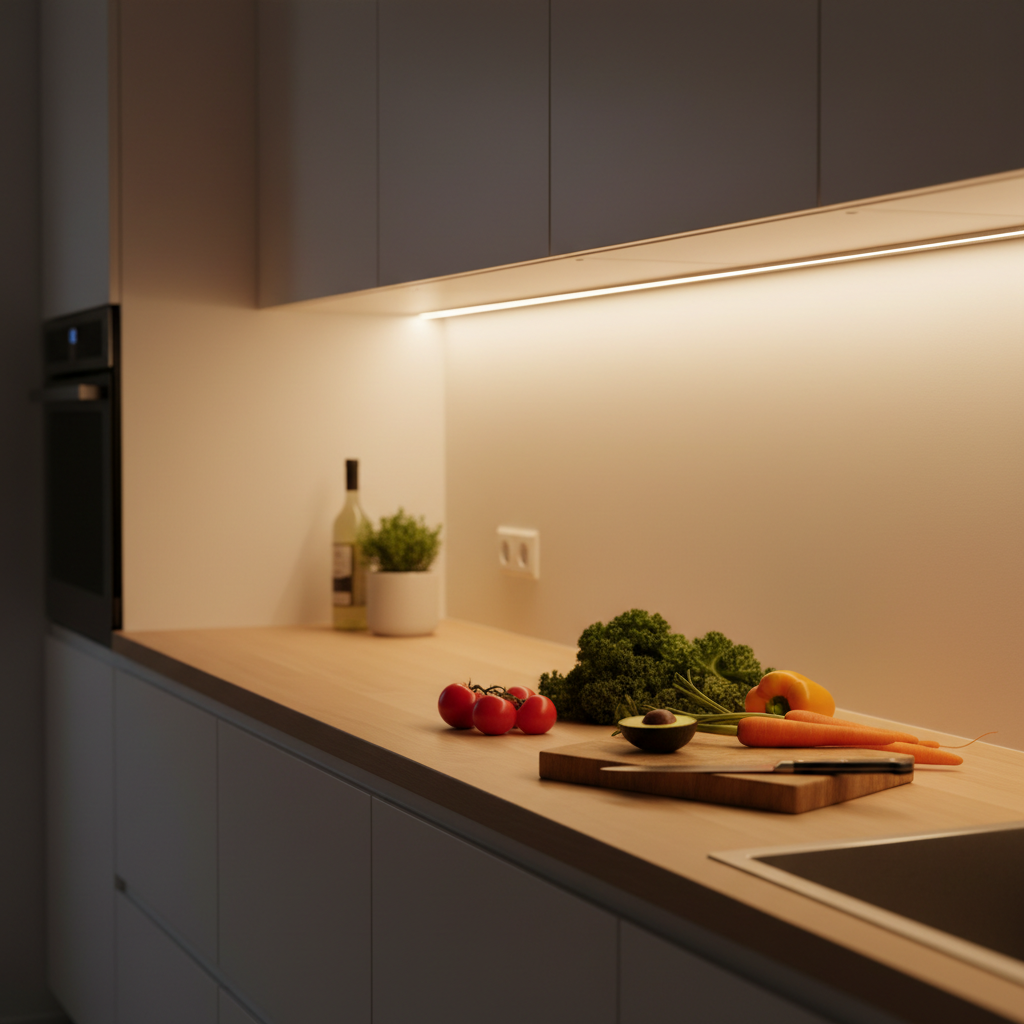
For illuminating a flat surface (countertop, inside a closet, under a cabinet, an entire shelf), a strip light is much more effective. It distributes light evenly along its entire length, with no dark spots.
If your goal is to see clearly while cooking, finding clothes in your closet, or reading the back of a cupboard, the strip light meets that need exactly. For this type of use, a wireless closet lighting solution with a strip light is often more suitable than a spotlight.
The Right Tool for the Job: Summary Table
| Situation | Directional Spotlight | LED Strip Light |
|---|---|---|
| Highlighting artwork | ✅ Ideal | ❌ Too diffuse |
| Lighting inside a closet | ❌ Dark spots | ✅ Ideal |
| Display case or decorative shelf | ✅ Dramatic effect | ✅ Uniformity |
| Kitchen countertop | ❌ Insufficient | ✅ Functional lighting |
| Hallway or staircase at night | ⚠️ Possible | ✅ More suitable |
| Sculpture / art object | ✅ Theatrical effect | ❌ Loses effect |
Top 5 Essential Criteria for Choosing a Wireless LED Spotlight
Not all rechargeable spotlights are created equal. Here are the concrete criteria to consider, in order of importance depending on your use.
1. Power Source: Rechargeable Battery or Disposable Batteries?
This is the most impactful criterion in the long run. A USB-rechargeable spotlight avoids disposable batteries and proves much more economical after a few months of use. Models with integrated rechargeable batteries also generally offer more consistent light: the intensity doesn't gradually dim as with draining batteries.
Check the battery capacity (in mAh) and the advertised battery life. Be wary of battery life measured in continuous full-power mode: in reality, motion sensor use often multiplies battery life by 5 or 10. To better understand what these numbers mean, consult our guide on the lifespan of a rechargeable LED spotlight.
2. Luminous Flux: How Many Lumens for Your Use?
Lumens (lm) measure the total amount of light emitted. For a spotlight used for accent lighting (artwork, decorative object), 100 to 200 lumens are often sufficient. For functional use (reading in a closet, working on a surface), aim for 300 lumens or more.
Note: a spotlight with a very concentrated beam may appear brighter than it actually is, because all the light is directed to one point. Perceived illuminance (in lux) also depends on the distance and beam angle.
3. Color Temperature: Warm White, Neutral, or Cool White?
This criterion is often underestimated, yet it determines the ambiance.
- Warm White (2700-3000K): Ideal for decoration, living rooms, bedrooms, highlighting objects with warm tones (wood, leather, oil paintings). Creates a cozy atmosphere.
- Neutral White (4000K): Versatile, a good compromise between ambiance and functionality. Suitable for workspaces or kitchens.
- Cool White (5000-6500K): Light similar to daylight, ideal for workshops, garages, functional areas. Less flattering for decor.
For a shelf in a living room or a painting, warm white is almost always the right choice. For a closet or basement, neutral white is more practical.
4. Mounting: Adhesive, Magnetic, or Screwed?
For an adhesive spotlight, the quality of the adhesive is crucial. Cheap models peel off after a few weeks, especially in places with temperature variations or slight humidity (kitchen, garage). Look for mentions like "industrial adhesive" or "3M adhesive" in product descriptions.
Magnetic mounting is useful if the surface is metallic or if a magnetic mount is provided. It allows for easy repositioning without leaving marks.
Screwed mounting is more permanent but requires some DIY skills. Consider it for permanent uses where you want no unpleasant surprises.
5. Motion Sensor: Useful or Gimmick?
For a spotlight placed on a painting in a living room, a motion sensor isn't really useful. A switch or remote control is preferred for turning it on/off at will.
However, for a closet, hallway, or basement, the sensor becomes very practical: no need to search for a switch with your hands full. The spotlight turns on as soon as you approach and turns off automatically after a few seconds of inactivity. To understand how these sensors work precisely, our article on motion sensor lighting for LED spotlights answers all your questions.
Wireless LED Spotlight for Which Room or Use?
Usage dictates everything. Here are the most common situations, with concrete recommendations.
Lighting a Painting or Artwork
This is the most typical use for a directional spotlight. The goal is to create a beam that falls on the artwork to reveal its colors and details, without dazzling viewers. Here, look for a narrow beam angle (30° or less), good color rendering, and ideally dimmable light to adjust intensity to the room's ambiance.
In this specific case, an adjustable rechargeable LED spotlight is the best solution. The Movement 3.0 from Lumic, for example, is a diffuse light strip light: it's not designed for this use. To highlight a painting, you need a spotlight with a concentrated directional beam.
Display Shelf or Decoration
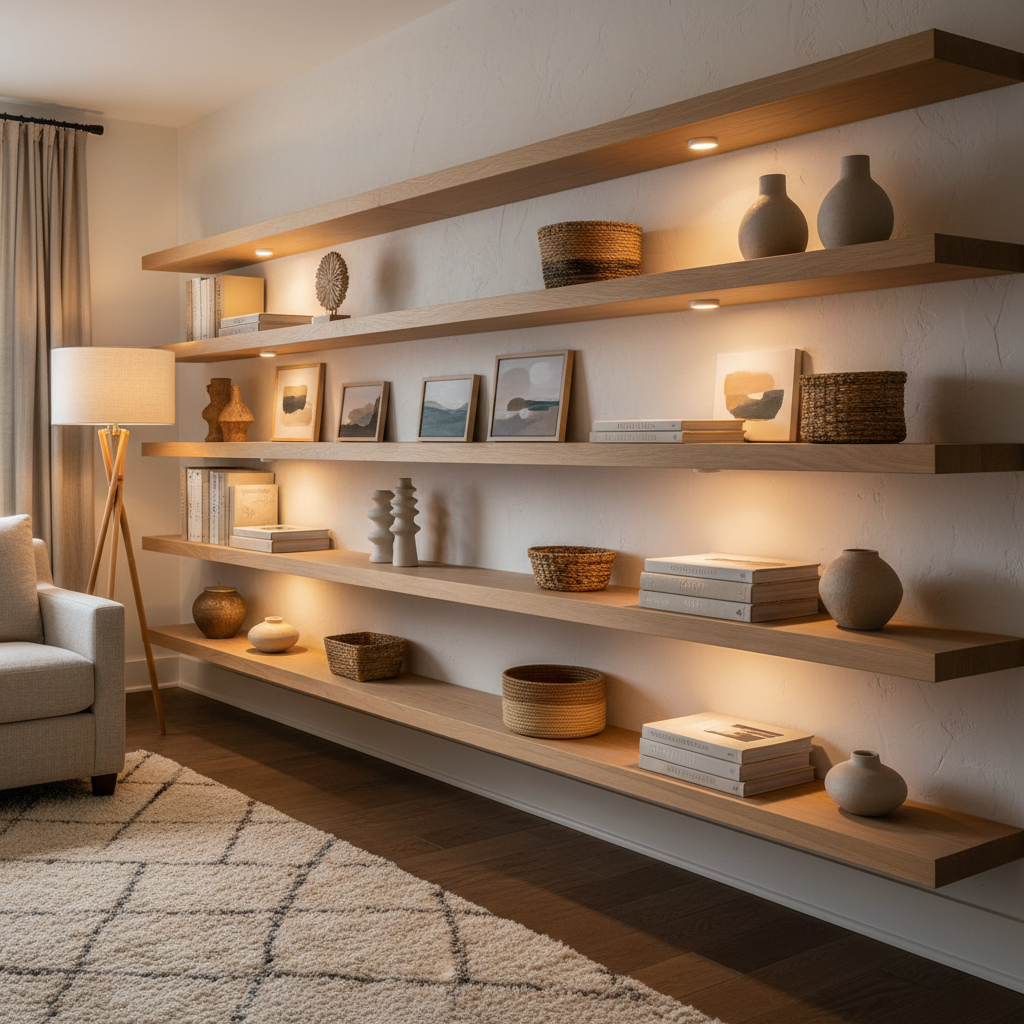
For a decorative shelf in a living room or a display case, both options (spotlight and strip light) work, but with different effects. The spotlight creates a dramatic effect on each individual object. A strip light placed under each shelf illuminates the entire surface uniformly.
If you have various objects in changing positions, the strip light is more flexible. If you want to highlight one or two specific objects, the spotlight has more visual impact.
Closet, Wardrobe, Cabinet
Here, the strip light clearly has the advantage. A single wireless spotlight in a closet inevitably creates dark spots in the corners. The strip light, placed under the top shelf or at the top of the wardrobe, diffuses homogeneous light that allows you to see everything at a glance.
For this type of use, discover our selection in the dedicated guide to the best LED closet light for 2026.
Basement, Garage, Workshop Without Electrical Outlets
Areas without electricity are often prime candidates for a standalone LED spotlight. In a basement, a rechargeable spotlight mounted near the entrance or above a specific storage area can be sufficient. The motion sensor is particularly useful here.
If you're looking to light an entire garage without electricity, a single spotlight won't be enough. You'll need a more powerful solution. Our guide on solutions for lighting a garage without electricity covers all available options.
What Manufacturers Don't Always Tell You
Some practical realities that product descriptions tend to downplay.
Advertised Battery Life Rarely Matches Real-World Experience
Manufacturers measure battery life under optimal conditions: ideal ambient temperature, minimum brightness setting, very moderate use. In real-world conditions, with full brightness and multiple activations per day, battery life can be two to three times shorter than advertised.
Always check if the manufacturer distinguishes between continuous mode battery life and motion detection mode battery life. These are radically different figures. A spotlight that lasts 5 hours continuously can last several weeks in sensor mode if you only pass by about twenty times a day.
Adhesive Mounting Needs to Be Tested on Your Specific Surface
Industrial adhesive holds very well on a smooth, clean, non-porous surface (glass, metal, melamine). On raw wood, plaster, textured tile, or brick, it's a different story. In such cases, prefer a magnetic system with a screwed mount, or direct screw mounting.
Pre-cleaning is mandatory: use isopropyl alcohol before applying the adhesive. This literally triples the adhesion time, regardless of product quality.
Color Temperature Changes with Battery Level
It's rarely mentioned, but on some low-end models, the light's color slightly shifts as the battery drains. What was neutral white becomes slightly orange. This phenomenon is called "color shift" and is related to the quality of the LED driver. On well-designed models, it's not noticeable.
Lumic's Movement 3.0: For What Use?
Let's be honest about this, because it's important to avoid disappointment.
The Movement 3.0 is an LED strip light, not a directional spotlight. It produces diffuse, homogeneous light along its entire length (9.1 inches or 15.7 inches). Therefore, it's not suitable for highlighting a painting or illuminating a specific object with a concentrated beam.
However, for what it is designed for, it performs exceptionally well:
- Under cabinet lighting in the kitchen, on countertops
- Inside closets or wardrobes
- Hallways or staircases with nighttime motion detection
- Under shelves for ambient lighting
It installs in less than 30 seconds (industrial adhesive + magnetic mounting), recharges via USB, and integrates both a motion sensor and an ambient light sensor to only turn on when needed. The 3000 mAh battery is larger than what's typically found on this type of product, which translates to a motion detection battery life of about 4 to 6 weeks depending on frequency of use and chosen length. Three color temperatures (3000K, 4000K, 6000K) are selectable, and brightness is adjustable. It comes with a 5-year warranty and a 90-day money-back guarantee.
If you're looking to uniformly light a storage space or a countertop, this is a solid option. If you're looking for a spot light to highlight a painting, opt for a product specifically designed for that.
How to Install a Wireless LED Spotlight Without Mistakes
A few simple steps to avoid unpleasant surprises.
Step 1: Prepare the Mounting Surface
Thoroughly clean the surface with a slightly damp cloth, then wipe with isopropyl alcohol (or 70% alcohol if isopropyl is unavailable). Let dry for 2 minutes. This step is often skipped and is the main cause of premature detachment. On varnished wood, test first on an inconspicuous corner.
Step 2: Position Before Fixing
Before removing the protective film from the adhesive, place the spotlight in the intended location and turn it on to verify that the beam illuminates exactly where you want it. For an adjustable spotlight, set the angle before sticking. Once the adhesive is in contact with the surface, it's much harder to reposition without leaving marks.
Step 3: Press Firmly and Let Rest
Once positioned, press firmly for at least 30 seconds over the entire contact surface. Avoid stressing the adhesive for the next 24 hours, especially if the surface is vertical. The full strength of industrial adhesive is reached after 24 hours, not immediately.
Step 4: Configure the Sensor if Applicable
If your spotlight has a motion sensor, adjust the detection range and turn-off delay according to your use. For a hallway, 30 seconds after the last movement is usually sufficient. For a closet that you open just long enough to grab an item, 10 seconds might be enough.
Wireless LED Spotlights: Common Mistakes
Some pitfalls to avoid so you don't end up with an unused product at the bottom of a drawer.
- Choosing a spotlight with too few lumens for the intended use: 80 lumens on a painting in a well-lit room won't be enough to create the desired effect.
- Sticking without preparing the surface: this is the primary cause of product returns. Adhesive sticks to clean surfaces, not dust.
- Confusing spotlight and strip light: the former for accent lighting, the latter for surface lighting. They are not interchangeable.
- Ignoring color temperature: a cool white on a painting with warm tones will distort the colors. This is detailed in our guide on choosing a rechargeable LED spotlight.
- Not testing the sensor range before permanent fixing: a misaligned sensor, and the spotlight won't turn on when you pass by.
Wireless LED Spotlight or Wireless Wall Light?
A common question: what's the difference between a wireless spotlight and a wireless wall light? A spotlight is adjustable and concentrates light. A wall light is often designed for more diffuse ambient lighting, with a design meant to be visible and decorative.
To compare the two options for your use, our guide on wireless wall lights details the differences and use cases for each solution.
Key Takeaways Before Buying
A wireless LED spotlight is a precise tool, designed for directional and accent lighting. It excels at highlighting an object, a painting, or a sculpture. It is not the right solution for uniformly lighting a surface or a storage space.
Before buying, ask yourself two simple questions: do I want to highlight a specific object, or do I want to illuminate an area clearly? In the first case, a rechargeable directional spotlight is the answer. In the second, an LED strip light with a motion sensor will be much more effective.
In both cases, mounting, actual battery life, and color temperature remain the decisive criteria. Take the time to check them before finalizing your purchase.