
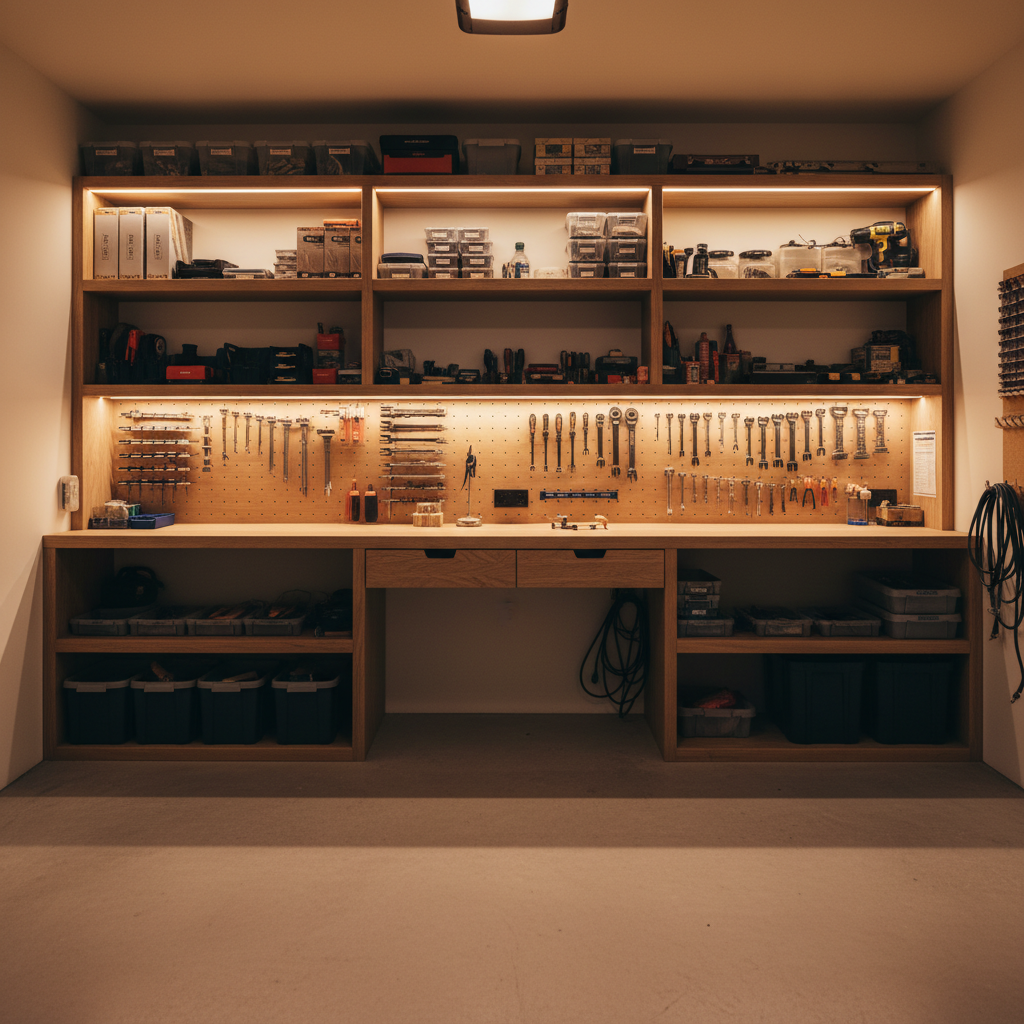
Your garage plunges into darkness the moment the door closes. Running an electrical cable from the house seems like a project you don't want to tackle. This is common for many garages — built when lighting wasn't a priority, or simply too far from the electrical panel for an easy hookup.
The good news: lighting a garage without electricity is now entirely feasible. No electrician, no drilling, no surprising bills. Standalone solutions have advanced significantly in recent years, with some truly viable for daily use.
This guide covers practical options, their real advantages, honest limitations, and how to choose based on your needs.
Why Lighting a Garage Without Outlets is Easier Than Before
For a long time, no electrical outlet in a garage meant either a hazardous extension cord or a costly installation. Today, three technologies have changed the game.
Rechargeable LEDs: The Most Significant Advancement
Lithium-ion batteries have improved in capacity and durability. A modern rechargeable LED light bar can last several weeks on a single charge, whereas early generations only lasted a few hours. Recharging is done via USB, like a phone — no need for an outlet in the garage itself, just inside the house.
Installation has also changed. Magnetic systems paired with industrial adhesives allow you to install a light bar under a shelf, against a wall, or under a cabinet in less than a minute. No screws, no anchors, no drill.
Solar: Finally Usable in Garages
First-generation solar lights had a critical flaw: they required direct, prolonged sunlight, making them useless in a closed garage. Current models separate the solar panel (placed outside, under the gutter or above the garage door) from the light source itself (inside the garage). The cable connecting them is thin, discreet, and easily passes under a door or through a gap.
For garages with a window or exterior access, this is often the most autonomous solution: zero manual recharging, zero batteries, no intervention once installed.
Rechargeable Batteries and Hybrid Systems
Less durable long-term than integrated batteries, systems powered by USB-rechargeable batteries remain a valid backup option, especially for very occasional use. Avoid them for daily lighting.
Practical Solutions for Autonomous Garage Lighting
Here are the main product categories available, with their suitable uses.
Rechargeable LED Light Bar with Motion Sensor
This is the most versatile solution for autonomous garage lighting. Install it where you need it — above a workbench, under a tool shelf, along a walkway — and it automatically turns on when you enter, then turns off by itself. No switch to fumble for in the dark.
The integrated ambient light sensor on better models prevents it from turning on unnecessarily during the day. This significantly impacts battery life: the battery is only used when truly needed.
Specifically, a light bar with a good battery capacity (3000 mAh and above) can last between 4 and 6 weeks in motion detection mode, depending on usage frequency. Recharge via USB overnight, and it's ready to go again.
If you want to compare available models, our comparison of wireless LED light bars will give you a clear view of options and criteria to consider.
Outdoor Solar Light with Motion Sensor
For the garage entrance, gate, or driveway: an IP65 solar light (rain, snow, frost resistant) with a well-oriented solar panel works year-round, even in winter, provided it gets a few hours of sunlight per week. Serious models have a battery that allows them to last several days without recharging.
This is also an interesting security solution: a light that turns on with motion deters intrusions better than permanent lighting.
To understand how this type of product works and how to choose it, consult our guide on solar lighting with motion detection.
Rechargeable Portable LED Lamps
For occasional or mobile use in the garage — working under a car, accessing a corner, moving around a large garage — a rechargeable portable LED lamp is often more suitable than a fixed light bar. It stores, transports, and charges like any USB device.
Adjustable or swivel-head models are particularly useful for tasks. Our selection of the best rechargeable portable LED lamps will help you make the right choice for your needs.
How to Choose Between the Different Options?
Before buying anything, a few simple questions will help you pinpoint the right solution.
What is the primary use of the garage?
The answer differs depending on whether you just park your car (quick entry, 30 seconds), use your garage as a workshop (prolonged work under good light), or store items and access them occasionally.
- Quick entry: A rechargeable LED light bar with motion sensor is more than enough. The automatic mode is perfect for this case.
- Prolonged work: You need sufficient light output (several hundred lumens minimum) and the ability to switch to continuous mode, not just detection. Also, consider the light's position to avoid shadows on your workbench.
- Occasional access: A rechargeable portable lamp is often the most flexible solution.
Does the garage have exterior access or a window?
If so, the solar option becomes relevant, especially for entrance and walkway lighting. A well-oriented exterior panel will power an interior light point without any manual intervention.
If the garage is completely enclosed with no exterior access, USB rechargeable remains the primary solution.
What area needs to be lit?
A standard garage is between 160 and 215 sq ft (15 and 20 m²). To properly cover this area with LED light bars, you often need multiple light points rather than a single central source. Two light bars at opposite ends of a garage generally provide much better results than a single one in the center.
For larger garages or workshops, plan for a main light bar (long, high output) and one or two complementary sources for specific areas.
Comparison Table of Garage Lighting Solutions Without Electricity
| Solution | Battery Life | Installation | Ideal For | Main Drawback |
|---|---|---|---|---|
| Rechargeable USB LED Light Bar | 4 to 6 weeks (detection mode) | Less than 1 minute, no-drill | Daily use, under cabinets, shelves | Requires periodic manual recharging |
| Outdoor Solar Lamp | Autonomous (solar) | Simple wall mounting | Entrance, driveway, gate, perimeter | Depends on available sunlight |
| Rechargeable Portable LED Lamp | Varies by model | None (portable) | DIY, occasional access | No permanent fixture |
| Extension Cord (from house) | Continuous | Simple but unsightly | Short-term troubleshooting | Visible cable, tripping hazard |
Key Technical Criteria Not to Overlook
Light Output: How Many Lumens for a Garage?
Light output is measured in lumens — this determines if you'll actually see anything or if it will remain dim. For a garage, 300 to 500 lumens minimum are generally considered necessary for functional lighting of a work area. For a simple walkway, 150 lumens may suffice if the light bar is well-placed (close to the lit area, not 10 feet (3 meters) high).
Mounting height significantly impacts the result: a light bar 20 inches (50 cm) from a surface illuminates much better than the same light bar 6.5 feet (2 meters) high.
Color Temperature: Warm White or Cool White?
For a garage or workshop, neutral white (4000K) is generally the best compromise: it renders colors well (important if you're working on mechanical parts or painting), without the harshness of cool white. Warm white (3000K) is suitable for storage or passage areas but can cause eye strain for precision work.
Actual Battery Life: Beware of Marketing Numbers
Advertised battery life is almost always measured under optimal conditions — often at minimum brightness and low activation frequency. In real daily use, expect shorter battery life. The important criterion is not the theoretical maximum, but the battery capacity (in mAh): this is objective data for comparing models. To learn more about this, consult our guide on LED light bar battery life.
Durability in a Garage (Humidity, Temperature)
A garage is not a living space. Temperatures fluctuate, humidity can be present, and vibrations too if you park a vehicle there. Ensure the chosen product is designed to operate outside standardized greenhouse conditions. An aluminum casing is a good sign of robustness. For an outdoor lamp or in a humid area, a minimum IP65 rating is recommended.
Is Lumic's Movement 3.0 Suitable for a Garage?
We often get this question. The Movement 3.0 is a rechargeable LED light bar with motion sensor, magnetic attachment, and industrial adhesive, available in 9 inches (~150 lumens) and 16 inches (~320 lumens). It works without cables, without outlets, and recharges via USB.
For a standard-sized garage, the 16-inch model with its 320 lumens is well-suited for lighting a defined work area — under a tool shelf, above a workbench — or for an access corridor. The 3000 mAh battery offers approximately 5 to 6 weeks of battery life in motion detection mode, depending on usage frequency.
Its strong point in a garage context: installation is truly immediate. The magnetic mount allows you to reposition it as needed without leaving marks. The aluminum body is suitable for less 'gentle' conditions than a kitchen.
What it doesn't do: it's not designed for large-area ambient lighting. If your garage is 320 sq ft (30 m²) and you do woodworking there, you'll need several, or you'll need to supplement it with another source.
Lumic offers a 5-year warranty and a 90-day satisfaction guarantee, with customer support based in the US. If it doesn't suit your needs, you can return it.
What to Avoid When Lighting a Garage Without Electricity
Common Mistakes to Avoid
- Buying the cheapest model available: Low-end LED light bars often have insufficient battery capacity, attachments that don't last long, and light that turns yellow after a few months. In use, you'll find yourself recharging a poorly secured lamp every two weeks.
- Installing at height without considering light output: A light bar mounted 6.5 feet (2 meters) high loses much of its effectiveness. It's better to place it closer to the area to be lit.
- Using only one light point for an entire garage: A single central point creates shadows in corners. Two well-placed sources are better than one powerful, poorly positioned one.
- Ignoring color temperature: 6000K cool white in a garage where you spend time can become uncomfortable. Neutral white at 4000K is generally better suited for workspaces.
To delve deeper into specific solutions for a garage without an electrical outlet, consult our detailed guide on solutions for lighting a garage without an electrical outlet.
Summary: Which Solution to Choose Based on Your Situation?
If you take away one thing from this guide: there's no universal solution, but there's a good one for every situation.
- You park your car and occasionally access items: A rechargeable LED light bar with motion sensor. Quick installation, zero maintenance for weeks.
- You have a workshop or regularly work in the garage: Several well-positioned LED light bars, with continuous mode in addition to detection mode. Check total light output.
- You want to secure the entrance or driveway: An IP65 outdoor solar lamp with motion sensor. Autonomous once installed, works summer and winter.
- You need mobile lighting for DIY projects: A rechargeable portable LED lamp, adjustable, that you store and move as needed.
Whatever option you choose, the lifespan of rechargeable LED lighting is now sufficient for sustained home use — this is one of the questions we often get, and the answer is reassuring. Quality models last several years without significant loss of brightness.
Garage lighting without electricity is no longer a compromise — it's a real solution.