Want to enjoy your patio at night without spending three weekends wiring or hundreds of dollars on an electrician? Solar patio lights are exactly the answer, provided you choose the right types for your actual needs.
Because let's be honest, lighting a patio rarely means just one need. There's the ambiance you want to create for summer evenings with friends. Then there's the functional aspect—that light that turns on when you go down the steps at night and can't see a thing. These two needs aren't met by the same product. We'll explain it all in this guide.
Why Choose Solar Lighting for Your Patio
The first reason is installation. Wiring a patio when there's no nearby outlet can quickly get expensive: between wall trenching, conduits, electrician fees, and finishing touches, you're easily looking at $400 to $800, sometimes more. And it leaves lasting marks on walls or the ground.
Solar, on the other hand, requires no cables, no outlets, and no tradesperson. You pick the spot, mount the fixture, and you're done. It's also one of the only truly suitable solutions for renters, who often aren't allowed to make permanent modifications. For homeowners, it's a tangible saving of time and money.
But Does Solar Really Work, Even in Winter?
This is the question we hear all the time, and it's a good one. Entry-level solar lights, the $15 ones you find on marketplaces, do struggle in winter or on cloudy days. Their panels are too small, their batteries too limited.
But it's not a lost cause. A quality solar fixture, with a larger panel and a good capacity battery, can operate for several days without direct solar recharge. It's about choosing a product designed to perform in real-world patio conditions in North America, not just under bright July sun in Arizona.
Solar vs. Wired Lighting: What Do You Really Choose?
Wired lighting remains superior in terms of absolute consistency and unlimited light intensity. But for a patio used primarily for evening ambiance, modern solar is more than sufficient. The question isn't "which is better" but "for what use, under what installation constraints?"
If you already have an outdoor outlet, wired lighting might make sense for decorative posts or wall sconces. If you're starting from scratch or are a renter, solar is almost always the simplest and most cost-effective solution.
The Two Needs of a Well-Lit Patio
Before looking at products, let's clarify something: a patio has two distinct lighting types, and confusing them often leads to disappointment.
Ambiance: What You Want to See and Feel
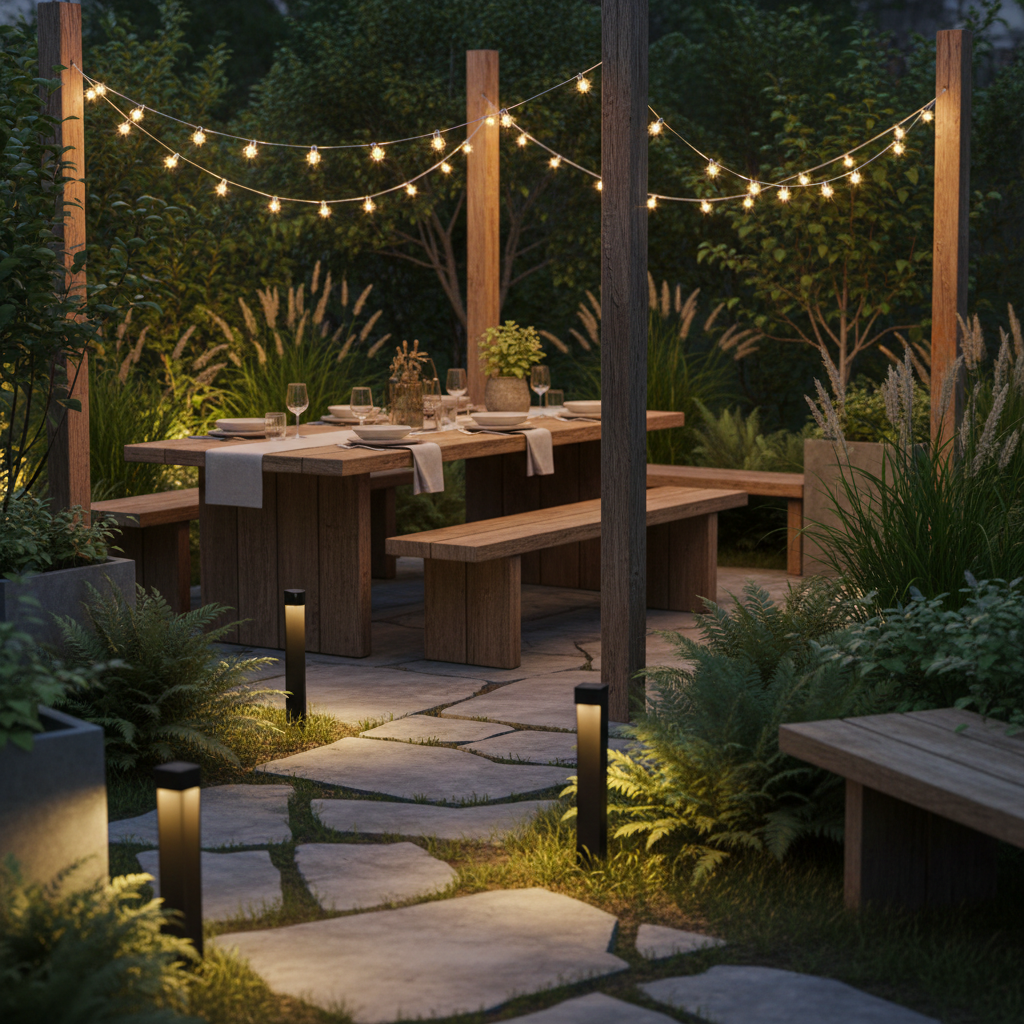
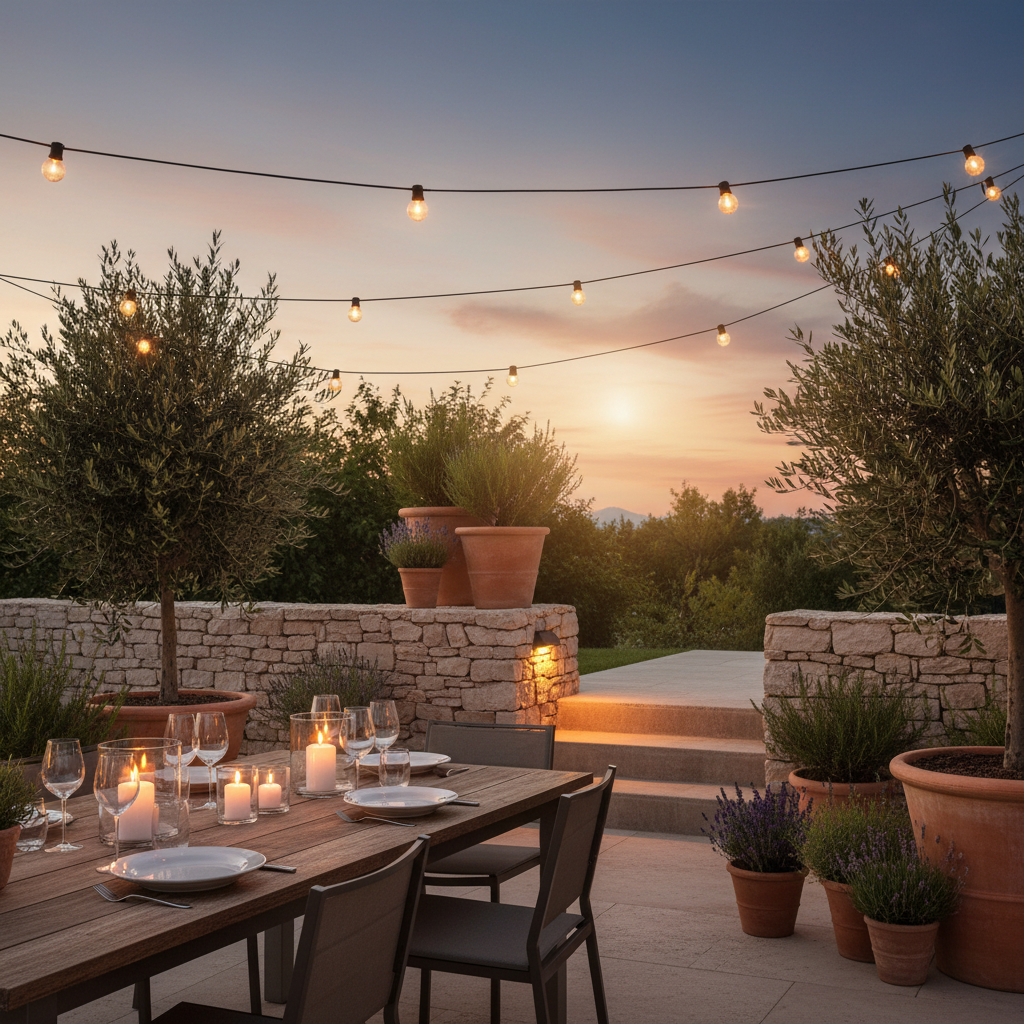
This is the primary need for most patios. You want soft, warm light that invites you to linger, creating a pleasant atmosphere for evenings. Think solar string lights draped overhead, solar table lamps on furniture, or ground lanterns along a paved path.
The ideal color temperature for ambiance is warm white, around 2700 to 3000 Kelvin. This is the same tone as a candle or an incandescent bulb. It visually warms the space and creates that relaxed atmosphere you're looking for.
To learn more about creating a cohesive lighting ambiance on a patio, our article on solar patio lighting for true ambiance details combinations that truly work.
Safety: What You Absolutely Must Have
This is the less glamorous need, but potentially the most important. There are situations where ambiance lighting alone isn't enough: descending patio steps, walking a dark path to the gate at night, finding your way back to the house after parking the car.
In these cases, you want a light that turns on automatically when you pass, powerful enough to see where you're stepping, and that turns off on its own. This isn't the same technology, it's not the same product. And it's often the missing link for people who find themselves fumbling in the dark despite their string lights.
Which Type of Solar Light for Which Patio Zone
Now that we have both needs in mind, here's how to map them to different areas of your patio.
| Zone | Primary Need | Recommended Light Type |
|---|---|---|
| Table & Dining Area | Ambiance | String lights or solar table lamp |
| Steps & Level Changes | Safety | Motion sensor wall sconce |
| Walkway & Path | Safety + Guidance | Spotlight or motion sensor sconce |
| Outdoor Lounge/Sofa Area | Ambiance | Lantern or decorative bollard |
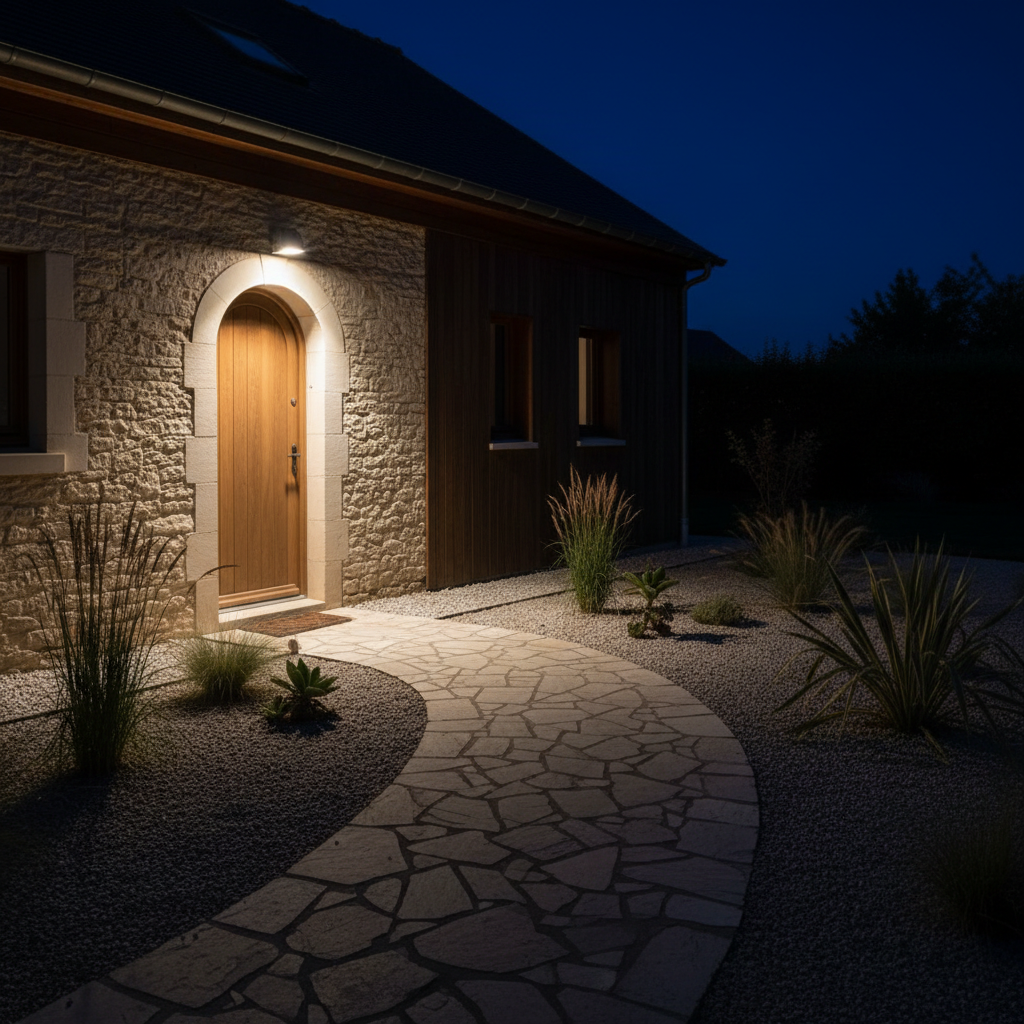
| House Entrance from Patio | Safety | Motion sensor wall sconce |
Can One Light Be Used for the Entire Patio?
Theoretically, yes; practically, no. A single light source, even a powerful one, will inevitably create shadows and won't provide both ambiance and safety satisfactorily. The winning combination is usually decorative string lights or a lamp for ambiance, complemented by a motion sensor sconce for steps or the entrance. Two products, two roles, one truly well-lit patio.
Solar Wall Sconces: The Missing Link
We talk a lot about string lights and lanterns, but solar wall sconces are often underestimated. Yet, they have a major advantage: mounted high on a wall, they illuminate a wide area on the ground, exactly where you need it to secure steps or a walkway.
To learn everything about selecting and installing them, check out our guide on how to choose your outdoor solar wall light.
Essential Criteria for Choosing Your Solar Patio Light
The market is flooded with solar lights, and the quality difference between a $12 product and one designed to last is huge. Here's what really matters.
Panel Power and Battery Capacity
This is the core issue. A small, poorly sized solar panel won't sufficiently recharge the battery on a cloudy day. A battery that's too small will be dead by 11 PM. These two elements must be oversized for the intended use if you want real reliability, especially from September to March.
Entry-level products rely on tiny batteries and minuscule panels. The result: a light that dies in the middle of the evening or doesn't turn on at all in winter.
IP Rating: Non-Negotiable for Outdoors
An outdoor light must have at least an IP44 rating, which guarantees protection against splashes. For patio use exposed to rain, IP65 is the recommended standard: it guarantees watertightness against direct water jets and dust. This is the minimum to sleep soundly when a storm hits at 3 AM.
Material Durability
Cheap plastic yellows, cracks, and becomes brittle after a few seasons. Opt for outdoor-treated materials, resistant to UV rays and temperature variations. A light exposed year-round faces significant stress; it must be designed for it.
Motion Sensor Quality
For safety sconces, the sensor is the key element. A good sensor should have sufficient range (around 26 feet), adjustable sensitivity to avoid false alarms, and a wide detection angle. An overly sensitive sensor will turn on at the slightest passing cat. Too insensitive, it won't detect someone walking up the steps.
To delve deeper into this specific topic, our guide on solar lights with motion sensors will help you make the right choice.
The Scenario We All Experience: The Perfect Evening, Then Back to Darkness
You know the scene. Successful evening on the patio, great atmosphere, string lights on, aperitif lingering. Then it's time to go inside. You get up from the table, navigate around chairs, approach the steps... and it's pitch black. The string lights illuminate the table, not the steps. You feel your way down, hoping not to miss a step.
This is exactly why the ambiance + safety combo isn't a luxury. Decorative lighting creates atmosphere, but it doesn't replace functional light in high-traffic and uneven areas. And when you have children or guests unfamiliar with the steps, it becomes truly critical.
Lumic's SolarGlow: Designed for This Specific Role
If you're looking for a motion sensor solar sconce to secure your steps or entrance, Lumic's SolarGlow was designed for exactly this type of use. It delivers 1,200 lumens, which is enough to brightly illuminate a passageway, with two 180° motion sensors and a range of approximately 26 feet. UL listed IP65, it withstands rain, snow, and frost.
What sets it apart from low-end alternatives is its significantly larger solar panel and battery compared to what's usually found at this price point. The result: up to 20 days without solar recharge in detection mode, and a continuous runtime of 36 hours. In short, it works even when the sun has been absent for several days. 5-year warranty, no electrical installation, no complex drilling.
How to Organize Your Patio Solar Lighting: A Simple Method
Instead of listing products, here's a practical way to think about your patio lighting based on your actual uses.
Step 1: Identify Your Zones and Uses
Walk around your patio and ask yourself two questions: where do I spend the most time sitting and relaxing? And where do I walk in the dark and feel a bit uneasy? The first areas are for ambiance. The second are for safety. Literally write them down.
Step 2: Address Safety First
Start by installing a motion sensor sconce in each risky area (steps, main walkway, entrance). It's quick, doesn't require extensive aesthetic consideration, and solves the urgent problem. Once you know you won't trip over a pot or miss a step, you can work on ambiance.
Step 3: Build Ambiance in Layers
Ambiance is built by layering several soft light sources rather than one strong one. String lights overhead for general illumination, one or two lanterns or table lamps for task lighting, and possibly some ground bollards to define the space. All in warm white, at a maximum of 3000 K.
For concrete ideas organized by ambiance type, our article on ideas for wireless patio lighting provides ready-to-use configurations.
Step 4: Check Solar Panel Orientation
This is a step often overlooked. Integrated solar panels in fixtures should be oriented south to maximize recharging. If you mount a sconce on a north-facing wall, it will recharge much less efficiently. Some fixtures have a remote, adjustable panel, which solves this problem. Check this point before purchasing.
What to Avoid When Buying a Solar Patio Light
Some common mistakes we see repeatedly:
- Buying solely based on price. A $12 product will almost always have an undersized panel and battery. It works in July in full sun, not in October when evenings start early.
- Neglecting the IP rating. A light not labeled or with an IP rating below 44 has no place outdoors. The first rain can damage it.
- Placing the solar panel in the shade. If the perfect aesthetic location is also in shade all day, the product won't work correctly. Adjust the location or choose a model with a remote panel.
- Forgetting to check the warranty period. For a product exposed to weather year-round, a one-year warranty is insufficient. Aim for at least 3 to 5 years.
- Mixing color temperatures. Cool white (6000K) string lights mixed with warm white (2700K) lanterns create a visually inconsistent result. Choose one temperature and stick to it for the entire patio.
For an overview of different outdoor solar lighting options, our complete guide to outdoor solar lighting details each product category with its specific uses.
Key Takeaways for Choosing Your Solar Patio Light
Lighting a patio with solar fixtures is achievable without major work, without an electrician, and often for much less than a wired installation. But the right result doesn't come from a single miracle product; it comes from a combination tailored to your real needs.
Ambiance is 80% of the patio evening experience. String lights, lanterns, and warm white table lamps, layered to create luminous depth. Safety is the 20% that changes everything at night when you're descending steps in total darkness. A good motion sensor sconce, correctly placed, solves this problem once and for all.
The criterion that truly differentiates a good from a bad solar light is the size of the panel and battery. Everything else is secondary. And if you want a light that lasts, weather resistance (IP65) and warranty duration are the first two numbers to look at.