You're browsing the outdoor lighting aisle at Home Depot or Lowe's, you see solar lights at what seem like reasonable prices, and you wonder if it's a good idea. Fair question. Before you swipe your credit card, here's what you really need to know about these products — and the right questions to ask so you don't regret your purchase in six months.
What You Really Find at Home Depot / Lowe's in Solar Lighting
Home Depot and Lowe's are major general hardware stores. They offer a range of outdoor solar lighting that covers common needs: solar spotlights with motion sensors, garden solar path lights, solar string lights, and stake lights for flowerbeds. Prices generally range from entry-level to mid-range, often under store brands or from lesser-known suppliers.
The main advantage is clear: you can see and touch the product in-store, read the packaging, ask for advice from a sales associate, and if it doesn't suit your needs, return it to the store. This is a real plus for someone buying their first outdoor solar light who wants the reassurance of a physical store.
What Types of Solar Lights Are Available?
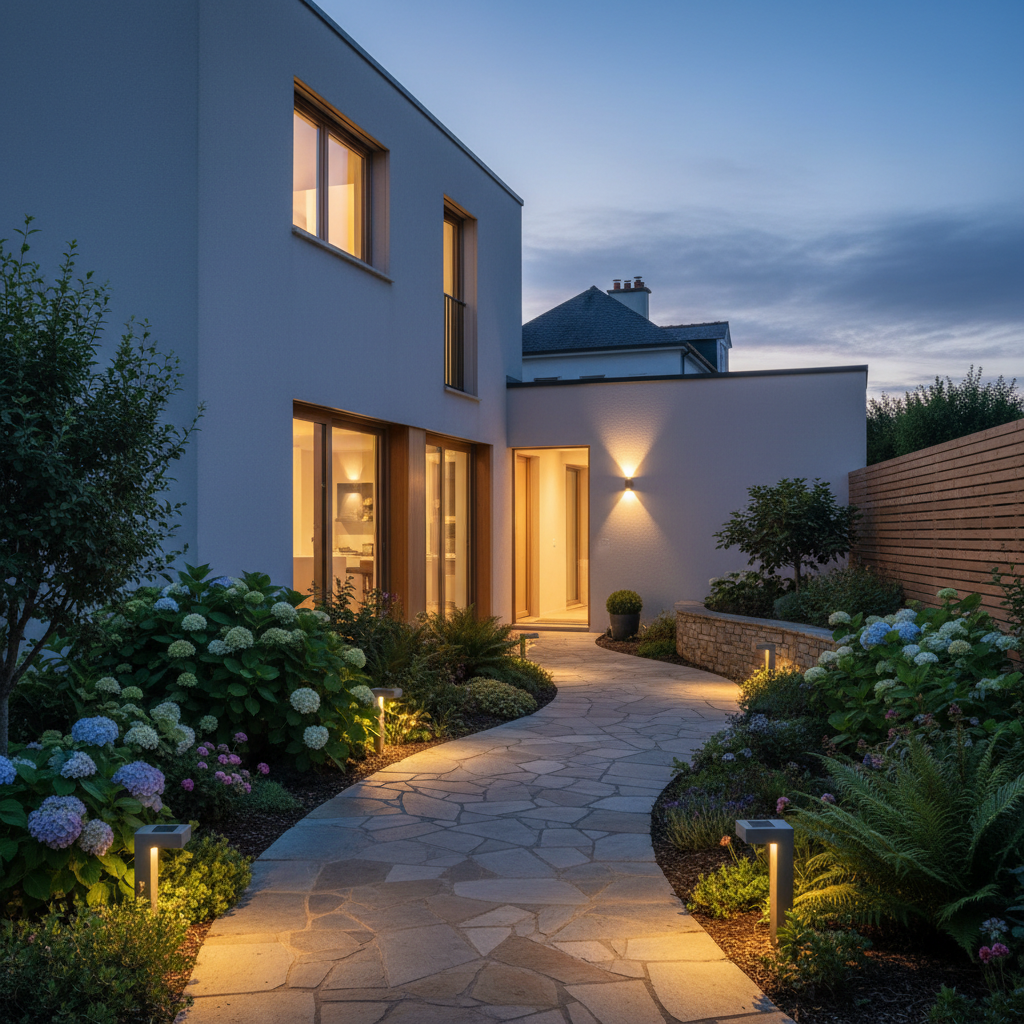
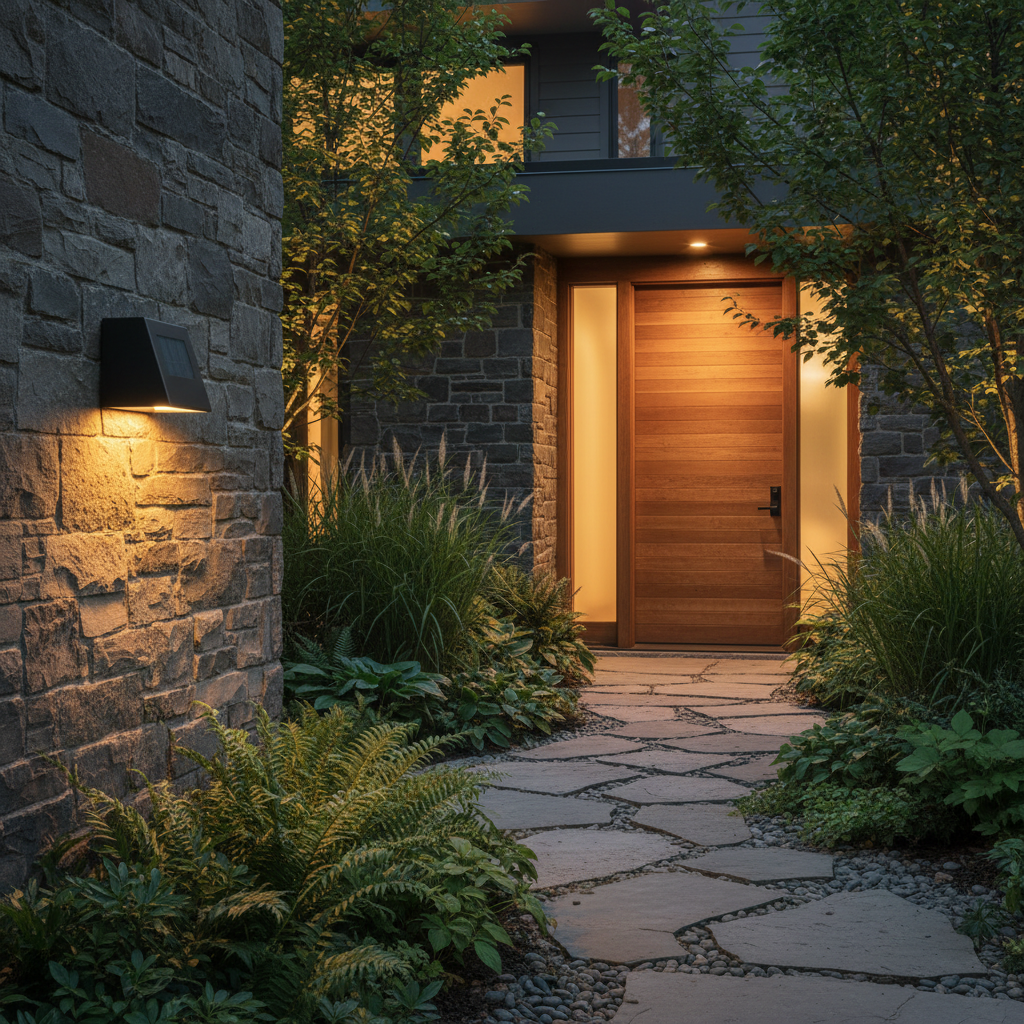
You'll primarily find three categories in-store: solar spotlights with integrated motion sensors (to secure an entrance or garage), solar path lights to mark a pathway or define a garden, and solar wall lights for illuminating a patio or facade. If you're looking to choose the right solar path light for your pathway, the models available at big-box stores can be a temporary fix, but their features require careful consideration.
Are There Known Brands or Just Generics?
Most items on the shelves are store brands or brands with limited presence outside of big-box retail. This is common in this sector and not necessarily a flaw, but it means it's hard to find detailed online reviews, know the true technical specs, or access specialized customer support if a problem arises after a few months.
Top 3 Questions to Ask Before Buying an Outdoor Solar Light at Home Depot / Lowe's
When you're in the aisle — or looking at a product description online — there are three pieces of information that truly determine if a solar light will deliver on its promises long-term. If you don't find them on the packaging, be wary.
What is the Battery Capacity in mAh?
This is the number one criterion. The battery determines how long your light stays on after a cloudy day or in winter. A light with an 800 mAh battery will run out much faster than a 2,000 or 3,000 mAh model. Many entry-level solar lights boast impressive lumens on the box but come with a tiny battery — resulting in 30 to 60 minutes of actual illumination per night. On big-box store packaging, this information isn't always clearly displayed. Ask for it explicitly.
What is the Actual Size of the Solar Panel?
The larger the panel, the more solar energy it captures — especially in fall and winter when the sun is low. A tiny panel embedded in the top of a path light is often insufficient to properly recharge the battery outside of June-August. If the technical sheet doesn't indicate the panel surface area in square inches (cm²), it's rarely a good sign. Choosing a solar light that actually works in winter largely depends on this feature.
What is the Warranty Period?
This is the question few people think to ask, yet it's telling. A 1-year warranty (sometimes just the legal 2-year warranty) on an outdoor solar light is short. The components that wear out first — the battery and the panel — often degrade after 18 to 24 months of intensive use. A 5-year warranty is a strong signal that the manufacturer believes in the durability of their product.
What Reviews of Home Depot / Lowe's Solar Lights Reveal in Practice
Customer feedback on solar lights purchased at big-box hardware stores often highlights the same issues. In practice, several recurring themes appear in buyer comments.
What Works Well
Installation is generally simple — a common strength of all solar lighting. The product works correctly during summer months. In-store returns are convenient if the product is defective right out of the box. For seasonal use or a tight budget, this might be sufficient.
What Disappoints After a Few Months
Negative feedback primarily points to two recurring problems: autonomy drops significantly by fall (because the battery doesn't recharge sufficiently with less sun) and the battery no longer holds a charge after one to two seasons. These problems are not a surprise — they are often the direct consequence of a small battery and an undersized solar panel. To better understand why the battery makes all the difference, this article on solar light batteries explains the mechanisms in detail.
How Good is Home Depot / Lowe's Solar Lighting for Security Use?
For motion-sensing solar lighting — the most requested type for securing an entrance or garage — sensor quality matters as much as the battery. Entry-level models often have limited detection range and angle, and poorly adjustable sensitivity. The result: false positives (turns on with wind), or conversely, delayed detection. This is a difficult element to evaluate in-store.
Comparison: Home Depot / Lowe's Solar Light vs. Criteria for Good Outdoor Lighting
Here's a table comparing typical characteristics of solar lights sold at big-box hardware stores with what a truly high-performance model should offer.
| Criterion | Big-Box Store Solar Light (Typical) | What a Good Model Should Offer | SolarGlow (Lumic) |
|---|---|---|---|
| Battery | Often not communicated / low | 2,000+ mAh | Battery 4x market average |
| Solar Panel | Small, often not communicated | Sufficient surface for winter | Panel 3x larger than average |
| Runtime (motion detection mode) | Variable, often 1-3 days without sun | 10+ days without sun | 20 days without solar recharge |
| Lumens | 200-800 lm (often overestimated) | 800+ actual lm | 1,200 lm |
| Motion Detection | 1 sensor, limited angle | Wide coverage, low false positives | 2 sensors 180°, range ~26 feet (8 m) |
| Water Resistance | Sometimes IP44, often not certified | IP65 minimum | IP65 |
| Warranty | 1 to 2 years | 3 years minimum | 5 years + 90-day money-back guarantee |
| Installation | Wireless | Wireless, no electrician needed | Wireless, no electrician needed |
| Customer Support | In-store return | Responsive customer support | US-based customer support, 24-hour response |
This table isn't meant to discredit Home Depot or Lowe's, but to establish proper comparison criteria. An honest comparison of big-box store solar lights shows that these retailers focus on price and immediate availability — these are real strengths. But technical specs often remain obscure.
Home Depot / Lowe's vs. Specialist: Two Different Buying Logics
Here's how I'd clearly position things:
Home Depot / Lowe's is the right choice if:
- You want to see the product before buying and ask questions to a sales associate.
- You're looking for a temporary or decorative solution (solar string lights, ambient path lights).
- Your budget is tight, and you're okay with replacing the product in 1-2 years.
- You need the product today, physically, without waiting for delivery.
A specialist is better if:
- You want solar lighting that still works well in winter and fall.
- You're installing for 5 years and don't want to replace it in 18 months.
- Your property's security depends on the light's reliability (gate, entrance, garage).
- You want transparent technical specs before buying.
Buying at Home Depot or Lowe's is often an impulse purchase or for immediate necessity. Buying from a specialist is a 5-year investment. These two logics are not mutually exclusive — they simply correspond to different needs.
Solar Path Lights and Spotlights: How Good Are They Really Outdoors?
If your primary need is to mark a pathway or illuminate a garden path, the solar path lights available at big-box stores have the advantage of being aesthetically integrated into their in-store display. But in practice, their illumination height is low, their battery often small, and their durability in freezing weather is rarely guaranteed. To choose this type of product well, this guide on solar path lights for garden pathways provides concrete benchmarks.
What's the Winter Performance for a Home Depot / Lowe's Solar Spotlight?
This is where most disappointments occur. A solar spotlight purchased in May, which works perfectly in summer, can become almost useless in December. The reason is simple: with less than 4 to 5 hours of sunlight per day in winter, a small panel doesn't sufficiently recharge the battery to ensure multiple nighttime activations. If you're looking for year-round use, the solar panel specs become critical — and they are rarely communicated on big-box store packaging.
Does a Home Depot / Lowe's Solar Fixture Really Withstand Inclement Weather?
The Ingress Protection (IP) rating should be indicated on the packaging. IP44 = protected against splashing water (suitable for a sheltered patio). IP65 = protected against water jets and dust (recommended for year-round outdoor use). Some big-box store models don't display a clear IP certification — this is a warning sign. A truly reliable outdoor solar fixture must combine weather resistance and long-term durability, not just a nice in-store design.
What We Really Recommend Based on Your Needs
No universal answer here — it depends on what you're trying to achieve.
For decorative garden solar lighting, a string light or ambient path light from Home Depot or Lowe's might do the trick. The product doesn't need to be ultra-high performance, just visually appealing.
For functional year-round lighting — securing an entrance, illuminating a gate, lighting a garage — the criteria change completely. You need actual lumens (not inflated on the packaging), a battery capable of lasting several nights without sun, and a panel that recharges even in November. This is where Lumic's SolarGlow stands out: 1,200 lumens, a battery 4 times larger than the market average, a panel 3 times larger, two 180° motion sensors with a 26-foot (8-meter) range, and an IP65 certification. And if it doesn't suit you, 90 days to return the product, 5-year warranty. For a thoughtful, long-term purchase, specs matter more than the initial purchase price.
Before finalizing your choice, take the time to understand the criteria for choosing an outdoor solar light — whether you buy from Home Depot, Lowe's, another general retailer, or a specialist. The key is that the product still meets your needs in 3 years.
In Summary: Key Takeaways
- Home Depot / Lowe's is useful for seeing and touching a product, getting quick in-store advice, and making easy returns if needed.
- The solar range at big-box stores primarily covers entry and mid-range, with often vague technical specs.
- The 3 essential questions before buying: battery capacity in mAh, solar panel size, warranty duration.
- For decorative or seasonal use: a Home Depot / Lowe's solar light might suffice.
- For security use, year-round, in all weather: prioritize verified specs and a long-term warranty.
- Big-box store purchase = convenient and immediate. Specialized purchase = thoughtful and durable.