Looking to install a solar spotlight in your yard but can't decide between models? It's common. There isn't one universal type of solar garden spotlight. There are two, with completely different purposes. Choosing the wrong one means paying for something that won't perform its intended function.
This guide explains how to distinguish these two uses, what criteria to look for in each, and how to avoid common mistakes.
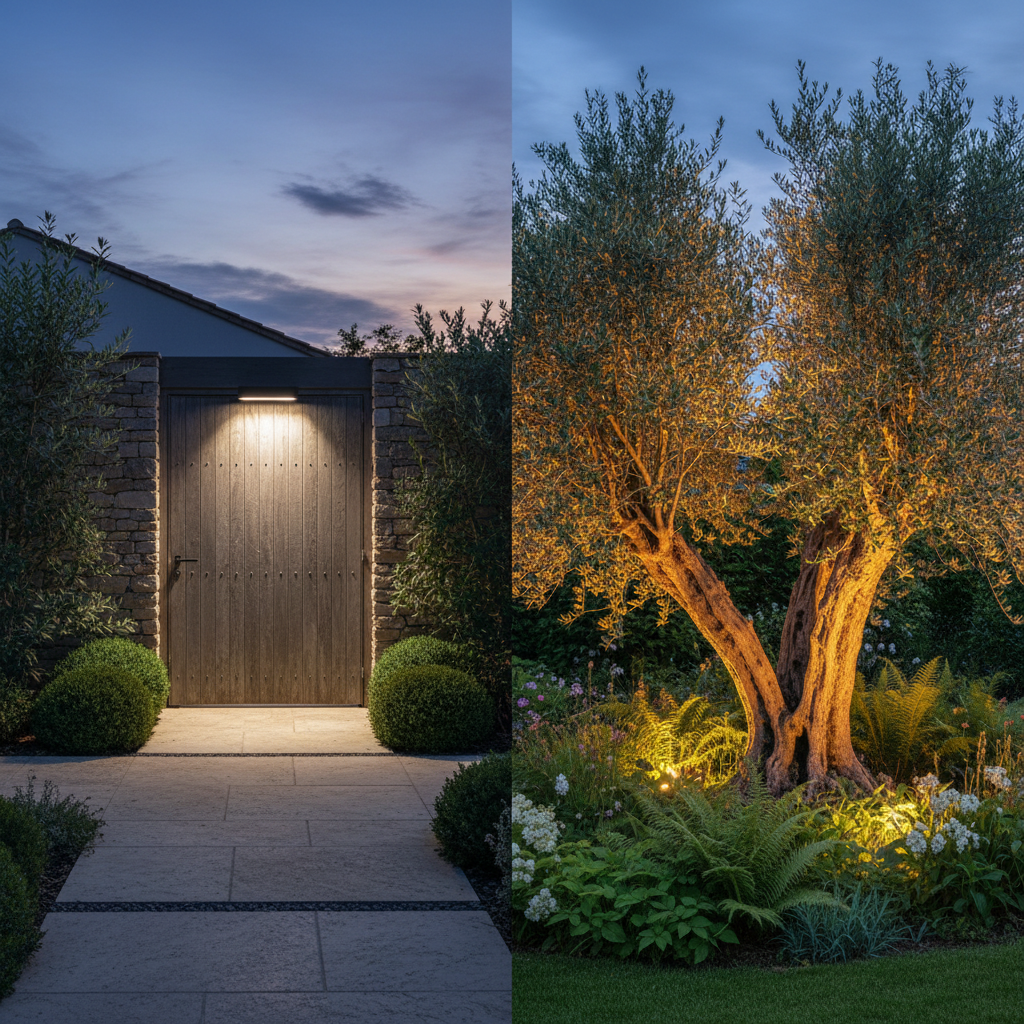
Two Uses, Two Logics: Security or Ambiance
Before checking lumens or battery life, ask yourself one simple question: What will your spotlight be used for? The answer will completely change your choice.
Securing an Entrance, Gate, or Garage
For security, the solar garden spotlight must turn on brightly and quickly when someone approaches. The goal isn't to create ambiance; it's to deter and provide clear visibility in the dark. Two criteria become non-negotiable: a motion sensor and at least 1000 lumens of power.
The sensor allows the spotlight to turn on instantly during an intrusion and conserve battery life otherwise. Without it, you'll drain your solar panel by leaving the light on all night. As for lumens, below 800-1000, you'll get an insufficient glow to cover a driveway or gate.
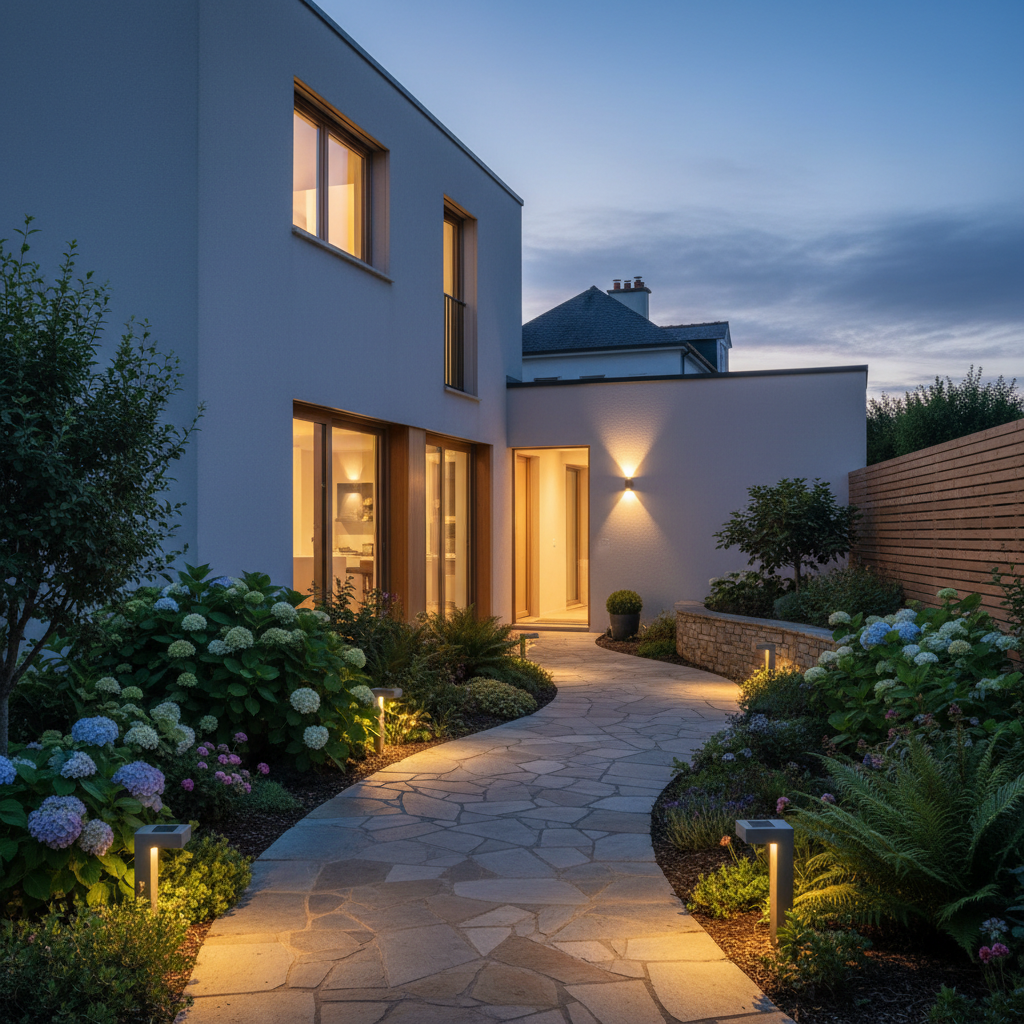
For this use, a wall-mounted format is ideal. It's fixed high (7-10 feet (2-3 meters) ideally), directs the beam downwards, and covers a wide area. This is exactly what Lumic's SolarGlow does: 1200 lumens, two 180° motion sensors with a 26-foot (8-meter) range, IP65 rated for rain, frost, and snow. If you need to secure a home entrance or gate, this format gets the job done without compromise. 5-year warranty, 90-day money-back guarantee.
Highlighting a Tree, Facade, or Hedge
For accent lighting, the logic is reversed. You're not trying to flood an area with light; you want to sculpt your garden at night. Create contrasts. Highlight a remarkable tree, a stone facade, or a plant bed.
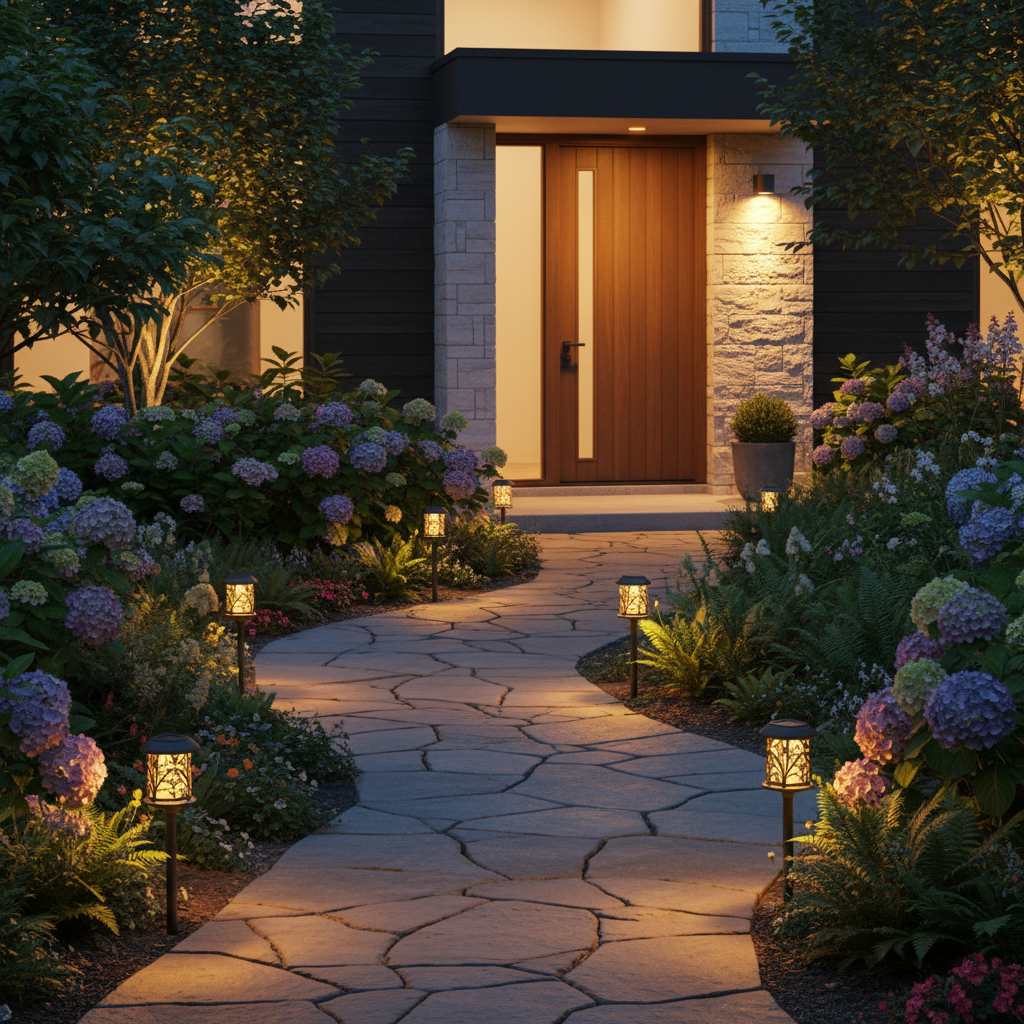
For this, you don't need 1000 lumens. 200 to 600 lumens are ample, provided the beam is directed and focused. We're talking about garden spots or stake lights planted in the ground, aimed upwards. The effect is completely different from a wall-mounted spotlight: the tree is lit from below, shadows play in the branches, creating an architectural effect.
To create a beautiful lighting ambiance on a patio, the rules are similar: focus on targeted areas rather than uniform light. If this is your goal, our guide on creating a luminous ambiance on a patio will give you concrete ideas.
Key Criteria for a Solar Garden Spotlight
Once you've identified your use, here are the criteria to seriously consider. Not all of them, some are often oversold. We'll get straight to the point.
Lumens: How Many Do You Really Need?
Lumens are what matter, not watts. Watts measure power consumption; lumens measure what you actually see.
| Use | Recommended Lumens | Suitable Format |
|---|---|---|
| Accent Lighting (tree, hedge) | 200 to 600 lm | Stake light, ground |
| Ambiance Lighting (patio) | 400 to 800 lm | Wall-mounted, stake |
| Entrance/Gate Security | 800 to 1200 lm | High wall-mounted |
| Long Driveway / Parking | 1200 lm and up | Wall-mounted, dual-head |
A solar garden spotlight advertised at 5000 lumens on low-end packaging? Be wary. This figure often represents the theoretical maximum at cold temperatures, never achieved in real-world conditions. Reputable models state values measured under normal operating conditions.
The Solar Panel: The Often-Overlooked Variable
The battery life of a solar garden spotlight directly depends on the size of the solar panel and the battery capacity. This is where many entry-level models disappoint.
A small panel means insufficient recharging in winter or on cloudy days. Result: the spotlight turns off in the middle of the night. To avoid this, look for a model with a large surface panel and sufficient battery capacity. Some spotlights offer a remote panel, meaning it's separate from the light head. This is a real advantage: you place the panel in the sun, and the spotlight in the shade or under an overhang. Ideal if the area you want to light doesn't get direct sunlight.
If you want to understand what truly makes the difference between models in terms of power and battery life, our article on powerful solar spotlights details this point by point.
IP Rating: Essential for Outdoor Use
For an outdoor solar garden spotlight, the IP rating is non-negotiable. It indicates resistance to dust and water. In the US and Canada, with varied weather conditions, a minimum IP65 rating is essential. IP65 means: resistant to water jets and dust. IP67 or IP68 go further, but IP65 is sufficient for typical garden use.
A model without a clearly displayed IP rating, or advertised as IP44 (splash-resistant), won't last multiple seasons under a gutter or in a driveway exposed to the elements.
The Motion Sensor: Settings and Angles to Check
For a security solar spotlight, the motion sensor should have a range of at least 20-26 feet (6-8 meters) and a sufficiently wide detection angle. A 120° angle covers a reasonably wide area. The best models offer 180° or two independent sensors to cover blind spots.
Another often-ignored point: the ambient light sensor. It allows the spotlight to activate only at dusk. Without it, your sensor might trigger the light in broad daylight if someone passes by. Some models also include timer settings (duration the light stays on after detection): 10, 30, or 60 seconds. Useful for adjusting based on use. To learn more about this, our article on solar spotlights with motion sensors details the settings to master.
Solar Garden Spotlight: Where to Place It Based on Use
Placement is everything. A good spotlight poorly placed will be useless. Here are the most common configurations and what truly works.
Home Entrance and Gate: The Right Installation Angle
To secure an entrance, install the spotlight 8-10 feet (2.5-3 meters) high, slightly angled downwards and towards the area to be monitored. Too low, the beam doesn't cover enough. Too high, it dazzles without truly illuminating the ground.
The solar panel should face south or southwest to capture maximum sunlight during the day. If the entrance faces north or is shaded by a tree, a model with a remote panel becomes almost indispensable.
Garden Path: One or More Spotlights?
For a path longer than 16 feet (5 meters), a single spotlight at the end won't be enough, even at 1200 lumens. The light will create an overly contrasted area with a very bright end and a shaded area near the house.
The solution: two spotlights facing each other, or a central spotlight with sufficient range. For a 10-13 foot (3-4 meter) path, an 800-1000 lumen model well-positioned at mid-height generally covers the entire area well.
Tree and Facade: Stake Lights for Accent Lighting
To highlight a tree or hedge, stake lights planted in the ground 20-30 inches (50-80 cm) from the base of the tree yield the best results. The beam travels upwards and creates the halo effect in the foliage you often see in well-designed gardens.
For a stone facade or pergola, you can also place the spotlight on the ground 3-7 feet (1-2 meters) from the facade, angled upwards at 45 degrees. The result is less dramatic than with a tree, but it truly enhances textures. Our guide on solar lighting for each garden zone provides detailed configurations by space type.
Common Mistakes to Avoid
These often come up in questions and customer reviews. Here are the most frequent, and how to avoid them.
Believing a Solar Spotlight Works Just as Well in Winter
This is the most common disappointment. In summer, a solar spotlight is almost self-sufficient. In December or January in many regions, with short daylight hours and often cloudy skies, daily recharging might be insufficient to guarantee a full night of continuous lighting.
The solution: choose a model with a large panel and a high-capacity battery. For security uses in winter, ensure detection mode (not continuous) is activated. Consumption in detection mode is much lower, allowing it to last several days without sufficient solar recharge.
Neglecting Solar Panel Orientation During Installation
A spotlight installed on a north-facing wall or under a deep overhang will never receive enough sun. This is often why the first few weeks go well (installed in summer, plenty of sun) and it becomes problematic in fall.
Before fixing anything, observe the exposure of the chosen location for an entire day. The panel needs at least 4-6 hours of direct sunlight daily to function correctly.
Buying Based on Lumens Advertised on Packaging
Marketing figures can be misleading, especially on general marketplaces. A spotlight advertised at 3000 lumens for $15 will never deliver that level of light output in real-world conditions. Lumens measured under normal operating conditions are consistently lower than theoretical peaks.
Read customer reviews, looking for those that mention use after several months, not just the first few days. Compare brands that publish their actual, measured data.
How to Choose Between Different Solar Spotlight Formats
You now have an idea of your use and the criteria to look for. Here's a summary to help you choose the right format.
| Format | Best Use | Advantages | Limitations |
|---|---|---|---|
| Wall-mounted with sensor | Entrance, gate, garage | High installation, wide beam, optimal security | Not ideal for landscape accent lighting |
| Ground stake light | Tree, hedge, plant bed | Adjustable beam, architectural effect | Less power, not suitable for security |
| Remote panel | Shaded areas | Panel in full sun, spotlight in shade | More complex installation |
| Dual-head rotating | Wide driveways, large areas | Covers two directions independently | Consumes more, requires good sun exposure |
For a more complete comparison of formats and criteria, our guide on how to choose an outdoor solar spotlight details each format with concrete examples.
What Users Say in Reviews
Reviewing customer feedback on various models, a few observations consistently emerge. The most satisfying spotlights are those whose users clearly identified their purpose before purchase. The most disappointing are often those bought for a different use than intended.
A wall-mounted security spotlight installed to highlight a tree: too much light, wrong angle, unsightly result. A stake light bought to secure an entrance: insufficient lumens, absent or ineffective sensor.
The question to ask yourself before buying: Was this model designed for what I want to do with it? If the product description doesn't clearly answer this, it's a red flag.
Our Recommendation Based on Your Needs
Here's a simple summary:
- To secure your entrance, gate, or garage: Get a wall-mounted spotlight with a motion sensor, at least 1000 lumens, IP65 rated. Lumic's SolarGlow fits this profile: 1200 lumens, two 180° sensors with a 26-foot (8-meter) range, IP65, long-lasting battery, wireless installation, and a 5-year warranty.
- To highlight a tree or hedge: Opt for an adjustable stake light, 200 to 500 lumens, with an integrated or remote panel if the area is shaded. The SolarGlow isn't designed for this; it would be the wrong tool. A spotlight designed for landscape lighting is better.
- To light a path: This depends on the length. For less than 13 feet (4 meters), a single wall-mounted spotlight is sufficient. Beyond that, plan for two light points or a dual-head model.
The good news with solar: no wires, no electrician, no electricity bill. The bad news: you still need to choose the right model from the start. A solar garden spotlight ill-suited to its purpose is wasted money and a re-installation waiting to happen.
Take time to note your precise needs before ordering: use (security or ambiance), location (sun exposure, installation height), area to cover. With these three pieces of information, you'll be on the right track.