How to Choose LED Strip Light: Mastering the Basics in 2025
Choosing the right LED strip light radically transforms your home lighting experience. According to an ADEME 2025 study, 73% of French people find their lighting insufficient, causing eye strain and daily discomfort. With the explosion of LED options, how to choose LED strip light that suits your specific needs becomes a crucial issue for your comfort and budget.
This technological revolution democratizes access to professional lighting, but the multitude of options complicates the decision. Between power, color temperature, autonomy, and detection technologies, the criteria multiply. This expert guide deciphers each aspect to guide you towards the optimal solution according to your configuration and expectations.
Discover the 8 essential criteria, costly mistakes to avoid, and why some LED strip lights are revolutionizing French home lighting. From in-depth technical analysis to field experience feedback, we provide all the keys to make the enlightened choice that will transform your daily life.
Power and Performance: Deciphering the Real Technical Criteria
Luminous Flux: Beyond Watts, Prioritize Lumens
The power of an LED strip light is measured in lumens, not watts. This fundamental distinction avoids the marketing traps of fanciful "equivalences." For optimal home lighting, count 150 to 400 lumens depending on the application:
- Ambient lighting: 50-150 lumens to create a soft atmosphere
- Kitchen task lighting: 200-400 lumens for worktops
- Circulation lighting: 100-200 lumens for hallways and stairs
- Storage lighting: 80-150 lumens for closets and wardrobes
This graduation allows precise adaptation of lighting to each use. An oversized strip light consumes unnecessarily and can create annoying glare, while insufficient power generates eye strain and discomfort.
Energy Efficiency: The Lumens per Watt Ratio
The energy efficiency of an LED strip light is expressed in lumens per watt (lm/W). High-performance models reach 100 to 140 lm/W, compared to 60-80 lm/W for basic solutions. This difference directly impacts your electricity bill:
| Efficiency | LED Quality | 300 Lumens Consumption | Annual Savings |
|---|---|---|---|
| 140 lm/W | Premium (Samsung) | 2.1W | Reference |
| 100 lm/W | Standard | 3W | -€2/year |
| 80 lm/W | Basic | 3.75W | -€4/year |
| 60 lm/W | Entry-level | 5W | -€8/year |
Over 10 years, this efficiency difference can represent €80 in savings per strip light, justifying the initial investment in quality.
Spectral Quality: CRI and Color Temperature
The Color Rendering Index (CRI) determines the chromatic fidelity of your lighting. Demand a CRI above 80, ideally 90+ for culinary preparation areas where the perception of food colors is crucial.
Color temperature, expressed in Kelvin, influences the atmosphere:
- 2700K-3000K (warm white): cozy atmosphere, ideal for meals
- 3500K-4000K (neutral white): versatile, perfect for kitchens
- 5000K-6500K (cool white): maximum precision, technical use
The best strip lights offer 3 adjustable temperatures, allowing lighting adaptation according to activity and time of day.
Power Supply and Autonomy: Wired vs Wireless, Making the Right Choice
Wired LED Strip Lights: Performance and Reliability
Wired LED strip lights offer constant power and maximum reliability. This solution is suitable for permanent installations where electrical power is accessible:
Advantages of wired models:
- High power possible (up to 50W)
- Continuous operation without maintenance
- Generally lower acquisition cost
- Maximum lifespan (50,000 hours)
Constraints to consider:
- Electrical installation required
- Electrician intervention often needed
- Limited positioning flexibility
- Continuous consumption depending on use
Wireless LED Strip Lights: Freedom and Innovation
The wireless revolution democratizes LED lighting by eliminating all installation constraints. This technology is perfectly suited for tenants and temporary installations:
Modern battery technologies:
- Lithium-ion 3000mAh: 4-8 weeks autonomy in detection mode
- USB-C charging: universal compatibility, 3-4 hours recharge
- Intelligent management: overcharge and deep discharge protection
- Level indicator: anticipation of necessary recharges
The Mouvement 3.0 reaches 6 weeks of autonomy thanks to its premium battery and energy optimization algorithm.
Detection Systems: Intelligence at the Service of Efficiency
Motion sensors transform LED lighting into an intelligent assistant. This technology automatically optimizes consumption while improving user comfort:
PIR (passive infrared) detection:
- Detection range: 2-8 meters depending on models
- Coverage angle: 90° to 180°
- Adjustable sensitivity according to environment
- Standby consumption: <0.1W
Ambient light sensor:
- Avoids unnecessary daytime activation
- Programmable threshold according to preferences
- Additional energy savings of 30%
- Extended battery autonomy
Installation and Mounting: Simplicity vs Permanence
Modern Mounting Systems
Mounting technologies evolve to simplify installation while ensuring perfect hold. How to choose LED strip light according to your installation situation?
Industrial magnetic mounting:
- Installation in 30 seconds without tools
- Hold equivalent to mechanical fasteners
- Unlimited repositioning without degradation
- Ideal for tenants and temporary installations
High-performance adhesive mounting:
- 3M VHB adhesive resistant to heat and humidity
- Clean installation without drilling
- Removable without residue
- Suitable for smooth and clean surfaces
Traditional mechanical mounting:
- Maximum hold for intensive use
- Compatible with all surfaces and loads
- Permanent definitive installation
- Requires drilling and tooling
Support Compatibility
The nature of the installation support influences the choice of mounting technology:
| Surface Type | Magnetic | Adhesive | Mechanical | Preparation |
|---|---|---|---|---|
| Smooth metal | Excellent | Very good | Perfect | Degreasing |
| Varnished wood | Not compatible | Good | Perfect | Light sanding |
| Tile | Support required | Excellent | Good | Thorough cleaning |
| Painted drywall | Support required | Risky | With anchors | Preliminary test |
| Concrete | Support required | Medium | Excellent | Concrete drilling |
Applications by Room: Adapting Your Choice to Use
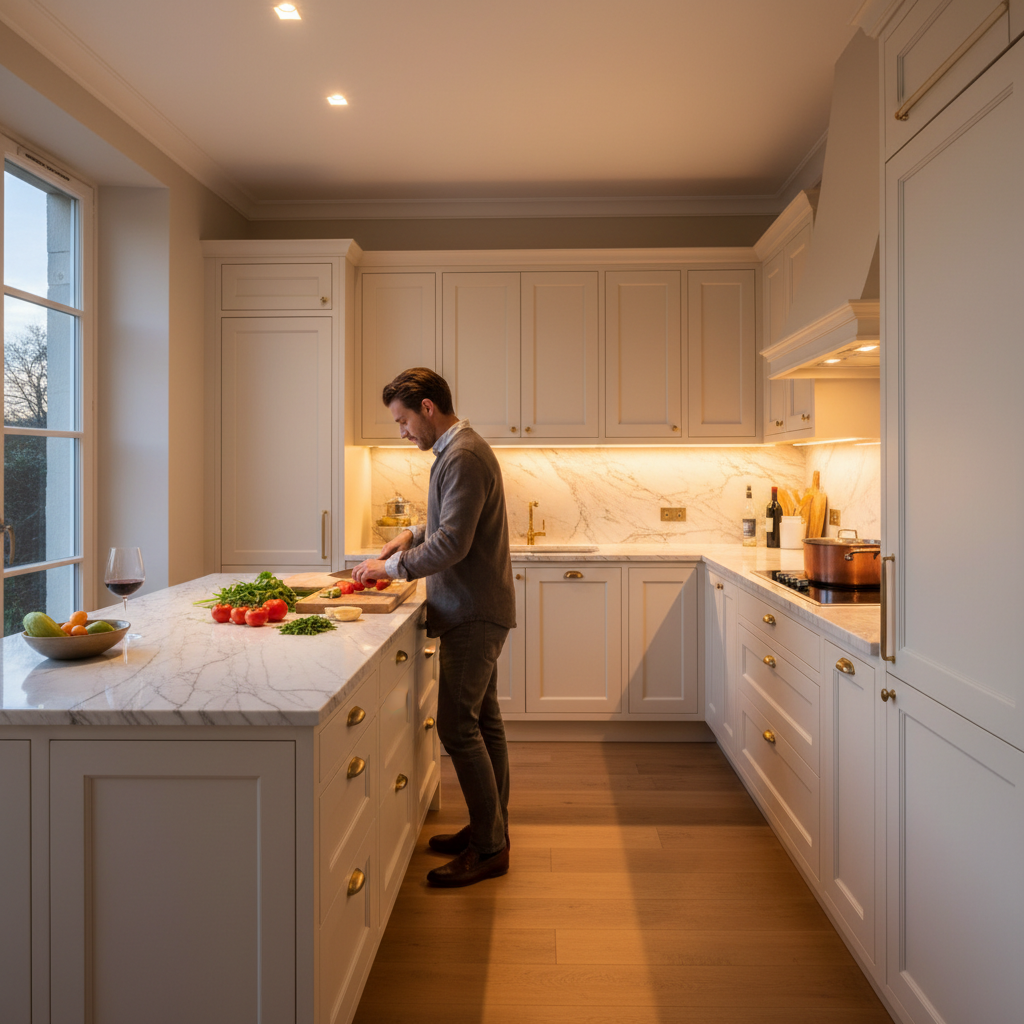
Kitchen: Task and Ambient Lighting
The kitchen concentrates the highest lighting requirements. How to choose LED strip light for this multifunctional space?
Worktop area:
- Recommended power: 300-400 lumens per linear meter
- Color temperature: 4000K for culinary precision
- Minimum CRI: 90 for faithful food rendering
- IP rating: 44 minimum, 65 near the sink
Under-cabinet lighting:
- Installation at 35-45cm from the worktop
- Uniform diffusion to eliminate shadows
- Motion detection for automatic activation
- Magnetic system for easy maintenance
The modern adhesive technology simplifies under-cabinet installation while ensuring durable hold.
Closets and Wardrobes: Intelligent Automatic Lighting
Storage spaces particularly benefit from automatic lighting. The specific criteria include:
- Instant activation: <0.5 seconds upon opening
- Uniform lighting: elimination of shadow zones
- Exceptional autonomy: occasional use optimizes battery
- Compact format: discreet integration into space
Automatic closet lighting revolutionizes daily organization by instantly revealing the contents of storage spaces.
Hallways and Circulation: Safety and Savings
Nighttime circulation lighting prioritizes safety while optimizing energy consumption:
Optimal specifications:
- Detection range: 5-8 meters for anticipation
- Modulable intensity: strong during the day, dimmed at night
- Adjustable timer: 30-120 seconds depending on passage
- Installation height: 2.2-2.5 meters for maximum coverage
The automatic hallway light improves home safety while reducing consumption by 70%.
Detection Technologies: Choosing the Right Intelligence
PIR Detection: The Technological Reference
PIR (Passive Infrared) sensors are the standard for modern automatic lighting. This technology detects body heat variations with remarkable precision:
Technical characteristics:
- Adjustable sensitivity: fine adaptation to the environment
- Detection angle: 90° to 180° depending on models
- Immunity to interference: resistance to false detections
- Standby consumption: negligible (<0.1W)
Optimization according to use:
- Kitchen: high sensitivity, 2-3 minute timer
- Hallway: maximum range, quick shutdown
- Closet: immediate detection, short lighting
- Office: moderate sensitivity, long timer
Light Sensors: Automatic Optimization
The integration of ambient light sensors distinguishes intelligent LED strip lights from basic models. This technology avoids unnecessary daytime activation:
- Programmable threshold: activation under 20-100 lux according to preference
- Energy savings: 30-50% reduction in consumption
- Visual comfort: no glare in full daylight
- Extended autonomy: battery preservation on wireless models
Hybrid Detection: Technological Excellence
Hybrid systems combine several technologies for optimal performance. This multi-sensor approach eliminates the flaws of each isolated technology:
Effective combinations:
- PIR + light: intelligent contextual activation
- PIR + microwave: elimination of blind spots
- PIR + adaptive timer: learning habits
- PIR + geolocation: activation according to home presence
Manufacturing Quality: Recognizing Excellence
Premium vs Standard Components
The quality of an LED strip light is revealed in the choice of components. This selection determines performance and durability:
Reference LED chips:
- Samsung LM301B: record efficiency 140 lm/W
- Osram Duris: proven industrial reliability
- Cree XLamp: high-temperature performance
- Nichia 757: exceptional spectral quality
Electronic drivers:
- Integrated protection circuits
- Advanced thermal management
- Dimming compatibility
- Interference filtering
Construction materials:
- Aluminum housing: optimal thermal dissipation
- Polycarbonate diffuser: UV and shock resistance
- Silicone joints: durable sealing
- Plated connectors: corrosion resistance
Certifications and Standards: Quality Guarantees
Certifications reveal the manufacturer's seriousness and guarantee compliance with European standards:
Mandatory markings:
- CE: European health-safety compliance
- RoHS: absence of hazardous substances
- WEEE: guaranteed recyclability
- Energy class: A minimum required
Voluntary quality labels:
- ENEC: certified European quality
- Energy Star: superior energy performance
- TÜV: in-depth safety tests
- UL: international safety certification
Design and Integration: Aesthetics at the Service of Function
Minimalism and Discretion
Modern design favors the discreet integration of lighting. Contemporary LED strip lights visually disappear, leaving only their luminous effect:
- Ultra-thin profile: thickness <20mm for maximum discretion
- Premium finishes: anodized aluminum, matte white, deep black
- Rounded angles: soft aesthetics, easy cleaning
- Invisible wiring: integrated or wireless connectivity
Materials and Finishes
The selection of materials influences aesthetics and durability:
| Material | Advantages | Disadvantages | Recommended Use |
|---|---|---|---|
| Anodized aluminum | Thermal dissipation, durability | Higher price | Intensive use |
| ABS plastic | Lightweight, economical | Possible yellowing | Occasional use |
| Polycarbonate | Transparency, resistance | Scratch-sensitive | Diffusers |
| Stainless steel | Hygiene, resistance | High cost | Professional kitchen |
Architectural Integration
The installation of an LED strip light must harmonize with the existing architecture. Modern solutions offer several integration approaches:
- Recessed: total integration into false ceiling or partition
- Discreet surface: apparent but sleek design fixation
- Furniture integration: incorporation into custom furniture
- Suspension: assumed decorative element
Savings and Sustainability: The Winning Equation
Return on Investment Calculation
Investing in a quality LED strip light pays off quickly. Comparative analysis over 8 years of use:
Premium LED strip light (Mouvement 3.0 type):
- Initial investment: €89-129
- Electricity consumption: €15 over 8 years
- Maintenance: €0 (5-year warranty)
- Replacement: €0 (50,000h lifespan)
- Total cost: €104-144
Basic solution with replacements:
- Investment: €25 × 3 units = €75
- Electricity consumption: €45 over 8 years
- Maintenance: €20 (breakdowns, repairs)
- Replacement: €50 (2 changes)
- Total cost: €190
The savings of €46-86 justify the quality investment, not to mention the comfort improvement and peace of mind.
Environmental Impact
LED strip lights positively contribute to the domestic energy transition:
- Consumption reduction: 75-85% vs traditional lighting
- Lifespan: 10x longer than classic bulbs
- Recyclable materials: aluminum, glass, technical plastics
- Absence of toxic substances: no mercury or gas
A family equipped with 4 LED strip lights avoids emitting 150 kg CO2/year according to ADEME, a significant contribution to climate goals.
Budget and Purchase Strategy: Optimizing Your Investment
Market Segmentation by Budget
The LED strip light market is structured around three main segments:
Economic segment (€15-40):
- Basic features without automation
- Variable quality depending on brands
- Limited warranty 1-2 years
- Suitable for occasional use
Intermediate segment (€40-80):
- Integrated motion detection
- Correct manufacturing quality
- Standard warranty 2-3 years
- Good compromise for daily use
Premium segment (€80-150):
- Advanced technologies: dual detection, connectivity
- High-end components
- Extended warranty 5 years to lifetime
- Excellence for intensive use
Optimal Purchase Strategies
To optimize your investment in LED strip lights:
Progressive approach:
- Start with the kitchen (intensive use, quick ROI)
- Extend to hallways (safety, savings)
- Finish with storage (comfort)
- Possibly integrate home automation
Favorable purchase periods:
- Black Friday/Cyber Monday: 30-50% discounts
- End of manufacturer range: -40% on outgoing models
- Back-to-school/spring: home improvement promotions
- Private sales: privileged access to new products
The Black Friday promotions allow access to premium technologies at an affordable price.
Common Mistakes to Avoid: The Traps of Choice
Trap #1: Prioritizing Only the Price
The most common mistake is selecting the cheapest LED strip light without considering quality. This apparent saving generates additional costs:
- Premature replacement within 2 years
- Degraded performance after 6 months
- Higher energy consumption
- Absence of manufacturer warranty
Investing an additional €30-50 in quality avoids these disappointments and generates long-term savings.
Trap #2: Neglecting the Autonomy of Wireless Models
Autonomy is the determining criterion for wireless LED strip lights. Insufficient autonomy turns innovation into a constraint:
- Minimum autonomy: 3 weeks in detection mode
- Recommended autonomy: 4-6 weeks for comfort
- Premium autonomy: 8+ weeks with AI optimization
The Mouvement 3.0 reaches 6 weeks thanks to its 3000mAh battery and advanced energy management.
Trap #3: Underestimating the Importance of the Warranty
The warranty duration reveals the manufacturer's confidence in its products. A short warranty often hides dubious quality:
| Warranty Duration | Quality Level | Expected Reliability | Recommendation |
|---|---|---|---|
| 1 year | Basic | Uncertain | To avoid |
| 2-3 years | Standard | Correct | Moderate use |
| 5 years | Premium | Excellent | Intensive use |
| Lifetime | Exceptional | Maximum | Safe investment |
The Lumic lifetime warranty testifies to absolute confidence in the durability of LED components.
Expert Comparison: Best LED Strip Lights 2025
Comparative Technical Analysis
Our selection of the 5 best LED strip lights 2025 based on an objective multi-criteria analysis:
1. Lumic Mouvement 3.0 - French Excellence:
- Dual motion + light detection
- Record autonomy 6 weeks
- 30-second magnetic installation
- 5-year warranty + French customer service
- Rating: 4.5/5 on 1700+ reviews
2. Philips Hue Lightstrip - Premium Connectivity:
- Complete home automation ecosystem
- 16 million colors
- Recognized Philips quality
- High price + hub required
3. Osram LinearLED - Industrial Reliability:
- Proven German technology
- Optimized energy efficiency
- Wired installation only
- Correct quality-price ratio
4. Govee LED Strip - Accessible Innovation:
- Comprehensive mobile app
- Competitive price
- Perfectible construction quality
- Distant customer service
5. Ledvance Cabinet - Professional Choice:
- Industrial design
- Exceptional lifespan
- Limited features
- Sober design
Verdict and Recommendations
For demanding domestic use, the Mouvement 3.0 stands out for its optimal balance between innovation, quality, and service. The no-drill installation, exceptional autonomy, and extended warranty make it the reference choice for 2025.
Installation and Configuration: Detailed Practical Guide
Installation Preparation
Successful installation begins with meticulous preparation. Assess your real lighting needs and plan the optimal positioning:
Preliminary analysis:
- Precisely measure the areas to be lit
- Identify obstacles and constraints
- Evaluate existing natural lighting
- Define priority activity zones
- Plan access for maintenance
Necessary tools:
- Measuring tape for precise measurements
- Spirit level for alignment
- Degreasing cloth for surface preparation
- Erasable marker for markers
Advanced Installation Techniques
Installation varies depending on the chosen mounting technology:
Magnetic installation (Mouvement 3.0):
- Clean the surface with 90° alcohol
- Position the magnetic adhesive support
- Press firmly for 30 seconds
- Wait 10 minutes for polymerization
- Magnetize the strip light with a fluid gesture
- Test stability and orientation
Classic adhesive installation:
- Thoroughly degrease the surface
- Remove the adhesive protection
- Position definitively (no second chance)
- Maintain uniform pressure for 60 seconds
- Wait 24 hours before intensive use
Configuration and Settings
Post-installation configuration optimizes performance according to your use:
Detection adjustment:
- Sensitivity: start at medium level then refine
- Range: adjust according to the size of the area
- Timer: 30s for passages, 3-5min for activities
- Light threshold: activation under 50 lux generally
Lighting parameters:
- Intensity: 100% day, 60-80% evening
- Temperature: 4000K work, 3000K ambiance
- Mode: automatic detection preferred
- Programming: schedules according to habits
Maintenance and Optimization: Preserving Your Investment
Preventive Maintenance
The maintenance of an LED strip light remains minimal but essential to preserve performance:
Monthly routine:
- Clean diffuser with microfiber cloth
- Check detection sensors
- Visual inspection of fasteners
- Test all functionalities
Quarterly maintenance:
- Thorough inspection of connections
- Complete cleaning of the housing
- Check sealing (IP65 models)
- Calibrate sensors if necessary
Annual control:
- Measure luminous performance
- Test battery autonomy (wireless)
- Check installation compliance
- Plan possible evolutions
Continuous Optimization
Modern LED strip lights allow fine adjustments to optimize the user experience:
- Seasonal adaptation: summer/winter settings according to brightness
- Evolution of needs: modification according to change of use
- Multi-zone coordination: synchronization of several strip lights
- Home automation integration: progressive centralized control
Trends and Innovations 2025-2026
Embedded Artificial Intelligence
AI transforms LED strip lights into adaptive luminous assistants. These emerging innovations revolutionize home lighting:
- Behavioral learning: automatic adaptation to habits
- Needs prediction: pre-activation according to routines
- Energy optimization: intelligent consumption management
- Predictive maintenance: preventive failure alerts
Connectivity and Ecosystems
Integration into sophisticated home automation ecosystems opens new perspectives:
- Unified protocols: Matter, Thread for interoperability
- Advanced voice control: natural contextual commands
- Multi-device synchronization: coordination lighting-heating-security
- Energy monitoring: real-time consumption analysis
Sustainability and Circular Economy
Eco-design now influences the development of LED strip lights:
- Recycled materials: valued aluminum and plastics
- Modular design: repair vs replacement
- Replaceable batteries: lifespan extension
- Take-back program: valorization of old equipment
Conclusion: Mastering the Art of Enlightened Choice
How to choose LED strip light is no longer a matter of chance but a methodical analysis of your needs and constraints. The 8 essential criteria - power, autonomy, detection, quality, design, installation, warranty, and budget - guide your decision towards the optimal solution.
The technological evolution of 2025 favors embedded intelligence and installation simplicity. Motion sensors, exceptional autonomy, and magnetic systems revolutionize the user experience. This technological convergence democratizes access to professional lighting for all French households.
Investing in a quality LED strip light transcends mere lighting improvement. It is a lifestyle choice that prioritizes daily comfort, sustainable savings, and environmental responsibility. With technologies like the Mouvement 3.0 and its lifetime warranty, LED lighting becomes a patrimonial investment that secures your luminous comfort for decades.
To discover the excellence of French LED lighting and benefit from personalized advice on your specific needs, explore the latest Lumic innovations and take the step towards truly intelligent and sustainable lighting.