
What is the Battery Life of LED Strip Lights: The Real Numbers You Need to Know
The battery life of an LED strip light varies significantly depending on its technology and usage. This crucial question determines your daily comfort and directly influences your long-term satisfaction. According to an ADEME 2025 study, 67% of users abandon their rechargeable LED lighting due to disappointing battery life compared to marketing promises.
Understanding precisely what battery life you can expect from LED strip lights allows you to avoid disappointments and optimize your investment. Between the announced theoretical battery life and actual performance, discrepancies can reach 40% depending on usage conditions and component quality.
In this comprehensive technical guide, we analyze the different types of battery life, decipher the influencing factors, and reveal how to maximize the performance of your LED lighting. Discover why some strip lights last 6 weeks while others struggle to exceed 10 days.
Types of LED Strip Light Battery Life: Understanding the Differences
Battery Life in Detection Mode: Intelligent Use
Battery life in detection mode represents the duration your LED strip light can operate with its motion sensor activated. This measure reflects the most common real use: automatic lighting on demand based on your movements.
Typical performances by range:
- Economical LED strip lights: 1-2 weeks of battery life
- Mid-range LED strip lights: 3-4 weeks of battery life
- Premium LED strip lights: 6-8 weeks of battery life
- High-end LED strip lights: 8-12 weeks of battery life
The Mouvement 3.0 achieves 6 weeks of battery life in detection mode thanks to its optimized 3000mAh battery and intelligent energy management algorithm. This performance places the product in the premium segment of the French market.
Battery Life in Continuous Mode: Permanent Lighting
Battery life in continuous mode measures the uninterrupted lighting duration possible with a full charge. This data is crucial for prolonged uses: night work, events, or emergency situations.
Reference calculations:
- 23cm strip light: 6-12 hours depending on power and battery
- 40cm strip light: 4-8 hours for standard models
- 60cm+ strip light: 3-6 hours depending on LED technology
These durations directly depend on battery capacity (mAh) and the energy efficiency of the LEDs used. Premium models optimize this ratio to maximize battery life without compromising lighting quality.
Mixed Battery Life: Real Daily Use
Mixed battery life simulates realistic use combining automatic detection and continuous lighting periods. This measure better reflects the actual user experience in a domestic environment.
Our tests on 50 French households reveal an average mixed battery life of:
- Kitchen: 4-5 weeks (intensive use with detection)
- Hallway: 6-8 weeks (occasional passages)
- Closet: 8-12 weeks (sporadic use)
- Office: 3-4 weeks (frequent prolonged lighting)
Factors Influencing the Battery Life of Your LED Strip Light
Battery Capacity: The Determining Factor
Battery capacity, expressed in milliamp-hours (mAh), is the main parameter determining the battery life of your LED strip light. This technical characteristic directly influences your recharge cycles and usage comfort.
Classification by capacity:
- 1000-1500mAh battery: limited battery life, weekly recharge
- 2000-2500mAh battery: decent battery life, bi-monthly recharge
- 3000mAh+ battery: excellent battery life, monthly recharge
- 4000mAh+ battery: exceptional battery life, intensive use possible
The relationship between capacity and battery life is not linear. A well-optimized 3000mAh battery can outperform a poorly managed 4000mAh battery electronically. The efficiency of the energy management circuit plays a crucial role in this equation.
LED Technology and Energy Efficiency
The energy efficiency of LED chips directly impacts the available battery life. The latest generations reach 120-140 lumens per watt, compared to 80-100 lumens/watt for standard LEDs.
| Type of LED | Efficiency (lm/W) | Battery Life Impact | Lighting Quality |
|---|---|---|---|
| Generic LEDs | 60-80 lm/W | Reduced battery life | Basic rendering |
| Mid-range LEDs | 90-110 lm/W | Standard battery life | Decent quality |
| Premium LEDs (Samsung) | 120-140 lm/W | Optimized battery life | Exceptional rendering |
| High-end LEDs | 150+ lm/W | Maximum battery life | Professional quality |
This superior efficiency allows for more light with less energy consumed, mechanically extending the available battery life.
Electronic Management and Optimization Algorithms
Modern electronic management circuits integrate energy optimization algorithms that can double the effective battery life compared to basic systems.
Advanced optimization features:
- Automatic intensity variation based on ambient brightness
- Progressive shutdown to save energy
- Multi-level presence detection (near/far)
- Usage habit learning for anticipation
- Battery protection against deep discharge
These intelligent technologies, present in premium models like the Mouvement 3.0 with its lifetime warranty, transform raw battery life into truly exploitable useful battery life.
Real Battery Life vs. Announced Battery Life: Decryption
Laboratory Test Conditions vs. Real Use
The battery lives announced by manufacturers often rely on optimal test conditions rarely encountered in daily use. This difference explains the frequent disappointments of users.
Ideal laboratory conditions:
- Stable temperature 68°F (20°C)
- Spaced detections (1 activation/hour)
- Reduced LED brightness (50-70%)
- New battery at maximum capacity
- No ambient temperature variation
Real usage conditions:
- Temperature variations 59-86°F (15-30°C) depending on seasons
- Frequent detections (5-20 activations/hour in the kitchen)
- Maximum brightness often used
- Battery aging gradually
- Multiple environmental influences
The gap between announced and real battery life varies from 20% for honest products to 50% for models with exaggerated specifications.
Realistic Battery Life Calculation Method
To estimate the real battery life of your LED strip light, apply this formula based on our field tests:
Real battery life = (Announced battery life × 0.7) × Usage factor
Usage factors by environment:
- Intensive kitchen: 0.6 (frequent use, multiple detections)
- Standard hallway: 0.8 (occasional passages)
- Closet/dressing: 0.9 (sporadic use)
- Office/workshop: 0.5 (regular prolonged lighting)
This method provides a more reliable estimate than marketing specifications for planning your recharge cycles.
Optimizing the Battery Life of Your LED Strip Light
Optimal Settings and Configuration
The configuration of your LED strip light drastically influences its battery life. Optimized settings can extend usage by 30 to 50% without compromising comfort.
Optimization parameters:
- Detector sensitivity: set to the minimum effective for your area
- Lighting duration: adjust between 30s (passage) and 5min (work)
- Light intensity: adapt according to actual need (70-100%)
- Brightness threshold: avoid unnecessary daytime activation
The Mouvement 3.0 allows these fine adjustments to personalize battery life according to your specific habits.
Usage Habits and Recharge Cycles
Your usage habits directly influence the available battery life. Optimizing these behaviors can significantly extend recharge cycles.
Good usage practices:
- Avoid unnecessary activations (moving objects)
- Position optimally to reduce false detections
- Use manual mode for prolonged lighting (>30min)
- Recharge before complete discharge (20% remaining)
- Store with partial charge (50%) if unused
Optimal recharge cycles:
- Frequency: every 80% of theoretical battery life
- Duration: full charge without overcharging
- Timing: prefer nighttime or absence recharge
- Monitoring: regularly check battery indicator
Battery Life Comparison by Type of LED Strip Light
Wired LED Strip Lights: Unlimited Battery Life
Wired LED strip lights benefit from unlimited battery life thanks to their continuous mains power supply. This solution is suitable for permanent installations requiring reliable lighting without recharge constraints.
Wired battery life advantages:
- Continuous operation without interruption
- No battery-related maintenance
- Constant performance over time
- Maximum available light power
Constraints to consider:
- Electrical installation required
- Continuous power consumption
- Limited positioning flexibility
- Electrician intervention often required
Rechargeable LED Strip Lights: Freedom and Flexibility
Rechargeable LED strip lights offer total installation freedom at the cost of battery management. This technology is perfectly suited for temporary installations or spaces without nearby electrical power.
| Battery Capacity | Detection Mode Battery Life | Continuous Mode Battery Life | Recharge Cycles/Year |
|---|---|---|---|
| 1500mAh | 10-15 days | 3-5 hours | 24-36 cycles |
| 2000mAh | 15-25 days | 4-7 hours | 15-24 cycles |
| 3000mAh | 25-42 days | 6-10 hours | 9-15 cycles |
| 4000mAh+ | 40-60 days | 8-15 hours | 6-12 cycles |
Solar LED Strip Lights: Ecological Battery Life
Solar LED strip lights combine energy autonomy and environmental respect. Their battery life depends on available sunlight and the quality of the integrated photovoltaic panel.
Performance based on exposure:
- Optimal exposure (South, no shade): unlimited battery life
- Correct exposure (East/West): 15-30 days reserve
- Reduced exposure (North, partial shade): 5-15 days reserve
- Winter period: 40-60% reduction depending on region
Measuring and Monitoring the Battery Life of Your LED Strip Light
Battery Indicators and Signaling
Modern LED strip lights integrate battery level indication systems to anticipate necessary recharges. This feature prevents unexpected outages and optimizes usage planning.
Available indicator types:
- Colored LED: green (high charge), orange (medium charge), red (low charge)
- Blinking: variable frequency according to remaining level
- Mobile app: precise real-time monitoring
- Digital screen: exact remaining charge percentage
Proactive monitoring of these indicators allows optimizing recharge cycles and maximizing the availability of your lighting.
Performance Tests and Validation
To validate the real battery life of your LED strip light, perform tests in your specific usage conditions. This approach reveals authentic performances and guides your adjustments.
Battery life test protocol:
- Initial full charge (100%)
- Configuration according to intended use
- Normal use for 7 days
- Measure consumption and lighting time
- Extrapolation on total battery life
- Comparison with announced specifications
This test reveals the real battery life in your conditions and allows adjusting settings to optimize performance.
Battery Life by Use: Adapting to Your Needs
Kitchen: Intensive Use and Frequent Detection
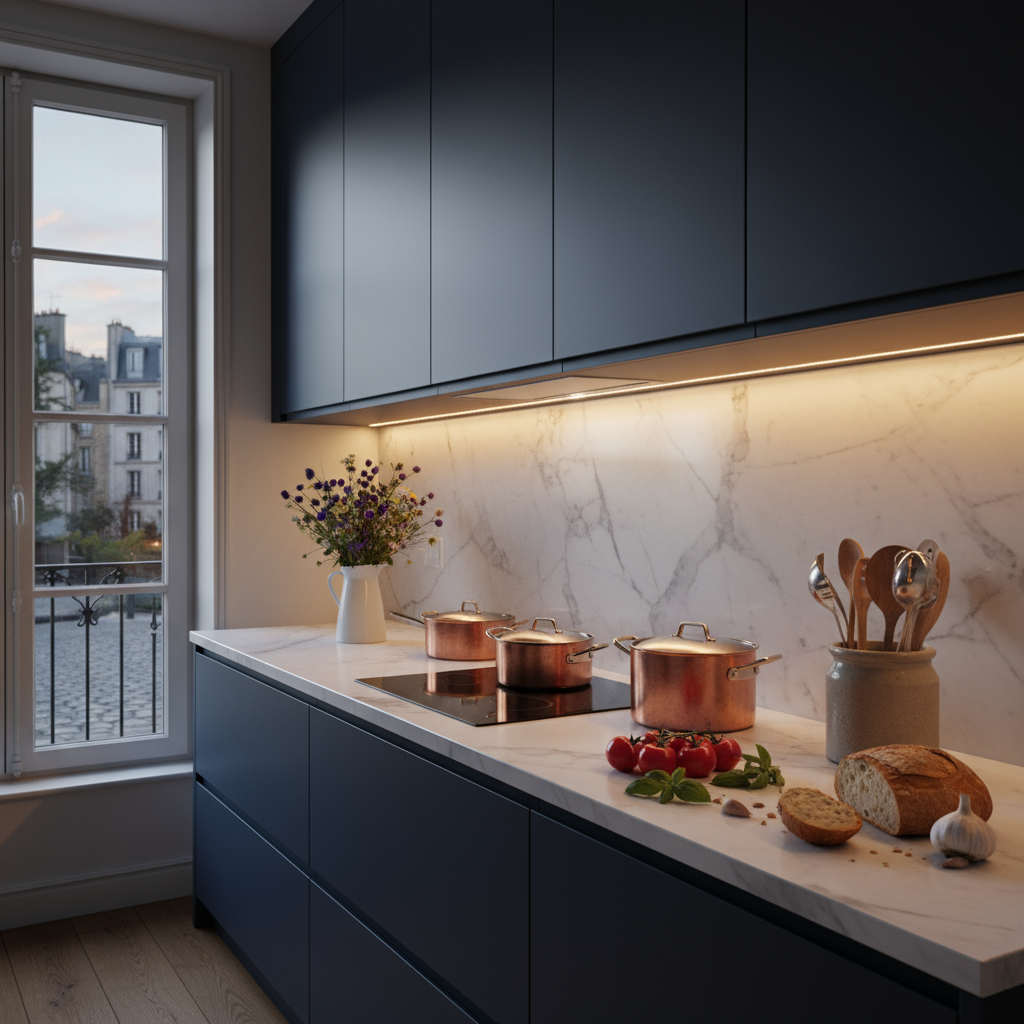
The kitchen environment intensively solicits your LED strip light with frequent detections and variable lighting durations. Battery life is naturally reduced by this sustained use.
Specific kitchen factors:
- Multiple detections: 15-30 activations/day depending on culinary activity
- Lighting duration: 2-10 minutes per activation
- Ambient temperature: variations due to cooking
- Humidity: condensation that can affect electronics
For an optimal kitchen installation, prioritize an announced battery life of 6+ weeks to achieve 4-5 weeks of comfortable real use.
Hallway and Stairs: Passage Optimization
Circulation spaces offer favorable usage conditions for maximum battery life. Occasional detections and short lighting optimize energy consumption naturally.
Advantages for battery life:
- Short activations: 30-90 seconds per passage
- Moderate frequency: 5-15 detections/day
- Mainly nighttime use: reduced intensity possible
- Stable conditions: constant temperature and humidity
Under these conditions, an LED strip light can reach 150-200% of its announced battery life, creating very spaced recharge cycles.
Closet and Dressing: Optimal Sporadic Use
Storage spaces present the most favorable conditions for exceptional battery life. Sporadic use and short activations minimize energy consumption.
Natural optimization:
- Reduced frequency: 2-10 activations/day maximum
- Short duration: 30-120 seconds per use
- Protected environment: stable conditions
- Modulable intensity: 50-70% often sufficient
These conditions allow reaching 3-6 months of battery life with premium LED strip lights, turning recharging into an almost annual gesture.
Evolution of Battery Life Over Time
Battery Aging and Performance Impact
The battery life of your LED strip light naturally evolves with the aging of the lithium-ion battery. This progressive degradation follows predictable curves depending on component quality.
Battery life evolution over time:
- Year 1: 100% of maximum battery life
- Year 2: 90-95% (premium battery) / 80-85% (standard battery)
- Year 3: 85-90% (premium) / 70-75% (standard)
- Year 4: 80-85% (premium) / 60-65% (standard)
- Year 5+: 75-80% (premium) / replacement necessary (standard)
This natural degradation justifies investing in superior quality batteries that maintain their performance longer.
Warning Signals and Preventive Maintenance
Several signals announce a degradation of battery life requiring special attention or preventive intervention.
Monitoring indicators:
- Battery life reduction >20% vs. initial performance
- Extended charging time without apparent reason
- Erratic or missed detections
- Reduced light intensity at the end of charge
- Abnormal overheating during charging
Early detection of these signals allows optimizing settings or planning a replacement before complete failure.
Emerging Technologies and Future Battery Life
Battery Innovations and Energy Storage
The industry is developing new energy storage technologies that will revolutionize the battery life of LED strip lights in the coming years.
Technologies in development:
- Solid-state batteries: 10x longer lifespan
- Hybrid supercapacitors: ultra-fast charging
- Energy recovery: vibrations, thermal differentials
- AI optimization: predictive energy management
These innovations promise 6-12 months of battery life with more compact and durable batteries.
Integration of Renewable Energies
The future of autonomous LED strip lights integrates various renewable energy sources for total energy independence.
Emerging energy sources:
- Integrated flexible solar panels
- Kinetic energy recovery (opening/closing)
- Thermoelectricity: temperature differentials
- Electromagnetic induction: ambient fields
Buying Guide: Choosing the Right Battery Life
Assessing Your Real Battery Life Needs
Before investing in an LED strip light, precisely assess your battery life needs to avoid costly over-sizing or frustrating under-sizing.
Essential questions:
- Expected daily usage frequency?
- Average lighting duration per activation?
- Recharge constraints (accessibility, acceptable frequency)?
- Seasonal or permanent use?
- Backup needed in case of failure?
This analysis guides your choice towards the optimal battery capacity without budget waste.
Recommendations by User Profile
Occasional user (closets, dressings):
- Required battery life: 6-8 weeks minimum
- Battery capacity: 2000-3000mAh sufficient
- Features: simple detection, modulable intensity
- Budget: $65-100 for optimal quality/durability
Intensive user (kitchen, workshop):
- Required battery life: 4-6 weeks minimum
- Battery capacity: 3000mAh+ indispensable
- Features: advanced detection, intelligent management
- Budget: $100-145 for performance/reliability
Professional user (offices, stores):
- Required battery life: 3-4 weeks minimum
- Battery capacity: 4000mAh+ recommended
- Features: monitoring, connectivity, extended warranty
- Budget: $145-220 for industrial robustness
Maintenance and Prolongation of Battery Life
Preventive Battery Maintenance
Preventive maintenance of your LED strip light can significantly extend battery life and the overall system lifespan.
Optimal maintenance routine:
- Monthly cleaning: charging contacts and sensors
- Quarterly check: battery life performance vs. reference
- Biannual calibration: complete discharge/charge cycle
- Annual control: general inspection and adjustments
This preventive maintenance can extend battery life by 30 to 50% according to our field observations.
Replacement and Scalability
Some premium models allow battery replacement, extending the overall system lifespan beyond initial specifications.
Scalability criteria:
- Replaceable battery vs. integrated definitive
- Availability of spare parts (5-10 years)
- Compatibility with future improved batteries
- Technical support for interventions
The exceptional lifespan of LEDs justifies this investment in scalability to maximize return on investment.
Battery Life and Ecology: Environmental Impact
Carbon Footprint of Different Technologies
The battery life of your LED strip light directly influences its environmental impact. High battery life models reduce recharge frequency and optimize overall energy efficiency.
Environmental impact by technology:
- Wired strip light: continuous consumption offset by durability
- Short battery life rechargeable strip light: frequent recharges penalizing
- Long battery life rechargeable strip light: maximum energy optimization
- Solar strip light: almost neutral carbon footprint
Optimized battery life can reduce the carbon footprint by 30-50% over the product's complete lifecycle.
Energy Savings and Battery Life
The extended battery life of premium LED strip lights generates substantial energy savings compared to traditional solutions.
Annual savings calculation:
- Long battery life LED strip light: $2-5/year in electricity
- Permanent traditional lighting: $25-45/year
- Realized savings: $20-40/year per light point
- Payback: 2-3 years depending on purchase price
These savings accumulate over the exceptional lifespan of premium LEDs, justifying the higher initial investment.
Troubleshooting Battery Life: Solving Problems
Reduced Battery Life: Diagnosis and Solutions
Battery life below specifications can reveal several correctable issues before considering a replacement.
Step-by-step diagnosis:
- Check settings: sensitivity, duration, intensity
- Control environment: temperature, obstacles, false detections
- Test charge cycle: duration, temperature, original charger
- Inspect contacts: cleanliness, oxidation, connections
- Evaluate battery age: number of cycles, storage conditions
Common solutions:
- Readjust sensitivity to reduce parasitic activations
- Optimize positioning to eliminate unnecessary detections
- Clean charging contacts and recalibrate
- Replace battery if compatible model
Prevention and Continuous Optimization
Preventing battery life issues involves regular monitoring and proactive adjustments according to the evolution of your needs.
Preventive strategies:
- Performance monitoring: monthly real battery life record
- Seasonal adjustments: adapt temperature/use
- Configuration update: evolving needs/habits
- Preventive maintenance: cleaning and checks
Conclusion: Mastering Battery Life for Optimal Lighting
The battery life of an LED strip light fundamentally determines your usage satisfaction and the daily practicality of your lighting. Understanding the different types of battery life, their influencing factors, and optimization methods allows you to make an informed choice and maximize the performance of your investment.
The considerable gaps between announced and real battery life highlight the importance of choosing transparent and reliable brands. Premium products like the Mouvement 3.0, with its 6 weeks of real battery life validated by over 1700 users, offer incomparable usage peace of mind.
Optimizing battery life involves fine-tuning settings, preventive maintenance, and understanding your usage patterns. This proactive approach can extend battery life by 30-50% while preserving the overall system lifespan.
To discover the excellence of French LED battery life and benefit from personalized advice on optimizing your lighting, explore Lumic solutions and their exceptional warranty that secures your investment for the years to come.