You come home, arms full of groceries. The garage is dark. You fumble for the light switch, brush against the wall, and knock something over. Almost everyone has experienced this scenario. Yet, good garage LED lighting solves this problem in minutes — or a few hours, depending on how you plan to use the space.
Because "the garage" covers many different realities: a 130 sq ft (12 m²) condo parking spot, a workshop where you spend hours, a storage area visited once a week, or simply a covered hallway. The ideal lighting isn't the same for each case.
This guide helps you choose the right solution — wired or rechargeable, spots or strip lights, motion sensor or switch — based on how you actually use your garage.
Why Garage Lighting Deserves Real Thought
The garage is often the most poorly lit room in the house, yet one of the most used. It's not just about comfort: a poorly lit garage is a real risk. You miss a step, can't find the tool you're looking for, slip with a saw, or hit your car's rearview mirror.
What are the most common lighting problems in garages?
Most standard garages have one or two bulbs screwed into the ceiling, often old halogens or fluorescents. These solutions have two major flaws: they create significant dark spots (corners, under workbenches, back of shelves) and consume a lot of energy for disappointing results.
Basement or north-facing garages also suffer from a complete lack of natural light. Artificial garage lighting then becomes the sole source, and its output must be sufficient to fully compensate.
Another classic problem: the switch is poorly placed, sometimes inside the garage when you enter with your hands full. A motion sensor solves this immediately — more on that below.
Do you need to rewire your garage to improve lighting?
No. Many garages already have functional, even basic, electrical installations. In this case, adding a wired garage strip light is often the most economical long-term solution. But if your garage lacks an accessible outlet or you want to avoid any electrical work, rechargeable LEDs are a serious alternative — with limitations to be aware of.
The 4 Types of Garage Use and Their Adapted Lighting
Before choosing a product, determine your primary use. This dictates everything else: the necessary light output, mounting type, and power source.
Simple Parking: You Park, You Leave
For a garage used only for parking a car, lighting needs are modest. You need to see where you're stepping, avoid obstacles, and find items stored on shelves. Two LED strip lights are usually enough for a 160-215 sq ft (15-20 m²) garage.
In this context, a motion sensor is particularly useful. You don't have to search for the switch: you enter, it lights up. You leave, it turns off after a few seconds. No risk of leaving the light on all night without realizing it.
For this type of use, a rechargeable LED strip light with motion sensor like the LED strip light with motion sensor can suffice if your visits are occasional and brief. For a garage with electricity, a wired strip light with an integrated sensor remains the most reliable long-term solution.
Workshop: You Work for Hours Under the Light
Here, the scale changes completely. If you use your garage as a workshop — woodworking, mechanics, painting, welding — you need significant, homogeneous light output, without shadows on the workbench.
For this intensive use, a wired solution is essential. Several reasons for this:
- Even a high-performance rechargeable battery isn't designed for 4-8 hours of continuous daily use.
- You need a constant, unwavering light output. Some rechargeable LEDs dim slightly when the battery is low.
- Wired power allows for much higher light outputs.
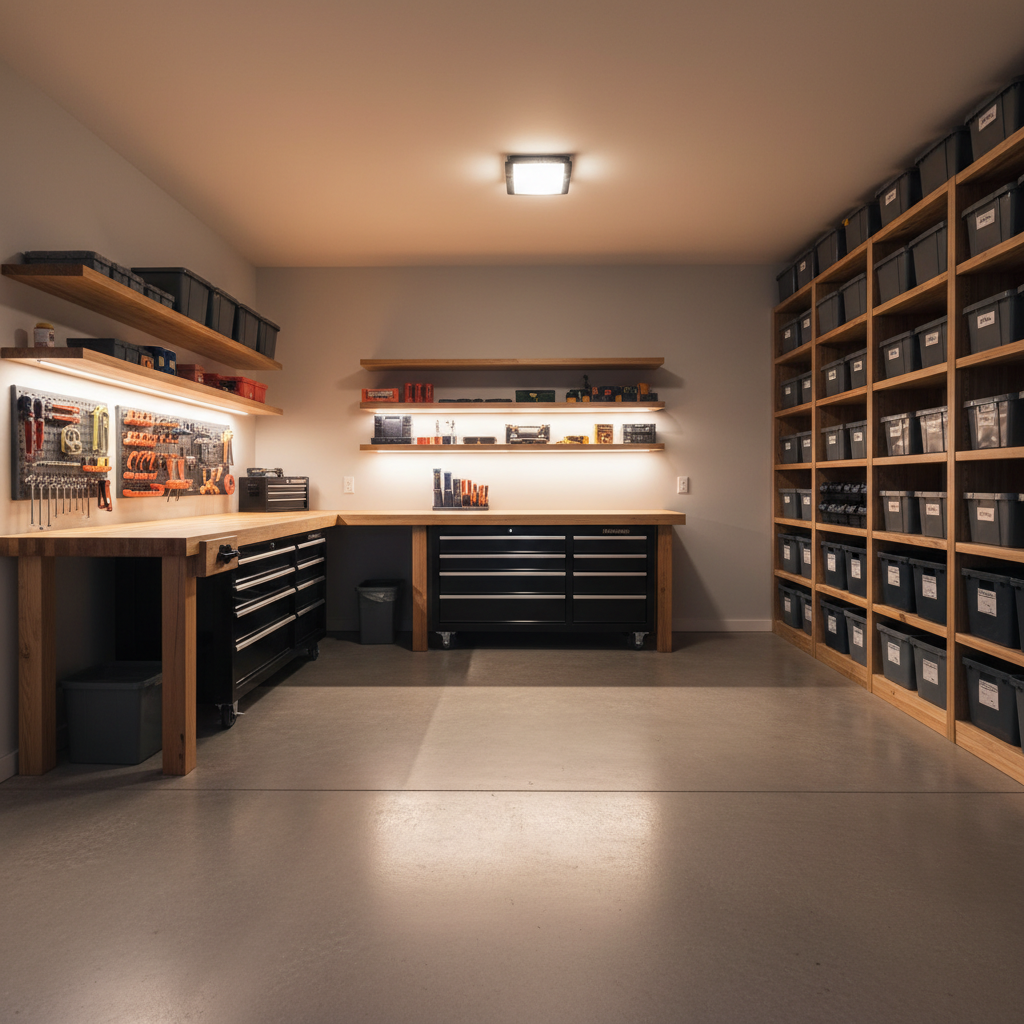
For a serious workshop, think in terms of zones: general overhead lighting (suspended or recessed wired strip lights), and precision lighting above the workbench. The LED strip light for workshop lighting must be positioned to eliminate cast shadows when you work standing at your workbench. If your garage doesn't have electricity yet, consult our guide on lighting a garage without an electrical outlet before proceeding.
Storage: You Occasionally Look for Items
A storage garage is used infrequently, but when you need it, you want to find things quickly. The need is different: not necessarily intense overall light, but targeted lighting on storage areas.
Rechargeable LED strip lights placed directly on shelves or cabinets are very effective here. You light up exactly where you're looking, not the entire room. Motion detection mode is ideal: you open the cabinet or pass by the shelf, and the light turns on.
In terms of consumption, occasional use favors rechargeable solutions. A battery recharged once a month is more than enough if you enter the garage for ten minutes a week.
Passageway and Entrance: The Most Neglected Area
This is where the fumbling for the switch problem is most acute. A garage entrance — whether you come in from inside the house or through the main door — is a transit area where hands are rarely free.
A motion sensor is the most obvious answer here. Lumic's Movement 3.0 is particularly suited for this use case: instant magnetic, no-drill installation, motion sensor + ambient light sensor (the light doesn't turn on in broad daylight), and a 3000 mAh battery — three times larger than low-end competitors — providing up to 4 weeks of autonomy in detection mode for the 9-inch (23 cm) model. You enter, it lights up. No more fumbling around.
Wired or Rechargeable: How to Choose Honestly
This is the question everyone asks, and the answer truly depends on your use. Here's a comparative table to clarify:
| Criterion | Wired Strip Light | Rechargeable Strip Light |
|---|---|---|
| Installation | Requires an outlet or electrical work | Magnetic or adhesive, less than 1 minute |
| Intensive Use (4+ hours/day) | Ideal, no limits | Not recommended |
| Occasional Use | Overconsumption if forgotten | Perfect, sensor cuts off automatically |
| Battery Life | Unlimited (grid power) | 4 to 6 weeks in detection mode |
| Light Output | Very high possible | 150 to 320 lumens depending on model |
| Installation Cost | $150 to $300 if electrician needed | Zero (DIY installation) |
| Ideal For | Workshop, long daily use | Passageways, storage, areas without outlets |
The honest conclusion: if your garage already has electricity and you use it intensively, wired is logical. If you want to add an extra light source quickly, secure an entrance, or light a storage area without modifying the existing installation, rechargeable is a very serious solution.
When Rechargeable Isn't Enough
Let's be clear: if you spend more than 5 hours a week tinkering in your garage, a rechargeable strip light won't be sufficient as your primary lighting. The battery might last, but the 150-320 lumens output remains modest compared to a high-power wired strip light. Use it as a supplement, not as the sole source.
When Rechargeable is the Best Option
For a garage without an accessible outlet, for a renter who doesn't want to drill or do renovations, or to add quick accent lighting: the rechargeable strip light is the way to go. You can also use it during your electrical work, then move it elsewhere in the house afterward. It's a light that travels with you. To explore all alternatives, consult our article on garage lighting solutions without electricity.
Strip Lights, Spots, Fluorescents, Floodlights: Which Form to Choose?
The garage LED lighting market offers several formats. Each has its advantages depending on the space and use.
LED Strip Lights for Garages
The strip light is the most versatile format. Long and thin, it diffuses light along its entire length, which limits cast shadows under a workbench or on a work surface. It's easily mounted on the ceiling or under a cabinet. This is the most common and recommended solution for workshop lighting or parking.
To choose the right strip light for your needs, you can refer to our dedicated article on how to choose an LED strip light.
LED Spots and Floodlights
Adjustable spots are interesting for targeting a specific area: the workbench, sorting area, or garage entrance. An LED floodlight is more suitable for a large space or a workshop garage over 270 sq ft (25 m²) where high overall light output is needed. They generally consume more than a strip light and require wired installation.
LED Fluorescent Tubes (T8 LED Tubes)
LED tubes replacing fluorescent lights are an economical option if your garage is already equipped with fluorescent fixtures. You swap old tubes for compatible LED tubes, sometimes without changing the ballast. The light output is homogeneous, and the lifespan is long. It's a simple and inexpensive renovation solution.
Color Temperature: Warm White, Neutral, or Cool White?
The color temperature of your garage LED directly influences your comfort and visual precision. It's not just an aesthetic matter.
Cool White (6000K) for Workshop and Precision
Cool white mimics natural daylight. It improves concentration and the perception of details, colors, and contrasts. This is the recommended choice for a workshop, sorting area, or any use where you need to see precisely — distinguishing wire colors, reading measurements, evaluating a painted surface.
Neutral White (4000K) for Versatile Use
Neutral white at 4000K is a good compromise. It's neither too yellow nor too cool. Ideal if your garage serves as both parking and a small workshop. It's less fatiguing on the eyes than cool white during prolonged use.
Warm White (3000K) for a Passageway
Warm white is softer, more familiar. In a garage entrance or service hallway, it creates a less harsh ambiance. Less recommended for precision work, but very suitable for a passageway or an area where you store items without working.
The Movement 3.0 offers all three temperatures to choose from — a real advantage for adapting the light to the precise location in your garage.
The True Cost of Good Garage Lighting
An often-overlooked point: the total cost of lighting isn't just the purchase price. The electrical consumption of an LED strip light and its lifespan are factors. You can consult our article on LED strip light energy consumption to calculate what you'll actually pay over several years.
The Real Cost of a Wired Installation in a Garage
If your garage doesn't have an electrical outlet where you need it, hiring an electrician typically costs between $150 and $300, depending on the complexity of the installation and your region. This investment is justified if you use the space intensively — workshop, daily garage. For occasional use or to test a setup, paying this price for a single strip light is debatable.
Rechargeable Lighting Has Zero Installation Cost
A rechargeable LED strip light with magnetic or adhesive mounting can be installed yourself in less than a minute, without an electrician or drilling. The cost is only for the product. For a storage garage or to secure an entrance, it's a very reasonable expense compared to an electrical installation. And if you move, you take it with you.
Lifespan: An Underestimated Criterion
A well-designed LED lasts a very long time. But quality differences between entry-level products and products with a serious warranty are real. To understand what impacts the lifespan of LED strip lights, a dedicated article explains the key factors — operating temperature, driver quality, frequency of use.
Practical Installation: What You Need to Know Before Starting
Whether you opt for wired or rechargeable, a few practical tips prevent unpleasant surprises.
Where to Position Strip Lights in a Garage?
The basic rule: avoid lighting only from the center of the ceiling. A single central light source creates cast shadows on the sides and under shelves. Prefer two or three sources distributed along the length of the garage. For a workbench, place the strip light in front of the work surface (facing you), not behind you, otherwise you'll be working in your own shadow.
How to Install an LED Strip Light Without Drilling in a Garage?
Industrial adhesive mounting is the solution. It holds on most smooth surfaces: painted metal, varnished wood, coated concrete. Be careful with crumbly surfaces (cracked plaster, untreated concrete) where the adhesive may not hold properly. For these cases, magnetic mounting — possible on metal — is often more reliable. The Movement 3.0 offers both options: adhesive backing and magnetic mounting.
What to Check Before Mounting a Rechargeable Strip Light to a Garage Ceiling?
Three points to validate: the surface is clean and dry (degrease with isopropyl alcohol), the ambient temperature is compatible with the adhesive (avoid extreme cold for initial application), and the weight of the strip light is compatible with the surface. A thin aluminum strip light weighs only a few ounces, which generally poses no problem for industrial-grade adhesive. For paneled or raw wood ceilings, magnetic is more suitable if a metal plate can be screwed in.
Summary: Which LED Lighting for Your Garage Based on Your Use?
You don't need to read this entire guide to choose. Here's the essential in a few lines:
- Simple Parking or Condo Garage: 1 to 2 LED strip lights, wired if electricity is available, or rechargeable with a sensor if installation is difficult.
- Intensive Workshop: Wired solutions are mandatory, multiple distributed strip lights, cool or neutral white, powerful output. Rechargeable can supplement a specific work point.
- Storage Garage: Rechargeable strip lights with sensors on shelf areas. Occasional use, battery life is more than sufficient.
- Passageway and Entrance: Motion sensor is imperative. The Movement 3.0 is sized exactly for this case — you enter with your hands full, it lights up, you don't have to touch anything.
Garage LED lighting isn't a complex purchase if you start with your actual use. The right tool for the right zone. And if you want to go further on rechargeable options, our article on rechargeable LED lighting explains what you can truly expect long-term.