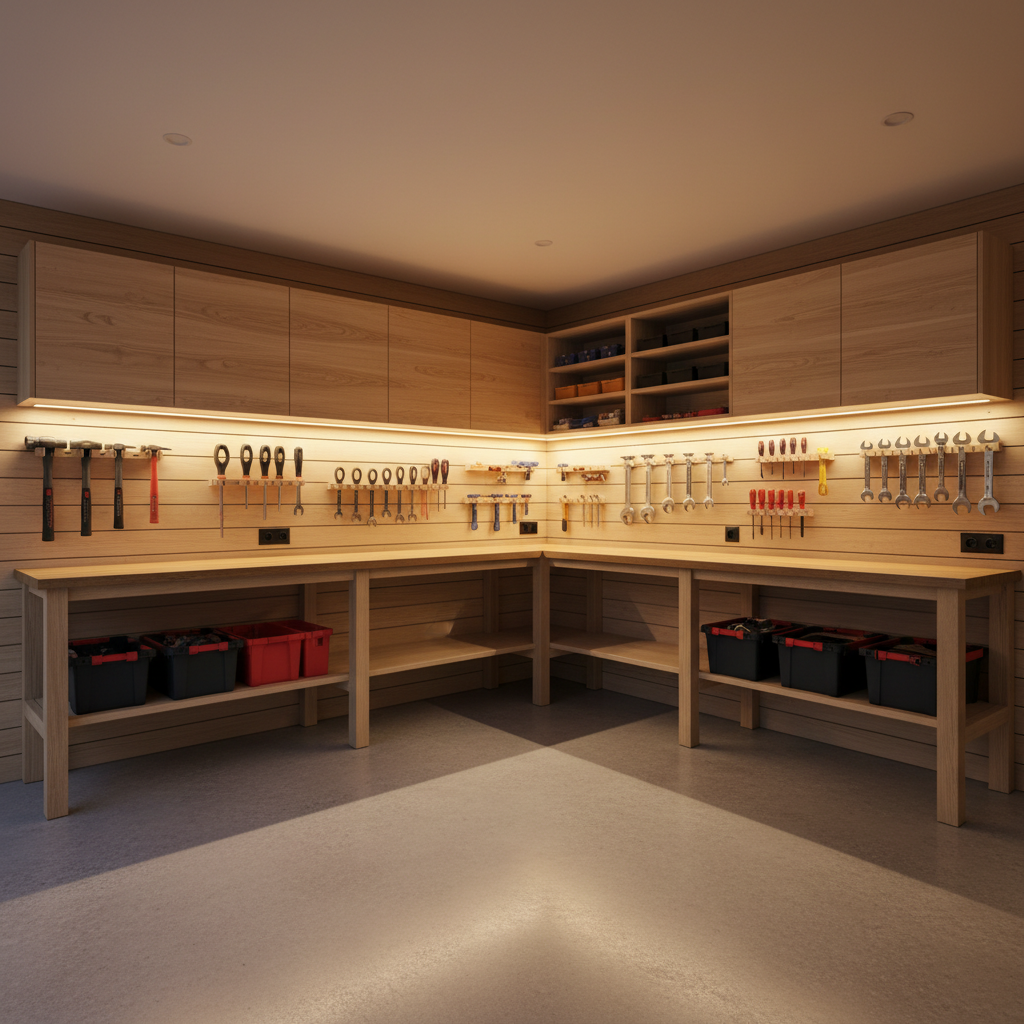
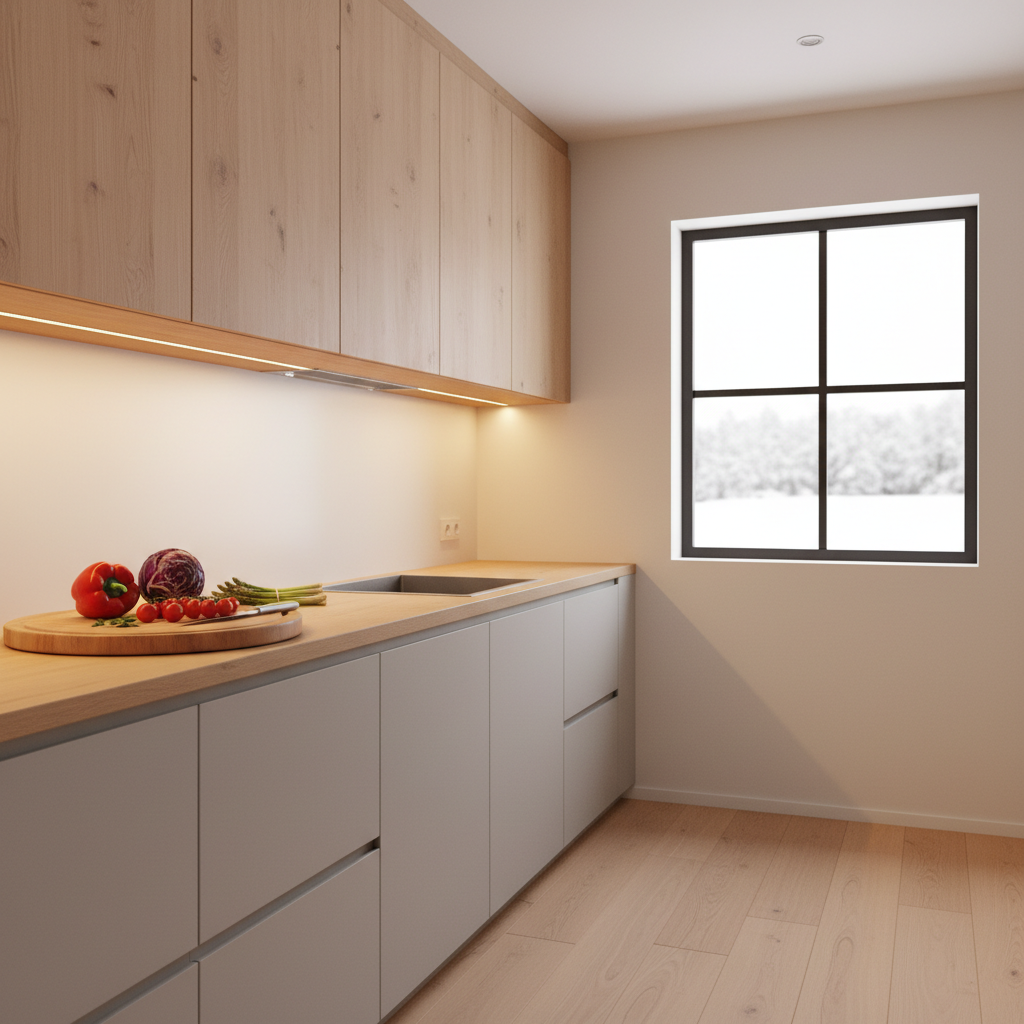
The real question isn't technical; it's visual.
Ever been in a dimly lit restaurant, golden light, struggling to tell if your steak was medium-rare? Or, conversely, in an ultra-bright kitchen, stark white light, cooking efficiently but with no desire to linger?
That's exactly what your LED's color temperature does. It's not a technical detail—it's a decision that fundamentally changes how you see, feel, and use your kitchen.
Good news: it's simpler than you think. We'll review the three main families—warm white, neutral white, cool white—with a mental image for each. By the end, you'll know exactly what to choose for your needs.
If you're also looking to revamp your entire lighting project, check out our guide on modern and efficient kitchen lighting—it will give you an overview before you start.
Warm White: Ambiance, Yes; Precision, No
Warm white is like candlelight or an old incandescent bulb. A golden, slightly orange hue, very enveloping. Pleasant to look at, flattering for faces, perfect for relaxing.
What is it good for?
In the kitchen, warm white creates a welcoming atmosphere. It's the perfect lighting for a dinner with friends, for appetizers on the countertop, for that evening hour when you just want to set the mood without feeling like you're in an open-plan office.
Many open-plan kitchens use it as primary lighting to avoid a stark contrast with the living area.
Why isn't it enough for cooking?
Here's the practical problem: with warm light, food colors get distorted. Your chicken might look pinker than it is, your vegetables' green becomes dull, and that meat you're watching... you're not really sure what you're seeing.
It's not dangerous, but it's imprecise. And when you're cutting, peeling, or checking doneness, visual imprecision is a real hindrance.
Warm white = perfect for ambiance, insufficient for cooking.
Neutral White: The Best Compromise for the Kitchen
Neutral white is like the light on a beautiful overcast morning. Neither warm nor cool. Clear, clean, without distorting colors. This is where you see things as they truly are.
Why is it the ideal choice for a countertop?
On a kitchen countertop, you need to see precisely: the color of meat, the ripeness of fruit, if your vegetables are clean, if your cuts are neat. Neutral white gives you exactly that—without eye strain.
Unlike cool white (we'll discuss that next), it doesn't create a sterile or stressful surgical ambiance. You can cook for an hour without feeling like you're in a warehouse.
This temperature also best suits kitchens with dominant white or light wood tones, without yellowing or over-whitening them.
Does it fit all kitchen styles?
Yes, and that's its strength. Modern kitchens with neutral tones, country kitchens, basic IKEA kitchens, or custom kitchens—neutral white adapts without ever looking out of place. It doesn't create a specific ambiance, but it doesn't detract from any ambiance either.
For kitchen countertop lighting, this is always our primary recommendation.
Neutral white = functional lighting, true colors, neutral and pleasant ambiance. The main choice for cooking.
Cool White: Maximum Precision, Zero Ambiance
Cool white is like the light in an office hallway, a classroom, or a hospital. Very bright, slightly bluish, uncompromising.
Is it really that bad in the kitchen?
Not bad—just very specific. If you have a precise task: fine slicing, reading small print recipes, checking surface cleanliness, cool white is excellent. You really see everything.
The problem is, nobody wants to spend an evening in hospital lighting. Even if you cook well, you won't enjoy the moment. And if your kitchen is open to the living room, this light will clearly disrupt any ambiance.
Who actually uses it?
In professional kitchens or some workshops, yes. In a standard family kitchen, it's rare—and often regretted afterward. The most common feedback we hear: "I chose cool, I thought it was clean, but now I feel like I'm in an office."
Cool white = maximum precision, non-existent ambiance. Reserve for occasional tasks.
Comparison Table: Warm, Neutral, or Cool White for Your Kitchen
| Criterion | Warm White (~3000K) | Neutral White (~4000K) | Cool White (~6000K) |
|---|---|---|---|
| Ambiance | Warm, cozy | Neutral and pleasant | Cold, clinical |
| Color Fidelity | Slightly distorts | Very faithful | Faithful but bluish |
| Ideal for Cooking | No | Yes | Acceptable |
| Ideal for Appetizers/Dinner | Yes | Correct | No |
| Open Kitchen to Living Room | Very good | Good | Not recommended |
| Precision Tasks | No | Yes | Yes |
Which Color Temperature to Choose Based on Your Kitchen Use?
The real answer depends on how you use your kitchen. Here are some concrete scenarios to help you decide.
Your kitchen is primarily a workspace.
You cook often, prepare full meals, and need to see what you're doing. Neutral white is your choice. You can supplement with warm light from the ceiling for ambiance, reserving neutral for the countertop.
This is often the most common approach in well-designed kitchens: two types of lighting with different roles. For more on this, our guide on wireless countertop lighting details how to combine light sources.
Your kitchen is open and part of the living room.
Here, ambiance matters as much as functionality. Warm white for general lighting, with neutral white under upper cabinets or on the countertop: that's the winning duo. You maintain the warmth of the living room while having the necessary clarity for cooking.
You cook little and just want good visibility.
If you rarely open your cabinets and don't spend long hours in the kitchen, neutral white remains the good default choice. Simple, effective, no regrets possible.
You want a candlelight ambiance for your evenings.
Warm white on the countertop, why not—but be prepared to squint when chopping vegetables in the evening. If ambiance is your priority, use warm white for ceiling spotlights and keep a clearer option under cabinets for when you really need to see.
What if you didn't have to choose just one forever?
This is the real limitation of a fixed-temperature light: you decide once, and you live with it. But your kitchen isn't used the same way at 7 AM, noon, 7 PM, or during a dinner party.
Some LED light bars offer all three temperatures in one fixture. In practice, this means: neutral white when cooking, warm white for appetizers, cool white if you need to make a precise cut or read tiny recipe text. A single switch (or press) to toggle between them.
This is exactly what Lumic's Movement 3.0 offers—3 selectable color temperatures, adjustable brightness, and a no-drill magnetic installation that takes less than 30 seconds. To understand why this truly changes usage, you can also read our guide on choosing the ideal LED light bar for your kitchen.
The principle is simple: why buy a light fixed to one color when you can have all three?
What to Remember Before Buying
The question "warm white or cool white in the kitchen" has a clear answer for most cases: choose neutral white for cooking. It gives you the best visibility without sacrificing ambiance. Warm white is a welcome addition for social moments; cool white remains marginal in a home setting.
But the real question to ask before buying is: does your kitchen always have the same use, at all hours? If not, a light bar with multiple color temperatures is objectively more versatile than a light stuck on a single setting.
To explore other ideas on how to arrange your lighting, also check out ideas and trends for modern kitchen lighting—it often provides great inspiration for combining sources and ambiances.
And if you want to go even further on the overall aesthetic of your project, the minimalist kitchen lighting approach is particularly interesting for those who want a clean kitchen where light plays a true design role.