You open your closet in the morning, fumble in the dark, and miss the jacket you were looking for. This scenario repeats because a LED closet light isn't yet on your priority list. Yet, the solution exists, it costs less than $40, and you can install it yourself in under a minute.
This guide gives you the three real options on the market, categorized by budget and closet type, with an honest calculation between battery-powered and rechargeable over 3 years. No unnecessary jargon, no false promises: just what you need to know to choose the right LED closet light for your situation.
Top 3 Types of LED Closet Lights: A Quick Overview
There are three main families of solutions for lighting a closet. Each has its logic, its audience, and its limitations. The right choice depends on your closet type, your budget, and how many times a day you open it.
Option 1: Battery-Powered Light with Door Opening Sensor ($5-$10)
This is the simplest and cheapest solution on the market. It works with two small magnets: one on the door, one on the frame. When you open the door, the circuit closes, and the light turns on. When you close it, it turns off.
This system is perfect for a classic closet with a door, as detection is instantaneous and doesn't depend on your movement in the space. No motion to detect, no delay to set. You open it, it lights up. You close it, it turns off.
The downside: batteries need regular changing. For a closet opened 4 to 6 times a day, expect to change batteries every 3 to 6 months. Over 3 years, you'll buy 6 to 12 sets of batteries, costing between $15 and $30 in consumables, in addition to the initial purchase price.
Ideal for: Hinged or sliding door closets, moderate use, tight budget.
Option 2: Rechargeable PIR Strip Light with Motion Sensor ($20-$40)
This offers the best balance of quality and practicality. These lights use a PIR (Passive Infrared) sensor that detects moving body heat. They turn on when you approach and turn off after a few seconds of inactivity.
What truly makes a difference here is the integrated rechargeable battery. No more buying batteries; just a simple USB recharge now and then. The best models also include an ambient light sensor: the light won't turn on if the room is already well-lit, significantly extending battery life.
For an open walk-in closet without a door, this is clearly the best option: the PIR sensor detects your presence even if you don't touch anything, whereas a door opening sensor would be useless.
Ideal for: Open walk-in closets, niches, doorless spaces, frequent use, "I don't want to think about batteries anymore" profile.
Option 3: Wired LED Strip or Permanent Light Bar ($30-$80 + Installation)
This is the brightest and most durable solution, but also the most complex to install. It requires a power source nearby, sometimes a bit of electrical work, and isn't feasible for renters without landlord approval.
It's suitable for a well-appointed walk-in closet where you want long-term, high-quality lighting, possibly controlled by a switch or a detector integrated into the electrical panel.
Ideal for: Homeowners, renovation projects, large walk-in closets, no budget constraints.
Closed Closet or Open Walk-in: The Simple Rule for Choosing Right
Many people choose the wrong solution because they don't start from the right premise. Before comparing prices or brands, ask yourself this question: does my space have a door?
Closet with a Door: An Opening Sensor is Enough
If your closet closes with a door, a magnetic opening sensor is the most reliable and energy-efficient solution. The light only turns on when truly needed, the battery lasts a long time, and the system is almost foolproof.
You don't need a PIR here: you're never in the closet without having opened it first. The natural trigger is the door opening.
Open Walk-in Closet: PIR is Essential
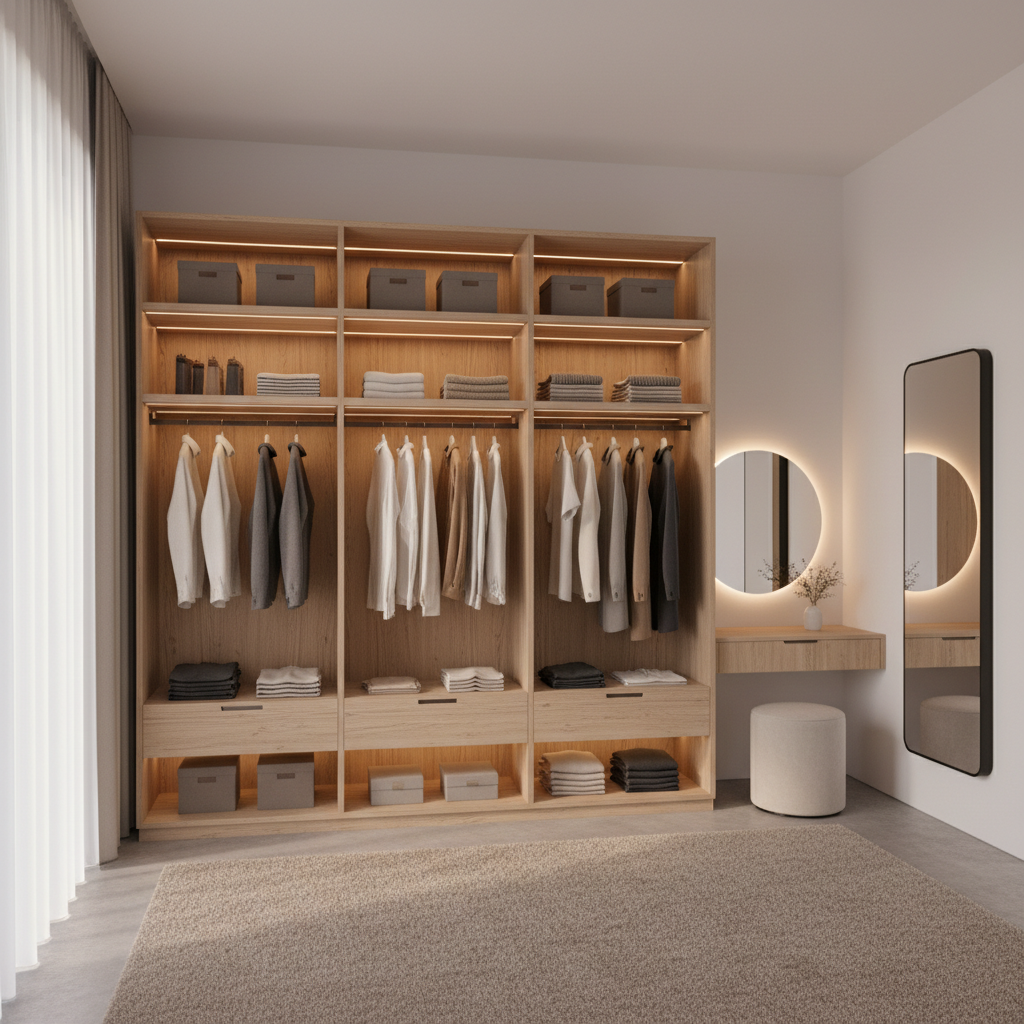
An open walk-in closet, an open niche, a directly accessible storage space: here, a door sensor makes no sense. You need an infrared motion detector (PIR) for the light to react to your presence.
If you want to delve deeper into automation for this type of space, our guide on automatic closet lighting covers the most common cases with concrete configurations.
The True Cost of Batteries vs. Rechargeable Over 3 Years
The cost of batteries is systematically underestimated. Here's an honest calculation for a closet opened an average of 5 times a day.
| Criterion | Battery-Powered Light ($5-$10) | Rechargeable Strip Light ($20-$40) |
|---|---|---|
| Purchase Price | $5 to $10 | $20 to $40 |
| Battery Replacement (3 years) | $15 to $30 estimated | $0 |
| Total Cost 3 years | $20 to $40 | $20 to $40 |
| Maintenance Constraint | Buy batteries ~every 6 months | Occasional USB recharge |
| Constant Brightness | Decreases with batteries | Stable until recharge |
The result is clear: over 3 years, a rechargeable strip light costs the same as a battery-powered light, but without the hassle. And if you use your closet often, rechargeable is even cheaper in the medium term.
To learn more about this topic, you can consult our article on rechargeable portable LED lamps which compares several usage profiles.
How the Ambient Light Sensor Works and Why It's Important
This feature is often overlooked in product descriptions, but it makes a real difference in battery life.
The Logic of the Combined Motion + Light Sensor
A LED light bar equipped with an ambient light sensor simply won't turn on if the room is already well-lit. In practice: if you open your walk-in closet in the middle of the afternoon with the blinds open, the light stays off. It only turns on when necessary, meaning in a dark environment.
Concrete result: instead of turning on 5 times a day, it might only turn on 2 to 3 times. Battery life can easily double.
What Impact on Real Battery Life?
In practice, a rechargeable strip light with this dual sensor can last several weeks between charges with normal use. Lumic's Movement 3.0, for example, boasts up to 4 weeks of battery life in detection mode for the 9-inch (23 cm) model, and up to 5 to 6 weeks for the 15.7-inch (40 cm) model, with its 3000 mAh battery. This is partly thanks to the ambient sensor that prevents unnecessary triggers.
To understand the factors that truly influence the lifespan of this type of system, our article on rechargeable LED lighting and its lifespan details the key parameters to consider.
What Color Temperature for a Closet or Walk-in?
The choice between warm white, neutral white, and cool white is not trivial in a storage space. It changes your perception of colors and your visual comfort.
Warm White (3000K): The Cozy Option, But Not Always Practical
Warm white creates a soft, warm ambiance, pleasant in a hallway or entryway. But in a walk-in closet, it can make it difficult to distinguish between similar colors: navy vs. black, light gray vs. beige. If you often choose your clothes under this lighting, you risk unpleasant surprises once in daylight.
Neutral White (4000K): The Best Compromise for a Walk-in Closet
Neutral white renders colors faithfully without being harsh. It's equivalent to a well-adjusted office light. For a walk-in closet where you need to make quick clothing choices, it's often the most suitable.
Cool White (6000K): Useful in a Utility Storage Closet
Cool white is more visually stimulating but less pleasant over time. It can be suitable for a laundry closet, a technical space, or garage storage, but it's not recommended in a walk-in closet if you want natural color rendering.
The Movement 3.0 offers all three temperatures to choose from, allowing adaptation to the exact use of the closet.
Installation: What to Check Before Buying
One point many forget: mounting. A LED closet light can be mounted in several ways, and not all are suitable for all surfaces.
Industrial Adhesive: Pay Attention to Surface Type
Most wireless strip lights use 3M or similar adhesive to stick under a shelf or inside furniture. On smooth painted wood, it holds very well. On very smooth melamine or a porous surface, the result may be less stable. The rule: clean the surface with isopropyl alcohol before applying, and allow 24 hours for adhesion before stressing the mount.
Magnetic Mounting: Added Flexibility
Some strip lights, like the Movement 3.0, combine industrial adhesive and magnetic mounting. Specifically, you install the magnetic bracket once, and you can remove and reposition the strip light without leaving a trace. This is particularly practical if you sometimes want to use the light elsewhere, or if you're a renter and want to be able to remove everything cleanly when you leave.
Does It Really Last?
In closet use, the main enemy of adhesive is humidity and heat. In a bedroom or entryway closet, conditions are stable, and adhesion is generally very good over time. In a bathroom or near a radiator, it's better to opt for screw mounting if possible.
Our Recommendations Based on Your Profile
To summarize directly:
- Tight budget, closet with door, light use: A battery-powered light with a magnetic opening sensor ($5-$10) will do the job perfectly.
- Open walk-in closet, daily use, you want to forget about batteries: A rechargeable PIR strip light in the $20-$40 range. Lumic's Movement 3.0 stands out here with its 3000 mAh battery (advertised as 3x larger than competitors), its dual motion + ambient light sensor, and its no-drill magnetic mounting. It's available in 9 inches (~150 lumens) and 15.7 inches (~320 lumens) depending on your space's width. It comes with a 5-year warranty and a 90-day money-back guarantee if you're not satisfied.
- Homeowner with budget, large walk-in closet: Invest in a wired LED strip or a light bar with a switch, ideally with a detector integrated into the circuit.
To adjust the sensitivity settings of your detector once installed, our guide on optimal motion detector settings will give you best practices to avoid false detections.
And if you're still hesitating between several types of wireless strip lights for your closet, our complete comparison of wireless LED strip lights covers the entire market with objective criteria.
Key Takeaways
Choosing a LED closet light is not complicated if you start with the right criterion: the presence or absence of a door. Magnetic sensor for a closed closet, PIR for an open walk-in. Between the two, rechargeable wins over batteries once you calculate the real cost over 3 years. And the ambient light sensor, often underestimated, can double a strip light's battery life by preventing unnecessary triggers.
Wireless installation remains the best choice for the vast majority of situations, renters or homeowners: no cables, no drilling, repositionable at will.