You open your closet door in the morning, hit the overhead light — the one that illuminates the room, but not your clothes. You search for the right sweater, compare two pairs of pants, try to tell if that jacket is navy or black. The result: you make a mistake, step outside, and realize your error. Sound familiar?
Wireless closet lighting solves this exact problem. No electrician needed, no drilling, no wires. Just a light that turns on when you enter and off when you leave. This guide explains how to choose the right solution, what truly makes a difference, and how to install it in under 30 seconds.
Why the Closet is the Perfect Use Case for Wireless Lighting
A closet doesn't have the same demands as a kitchen or living room. You don't need continuous light — you spend an average of 2 to 5 minutes getting dressed in the morning, sometimes a bit more in the evening. This short, repeated usage pattern is exactly what a motion sensor is designed for.
Why Not Just Use the Overhead Light?
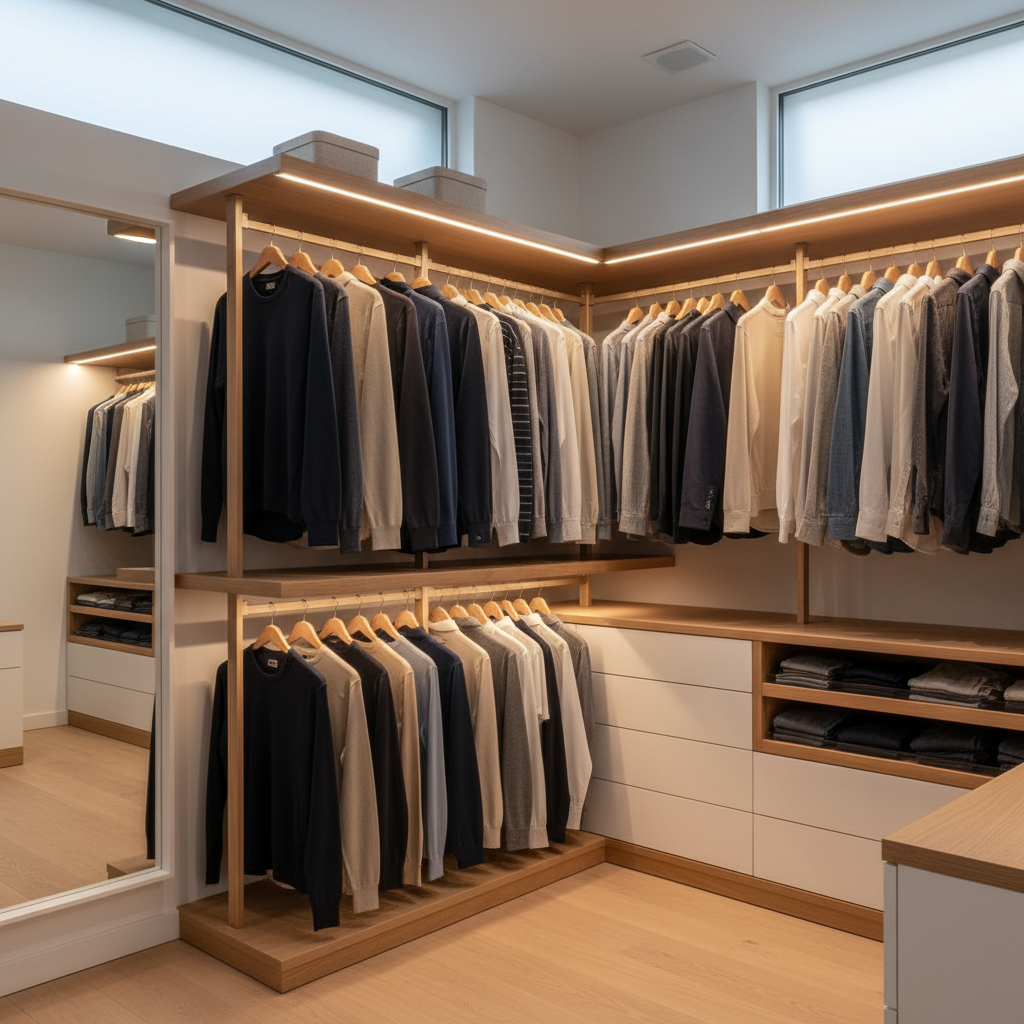
Overhead lights illuminate from above, often poorly. They create shadows on shelves, in corners, under hanging clothes. To truly see your garments — their colors, their details — you need light placed in the right spot: at the clothes rail level, under shelves, inside the cabinet itself.
Recessed spotlights in a closet are technically possible. But they require an electrician (expect to pay $100-$200 for labor), ceiling clearance, and often involve work you can't do if you're a renter. For 5 minutes of use per day, it's not practical.
Wireless Closet Lighting: Tangible Daily Benefits
A wireless LED light bar truly changes your daily routine. You no longer search for a switch, turn it on then off, or wonder if you turned it off when you left. The light turns on when you arrive, stays on as long as needed, and turns itself off. It's discreet, it works, and you quickly forget you even installed it — in a good way.
What if you reorganize your closet? A magnetic strip light moves in three seconds. No screws to remove, no holes to patch.
Color Temperature: The Unsung Hero
This is probably the most important point in this guide, and the least often discussed. When choosing a light for your closet, color temperature changes everything about how you perceive your clothes.
Warm, Neutral, or Cool White: What's the Difference in a Closet?
There are three main color temperatures for LEDs:
- Warm White (3000K): Cozy ambiance, golden light. Comfortable, but it distorts colors. A blue shirt might look greenish-gray, black jeans might appear faded.
- Neutral White (4000K): Balanced light, close to natural daylight. This is the standard for a closet. You see colors as they truly are.
- Cool White (6000K): Bright, slightly bluish light. Effective for concentration, but too cool for clothing — it can make warm tones look dull.
The recommendation is clear: 4000K for a closet. This temperature allows you to see if your jacket is navy or black, if your sweater is burgundy or brown, if two pieces truly coordinate. No surprises once you step outside.
Can You Have Multiple Temperatures on the Same Light Bar?
Some light bars allow you to choose the temperature before installation — this is the case with the Movement 3.0, which offers three options: 3000K, 4000K, and 6000K. You choose once, install it, and you're set. This is more practical than fixed-temperature models, especially if you use multiple light bars in different spaces.
How to Choose the Right Size Light Bar for Your Closet
The size of the light bar directly determines the illuminated area. Choosing too small means dark spots. Choosing too large means it extends beyond the rail or shelf, which can look awkward.
What Length to Choose Based on Closet Configuration?
Here are some practical guidelines:
| Area to Illuminate | Recommended Size | Lumens | Note |
|---|---|---|---|
| Small shelf / drawer | 9 inches (23 cm) | ~150 lm | Ideal for a cabinet or targeted space |
| Standard clothes rail | 16 inches (40 cm) | ~320 lm | Covers an entire hanging section, more uniform lighting |
| Large wardrobe / open closet | 2x 16 inches (2x 40 cm) | ~640 lm | Place one light bar at each end of the rail |
For a walk-in closet or a wardrobe with multiple sections, the best approach is to use multiple light bars rather than trying to find one very long one. This allows for more even lighting, and you can install them according to your space's layout.
Is the Brightness of a Wireless Light Bar Sufficient for a Closet?
Yes, if you choose the right size. A 16-inch (40 cm) light bar with 320 lumens, placed under a shelf or above a rail, effectively illuminates the task area — where you look at your clothes. It's not meant to light up the entire room, and that's exactly what it's designed for. For more info on general selection criteria, our article How to Choose an LED Light Bar details each parameter.
Battery Life: How Long Without Recharging?
This is a legitimate question when it comes to wireless. Nobody wants to recharge their light every week. The good news: for closet use, battery life is more than sufficient.
How Long Does a Wireless Light Bar's Battery Last in a Closet?
In motion sensor mode, the light only turns on when you pass in front of the sensor. In a closet used a few minutes a day, this represents very low power consumption. The Movement 3.0 features a 3000 mAh battery — significantly larger than most alternatives on the market. In standard detection mode, battery life reaches approximately 4 weeks for the 9-inch (23 cm) model and up to 5-6 weeks for the 16-inch (40 cm) model. For a closet, you'll likely recharge once a month via the included USB cable.
To learn more about this topic, we've written a complete guide on LED Light Bar Battery Life — covering the factors that truly influence battery longevity.
Detection Mode vs. Continuous Mode: Which to Choose for a Closet?
The choice is simple here: detection mode for a closet, without hesitation. There's no reason to leave the light on continuously in a space where you spend a maximum of 5-10 minutes. Continuous mode is useful for a kitchen during meal prep or a hallway with constant foot traffic. It also consumes much more power — 5 hours for the 9-inch (23 cm) model, 8 hours for the 16-inch (40 cm) model in continuous mode. Better to save that battery life for when you truly need it.
Installation in Under 30 Seconds: How It Actually Works
The point that often makes people hesitate is mounting. Does it really hold? Will the adhesive damage the wood? Is it complicated to install?
How to Install a Magnetic LED Light Bar in a Closet?
The procedure is truly simple, requiring no tools:
- Clean the surface: A quick wipe with a dry cloth is enough to remove dust. On varnished wood, melamine, or metal, industrial adhesive sticks without a problem.
- Attach the magnetic mount: Press the mount for a few seconds. It's designed to hold several pounds — more than enough for an aluminum light bar.
- Clip the light bar onto the mount: The magnetic attachment snaps instantly. No screws, no screwdriver.
- Adjust the sensor (if needed): The detection angle can be oriented to cover the exact area in front of the closet.
You can move the light bar anytime without leaving a trace — or almost. Industrial adhesive removes cleanly if you're careful, but avoid fragile, untreated surfaces.
Does the Mount Hold Under a Closet Cabinet?
In practice, the adhesive mount + magnetic attachment combination holds very well on standard smooth surfaces: melamine, varnished wood, lacquered metal. These materials make up the majority of commercial closet furniture (Home Depot, Lowe's, etc.). If your surface is porous, untreated, or uneven, the grip may be less reliable — in this case, an intermediate surface (strong double-sided tape) can supplement the attachment. The benefits of wireless LED light bars also include this placement flexibility that wired installations cannot offer.
The Motion Sensor in a Closet: Is It Really Practical?
Some wonder if the sensor is too sensitive, or conversely, insufficient in a room you don't frequent often. This is a valid question.
Does the Sensor Turn On for No Reason (Pets, Drafts)?
Modern LED light bars with passive infrared (PIR) sensors detect body heat and movement — not drafts or slight vibrations. However, a pet sneaking into the closet can trigger the sensor. This is generally perceived as acceptable behavior rather than a bug. If you want to understand how to optimize this setting, our article on motion sensor adjustment explains the parameters to adjust for your use.
Does the Light Stay On Long Enough to Get Dressed?
The illumination duration after detection is usually adjustable or set to a reasonable length. In the case of the Movement 3.0, the sensor combines motion detection with an ambient light sensor: the light won't turn on if you open your closet in broad daylight with a window facing it. This dual criterion prevents unnecessary activations and extends battery life.
The Movement 3.0 for a Closet: What Makes It Stand Out
If you're looking for an automatic wireless closet light, Lumic's Movement 3.0 is perfectly suited for this use case. Here's what makes it relevant, without the marketing jargon:
- Two sizes available: 9 inches (23 cm) (150 lumens) for a small wardrobe or cabinet, 16 inches (40 cm) (320 lumens) for a standard clothes rail.
- Three selectable temperatures: Choose 4000K before installation, and you're guaranteed to see the true colors of your clothes every morning.
- 3000 mAh rechargeable USB battery: No batteries to replace. Recharge approximately once a month depending on usage.
- Magnetic mounting: Move the light bar without tools if you reorganize your closet.
- 5-year warranty and 90-day satisfaction guarantee.
If you want to compare it with other models on the market, our wireless LED light bar comparison reviews the options with their respective pros and cons.
For those interested in automatic lighting more broadly — not just for closets — our guide on automatic closet lighting also covers switch-operated solutions, LED strips, and battery-powered spotlights.
What Users Notice After a Few Weeks
Beyond the installation — which is indeed quick — it's the daily use that matters. What users most often mention in Trustpilot reviews (4.5/5 from over 2200 reviews) is forgetting it's even there. Not in the sense that it's useless, but in the sense that it becomes natural. You open the closet, it lights up. You leave, it turns off. You no longer have to think about it.
Another frequently cited point: the difference in color perception with 4000K. Users who thought their clothes were one color realize they're another. It's a detail that truly changes how you get dressed, especially in winter when natural light is dim.
Conclusion: Wireless Closet Lighting, a Practical Essential
Wireless closet lighting is not a gadget. It's a solution that precisely addresses the constraints of a space used for short periods, often early morning or late evening, where color perception truly matters. No wires, no electrician, no drilling — just a light that does its job when you need it and disappears the rest of the time.
If you're still hesitating between options, start by defining two things: the size of the area to illuminate (9 inches or 16 inches) and the color temperature (4000K for a closet, no debate). The rest — mounting, battery life, automation — naturally follows.