You walk in with arms full of groceries, push the garage door open with your elbow — and fumble for the light switch in the dark. It seems like a small detail, but it's annoying every single day. A good garage LED light bar solves this permanently.
The problem is, "garage LED light bar" covers many different scenarios: a large workshop where you spend hours tinkering, a quick pass-through garage for groceries, or even a space with no electrical outlets. The right solution isn't the same for all three. This guide helps you choose correctly.
Why Garage Lighting is Often Poorly Designed
Most garages have a single central ceiling light — sometimes an old, buzzing fluorescent tube, sometimes a bare 60W bulb. The result: shadows everywhere, especially on the sides and under workbenches. If you're working on projects, you often find yourself in your own shadow.
The Real Problem: Busy Hands and Darkness
In a garage, your hands are rarely free. You're carrying something, holding a tool, or maneuvering a trash can. Reaching for a light switch in these conditions is either a hassle or a bumped knee on the car. Lighting that automatically activates when you enter the room truly changes daily habits.
Fluorescent vs. LED Light Bar: What's the Concrete Difference?
Old fluorescent tubes (T8 or T5) consume much more energy for an often yellowish, unstable light. A modern garage LED light bar provides better illumination, uses less power, and won't buzz after 3 years. The difference shows up on your electricity bill and in your comfort, especially for precision work where you need clear, stable light.
Top 3 Garage Use Cases (and the Right Light Bar)
Before looking at models, ask yourself three questions: Do you do serious DIY work, or just pass through quickly? Does your garage have an easily accessible electrical outlet? What's its approximate size? The answers change everything about your light bar choice.
Case 1: Large Garage or Workshop — You Work for Hours
If you spend 2, 3, or 4 hours in your garage tinkering, repairing, painting, or woodworking, a rechargeable light bar won't be enough. A portable light bar battery, even a good one, provides 5 to 8 hours of continuous light — and brightness decreases as the battery drains.
For this case, wired is the reliable solution. A wired LED light bar, 24 to 48 inches long, with appropriate wattage for the area, ensures constant, uninterrupted lighting without worrying about recharging. For a workshop, aim for an IP44 rating minimum if you work with liquids or if your garage isn't heated — this protects electronics from water splashes and fine dust.
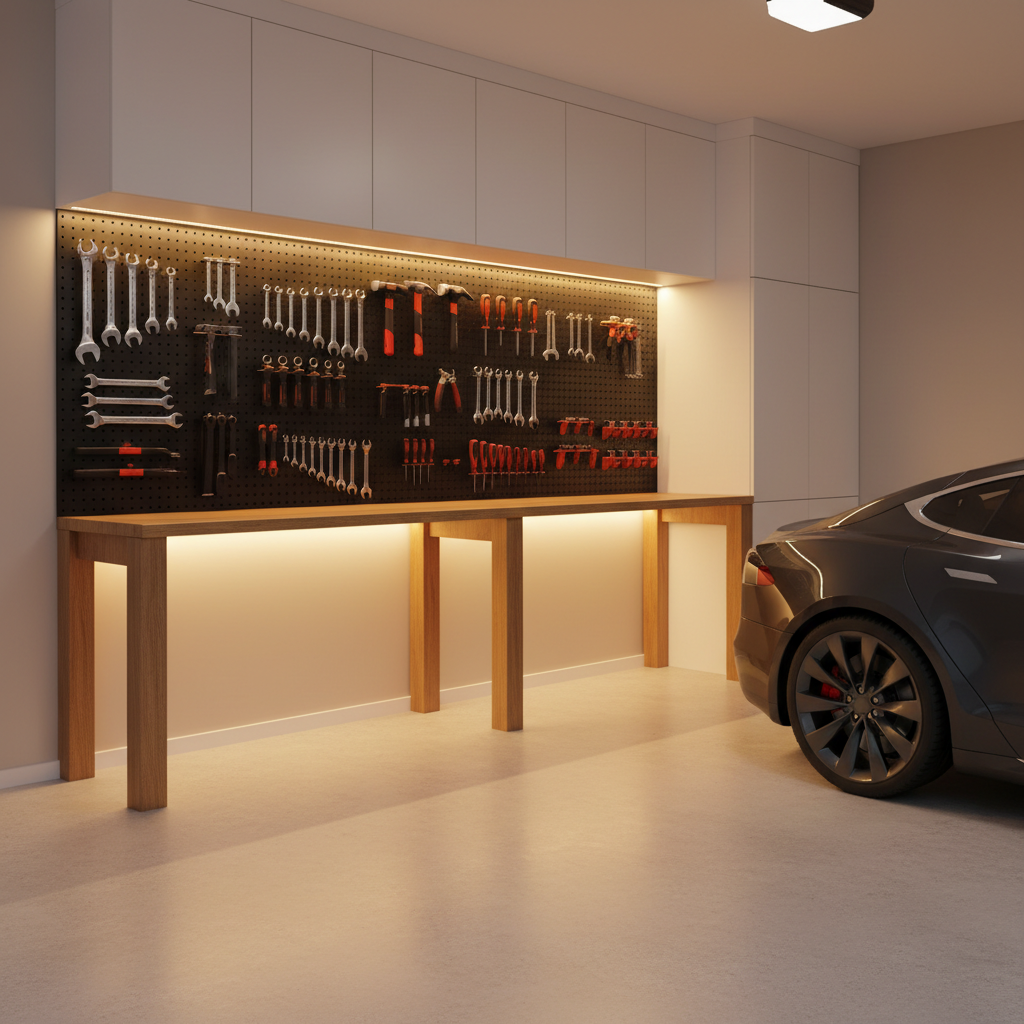
If you have multiple areas to light (workbench, storage, entrance), consider installing several light sources rather than a single central light bar. Two well-placed light bars illuminate better than one strong but poorly positioned ceiling light. For more on positioning based on your use, check out this article on types of garage LED lighting.
Case 2: Small Garage or Pass-Through Area — You're In and Out
You primarily use your garage as a pass-through: you park the car, drop off groceries, grab a tool. You don't spend more than a few minutes at a time, and you don't necessarily want to do electrical work for it.
In this case, a rechargeable LED light bar with a motion sensor does exactly what you need. You enter: it turns on. You leave: it turns off after a few seconds. No need to touch a switch, no electrician, no drilling wires into walls.
Motion detection combined with an ambient light sensor is particularly smart here: the light bar only turns on if necessary (it won't activate in broad daylight if you have a window). This saves battery, and you don't have to remember to recharge every week. A light bar with a 3000 mAh battery in detection mode can last about a month depending on usage frequency. To understand all comparison criteria, consult our guide on rechargeable LED light bars.
Case 3: Garage Without Electricity — No Accessible Outlet
Some garages, especially in apartment building basements or detached units, simply lack power outlets. Having an electrician install a circuit typically costs between $150 and $300, depending on complexity. Before resorting to that, a rechargeable light bar is a serious alternative.
The condition for long-term effectiveness: a large enough battery so you don't have to recharge every two weeks, and a detection mode to avoid wasting charge unnecessarily. This is similar to Case 2, but with an added constraint: you must be able to easily remove the light bar to recharge it inside your home via USB. Magnetic mounting is a real advantage in this situation — you detach, recharge, reattach. For broader alternatives, you can also check out solutions for lighting a garage without electricity.
How to Choose the Right Size LED Light Bar for Your Garage
The size of the light bar largely determines the number of lumens emitted, and thus the effectively lit area. A light bar that's too short for a large space creates more frustration than it solves.
Garage Size and Lumens: Good Benchmarks
For a pass-through area or garage entrance (approximately 20 to 40 sq ft), a 9-inch (23 cm) light bar with about 150 lumens is plenty — the goal is to see where you're walking, not to light it like a football field. For a workspace or larger garage (80 to 160 sq ft), you'll need multiple sources or a larger wired light bar with adequate actual wattage.
Key takeaway: a 16-inch (40 cm) rechargeable light bar (approx. 320 lumens) effectively illuminates a 20 to 40 sq ft area, like a garage entrance or workbench. It's not designed to replace central lighting in a 200 sq ft workshop. It's important to be realistic about this.
Wired or Rechargeable: The Decision Table
| Criterion | Wired Light Bar | Rechargeable Light Bar |
|---|---|---|
| Heavy Use (4h+) | ✅ Ideal | ❌ Limited |
| No Accessible Outlet | ❌ Impossible without electrical work | ✅ Direct Solution |
| Installation Without Electrician | ❌ Wiring required | ✅ In under a minute |
| Motion Detection | Optional (model dependent) | ✅ Integrated on good models |
| Installation Budget | High (material + labor) | Low (self-contained) |
| Maximum Brightness | Very High | Adequate for limited areas |
| Ideal for Renters | ❌ Permanent modifications | ✅ No drilling or wiring |
Color Temperature: Warm, Neutral, or Cool White in a Garage?
This is often overlooked, but it really changes daily comfort. The three common temperatures are 3000K (warm white), 4000K (neutral white), and 6000K (cool white).
Which Color Temperature for a Workshop or Garage?
For a workshop garage where you do precision work (woodworking, electronics, mechanics), neutral white at 4000K or cool white at 6000K are generally preferred. They provide light closer to daylight, which helps distinguish details, wire colors, or imperfections on a surface.
For a pass-through garage or nighttime entry, warm white at 3000K is more pleasant — you don't walk into aggressive light when you come home tired at night. It's also gentler on the eyes when transitioning from darkness to light in seconds. If you can choose a light bar with adjustable brightness and adjustable temperature, that's a definite plus.
What About Glare in a Garage?
An often-forgotten point: in a garage with low ceilings (7.2 to 8.2 feet), a very bright light bar positioned too low can cause direct glare when you look up. Opt for a light bar with a diffuser rather than an exposed bare LED, especially for eye-level installation (under a cabinet or on a shelf).
Installation: How Long and What Tools?
Installation is often what causes hesitation. For a wired light bar, you need basic electrical skills (or hire a professional). For a rechargeable light bar with magnetic and adhesive mounting, installation takes less than a minute with no tools.
Installing a Rechargeable Light Bar in a Garage: Quick Guide
The principle is simple: position the adhesive mount where desired (under a cabinet, high on a wall, under a shelf), let the adhesive set according to instructions, then attach the light bar magnetically. Magnetic mounting offers a concrete advantage: you can easily move or remove the light bar if you reorganize your space, and take it out to recharge without disassembling anything.
For garage entry use (hands full, darkness), the ideal is to mount the light bar high, where the motion sensor can effectively detect movement (about 5.9 to 6.5 feet from the floor). Avoid placing it too low or pointed at an opaque wall that would block detection.
The Motion Sensor Light Bar, Practically in a Garage
A motion sensor in a garage isn't a gadget. It's a real solution to the problem of busy hands. The integrated ambient light sensor adds a layer of intelligence: the light bar only turns on if natural light is insufficient. As a result, the battery lasts much longer, and you don't have a light flickering unnecessarily during the day. To understand all the subtleties of this type of equipment, our complete guide on the LED light bar for garage with motion sensor goes further into installation and adjustment.
What Movement 3.0 Offers in a Garage Context
If your needs match Case 2 or Case 3 (pass-through garage, or no electrical outlet), Lumic's Movement 3.0 is an option to consider. It's not a universal solution for all garages — let's be clear about that.
It's relevant if you're looking for: cable-free, no-drill installation, automatic motion detection, and a battery that lasts without weekly recharging. The 3000 mAh battery is three times larger than what's typically found on similar products, translating into real autonomy: about 4 weeks in detection mode for the 9-inch model, 5 to 6 weeks for the 16-inch model.
Magnetic mounting is particularly useful in a garage because you can reorient the light bar as needed, remove it for USB recharging, and reattach it in seconds. The 5-year warranty and 90-day return policy if it doesn't suit your needs are strong arguments when ordering online. The 4.5/5 rating from over 2200 Trustpilot reviews reflects real-world use, not a lab test.
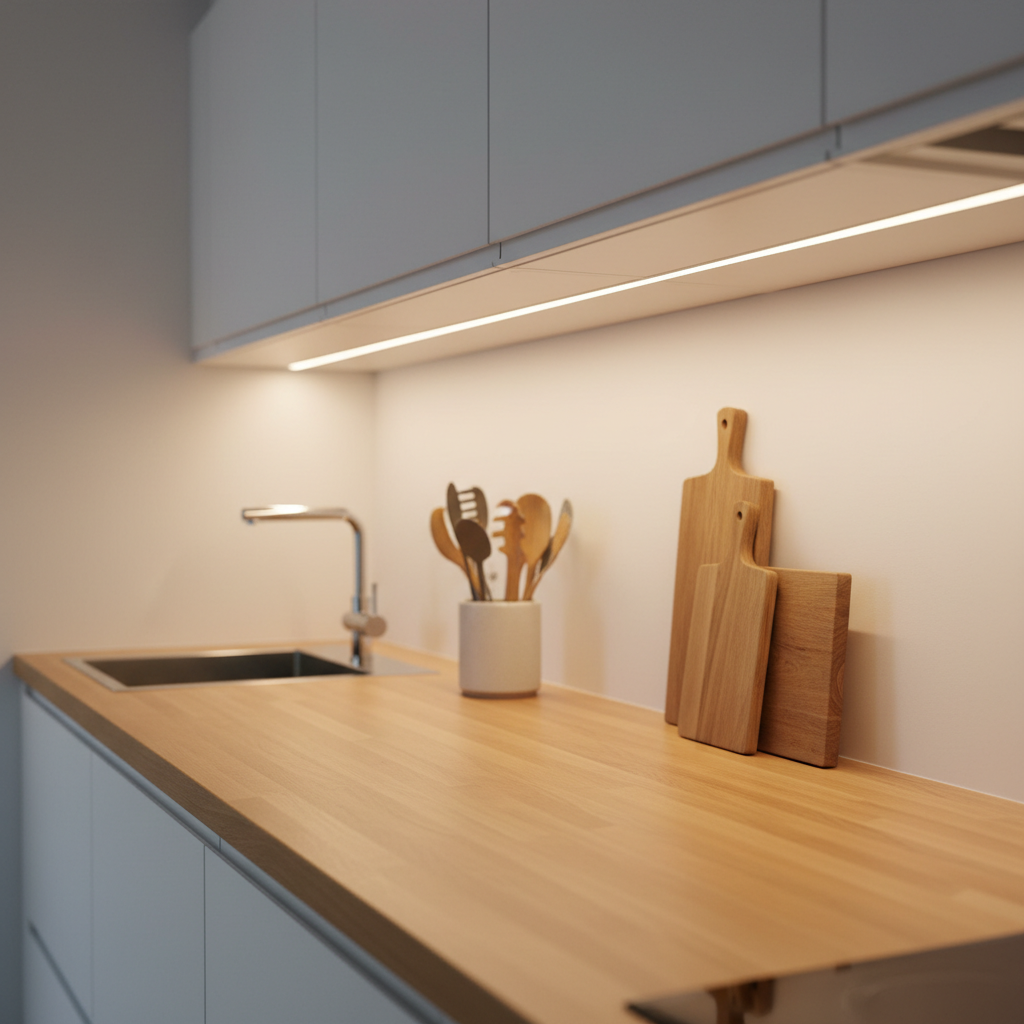
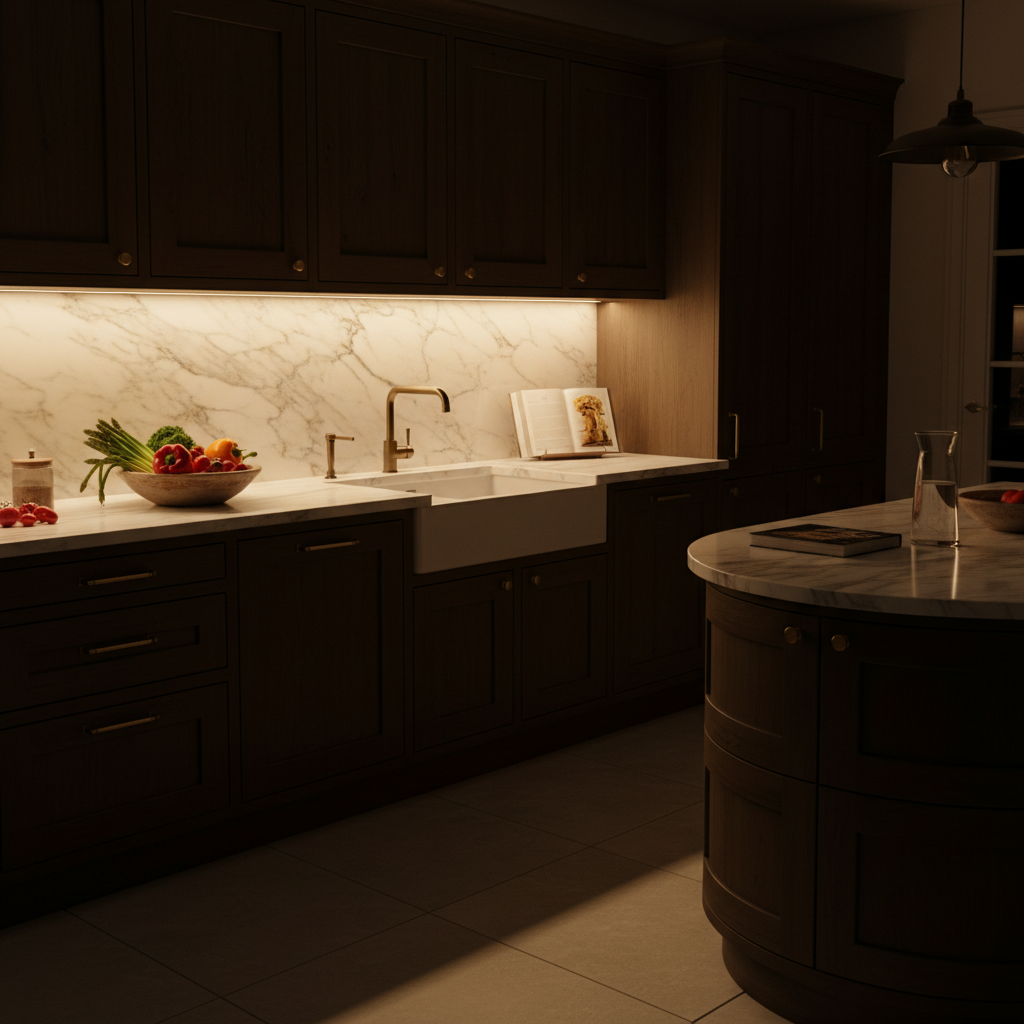
For kitchen, entryway, or closet use, check out our summary of garage lighting solutions by budget and use, which covers all criteria.
Common Mistakes to Avoid When Choosing a Garage Light Bar
- Choosing a light bar that's too short for the space: 150 lumens is good for a specific area, not an entire garage.
- Forgetting the IP rating: In an unheated garage with humidity, condensation, or splashes, an IP44 minimum prevents premature failures on wired models.
- Placing the sensor facing a wall: The sensor must be oriented towards the traffic area to detect movement correctly.
- Choosing rechargeable for intensive daily use: If you spend 4 hours a day in your workshop, a rechargeable light bar won't replace dedicated wired lighting.
- Neglecting color temperature: For precision work, avoid overly warm white that slightly distorts color perception.
- Applying adhesive to a dusty surface: Clean and degrease the surface before installation, otherwise the adhesive won't hold long-term, even on a quality product.
Summary: Which LED Light Bar for Your Garage?
If you take one thing away from this guide, it's this: the right garage LED light bar model depends primarily on your use case, not just a spec sheet.
- You do serious DIY for several hours: go for wired, at least 24 inches, with IP44.
- You pass through quickly, hands full: a rechargeable light bar with motion detection does the job better than any switch.
- Your garage has no electricity: rechargeable is the only solution without hiring an electrician. Check battery life in detection mode before buying.
Garage lighting is often the last thing people think about — yet, it's what changes daily comfort the most. A well-chosen and well-placed light bar is a practical convenience you'll appreciate multiple times a day without even thinking about it.