You're cooking dinner, chopping vegetables, and realize you're working in your own shadow. The ceiling light illuminates the top of your head, not your cutting board. It's frustrating, and yet it's one of the most common mistakes in kitchen lighting.
The good news: the three problems that lead to poorly lit kitchens are always the same. And once you know them, you can fix them easily, without necessarily calling an electrician or redoing everything.
Top Mistake #1: Relying Solely on Ceiling Lights
The ceiling light is the root of the problem in most kitchens. Not because it's bad in itself, but because it's behind you when you're working.
Why Does Your Body Cast a Shadow on the Countertop?
It's pure physics. When you stand facing your countertop, the light comes from the ceiling, behind you. Your body blocks some of that light, and the exact area where you're cutting, preparing, or pouring ends up in shadow. You squint. You shift. You start over. It's exhausting over time.
The obvious solution would be to put a ceiling light in front of you, but in most kitchens, this isn't structurally possible. What you need instead is a light source above the countertop, not above your head.
The Real Rule of Functional Kitchen Lighting
Effective kitchen lighting relies on two distinct layers:
- General lighting: The ceiling light or recessed spotlights, to see generally in the room.
- Task lighting: A light placed directly above your work area, independent of the ceiling light.
Without this second layer, no matter how powerful your ceiling light, you'll always cook in the shadow as soon as you lean over your countertop. This is a basic principle many still ignore, and you can find it in detail in our article on common kitchen lighting mistakes.
Recessed Spotlights, Pendants, or LED Light Bars: What to Choose?
Several solutions provide this task lighting:
- Recessed spotlights under upper cabinets: Effective, aesthetic, but require electrical installation by a professional.
- Pendant lights above an island: Very decorative, suitable for large kitchens with a central island, but useless above a standard wall-mounted countertop.
- LED light bars under cabinets: The most accessible solution, whether wired or wireless.
For a countertop along a wall with upper cabinets, an LED light bar remains the most logical option. And depending on whether you own or rent, wired or wireless, the options differ. We'll get back to that shortly.
Top Mistake #2: Choosing the Wrong Color Temperature
If you've ever felt that a kitchen lit with LEDs looked like a medical waiting room, it's probably a matter of color temperature.
What is Color Temperature in Practice?
Color temperature, measured in Kelvin (K), determines whether your light leans towards warm yellow/orange or cool blue/white. It's not just about ambiance: in the kitchen, it also changes how you perceive the colors of food and surfaces.
- 3000K (warm white): Golden light, candle effect. Pleasant in the evening in a living room, but in the kitchen, it makes white countertops appear yellow, food look less fresh, and readability decreases.
- 6000K (cool white): Very cold blue light. Some choose it for its "bright" side, but the result is often harsh, almost stressful. Sterile rather than welcoming ambiance.
- 4000K (neutral white): The ideal compromise for the kitchen. The light is clear without being harsh, colors are accurately rendered, and you see what you're doing without feeling like you're in a lab.
Which Temperature to Choose for Everyday Cooking?
For a kitchen used for both cooking and eating or family gatherings, 4000K is the sweet spot. It's neutral enough for food colors to appear natural, yet warm enough so the ambiance isn't cold.
If you want to delve deeper into this topic before buying anything, we've written a complete comparison on choosing color temperature in the kitchen.
What if You Want Multiple Ambiences Depending on the Time?
Some LED light bars allow you to change the color temperature on demand. This is useful if you use your kitchen for intense cooking sessions at 6 PM and for weekend aperitifs. In the morning, you switch to 4000K to wake up. In the evening, you lower it to 3000K for ambiance. This feature is a priority if you want maximum flexibility.
Top Mistake #3: Forgetting About Shadowed Areas
The third mistake is often invisible until you suffer from it: certain areas of the kitchen systematically remain in darkness, and no one thinks to light them.
Which Kitchen Areas Are Often Poorly Lit?
Here are the most common blind spots in a kitchen:
- Under upper cabinets: This is where you prepare your dishes, and it's often the darkest area if no dedicated lighting is provided.
- Inside cabinets: You rummage in the dark, miss spices, grab the wrong ingredients. Interior lighting truly changes daily life.
- The stove area: Tiled backsplashes reflect little light, and the area around the burners is often poorly lit.
- The end of a galley kitchen or closed kitchen: U-shaped kitchens or galley kitchens accumulate shadowed areas at the ends.
How to Identify Dark Areas in Your Own Kitchen?
A simple test: cook at night, using only the ceiling light. Mentally note the places where you have to tilt your head or lean in to see what you're doing. These are the areas to address first.
To learn more about under cabinet kitchen lighting, we've prepared a dedicated guide with concrete criteria to check.
The Concrete Solution for Dark Areas Under Cabinets
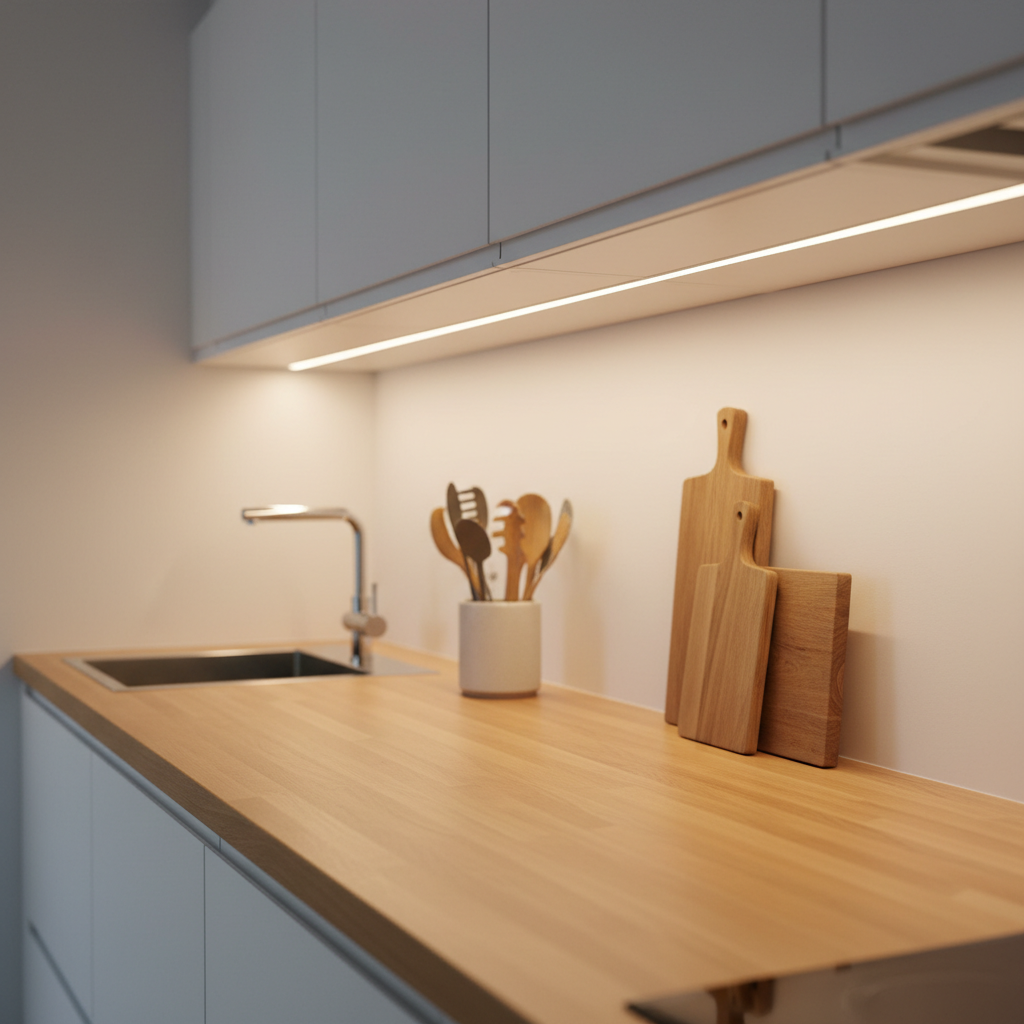
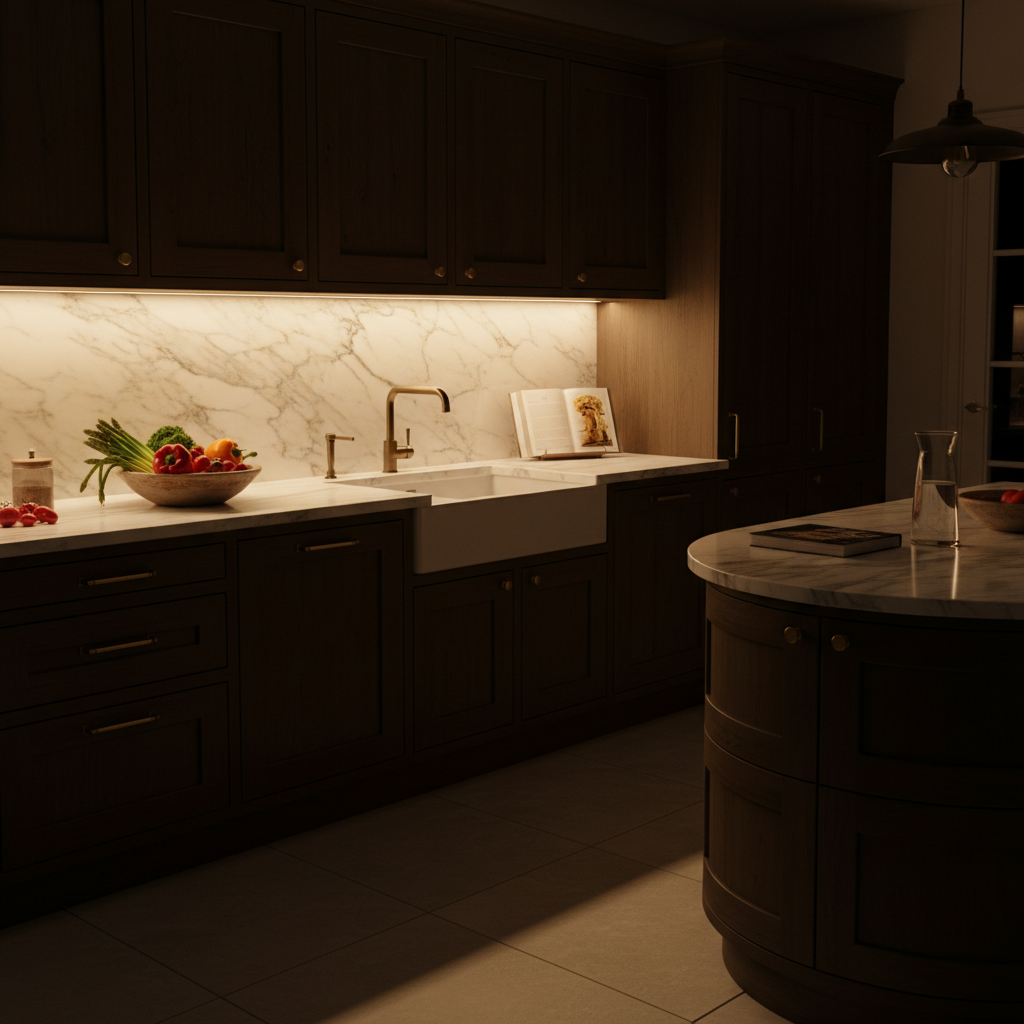
Once the problem is identified, the solution becomes obvious: you need to add a light source under the upper cabinets, directed towards the countertop. Where your eyes need it, not high up behind you.
Wired Option: Effective but Restrictive
A wired LED light bar, fixed under upper cabinets, generally yields excellent results. The power is constant, no battery to monitor, and wired models often have more features.
The problem: it assumes you have an accessible outlet under the upper cabinets, or that you run a cable. If no outlet is planned there, you need to call an electrician. This represents a real cost, time, and often a constraint for renters or those who want a quick solution. To compare both options in detail, our article on wired or rechargeable LED light bars will give you the keys.
Wireless Rechargeable Option: The Answer for 90% of Cases
For most kitchens, a rechargeable LED light bar solves the problem in 30 seconds. You stick it or magnetically attach it under the cabinet, and you're done. No cables, no drilling, no handyman.
The point of vigilance: battery life. Some low-end light bars last a few days before needing a charge. Serious models last several weeks in motion sensor mode, meaning they only turn on when you pass by and turn off automatically.
Lumic's Movement 3.0 operates on this principle: integrated motion sensor + ambient light sensor (it doesn't turn on if the kitchen is already lit). The 3000 mAh battery offers about a month of battery life in detection mode, which is well above average. It's available in 9 inches (~150 lumens) or 16 inches (~320 lumens) depending on the cabinet length to be lit, and offers three color temperatures: 3000K, 4000K, and 6000K, with adjustable brightness. Installation is via industrial adhesive or magnet, no drilling required. 5-year warranty.
This is particularly suitable for renters or those who want to test without commitment. Lumic offers a 90-day satisfaction guarantee and premium European customer support reachable within 24 hours.
Summary: How to Properly Light Your Kitchen
The three mistakes always come back to the same basic principles:
- A ceiling light alone is not enough: It lights the room, not the countertop. You need a light source directly above the work area.
- Color temperature changes everything: 4000K for cooking (neither too warm nor too cold), 3000K if you want warmth in the evening, 6000K to avoid unless for specific cases.
- Shadowed areas exist in all kitchens: Under upper cabinets, inside cabinets, in corners. A well-placed light bar solves the problem in minutes.
If you want to go further on current trends and installation ideas, we also have a selection of inspirations in our article on kitchen lighting trends.
Kitchen lighting is ultimately a simple subject once you understand these three mechanisms. And correcting years of bad lighting can take less than an hour, without opening walls or calling anyone.