The Mistake (Almost) Everyone Makes on the First Try
You buy your first under cabinet kitchen light, stick it at the back, against the wall. You turn it on. The light illuminates the back wall, not the countertop. Result: your countertop stays in shadow, and you end up with a nice decorative halo effect... not very useful when you're chopping vegetables at 7 PM.
This mistake is so common it could almost be called the initiation ritual of under cabinet lighting. It comes from a logical but misleading reflex: we stick the LED light bar "at the back" so it's hidden. Except the countertop is in front. If the light is at the back, it illuminates what's behind you — not what's in front.
This guide is here to help you avoid that. We'll talk placement, position, color temperature, and what truly differentiates a well-thought-out installation from one that frustrates you from day one. To learn more about choosing the right model, check out our complete guide to kitchen LED light bars — it complements what we're discussing here.
Exactly Where to Place Your Under Cabinet Kitchen Light
The Two-Thirds Rule: Simple, Effective
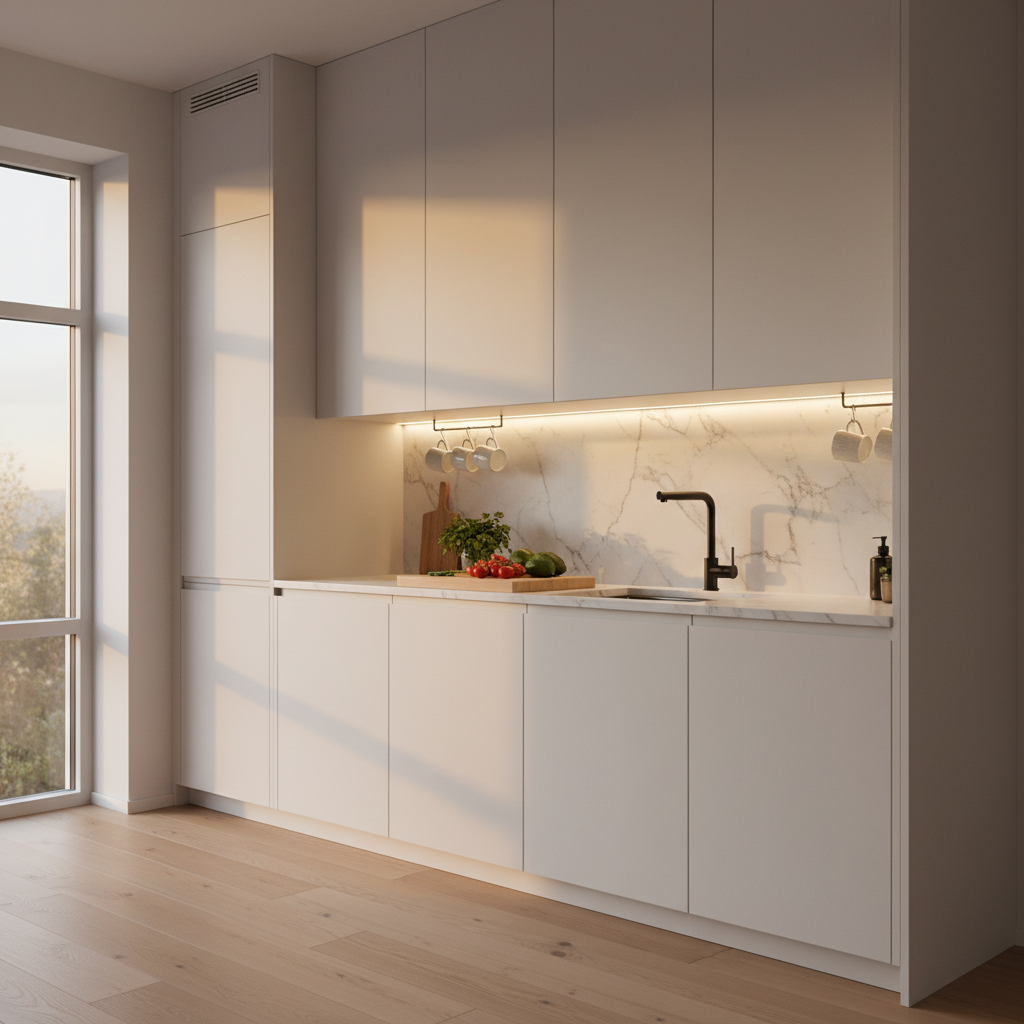
The correct position for an under cabinet LED light bar is two-thirds of the way towards the front of the cabinet — not at the back, not at the very edge, but in between. Specifically: if your cabinet is 12 inches (30 cm) deep, the light bar should be placed approximately 4 inches (10 cm) from the front edge.
This positioning achieves two things simultaneously. First, the light bar remains invisible from normal eye level (you don't see the light source directly). Second, and most importantly, the light falls directly onto the countertop, right where you're working. This is the difference between functional lighting and decorative lighting.
Note: these measurements are guidelines, not hard and fast rules. Every kitchen is different — cabinet depth, height, countertop color. The best approach is to test before permanently fixing. We'll come back to this in a moment.
The Sink: A Trap Zone to Avoid
If you have an upper cabinet above your sink, resist the urge to put a light bar there. Water creates reflections. Light bounces off the bottom of the sink, off chrome faucets, off drying dishes — and you end up with glare that strains your eyes. It's not an emergency if you already have one there, but if you're choosing your placement, prioritize cutting and prep areas.
The area between the sink and the stove, however, is ideal. This is where you spend the most time preparing food, and it's often the least well-lit area in most kitchens.
One Light Bar Per Cabinet or One Long Strip Covering Everything?
It depends on your setup. A long light bar running the entire length of the upper cabinets provides a very clean, uniform look and avoids shadows between cabinets. But it requires either wiring or a sufficiently long rechargeable light bar.
Short light bars per cabinet offer more flexibility and allow you to adjust intensity zone by zone. To learn more about wired and rechargeable options, the comparison between wired or rechargeable kitchen light bars is a good starting point before deciding.
What Color Temperature to Choose for Cooking?
Why 4000K is the Right Balance for the Kitchen
LED light bars are available in several color temperatures: warm white (3000K), neutral white (4000K), cool white (6000K). For the kitchen, the short answer is: 4000K.
Here's why. Warm white (3000K) is pleasant in the evening, creating a cozy ambiance — but it slightly distorts color perception. When you want to check if meat is cooked through or if your vegetables are fresh, this orange tint can be misleading. Cool white (6000K), on the other hand, is too harsh for prolonged use in the kitchen. It strains the eyes and gives an unpleasantly sterile look.
Neutral white at 4000K offers the best of both worlds: a light cool enough to clearly see details and food colors, without being aggressive. This is the temperature found in professional kitchens for this precise reason. If you're still unsure, our article on choosing between warm white and cool white in the kitchen details the use cases for each option.
What If You Want Two Different Ambiences?
Some people want functional light when cooking, and a softer ambiance when dining or having coffee in the morning. This is entirely possible if you choose a light bar with adjustable brightness. You keep the 4000K but lower the intensity to create a different mood. This is often more practical than having two distinct lighting systems.
Why Placement is So Hard to Get Right the First Time
No Two Kitchens Are Alike
A white marble countertop reflects light differently than a dark wood one. An upper cabinet 70 inches (180 cm) from the floor doesn't illuminate the same way as one 87 inches (220 cm) high. A kitchen with lots of natural light has different needs than a ground-floor apartment. These variables mean that generic advice — "stick it 4 inches (10 cm) from the edge" — doesn't always work.
That's why the ability to test before fixing is probably the most underestimated criterion when choosing under cabinet lighting. For truly successful indirect kitchen lighting, fine-tuning often makes all the difference between an acceptable result and a perfect one.
The Real Problem with Adhesive
Most LED light bars on the market use double-sided adhesive tape. It's effective once in place, but it's unforgiving of mistakes: if you misplace it, you tear off the light bar, potentially damage the cabinet surface, and the adhesive won't stick as well the second time. So you need to be sure of your placement before installing.
Result: many people hesitate for a long time, end up sticking it anywhere just "to see," and live with suboptimal placement because starting over is too much hassle.
Magnetic Mounting Changes the Game
This is where Lumic's Movement 3.0 philosophy makes sense. Its mounting system uses an adhesive bracket applied once to the cabinet, and the light bar then magnetically clips onto it. If you realize afterward that the placement isn't ideal, you unclip the light bar in a second, reposition the bracket a few inches, and re-clip. No need to tear everything off and start from scratch.
For someone unsure of the ideal placement in their kitchen — and that's most people, honestly — this type of repositionable mounting removes enormous pressure. You test, you adjust, you approve. And if in six months you remodel your kitchen and move cabinets, the light bar follows without damage.
Under Cabinet LED: Most Common Configurations
Under Upper Cabinets Above the Countertop
This is the most classic configuration and the one that provides the most daily comfort. An under cabinet LED placed according to the two-thirds rule directly illuminates the work area, reduces visual fatigue during meal prep, and prevents working in your own shadow — which systematically happens with ceiling lighting alone.
For this configuration, a 16-inch (40 cm) light bar (with about 320 lumens) is suitable for standard cabinets. For a shorter cabinet, the 9-inch (23 cm) version (about 150 lumens) is sufficient.
Inside Cabinets and Drawers
A poorly lit cabinet is a daily frustration. You search for a spice at the back, see nothing, and pull everything out to find what you're looking for. A small motion sensor light bar in a cabinet automatically turns on as soon as you open the door — without touching anything — and turns off by itself when you close it. It's discreet, useful, and the battery life easily lasts several weeks with normal use.
Under a Range Hood or Central Island
A central island without dedicated lighting is often under-lit, even in well-designed kitchens. Placing an LED light bar under the range hood or island provides effective accent lighting. The advantage of a wireless solution: no need to run cables through the structure — often complex and costly.
How Long Does a Rechargeable Light Bar Battery Last?
This is the most common question, and the answer depends on the usage mode. In motion sensor mode — the primary mode for under cabinet kitchen use — the light bar only turns on when someone passes in front of it. In daily practice, this represents far fewer hours of active lighting than one might imagine. On the Lumic Movement 3.0, the 3000 mAh battery (three times larger than what's generally found on this type of product) offers approximately 4 weeks of battery life for the 9-inch (23 cm) model, and 5 to 6 weeks for the 16-inch (40 cm) model.
In continuous mode, of course, it's different: about 5 hours for the 9-inch (23 cm), 8 hours for the 16-inch (40 cm). This mode is mainly useful for occasional situations where you want stable light without moving in front of the sensor.
Recharging is done via USB — like a phone. No batteries to buy, no obscure formats. You plug it in, wait a few hours, and it's good for several more weeks. For more details on criteria for choosing a rechargeable light bar, consult our guide to rechargeable LED light bars.
What People Often Forget Before Buying
Check the Space Between the Cabinet and Backsplash
If your light bar is 16 inches (40 cm) and your cabinet is only 14 inches (35 cm), you're going to have a problem. Measure the available space before buying, taking into account hinges and protruding elements. It's basic but happens regularly.
Consider the Direction of the USB Cable
On a rechargeable light bar, the USB port is somewhere on the device. If you place it in a hard-to-reach spot, plugging in the charging cable can become acrobatic. Check where the port is located and make sure you can recharge without dismounting the light bar every time.
Anticipate the Effect of Reflections on Shiny Surfaces
A stainless steel or glass countertop reflects light more than wood or concrete. On these surfaces, overly intense light can create annoying glare. The ability to dim the brightness then becomes useful — not just for ambiance, but for daily visual comfort.
Summary: Key Points Before You Start
- Position: two-thirds towards the front of the cabinet, not against the back wall
- Area to avoid: directly above the sink (reflections in water)
- Color temperature: 4000K for cooking, 3000K if you only want ambiance
- Test before permanent fixing: each kitchen reacts differently to light
- Magnetic mounting: preferable to adhesive alone if you're unsure of your placement
- Adjustable brightness: useful on reflective surfaces or for varying ambiances
Under cabinet kitchen lighting is one of those small changes that have a disproportionate impact on daily comfort. Well-placed, it truly transforms the cooking experience — less visual fatigue, more precision, and a much more pleasant ambiance. Poorly placed, it's useless. Take the time to test the placement before fixing, choose a color temperature suitable for your use, and opt for a repositionable solution if you have any doubts.