Ever walked out with mismatched socks? A sweater you thought was navy blue, but turned out gray in daylight? Black jeans that were actually charcoal? It's not your vision failing. It's your closet lighting deceiving you.
Closet lighting is often an afterthought. We throw in a yellow bulb, assume it's fine, and later discover that cream blouse we thought matched perfectly is actually ivory. This is a real problem, and the solution is simple.
This article won't ask you to repaint your walls or call an electrician. It explains why your current lighting plays tricks on you, what color temperature to choose, and where to place your light to finally see your clothes as they truly are.
Why Closet Lighting Really Changes Your Clothes' Color
This isn't personal perception. It's physics. A light source doesn't illuminate all colors the same way, depending on its temperature. In a closet, this effect is amplified: confined space, little natural light, absorbent surfaces (fabric everywhere).
How Bad Lighting Distorts Colors
An incandescent bulb or an aging halogen spot casts an orange light. It visually warms everything it touches. Whites turn cream, blues look gray, blacks appear brown from certain angles. The result: you build an outfit in a parallel reality, only to discover the mistake outside, under the sun.
Cool light (like a garage fluorescent) does the opposite: it washes out reds, burgundies, and warm tones. Warm colors look dull or faded. No better.
What "Color Temperature" Actually Means
Color temperature is measured in Kelvin (K). The lower the number, the warmer and more orange the light. The higher the number, the cooler and bluer it is. For daily closet use:
- 2700K - 3000K: Warm light, cozy ambiance, but colors are distorted. Perfect for a bedroom, less so for getting dressed.
- 4000K: Neutral white, closest to natural daylight on a slightly cloudy day. This is where colors appear as they truly are.
- 6000K and above: Cool light, almost surgical. Useful for precision tasks, but harsh in an intimate space.
The answer for a closet is clear: 4000K. Not too warm, not too cool. The only temperature that truly shows you what you're wearing before you step out.
Optimal Placement for Closet Lighting
The position of your light source changes everything. A poorly placed light creates shadows on clothes, illuminates the ceiling unnecessarily, or blinds you when you're rummaging through drawers.
High Up, Directed at Clothes: The Golden Rule
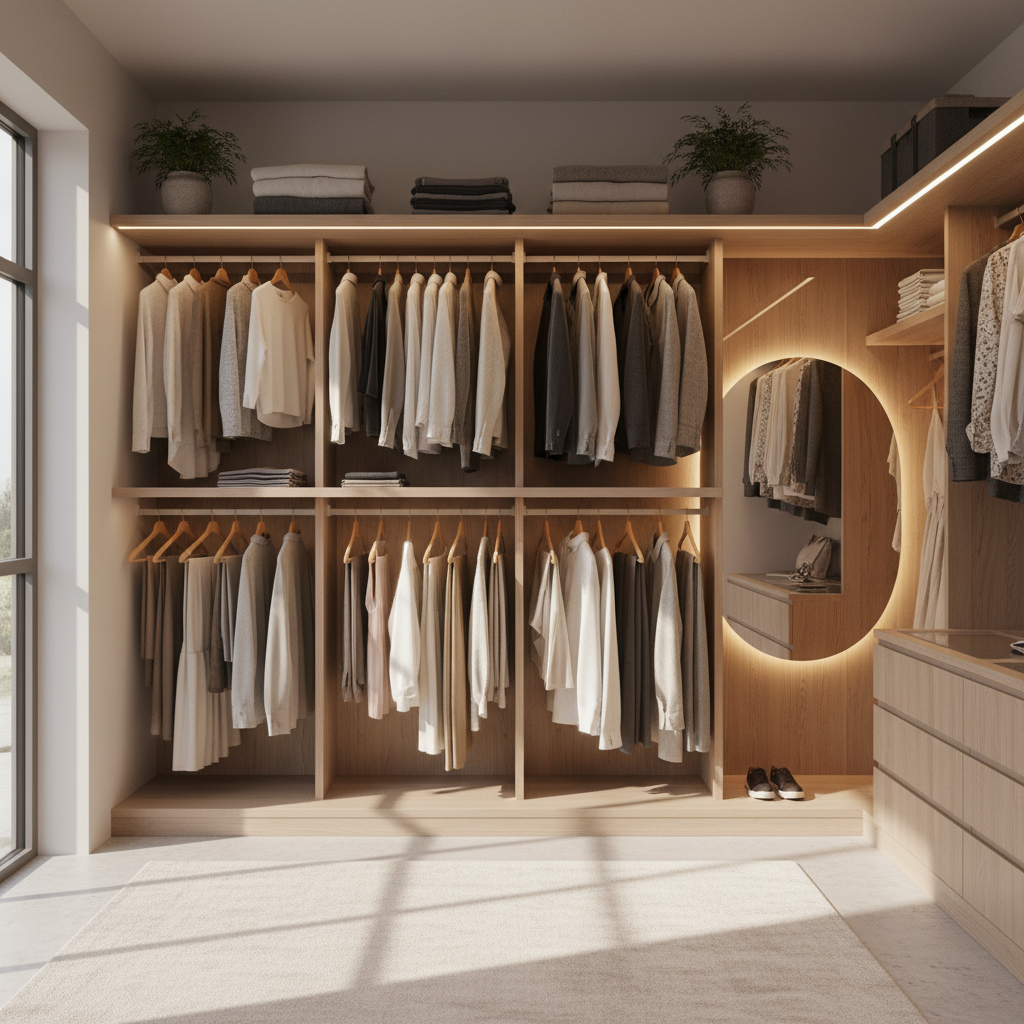
Place your closet light high up, under the top shelf or hanging rod, angled downwards and slightly forward. The goal: the beam hits the clothes, not you. It's the same principle as spotlights in high-end clothing stores: the light highlights the garments, not the space.
If you have a double hanging rod (two rods, one above the other), consider installing an LED strip light under each shelf, not just the top. The bottom row often remains in the shadow of the top row.
Don't Forget These Closet Areas
A complete closet usually has three types of spaces:
- Hanging sections: Lighting under the shelf, directed at hanging clothes.
- Folded shelves: One light at the top of each column is usually enough, but ensure bottom shelves aren't left in shadow.
- Drawers and low bins: Often overlooked. Lighting at the bottom of the hanging section can help identify shoes and accessories.
If you're looking for specific lighting solutions for closets and wardrobes, we've listed the best options by space type.
Closet Light, Strip Light, Spot: Which Solution for Your Closet?
There are several ways to light a closet. Not all offer the same practicality-to-result ratio. Here are the real no-installation options.
Rechargeable LED Light Bars: The Hassle-Free Solution
A USB-rechargeable LED light bar installs under a shelf in less than a minute. Magnetic or adhesive, no screws, no cables to hide. Charge it once, and the battery lasts for several weeks. This is the most suitable option for an existing closet you don't want to modify.
To learn more about this type of solution, our article on rechargeable LED light bars will help you compare important criteria before buying.
Recessed Spotlights: Yes, But...
A recessed spotlight in a closet ceiling is aesthetic. But it requires an electrician, a false ceiling or pre-wiring, and a budget easily between $100 and $200 per installed light point. Once installed, if you move or want to change the configuration, you can't take it with you. For most compact closets or renters, this is a disproportionate option.
Battery-Powered Lights: Avoid
Convenient in the short term, battery-powered lights always fail at the worst moment. Batteries gradually discharge, which varies light intensity and distorts color perception. They become expensive over time and are not eco-friendly. A USB-rechargeable solution is much better.
To compare all available options, check out our article on closet lighting from worst to best.
What if Your Light Turns On Automatically When You Open Your Closet?
This is where convenience makes all the difference. No more fumbling for a switch when you get up at 7 AM in the dark, or manually turning it off when you leave for work and wondering two hours later if you did.
Motion Sensor in a Closet: How It Works
A motion sensor light detects movement and turns on automatically. In a closet, it works perfectly: you approach, it lights up. You leave, it turns off after a few seconds. No waste, no fuss.
But there's an often-overlooked detail: the ambient light sensor. A good automatic closet light won't turn on if the room is already well-lit. It measures ambient brightness and only activates when necessary. Useful if your closet is adjacent to a bright room or if you use it during the day.
For more on this topic, consult our guide on automatic closet lighting, which details all criteria to consider.
Expected Battery Life for a Motion-Sensing Light Bar in a Closet
It depends on usage frequency. In motion detection mode, a light bar with a good battery (3000 mAh or more) typically lasts several weeks between charges. In practice, for a closet opened 2 to 3 times a day, we're talking about a month. This is very different from continuous mode, which consumes much more.
Continuous mode remains useful in certain cases: when you spend time in your closet organizing, decluttering, or rearranging your belongings. Having both modes available on the same light is ideal.
Key Questions Before Buying a Closet Light
No need for a 15-criterion comparison chart. The essential questions are simple:
What Length Light Bar for My Space?
The length of your light bar should match the width of your hanging section or shelf. A light bar that's too short leaves shadowed areas on the sides. In practice, a 15.7-inch (40 cm) light bar covers a standard hanging section well (23.6 to 35.4 inches wide), while a 9-inch (23 cm) light bar suits a more compact space, a single cabinet, or a temporary storage area.
Is 150 Lumens Enough for a Closet?
For a small cabinet or a single storage section, 150 lumens (9-inch format) are plenty. The space is confined, walls are close, and light reflects. For a hanging section 35.4 inches to 47.2 inches (90 cm to 1.2 m) wide, 320 lumens (15.7-inch format) provide a much more comfortable and uniform result. If you have a large L-shaped or U-shaped closet, consider multiple light points rather than one very powerful light.
Magnetic or Adhesive Mounting: Which to Choose?
Magnetic mounting is ideal for metal shelves or rods: you attach, remove, and reposition without leaving a trace. Industrial adhesive works for all other surfaces (wood, laminate). In a closet, most surfaces are laminate panels, so quality double-sided adhesive is often the primary solution. Ensure the surface is clean and dry before sticking.
Successful Closet Lighting: What Changes Daily
We underestimate the impact of good closet lighting on daily quality of life. Choosing clothes in the morning is often a source of silent stress: we hesitate, make mistakes, put things back, pick them up again. Appropriate lighting genuinely reduces this decision time by showing you exactly what you have and how colors combine.
It's not a luxury. It's a small, concrete improvement you feel from the first morning.
If you want to explore all wireless closet lighting options, we have a dedicated article comparing available alternatives based on your closet type.
The Movement 3.0 Choice for a Closet
If you're looking for a light bar that checks all the boxes without compromise, Lumic's Movement 3.0 perfectly meets these needs. It's available in 9 inches and 15.7 inches (23 cm and 40 cm), offers three color temperatures (including the essential 4000K), integrates a motion sensor and an ambient light sensor, and recharges via USB. Its 3000 mAh battery allows it to last about 4 weeks in detection mode (9-inch model) and 5 to 6 weeks for the 15.7-inch model. Mounting is magnetic and adhesive, tool-free installation in seconds.
Compared to a recessed spotlight requiring an electrician and a $100 to $200 budget per light point, the rechargeable light bar installs yourself in ten seconds and removes just as easily. For renters, in particular, it's the only truly logical option.
It comes with a 5-year warranty and a 90-day satisfaction guarantee. Customer support is US-based with a 24-hour response time. Over 2200 reviews on Trustpilot with a 4.5/5 rating.
Summary: 4 Key Points for Great Closet Lighting
For your closet lighting to truly work:
- 4000K temperature is essential: It's the only one that accurately renders your clothes' colors.
- Place high, directed at clothes: Not at the ceiling, not at your eyes.
- Multiple light points for large closets: Better three small, well-placed sources than one too strong, poorly positioned.
- Motion detection for daily convenience: Turns on when you arrive, turns off automatically.
Closet lighting is one of those details you set once and then don't notice. Except you really notice when it's done right: you step out dressed perfectly, no surprises, and without wasting ten minutes comparing two blacks that aren't really black.