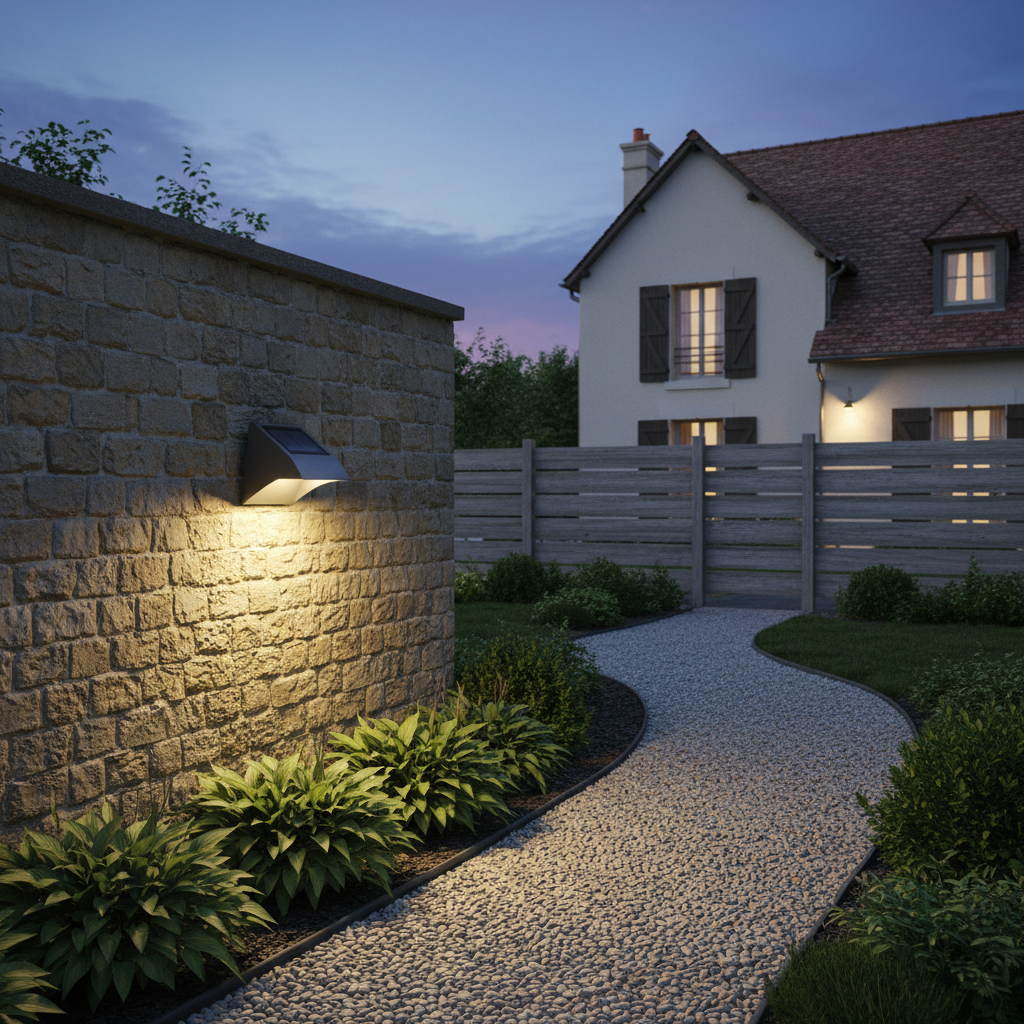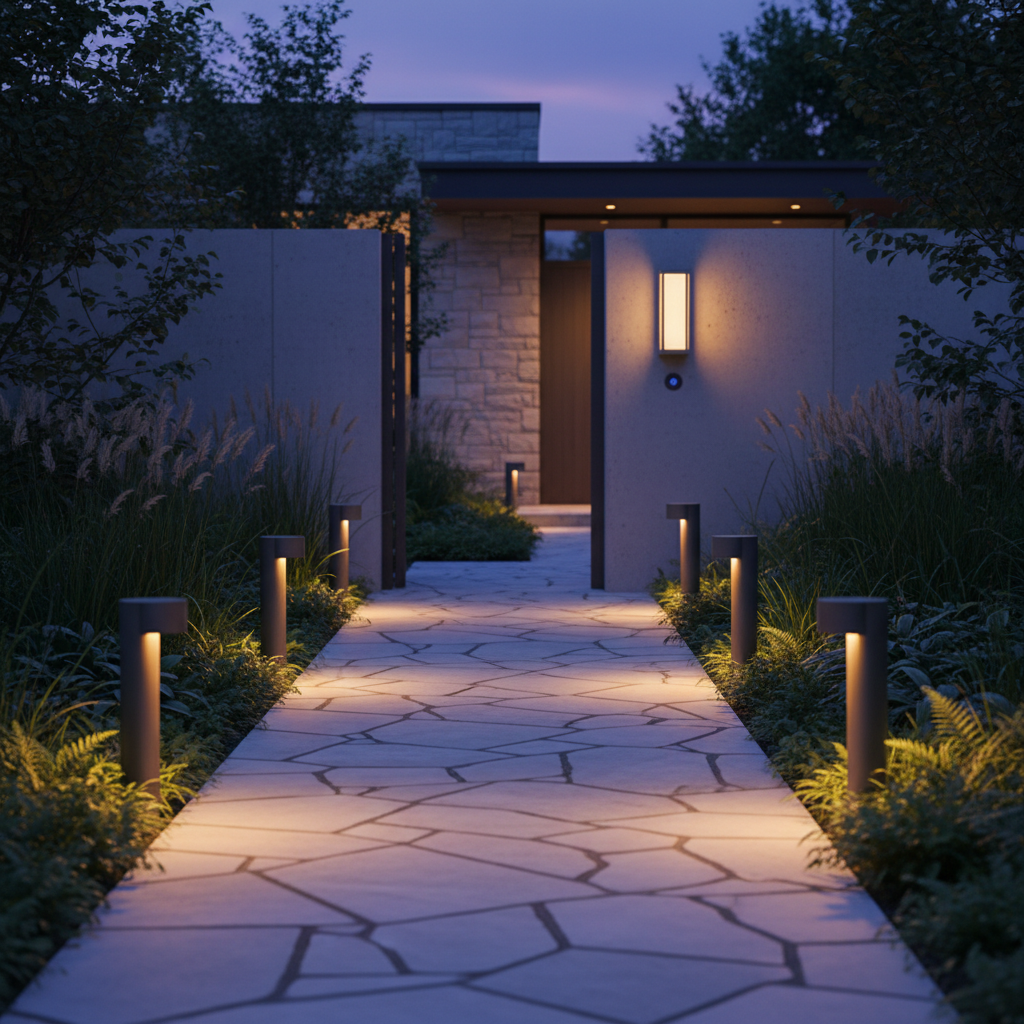
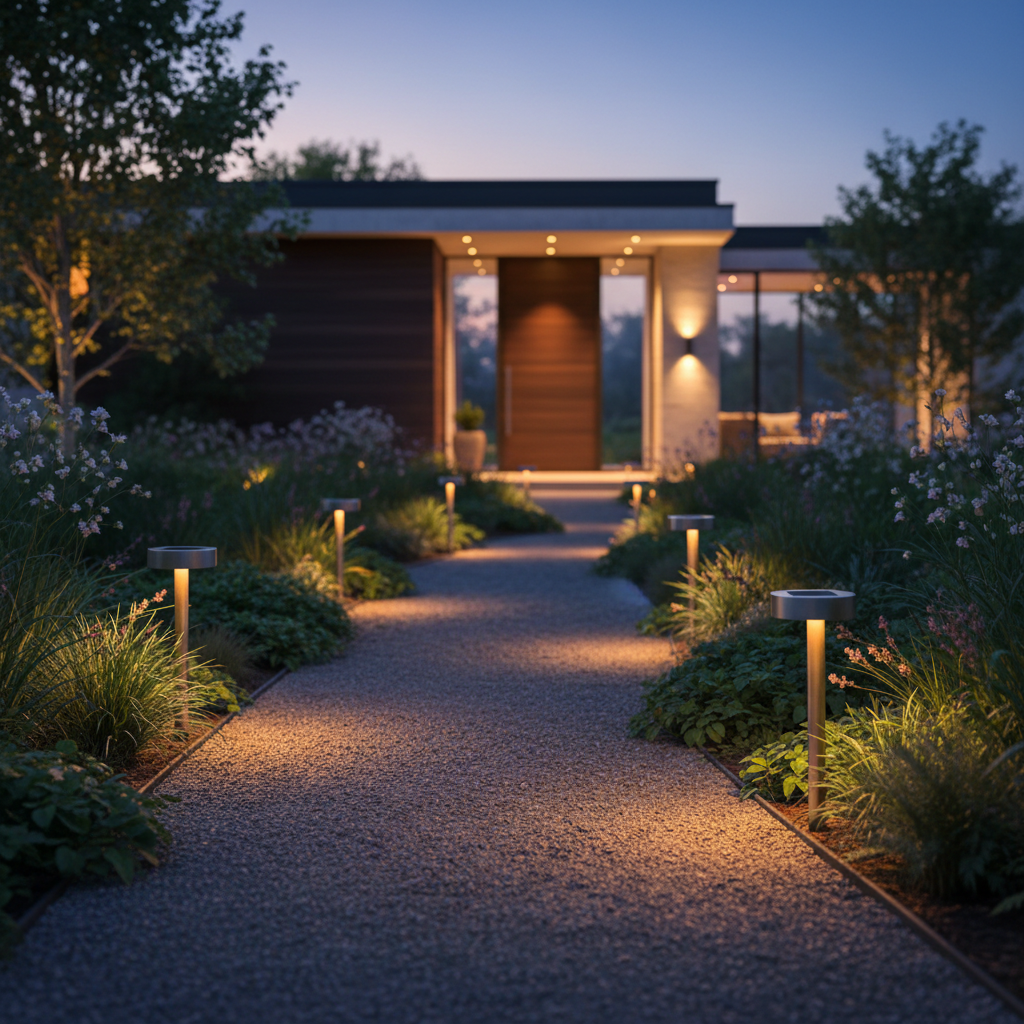
You have a gravel driveway, a wooden deck, or a winding path leading to your gate. And at night, it's pitch black. Solar garden lights solve this problem: no trenching, no electrician, no electricity bill. But with models that last three months and those that genuinely illuminate your garden for years, the choice isn't trivial.
This guide helps you choose the right solar pathway lights based on your actual needs: decorative pathway marking, path safety, or deck enhancement.
What Are Solar Garden Lights Really For?
A solar light is a luminous stake planted in the ground or placed on a surface, which automatically turns on at dusk. Its primary role is pathway lighting: visually defining a path, guiding to the front door, or securing deck edges in the dark.
Decorative Pathway Lighting vs. Functional Lighting: What's the Difference?
These are two distinct uses, requiring different equipment. A decorative pathway light emits between 20 and 50 lumens—enough to see where you're walking, create ambiance, and mark garden borders. A functional light exceeds 100 lumens, allowing easy movement in the dark. If you're just looking to beautify a pathway by guiding the eye, decorative models suffice. If you genuinely need to see where you're stepping, opt for brighter models or combine both.
Do Solar Lights Really Provide Good Illumination?
Honestly, not as much as a wired street light. This is an important point to understand before buying. Solar lights are designed for pathway marking, not to flood an area with light. If your goal is to powerfully illuminate an entrance or garage, you'll need something else—we'll discuss that below. For a path or driveway, however, they do exactly what's expected of them.
Key Factors That Truly Differentiate Models
The market is saturated with solar garden lights under $15 each. Most don't survive their first winter. Here's what distinguishes a good model from a piece of junk disguised as a lamp.
Height: Which Size for Which Use?
Solar lights range from 8 to 32 inches (20-80 cm) in height, and this isn't arbitrary. Short models (8-14 inches / 20-35 cm) are perfect for bordering flowerbeds or deck edges—discreet, they blend in without dominating. Medium-height models (16-24 inches / 40-60 cm) are suitable for pedestrian pathways: light diffuses at leg height, ideal for guiding without glare. Tall stakes (24-32 inches / 60-80 cm) are better used in grassy areas or to mark property boundaries. The rule of thumb: match the height to the surrounding vegetation.
Material: Stainless Steel or Plastic?
Plastic is lighter and cheaper, but ages poorly: it yellows, cracks with temperature variations, and the seal eventually fails. Stainless steel or aluminum resist moisture, frost, and UV rays much better. For year-round outdoor use (with its rainy winters and dry summers), definitely prioritize metal materials. The initial investment is slightly higher, but the lifespan is incomparable.
Water Resistance: The Often-Forgotten Parameter
A solar garden light should be at least IP44 (resistant to water splashes from all directions). In practice, for continuous rain exposure, IP65 is the reasonable standard. Beware of products that don't display an IP certification—it often means the manufacturer prefers not to tell you.
What Brightness for Pathway Lighting?
This is the question everyone asks, and brands don't always help with their vague descriptions. Here are concrete benchmarks.
20-50 Lumens: Ambiance and Delimitation
In this range, the light is subtle but sufficient to visually define a space. You see the path's contours, avoid stepping off the path, and it creates a pleasant evening atmosphere. This is the right choice for a wooden deck, a formal garden, or a winding path with low nighttime traffic.
80-150 Lumens: Functional Without Being Harsh
This brightness allows for comfortable movement. You can see what you're doing, carry groceries, or take out the trash without tripping. These are the most versatile models for a main pathway or home entrance.
Beyond 150 Lumens: Mostly for High-Risk Areas
Once you exceed this value, you're moving beyond the classic pathway light. Very bright models are suitable for property entrances or areas where safety takes precedence over aesthetics. For pathways, it's often excessive—it can even bother neighbors if the lights are close to a fence. For this type of need, an outdoor solar spotlight is often more appropriate than a row of overpowered pathway lights.
How to Space Solar Lights Along a Pathway?
The general rule: every 6.5 to 10 feet (2 to 3 meters). Too close, they visually saturate the space and cost more. Too far apart, the pathway lighting effect disappears, and the path remains dark between light points.
Calculate the Right Number of Lights for Your Pathway
Measure your pathway length, divide by 8 feet (2.5 meters) (average spacing), and add an extra light for each side if you want to light both edges. A 33-foot (10-meter) pathway, lit on one side every 8 feet (2.5 meters), requires about 4 to 5 lights. If you light both sides staggered (alternating sides rather than face-to-face), you can go up to 11.5 feet (3.5 meters) apart while maintaining the visual effect—and you cut the budget in half.
Should Lights Be Placed in a Straight Line or Staggered?
Staggered lights give a more natural impression of depth and movement than a symmetrical double row. It's also more economical. A straight-line arrangement on both sides is more suitable for formal entrances or wide pathways (over 6.5 feet / 2 meters). For a standard garden path, staggering is often the best visual and budgetary option.
Solar vs. Wired Pathway Lighting: The Real Calculation
Installing wired pathway lights along a path involves digging a trench, laying an electrical conduit, connecting it to the electrical panel—and often hiring an electrician. The total cost of such an installation can easily exceed $1,000 to $2,000 depending on the pathway length and your property's configuration.
Solar lights, on the other hand, are simply planted in the ground or fixed to a surface without any cables. Zero trenching, zero electrician, zero extra subscription on your electricity bill. The initial investment is focused on the product itself, and that's where it ends. For wireless outdoor lighting, this is the strongest argument.
The honest nuance: solar lights depend on sunlight. If your pathway is under dense trees or faces north, their performance will be limited. This is the only real disadvantage to consider.
Solar Lights in Winter: What They Don't Tell You
This is the big question everyone forgets to ask before buying. In winter, days are short, the sun stays low, and temperatures can drop below freezing. The vast majority of low-end lights charge their batteries poorly and turn off after only a few hours.
How to Know if a Light Will Last in Winter?
Two things to check: battery capacity and the quality of the integrated solar panel. A low-capacity battery doesn't store enough energy to last a long winter night. A poor-quality solar panel doesn't capture enough diffuse light on a cloudy December day. Serious models explicitly state their performance in low sunlight. If it's not mentioned, it's rarely a good sign. Our article on solar lights that work in winter details this point in depth.
The Battery: The Component That Truly Makes a Difference
On a solar light, as with any solar lamp, the battery determines the lighting duration. A good capacity battery, properly protected from frost, ensures several hours of light even after a less sunny day. Lithium-ion batteries resist cold better than NiMH batteries. If the seller doesn't specify the battery type, it's usually a sign that it's low-end. To learn more about this topic, see our article on the importance of the battery for solar lights.
What About the Garden Entrance?
Solar lights mark a path, but they don't really illuminate an area. For your property entrance—gate, garage access, service door—you need more powerful light that triggers at the right moment.
This is where motion sensor solar lighting makes perfect sense, complementing pathway lights. The pathway lights guide the eye along the path. The motion sensor floods the entrance with light as soon as someone arrives. The two systems don't do the same job: they complement each other naturally. Consult our guide on motion sensor solar lighting to choose the right model for your entrance configuration.
If you're comparing options available in stores, our comparison of Home Depot / Lowe's solar lights can help you understand what big box stores offer compared to specialists.
Comparison Chart: Which Type of Solar Light for Your Needs?
| Usage Profile | Recommended Brightness | Ideal Height | Recommended Material | Spacing |
|---|---|---|---|---|
| Deck ambiance / decorative | 20-50 lumens | 8-14 inches (20-35 cm) | Stainless steel or glass | 5-6.5 feet (1.5-2 m) |
| Main pathway lighting | 50-100 lumens | 16-24 inches (40-60 cm) | Aluminum / stainless steel | 6.5-10 feet (2-3 m) |
| Wooded path | 100-150 lumens | 20-28 inches (50-70 cm) | Treated aluminum | 6.5-8 feet (2-2.5 m) |
| Flowerbed / lawn delimitation | 20-40 lumens | 8-12 inches (20-30 cm) | Reinforced plastic or stainless steel | 3-6.5 feet (1-2 m) |
| Property entrance (security) | Supplement with motion sensor | 24-32 inches (60-80 cm) | Stainless steel or cast iron | 5-6.5 feet (1.5-2 m) (near gate) |
What to Check Before Buying Solar Lights
Before confirming an order, here's a quick checklist of points to verify. They often make the difference between a satisfying purchase and a disappointment six months later.
- IP rating: at least IP44, ideally IP65 for direct rain exposure.
- Body material: stainless steel or aluminum rather than plastic, especially if you're in a coastal area or have cold winters.
- Battery capacity: the higher it is, the longer the light lasts after a cloudy day.
- Battery type: lithium-ion preferred, for better cold resistance.
- Solar panel surface area: a large panel captures more diffuse light, crucial in winter or partial shade.
- Warranty and customer support: a manufacturer who doesn't guarantee their product for at least 2 years deserves suspicion.
- Mounting method: stake planted in the ground, screw-on base, or suction cup depending on your mounting surface.
Summary: Key Takeaways for Choosing Wisely
Solar garden lights are pathway tools, not floodlights. Their role is to define, guide, and create ambiance—not to flood an area with light. Once this is understood, the choice becomes much simpler.
Prefer stainless steel or aluminum over plastic, check the IP rating, and match brightness to use: 20-50 lumens for decorative, 80-150 lumens for functional. Space your lights every 6.5 to 10 feet (2 to 3 meters), staggered if you're on a budget. And if you also want to secure your entrance, combine pathway lights with motion sensor lighting—the two systems complement each other perfectly without replacing one another.
To delve deeper into choosing a powerful solar garden light suitable for other areas of your outdoor space, consult our dedicated guide.