You wake up at night, fumbling in the hallway, searching for the light switch in the dark. Or you open your closet with both hands and can't see a thing. These everyday frustrations? An indoor motion sensor light eliminates them completely — no electrical installation, no need for an electrician.
But between cheap battery-powered models that die after three weeks and truly practical solutions, the choice isn't always obvious. This guide gives you the key criteria for making the right choice.
What an Indoor Motion Sensor Really Does (and What We Expect From It)
A motion sensor light automatically turns on when it detects presence, then turns off by itself after a few seconds or minutes. That's the basic function. But how this detection works makes all the difference in daily use.
How Does an Indoor PIR Sensor Work?
Almost all automatic indoor lights use a PIR (Passive Infrared Sensor). This sensor detects variations in infrared heat — in other words, it senses the movement of a warm body within its detection field. It's reliable, fast, and energy-efficient.
What you need to know: a PIR sensor does not detect movement through walls or objects. It needs a direct line of sight. So, its detection angle and range are important criteria to check before buying.
Why Add an Ambient Light Sensor?
The best lights combine the PIR sensor with a light sensor. The result: the light only turns on if it's dark enough. In broad daylight with natural light, it stays off — even if you walk past it. This is what differentiates a smart light from one that turns on for no reason every five minutes.
This dual sensor significantly extends battery life and prevents unnecessary activations that eventually become annoying.
Automatic Detection Mode or Continuous Mode: Which to Choose?
Most modern indoor lights offer two modes:
- Detection Mode: The light only turns on when it detects motion, and in the dark. Ideal for hallways, stairs, closets, restrooms. Maximum battery life.
- Continuous Mode: The light stays on permanently, like a regular light. Practical for a kitchen countertop when you're cooking. Reduced battery life.
Having both options on the same light is a clear advantage for adapting to every use case.
Where an Automatic Light Truly Changes Your Life
An indoor motion sensor light is not a gadget. Placed in the right spot, it quickly becomes indispensable.
Under Kitchen Cabinets and Countertops
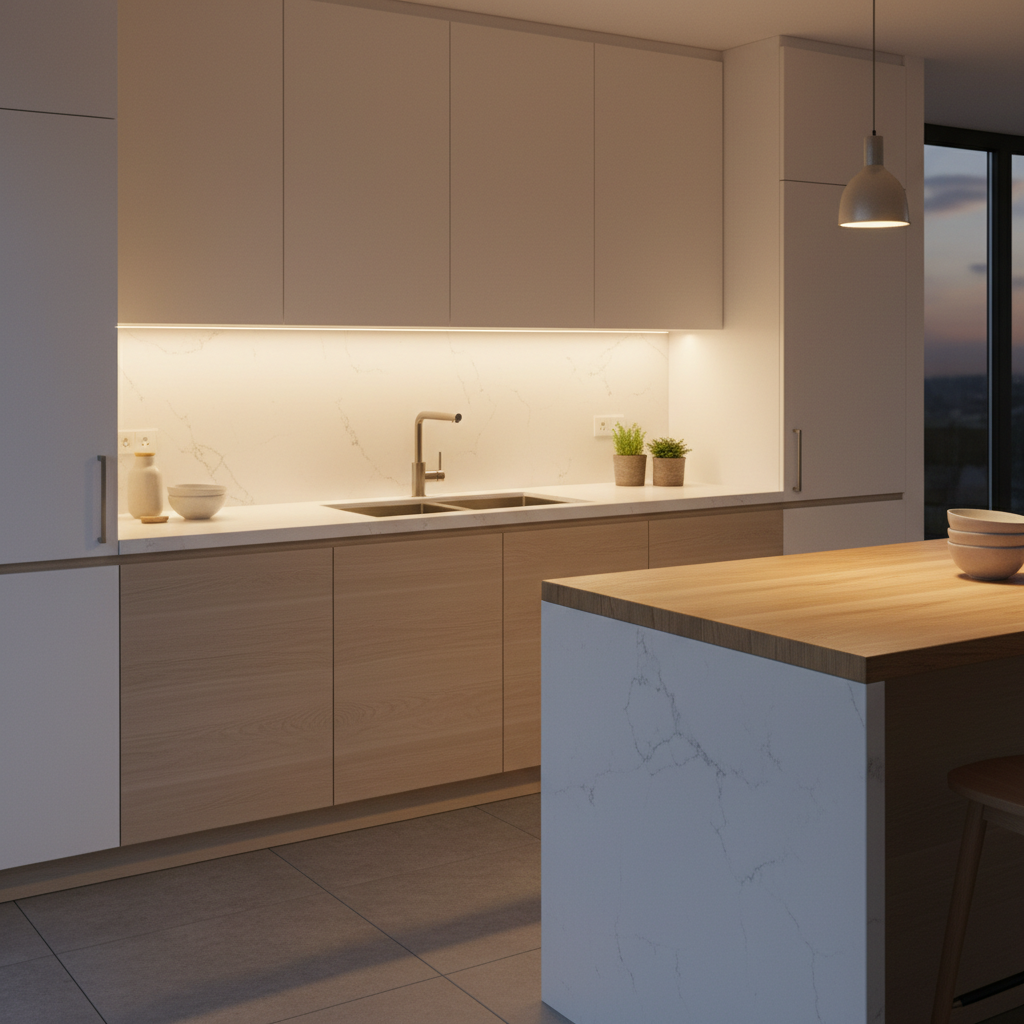
Your kitchen ceiling light illuminates the room, not your countertop. You often work in your own shadow. An LED light bar under upper cabinets solves this problem permanently: it turns on when you approach, illuminates exactly where you're cutting or preparing, then turns off by itself. No switch to search for, no wasted energy.
For this use, the length of the light bar matters: 15.7 inches (40 cm) is good for a standard countertop, 9.1 inches (23 cm) for a more restricted space like a coffee nook or a niche.
In Closets, Wardrobes, and Cabinets
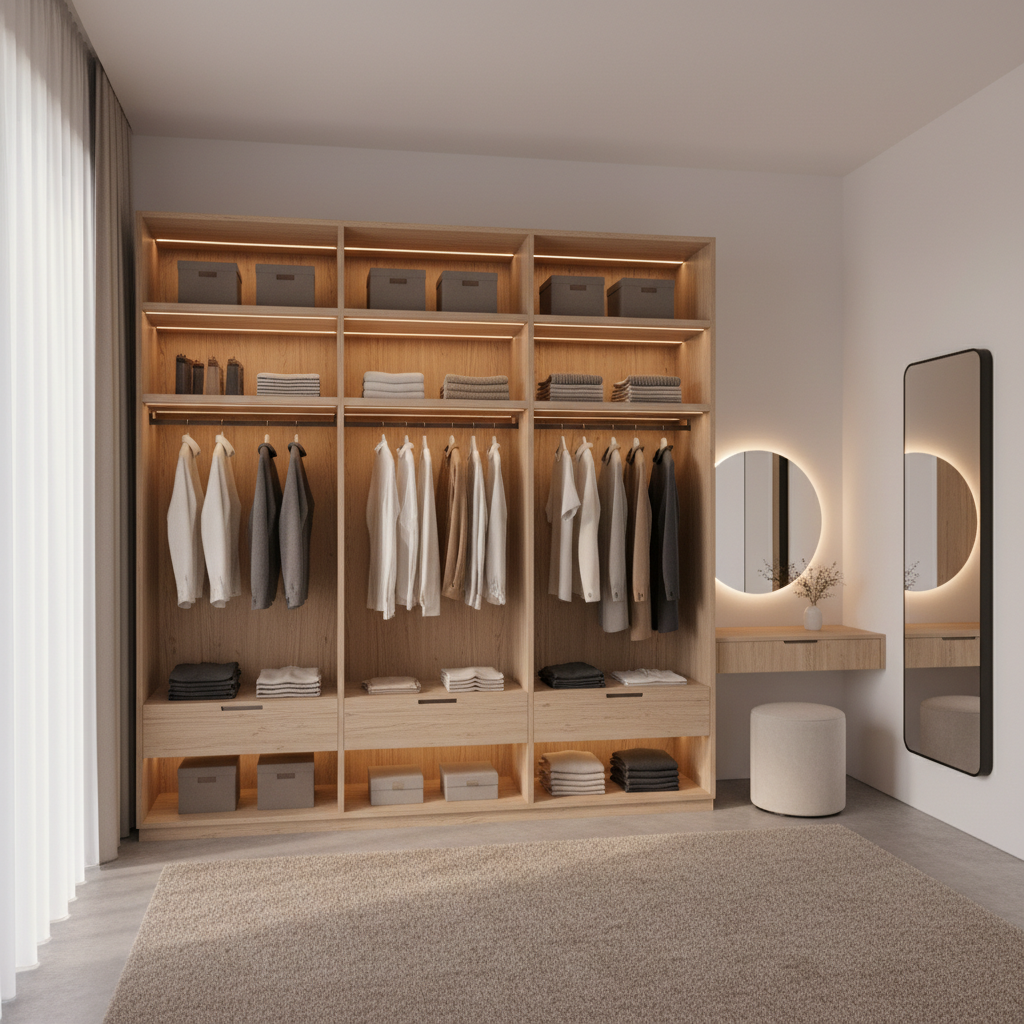
Closet lighting is often an afterthought in home decor. We often make do with a phone flashlight. A motion sensor light changes that: you open the door, the light automatically turns on. You close it, it turns off. Simple, efficient, zero wasted consumption.
For closed wardrobes or deep cabinets, continuous mode can be useful when you're searching for something for a long time. Detection mode is perfectly sufficient for quick daily access.
Hallways, Stairs, and Restrooms at Night
Getting up at night and turning on a too-bright light is the best way to ruin your sleep afterward. A motion sensor light in the hallway or on the stairs turns on softly, just enough to prevent tripping, without assaulting your eyes. The chosen color temperature (warm white at 3000K) plays an important role here.
In windowless restrooms, an automatic light is also a practical solution for children or seniors who don't want to search for the light switch in the dark.
Key Technical Criteria That Truly Make a Difference
You don't need an electronics degree to choose a good motion sensor light. Here's what really matters.
Battery Life and Power Source
This is the point where most people are disappointed with low-end lights. AAA or AA battery-powered models seem convenient to buy, but the batteries drain quickly — sometimes in a few weeks if the light turns on frequently. The result: constantly changing batteries, waste, and accumulating costs.
Lights with an integrated USB rechargeable battery are clearly superior in the long run. You recharge about once a month (in detection mode), and that's it. Battery size is crucial: a 3000 mAh battery offers significantly longer life than a 1000-1200 mAh battery often found on entry-level models.
Color Temperature According to Use
The choice of color temperature depends on the location and time of use:
| Temperature | Atmosphere | Ideal For |
|---|---|---|
| 3000K (Warm White) | Cozy, soft ambiance | Hallways, bedroom, living room, night |
| 4000K (Neutral White) | Balanced, natural | Kitchen, office, versatile |
| 6000K (Cool White) | Bright, stimulating | Garage, basement, workshop |
For nighttime use (getting up at night, hallways), warm white at 3000K is clearly recommended. For kitchen use during the day, neutral or cool white provides better visibility for food preparation. The ability to adjust brightness is a real plus depending on the context.
Mounting: Magnetic, Adhesive, or Screwed?
For an indoor light without major installation, two systems dominate:
- Industrial Adhesive: Sticks directly to the surface (wood, laminate, tile). Simple and discreet. The quality of the adhesive is crucial — a low-quality adhesive will fail under heat or the weight of the light.
- Magnetic Mounting: The bracket adheres to the surface, and the light attaches magnetically. This allows you to easily remove the light for recharging without detaching the bracket. It's often more practical for daily use.
The ideal solution: a system that combines both. An adhesive bracket installed once, and a light that clips/unclips magnetically when you need to recharge it. No need to remove everything just to plug in a USB cable.
Lumens: How Many Do You Need?
Lumens measure light intensity. For indoor use:
- 100-200 lumens are sufficient for a closet, a narrow entryway, a hallway at night, or a drawer.
- 250-350 lumens are needed for a kitchen countertop, a wardrobe, or stairs where you really need good visibility.
Beyond that, in an enclosed indoor space, it's often excessive and potentially dazzling. The ability to adjust brightness allows you to adapt to each situation without constantly setting everything to maximum.
What to Avoid When Choosing an Automatic Indoor Light
Disposable Battery Lights
We repeat this because it's truly the most common pitfall: battery-powered lights seem cheaper to buy, but they cost more in the long run. And changing batteries in a high cabinet or under a kitchen cabinet is a chore. USB rechargeable lights are more practical, more economical, and more eco-friendly.
Models Without Dual Sensors (PIR Only)
A light with only a PIR sensor will turn on day and night, as soon as there's movement. It drains much faster, and it can turn on for no reason in broad daylight — which eventually becomes annoying. The dual sensor (motion + ambient light) is truly essential for peaceful daily use.
Lengths Unsuited to the Space
A light bar that's too short on a large countertop creates shadows. Too long in a small closet, it protrudes or doesn't fit properly. Measure the space before ordering — it seems obvious, but it's the most common mistake in customer returns.
The Movement 3.0: Why It's a Frequent Choice
If you're looking for a rechargeable, no-drill indoor motion sensor light, the Movement 3.0 by Lumic is a serious option to consider. It combines the criteria that truly matter: dual sensor (PIR + light), 3000 mAh USB rechargeable battery, magnetic mounting on an adhesive bracket, and two available lengths (9.1 inches (23 cm) for ~150 lumens, 15.7 inches (40 cm) for ~320 lumens).
In detection mode, battery life is around one month to five weeks, depending on the model and frequency of use. You recharge it when it's empty — just like your phone. No batteries, no drilling, no electrician. It installs in less than a minute, making it suitable for both renters and homeowners.
The three color temperatures (3000K, 4000K, 6000K) with adjustable brightness allow it to be used in any context — kitchen during the day with neutral white, hallway at night with warm white. The 5-year warranty and 90-day money-back guarantee give you time to truly test it risk-free. Reviews on Trustpilot (4.5/5 from over 2200 ratings) confirm that this solution delivers on its promises over time.
To learn more about choosing an LED light bar with a sensor, consult our comparison of LED light bars with motion sensors, which details the different models available for various uses.
No-Drill Installation: Is It Really Possible?
Does Industrial Adhesive Really Hold?
This is the legitimate question everyone asks. A quality industrial double-sided adhesive, correctly applied to a clean, degreased surface, easily supports the weight of an aluminum LED light bar. The surface must be dry, clean, and smooth — laminate, painted wood, tile, metal. On textured wallpaper or stucco, adhesion is less reliable.
Practical tip: clean the surface with isopropyl alcohol before applying the bracket, wait 24 hours before using the light, and it will hold. Really.
How Long Does Installation Take?
With a magnetic + adhesive system, installation takes less than a minute: you clean the surface, stick the bracket, attach the light. No tools, no screws, no cables to run. It's designed so that even someone who isn't handy can do it alone.
If you have doubts about installation in a specific context — furniture with a curved surface, very restricted space — the practical guides available on the website detail the most common configurations. You can also consult our guide on lighting without electricity for similar situations.
What People Who Use It Daily Think
The most frequent feedback on indoor motion sensor lights focuses on a few recurring points, consistently found in online reviews:
- The automatic function is what convinces people most quickly — you only realize its value once you've used it for a few days.
- USB rechargeable is unanimously preferred over batteries after using both.
- The dual sensor prevents annoying false activations that occur with PIR-only models.
- The chosen length is often underestimated — many wish they had opted for the longer version in hindsight.
On Trustpilot, Lumic reviews (4.5/5 from over 2200 ratings) regularly mention ease of installation and battery life as the two most appreciated strengths.
Summary: Key Points for Making the Right Choice
Before ordering an indoor motion sensor light, check these five points:
- Dual sensor is mandatory (PIR + ambient light) — otherwise, it will turn on constantly.
- USB rechargeable battery rather than disposable batteries — for battery life, savings, and convenience.
- Length adapted to the space — measure before ordering.
- Color temperature suited to use — 3000K for night and living areas, 4000K for the kitchen during the day.
- Reliable mounting — industrial adhesive or removable magnetic system for easy recharging.
A well-chosen indoor motion sensor light provides subtle but real comfort in daily life. It blends seamlessly into the decor — you don't see it, you don't think about the switch, and you no longer change batteries. It's exactly the kind of small improvement that seems trivial until the day you can't live without it.