
You come home after dark, arms full, and need to go up or down your porch steps. Without proper lighting, this is the most dangerous area outside your home. Deck or entrance stairs account for a significant number of accidental falls at home, and in most cases, the cause is simple: you can't see where you're stepping.
Good news: many different solutions exist, depending on your budget, stair type, and tolerance for installation work. This article helps you choose the right one, honestly, even when the most aesthetic solution is also the most demanding.
Why Outdoor Stair Lighting is a Safety Priority
A poorly lit step at night is a real danger, not just a matter of comfort. The problem isn't always a total lack of light: a poorly positioned wall sconce, a ceiling light that illuminates your head but not your feet, or a cheap solar lamp that stops working after 6 months — these situations create a false sense of security.
What you want is reliable, automatically triggered lighting that truly illuminates the tread of each step, not just the surrounding area. And ideally, something that doesn't require weeks of work to install.
Outdoor Stairs: Specific Technical Constraints
Unlike indoor stairs, outdoor steps are exposed to moisture, frost, and temperature variations. Any buried or embedded electrical cable or housing must be perfectly waterproof. Otherwise, water infiltration is guaranteed, leading to cracks with the first freeze. This is a constraint many homeowners underestimate when considering recessed spotlights in each step.
How much light intensity is needed to properly illuminate stairs at night?
You don't need blinding light. The goal isn't to illuminate the entire street, but to clearly distinguish the edge of each step. In practice, a well-positioned light source with a few hundred lumens is sufficient for a 4 to 8-step staircase. What matters more than raw power is the beam angle and the position of the light source relative to the steps.
Recessed Spotlights per Step: Most Beautiful, but Real Work Involved
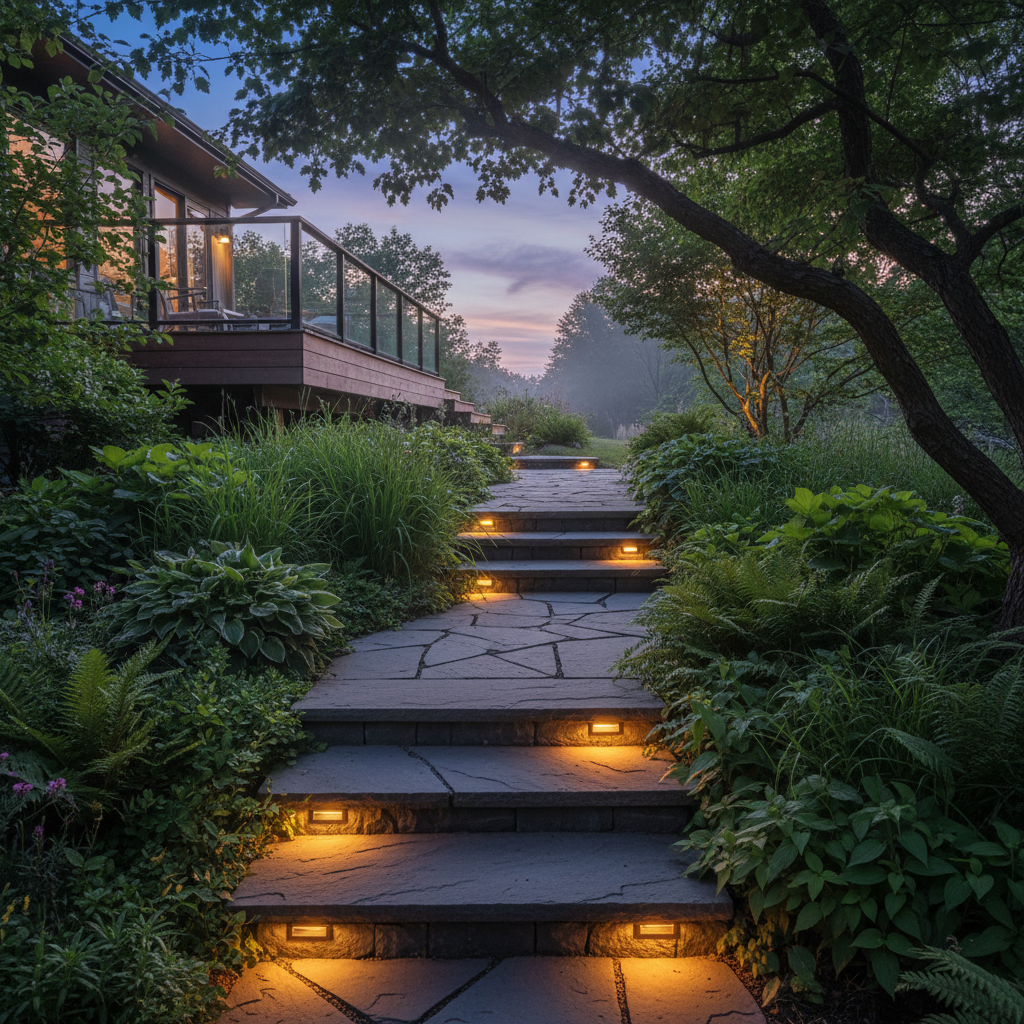
Recessed spotlights in each riser offer the most elegant result. For new construction or major renovations, this is clearly the preferred solution if aesthetics are an absolute priority. Each step is individually lit, wiring is integrated into the masonry, and the finish is clean.
Why it's Complicated for Existing Stairs
For an already built staircase, it's a different story. Drilling each step or riser to run an electrical cable creates potential water entry points. An untreated concrete or stone step that absorbs moisture into its wiring can lead to micro-cracks with the first freeze, or even accelerated masonry degradation.
Not to mention the cost: hiring an electrician to install IP65 (waterproof) recessed spotlights in 6 existing steps, with trenching and electrical connection, is a serious undertaking. This is not a weekend DIY project for a beginner.
Who is this Solution Really For?
If you're building or completely renovating your outdoor staircase, integrate the spotlights from the start. Wiring should be planned before pouring concrete or laying slabs. Otherwise, the technical and financial drawbacks often outweigh the aesthetic benefits. For an honest comparison of different LED solutions suitable for outdoor stairs, check out our comparison of LED lighting solutions for outdoor stairs.
Waterproof LED Strip Light at the Edge of Each Step: An Intermediate Option
An LED strip light (or tape light) attaches under the nose of each step, on the riser, to create a discreet but effective luminous border. It's less intrusive than recessed spotlights, but still a semi-technical installation.
Things to Check Before Starting
An outdoor LED strip light must be rated at least IP65. The connections (power supply, junctions) must also be protected from moisture. In practice, this means a secure outdoor power supply, protective conduit for cables, and adhesive or fasteners suitable for stone or concrete.
The result is appealing on wood or composite steps, where the adhesive backing of the strip holds well. On rough concrete or irregular stone, adhesion is often insufficient in the long term.
LED Strip Light and Winter Resistance
Most standard LED strip lights poorly withstand repeated freeze/thaw cycles. If you live in a region with cold winters, carefully check the thermal resistance specifications before purchasing. This is often the weakness of entry-level solutions sold at big box stores.
Wall Sconce with Motion Sensor: The Quickest Solution
Placing a wall sconce or motion-sensing light at the top (or bottom) of the stairs is the easiest solution to install and often the most effective for daily safety. A single, well-positioned light source can illuminate an entire staircase of 4 to 8 steps.
Where to Position the Sconce to Light All Steps
The ideal mounting point is at the top of the stairs, slightly forward of the landing, at a height of 6.5 to 8 feet (2 to 2.5 meters) from the ground. This position allows light to diffuse diagonally downwards, illuminating the nose of each step rather than casting shadows on the risers.
If your wall is too recessed or your entrance configuration is unusual, a side mounting point (on a wall perpendicular to the stairs) can also work. The key is that the light comes from the side or above, not directly in line with the ascent of the stairs.
Wired or Wireless: Two Very Different Scenarios
A wired wall sconce requires an electrical power point accessible from the wall. If you have one, that's ideal. If not, drilling into the wall and running a cable to the electrical panel is more electrician's work — with the associated costs.
This is where solar lighting changes the game. No cables to run, no electrical box needed, no intervention on the electrical panel. You mount the light on the wall, orient the solar panel towards the sky, and you're done. To learn all about the different technologies available, our article on wireless lighting technologies covers all the details.
Solar Lighting for Outdoor Stairs: Zero Cables, Zero Step Drilling
A solar lamp with a motion sensor placed at the top of a staircase is the most direct answer to the safety problem — without creating new problems. No cables in the steps, so no risk of infiltration. No electrical connection, so no electrician needed. And no electricity bill for this use.
Does a Solar Lamp Really Work in Winter?
This is the legitimate question most people ask if they've ever had a cheap solar lamp that died by November. The answer depends entirely on the quality of the solar panel and battery capacity.
Entry-level lamps have tiny panels and anemic batteries. The result: they work fine in July, and die earlier and earlier in the fall. In winter under cloudy skies, they are often unusable.
A solar lamp with a significantly larger panel and high-capacity battery continues to charge even on cloudy days and can last several weeks in motion-sensing mode without seeing the sun. This is exactly what people looking for a reliable year-round solution, not just for summer evenings, need. To delve deeper into this topic, our guide on outdoor solar lighting covers all scenarios.
How much light output is needed to illuminate a deck staircase?
For a 4 to 8-step outdoor staircase, a lamp delivering around 1000 lumens in motion-sensing mode is largely sufficient. The main thing is that the light is well-directed towards the steps and not towards the faces of people ascending. A motion detection range of about 26 feet (8 meters) covers most residential stair configurations.
How Lumic's SolarGlow Performs for This Use
If you want a serious solar lamp for your outdoor stairs, Lumic's SolarGlow is an option to consider. It delivers 1200 lumens, features two motion sensors covering 180°, with a range of about 26 feet (8 meters). Its IP65 rating makes it resistant to rain, snow, and frost.
What sets it apart from standard solar lamps is its solar panel size (about 3 times larger than entry-level alternatives) and battery capacity (about 4 times greater). In practice, it can last up to 20 days in motion-sensing mode without solar recharge, meaning it continues to function during long periods of bad weather.
Installation is wireless and takes just minutes. Mount it on a wall, orient the panel, and motion detection activates automatically at dusk. For a porch staircase or deck, it offers the most balanced practicality/efficiency ratio. Lumic provides a 5-year warranty and a 90-day refund policy, allowing ample time to test it in real-world conditions, even in the dead of winter.
If you want to compare SolarGlow with other types of autonomous outdoor lights, our dedicated article details the key criteria to look for.
Comparative Table of 3 Outdoor Stair Lighting Solutions
| Criterion | Recessed Spotlights per Step | LED Strip Light Under Step | Wall Sconce/Solar Lamp at Top |
|---|---|---|---|
| Ease of Installation | Heavy construction work | Semi-technical | Very easy |
| Water Infiltration Risk | High (step drilling) | Moderate | None (no step drilling) |
| Winter Resistance | Good if properly installed | Varies by quality | Good (IP65) |
| Automatic Detection | Possible (higher cost) | Rarely integrated | Yes, integrated |
| Installation Cost | High (electrician) | Moderate | Low to none |
| Aesthetic Result | Excellent | Good | Discreet and functional |
| Ideal For | New construction | Partial renovation | Existing stairs, renters |
Safety or Aesthetics: How to Choose Based on Your Situation
The honest answer is that it mostly depends on the current state of your stairs.
You're Building or Completely Renovating
This is the time to integrate recessed spotlights into the risers. Do it during masonry work, with IP67 rated enclosures and wiring planned from the design phase. This is the only situation where this solution is truly recommendable without reservation.
Your Stairs are Already Built and You Want a Quick Solution
A wall sconce or solar lamp at the top of the stairs is clearly the way to go. You don't have to touch the steps, don't need an electrician, and the safety result is immediate. A single, well-placed light source with good detection range covers the entire staircase.
You're a Renter or Don't Want to Drill into Walls
Wireless solar is your only real no-work option. No electrical point needed, no drilling into masonry, and you can take it with you if you move. To refine your choice based on your outdoor configuration, solutions for stair step lighting are detailed in our dedicated guide.
For those still torn between safety and aesthetics, our article on LED stair lighting safety and aesthetics explores both dimensions in depth.
Recap: Key Takeaways for Lighting Your Outdoor Stairs
Outdoor stair lighting is not a decorative luxury; it's a concrete safety measure. Here are the essential points to keep in mind:
- Recessed spotlights per step are beautiful, but require heavy construction or renovation. On existing stairs, drilling into steps for cables creates risks of infiltration and frost.
- LED strip lights are an intermediate solution suitable for wood or composite steps, but require careful attention to waterproofing and frost resistance.
- A wall sconce or solar lamp at the top of the stairs is the quickest and often most effective solution: a well-positioned light source with automatic detection covers all steps without touching the masonry.
- Reliable year-round solar lighting exists, provided you choose a lamp with a genuinely large solar panel and battery capacity, not an entry-level model.
- Motion detection is a key criterion: it ensures light is there when you need it, without wasting energy the rest of the time.
Whatever solution you choose, the main thing is that it's reliable, you don't have to think about it after installation, and it withstands outdoor conditions over time. Secure your steps before the next winter.