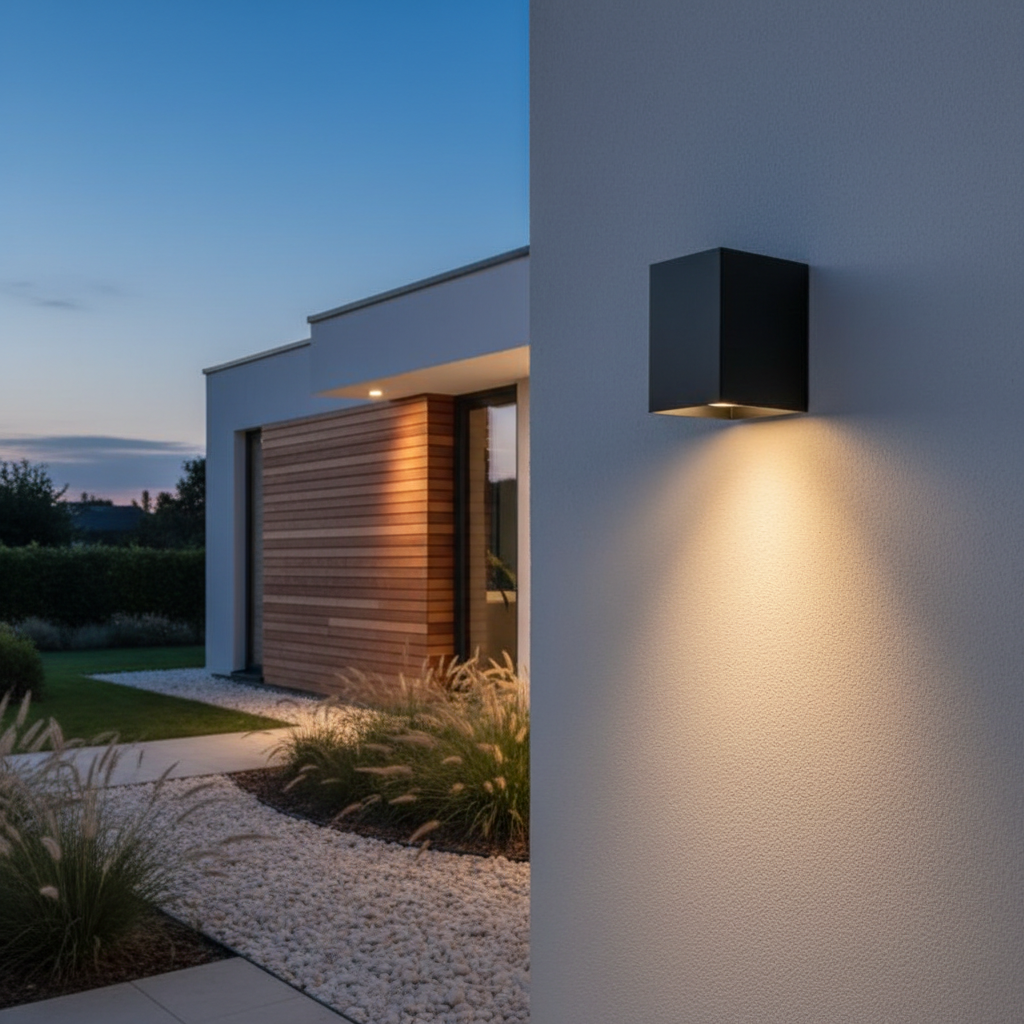
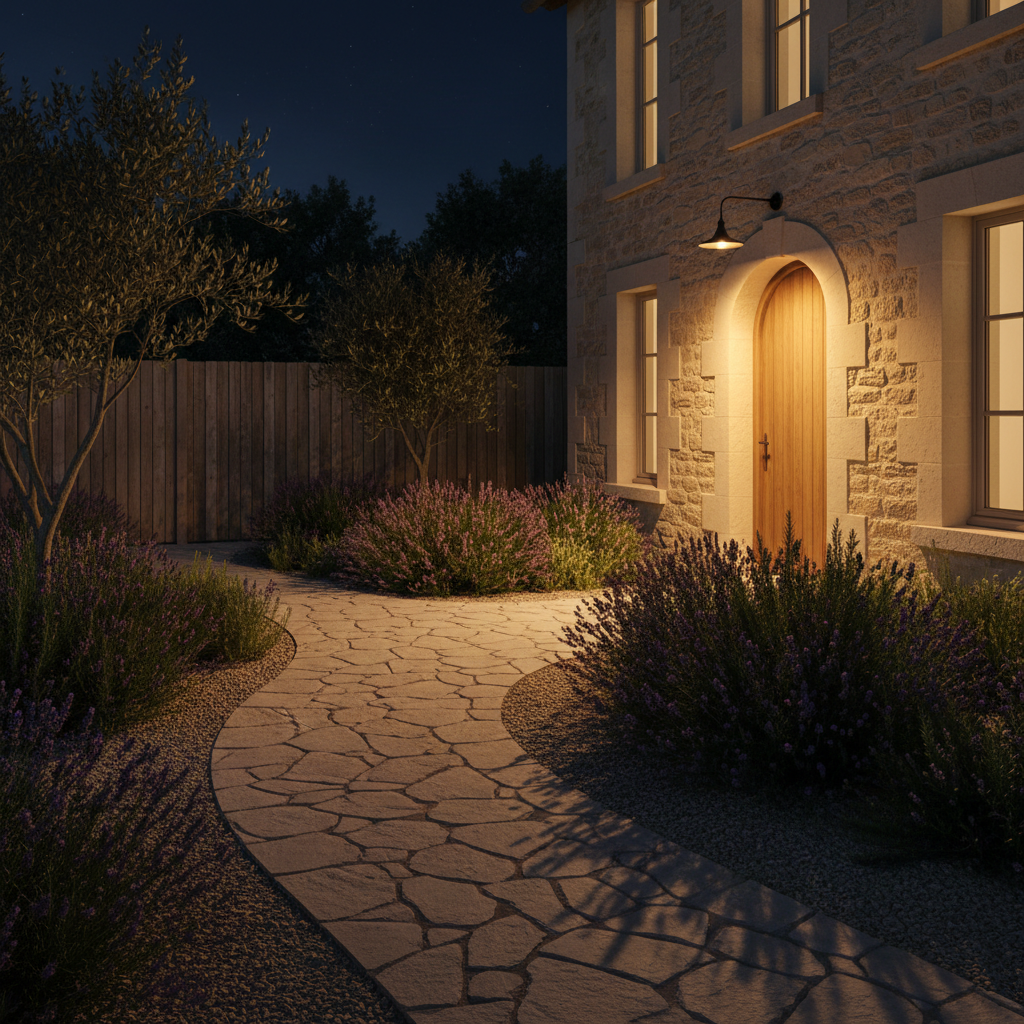
You arrive home, arms full of groceries. It's dark. You're fumbling for your keys in front of your door. Then, the light automatically turns on. That's a well-chosen outdoor motion sensor light — not a gadget, but a true everyday convenience.
But convenience is only half the picture. The other half is security. A light that turns on at the slightest movement in your driveway or in front of your gate can be a game-changer for deterring nighttime intrusions. The question is: which type should you choose, how should you place it, and is wired really better than solar?
This guide provides concrete answers, without technical jargon.
What a Motion Sensor Light Really Does
An outdoor motion sensor light combines two sensors: a PIR (Passive Infrared) sensor that detects moving body heat, and an ambient light sensor that prevents the lamp from turning on unnecessarily during the day. The result: the light only turns on when someone passes by, and only when it's dark enough.
How Does the PIR Sensor Work?
The PIR sensor detects changes in heat within its field of view. When a person, animal, or vehicle crosses the detection zone, the temperature difference between the body and the environment triggers the light. Most models have a detection range between 16 and 39 feet (5 and 12 meters), depending on their quality.
Key takeaway: angular range is as important as distance range. A sensor with a 90° horizontal coverage will miss someone passing on the side. 180° models cover an entire driveway from a side wall. To learn more about settings to avoid false alarms, check out our article on adjusting your motion sensor's sensitivity.
The Light Sensor: What's its Practical Use?
Without a dusk-to-dawn sensor, your lamp would turn on even at 2 PM in the summer when a cat walks by. The light sensor blocks activation above a certain natural light threshold. Result: zero wasted power during the day. This is what differentiates a self-sufficient lamp that lasts for weeks from one that drains in a few days.
Illumination Duration and Timer
Most outdoor motion sensor lights stay on for 15 seconds to 5 minutes after the last detection. Some models allow you to adjust this duration. For a 30-foot (10-meter) driveway, 30 to 60 seconds is usually enough. For a parking lot or a longer area to cross, extend it to 2-3 minutes.
Two Uses for an Automatic Outdoor Light
Many people buy a motion sensor lamp solely for convenience. Less than half realize it's also an effective security tool, and for different reasons.
Convenience Use: Never Fumble for Keys in the Dark Again
This is the everyday use. Arriving home after 9 PM, parking your car, bringing in groceries. Having your hands free without doing anything. The lamp turns on automatically as you approach, illuminates your path while you open the door, then turns off. This scenario, repeated every evening, significantly improves quality of life — it's not a luxury.
It's also valuable for nighttime outings: taking out the trash, grabbing something from the garage, letting the dog out. An automatic outdoor light conveniently replaces fumbling for a switch in the dark in all these situations.
Security Use: Deterrence and Detection
A light that suddenly turns on in the dark has an immediate effect on someone who shouldn't be there: they are surprised, exposed, visible. Most intrusion attempts target poorly lit areas. An entrance equipped with a motion sensor light is statistically less attractive to someone looking to act discreetly.
There's a second, less obvious effect: you're alerted. If you're home and see your outdoor light turn on at 2 AM for no apparent reason, you know there's movement outside. It's not an alarm, but it's a signal.
Wired or Solar: What Nobody Really Tells You
This is the central question. And honestly, both have their advantages — but not the same ones. For a complete analysis, we also wrote a dedicated article on wired or solar outdoor motion sensor lights.
Wired: Powerful, But Not Without Constraints
A wired motion sensor light is connected directly to the electrical grid. Advantage: it can deliver very high light output continuously, without depending on weather or battery status. For highly exposed areas or large spaces requiring constant, intense illumination, wired remains the technical standard.
But here's what's often overlooked: installation costs range from $200 to $500 by hiring an electrician, sometimes more depending on the location. You need to run a cable from the electrical panel, drill through exterior walls, and comply with IP standards. It's not a DIY weekend project for everyone.
And there's a rarely mentioned security point: an outdoor cable can be located and cut. It's not common, but it's possible. For someone wanting to act unnoticed, neutralizing an accessible wired light is technically feasible.
Solar: Self-Sufficient, and Without Physical Weak Points
A solar motion sensor light has no external cables. No wire to locate, no connection to cut. This is its most underestimated security advantage: it's structurally harder to discreetly neutralize.
The other obvious advantage: installation in minutes, anywhere, without an electrician. Brick wall, wooden fence, metal post — as long as there's sunlight, you can install it.
The real constraint of solar is its dependence on weather. Several consecutive cloudy days in winter can reduce available battery life. This is why the size of the solar panel and internal battery makes a huge difference between a cheap model that dies in November and one designed to work year-round.
Comparison Table: Wired vs. Solar
| Criterion | Wired | Solar |
|---|---|---|
| Installation Cost | $200-$500 (electrician) | $0 (DIY) |
| Continuous Power | Very High | Limited (battery) |
| Weather Dependence | None | Yes (sunlight) |
| Cuttable Cable | Yes | No |
| Installation Without Work | No | Yes |
| Suitable for Renters | Rarely | Yes |
| Maintenance | Low | Panel Cleaning |
Where to Place Your Motion Sensor Light for Maximum Usefulness
Placement determines 80% of effectiveness. A good lamp poorly positioned will be frustrating: too many false alarms, or conversely, blind spots where you need coverage.
Entrance and Main Door
This is the #1 placement. Ideally, the lamp is mounted high (8-10 feet / 2.5-3 meters) and oriented to detect someone before they reach the door. If it only turns on once you're already there, the convenience effect is reduced. Aim for a detection zone that starts 10-13 feet (3-4 meters) from the door.
Driveway, Gate, and Garage
For a driveway, two symmetrical lights (one on each side) avoid blind spots. For a gate, a high-mounted lamp with a 180° sensor covers the entire entrance from a central point. For a garage, the light should turn on before you arrive — not when you're trying to find the opener button.
Wall Corners and Secondary Areas
House corners are strategic placements for security: they allow you to cover two facades with a single lamp. For areas like the back patio or side of the house, consider the direction people actually pass through — not just proximity to the wall.
If you want to go further in optimizing your outdoor setup, our guide on powerful wireless outdoor lighting covers multi-sensor configurations and difficult areas.
Criteria to Check Before Buying
The market is saturated with models under $20 that last two winters if you're lucky. Here's what distinguishes a durable purchase from a bad surprise.
IP Rating: The #1 Criterion for Outdoors
An outdoor lamp must have a minimum IP65 rating. The first digit (6) means it's totally protected against dust. The second (5) means it resists direct water jets. Below IP65, you risk infiltration during heavy rain or freezing temperatures. Some models show IP44 or IP54 — this is insufficient for prolonged exposure to harsh weather.
Sensor Angular Coverage
Two lamps with the same range in feet can have very different detection fields. A 90° horizontal sensor suits a hallway or narrow entrance. A 180° sensor is necessary to cover a wide driveway, an open garage, or an entire house facade. For complex configurations, you can even find models with two independent sensors — eliminating blind spots without adding a second lamp.
Brightness: Lumens and Real-World Use
For a standard driveway or entrance, 800 to 1200 lumens are ample. Beyond that, you risk dazzling your neighbors or creating an unpleasant spotlight effect. For large spaces like a parking lot or a big yard, go for 1500-2000 lumens. What matters is not just total power, but also the quality of light diffusion — a beam that's too concentrated creates significant shadows around its axis.
Resistance to Extreme Temperatures
In the US/Canada, outdoor temperatures vary widely, from below 0°F (-18°C) in winter to over 100°F (38°C) in summer. Check that the advertised operating range covers at least -4°F to +122°F (-20°C to +50°C). Li-ion batteries (used in solar models) are sensitive to cold: a good capacity battery will compensate for performance loss at low temperatures, whereas a small battery will be dead by January.
The Solar Solution for Zero Installation Work
If you're a renter, if your desired location lacks an accessible electrical outlet, or if you simply want to avoid construction and electrician fees, solar is the logical answer. To delve deeper, read our article on solar motion sensor lights.
The SolarGlow by Lumic is our answer to a recurring problem: cheap solar lamps that work fine from April to September, then become useless in winter due to insufficient panels and batteries. It features a solar panel and battery sized to last up to 20 days without solar recharge in detection mode — covering typical cloudy periods.
It delivers 1200 lumens with two 180° PIR sensors and an 26-foot (8-meter) range. The IP65 rating covers rain, snow, and frost. Installation is cable-free, electrician-free, and takes minutes. For those seeking broader coverage, our article on solar floodlights with detectors explores higher-power options.
It comes with a 5-year warranty and a 90-day money-back guarantee. Customer support is US-based with a 24-hour response time. As with all our products, customer reviews on Trustpilot (4.5/5 from over 2200 reviews) provide insight into real-world feedback.
Common Mistakes to Avoid
Even with a good lamp, poor placement or incorrect settings can ruin the experience. Here are the most frequent problems and how to avoid them.
Pointing the Sensor Towards the Road
If your PIR sensor has a direct line of sight to a busy street or road, it will turn on every 30 seconds all night due to cars. Always orient the sensor perpendicular to the traffic flow or at an angle that excludes the road from its field of view.
Neglecting Static Heat Sources
A still-warm grill, an air conditioner blowing hot air, a chimney flue — all of these can trigger a PIR sensor. Before permanently mounting your lamp, test its reaction to everything in its field of view for 24 hours.
Installing Too Low
A lamp mounted below 6.5 feet (2 meters) has too limited a detection angle towards the ground and is more vulnerable to manual obstruction. The ideal height is between 8 and 11.5 feet (2.5 and 3.5 meters) for most residential installations.
Key Takeaways for Choosing Wisely
A well-chosen outdoor motion sensor light does two things at once: it simplifies your daily life and enhances your home's security. These two goals are not mutually exclusive — they are cumulative.
The wired versus solar choice primarily depends on your context: if you already have an accessible electrical point and want maximum power without weather constraints, wired is suitable (but budget for installation). If you want flexibility, zero installation work, and prefer no accessible outdoor cables, quality solar is the best compromise.
To further your consideration, our guide on choosing your outdoor motion detector compares technical criteria in detail, and our guide on solar motion detection lighting covers the specifics of autonomous solutions.
The final criterion? That your lamp still works flawlessly in two years. Check the IP65 rating, battery capacity if it's solar, and the manufacturer's warranty before finalizing your purchase.