You have a wall. You want to light it. And you want it to actually work, not just for the first three weeks before the light dies from lack of charge. Good news: a well-chosen and well-placed outdoor solar wall light can work year-round without a single wire, no electrician, no extension cord buried in the yard.
But here's what most guides don't tell you: the product matters less than where you install it. The wall's orientation, mounting height, nearby environment... these factors make all the difference between a light that turns on every night for five years and one that fails by November.
This guide gives you the real rules. No fluff.
Why a Solar Wall Light Instead of a Stake or Ground Light?
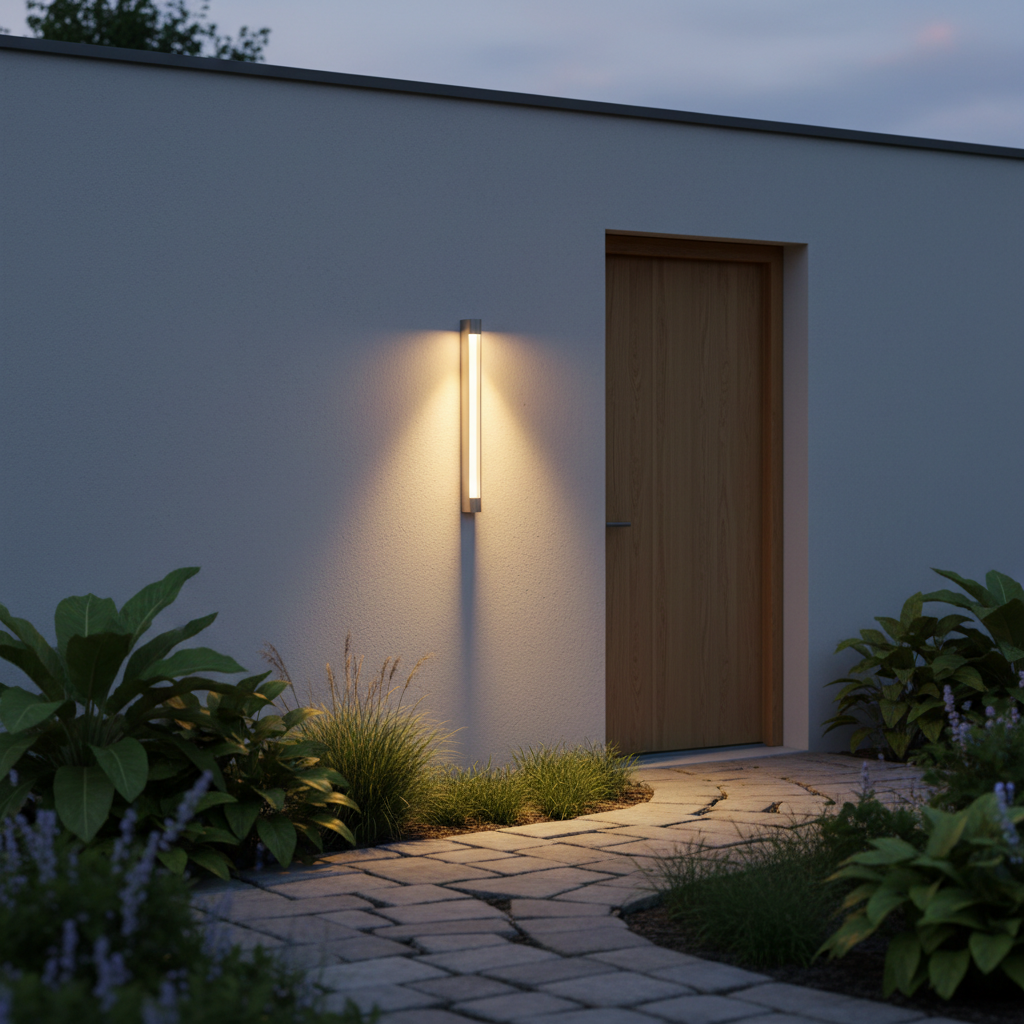
Height changes everything. An outdoor solar wall light mounted between 6.5 and 8.2 feet (2 and 2.5 meters) covers a much larger area than a garden stake light placed 20 inches (50 cm) off the ground. It illuminates an entire pathway, a garage entrance, outdoor stairs, or a patio corner.
Which Locations Benefit Most from a Solar Wall Sconce?
The four areas that truly benefit from a solar wall sconce are:
- Main Entrance: Welcome visitors, find your keys, see who's at the door. A light at 6.5 feet (2 m) with a motion sensor solves all these problems at once.
- Garage Side: A high-traffic area in the evening, often poorly lit. The light turns on when you approach, then turns off automatically. Practical and sleek.
- Patio or Outdoor Stairs: Safety first. A poorly lit step in the dark is a common accident waiting to happen. A well-aimed sconce eliminates this risk without visible cables.
- Fence or Gate: A real deterrent effect. A light that activates with motion at your property entrance is something opportunists prefer to avoid.
What Height Should You Mount an Outdoor Solar Wall Light?
The ideal height is between 6.5 and 8.2 feet (2 and 2.5 meters). Below this, the motion sensor's beam will be too short and too directional. Above 8.2 feet (2.5 m), detection becomes less precise, and ground illumination loses intensity. This range offers a good compromise between sensor range, illuminated area, and solar panel efficiency.
Wall Orientation: The Underestimated Factor
This is where it counts. You can buy the best outdoor solar wall light on the market, but if it's on a north-facing wall with a tree in front, it will barely charge in winter. Orientation directly dictates the amount of energy harvested daily.
Which Wall to Choose for a Solar Facade Light?
Here's a quick breakdown by orientation:
| Wall Orientation | Average Sunlight (Winter) | Verdict |
|---|---|---|
| South-facing | Optimal year-round | Perfect, works without compromise |
| Southeast / Southwest | Very good | Excellent choice, slight loss in winter |
| East or West | Good in summer, weak in winter | OK if large solar panel |
| North-facing | Very weak, especially Dec-Feb | Borderline case, even with a large panel |
Most solar wall lights sold in stores have tiny integrated panels, sometimes as small as 2x2 inches (5x5 cm). On an east or west-facing wall, this type of panel doesn't capture enough light in winter to maintain proper autonomy. Result: the light dies before 10 PM in December, or stops turning on altogether after a few cloudy days.
To learn about other criteria beyond orientation, our complete guide to choosing your outdoor solar wall light details each point with concrete examples.
Can a North-Facing Wall Still Work with a Solar Light?
This is a borderline case. In summer, even a north-facing wall receives enough indirect light to charge a battery. But in December and January, short days combined with a lack of direct sun make recharging very unreliable. If this is your only available wall, opt for a model with a large solar panel and high-capacity battery. But be honest with yourself: you won't get the same performance as a south-facing wall, no matter what the packaging promises.
What the Solar Panel Reveals About the Light
On Home Depot or Lowe's shelves, most solar facade lights look pretty similar. Same shape, same promises. Yet, one criterion radically separates them: the size of the solar panel.
Why is Solar Panel Size So Important?
A larger panel captures more light, even diffuse light. In winter under a cloudy sky, it's not direct brightness that's most lacking, it's the quantity of photons your panel can absorb. A tiny panel quickly saturates in mid-summer but becomes useless as soon as the sky turns gray.
In practice, entry-level lights often have panels of a few square inches. Serious models have panels two to three times larger, which makes all the difference on east, west, and even partially north orientations in autumn.
This logic guides the choice for powerful outdoor solar lighting: light output depends as much on the panel as on the LEDs themselves.
Autonomy: How Many Sunless Days Can a Good Solar Light Last?
A light equipped with a good capacity battery can maintain normal activity for several consecutive cloudy days, or even two to three weeks in motion detection mode. This is where you differentiate between a light that fails after the first rain and one that sails through winter without a hitch.
For reliable lighting in all seasons, the combination of a generous battery + large panel is not a luxury, it's a necessity. Consult our guide on solar lights that work in winter to understand exactly what happens to your battery in December.
Motion Sensor: Why It's the Smartest Default Mode
A solar wall light continuously on all night means a dead battery by dawn. Motion detection mode is why these lights can last for weeks without recharging: they only turn on when needed.
How Does the Motion Sensor Work on an Outdoor Solar Wall Light?
Most modern lights combine two sensors: a motion sensor (PIR) and an ambient light sensor. The principle: the light can only turn on when it's dark enough. During the day, even if you pass by, it won't react. At night, as soon as a presence is detected in the coverage area, it turns on immediately then turns off after a few seconds or minutes, depending on the setting.
The concrete result: your battery lasts much longer than in continuous mode, and you only light when necessary. It's both economical and smart. If you want to delve deeper into this, here's how to choose your solar light with motion sensor according to your specific use.
What Range Can You Expect from a Motion Sensor on a Wall Sconce Mounted at 6.5 feet (2m)?
Mounted at 6.5 feet (2 meters) high, a good sconce generally covers an arc-shaped area in front of it, with a real range of 20 to 33 feet (6 to 10 meters) depending on the model. A 180-degree sensor detects lateral movements, not just frontal ones. This is an important criterion for an entrance or gate where passages don't always come from the same direction.
Installation: 2 Screws and 10 Minutes, Really?
Yes, if you choose wisely. A wireless outdoor solar wall light requires no wiring, no plastering, no electrical work. Two screws in the wall (or industrial adhesive on some models), and it's installed.
What Materials Do You Need to Install a Solar Sconce on an Outdoor Wall?
For most classic wall-mount models:
- A drill with a bit suitable for the material (concrete, cinder block, brick)
- Two anchors and two screws (usually included)
- A spirit level to ensure the light is straight
- A screwdriver or appropriate wrench
Allow 10 to 15 minutes for someone who isn't a DIY expert. No electrician needed. No need to cut the circuit breaker. For an entrance or facade, this saves considerable time and money compared to a wired installation, which can easily cost between $300 and $500 with a professional.
To go further on installation and avoid common mistakes, consult our guide on how to choose and install your outdoor solar sconce.
Can an Outdoor Solar Wall Light Be Installed Without Drilling?
On certain surfaces (PVC, painted metal, tile), industrial adhesive systems can avoid drilling. This is convenient for renters or walls where drilling is difficult. However, for an outdoor wall mounting exposed to wind and weather, screw fixation remains more reliable long-term. Adhesive can peel off in hot weather or after several freeze-thaw cycles.
What to Expect from a Good Solar Facade Light
To summarize without jargon, here's what a solar wall light worth its price should do:
- Turn on with every passage, even in cloudy weather after several gray days. Not just in summer.
- Last for weeks in detection mode without solar recharge. If it only lasts 4 to 5 days, it's insufficient.
- Withstand weather: rain, frost, heat. A minimum IP65 rating is the serious threshold for outdoor installation.
- Cover a wide area with its sensor, not just the area directly in front of it.
- Be reliable for several years, not just the first season.
Lumic's SolarGlow meets these criteria: 1200 lumens, two 180-degree motion sensors with a range of about 26 feet (8 meters), IP65, and a battery sized to last up to 20 days in detection mode without solar input. It's precisely on this last point that many entry-level lights fall short: a few gray days and they're dead. For east or west-facing walls where winter days combine gray skies and low sunlight, this autonomy margin makes all the difference. With a 5-year warranty and a 90-day satisfaction guarantee, it's also a risk-free installation.
If you want to compare available market options with objective criteria, this guide on how to choose a reliable outdoor solar light fixture will give you a clear framework.
Checklist Before Buying Your Solar Wall Light
Before ordering, answer these questions honestly:
- What is your wall's orientation? South-facing: go for it. East or west: check the panel size. Pure north: reconsider the location if possible.
- Are there any obstacles? Tree, eaves, nearby neighbor: even slight shading reduces charge by half.
- What area do you want to cover? A narrow entrance or a 26-foot (8-meter) pathway: the choice of sensor and light output changes.
- What minimum autonomy do you need? If you're on a ten-day vacation in January, your light must last on its own without solar recharge.
- What's your DIY skill level? Simple drilling or need industrial adhesive: match the model to the wall.
A well-chosen and well-placed outdoor solar wall light is an installation you forget about after it's set up. It turns on, it turns off, it lasts through winter. The secret, you now have it: the wall's orientation determines everything else.