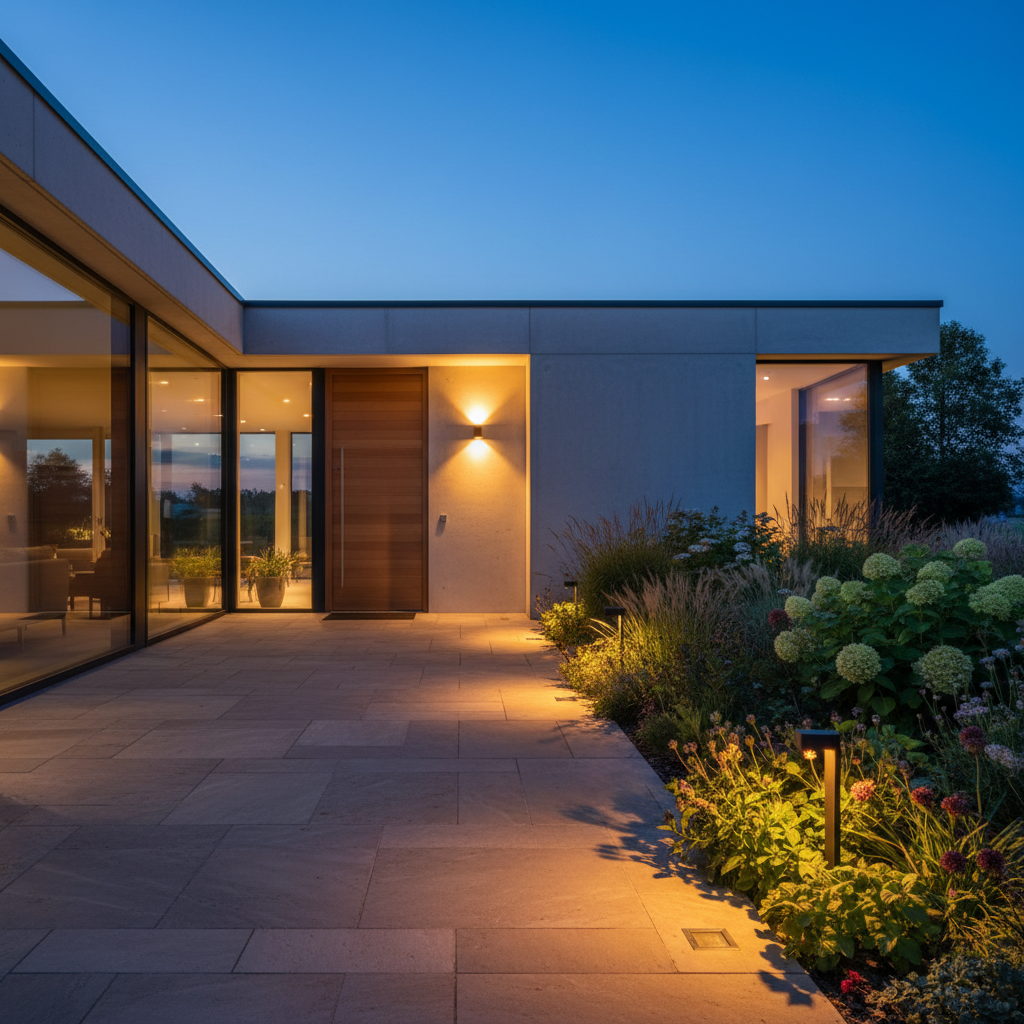
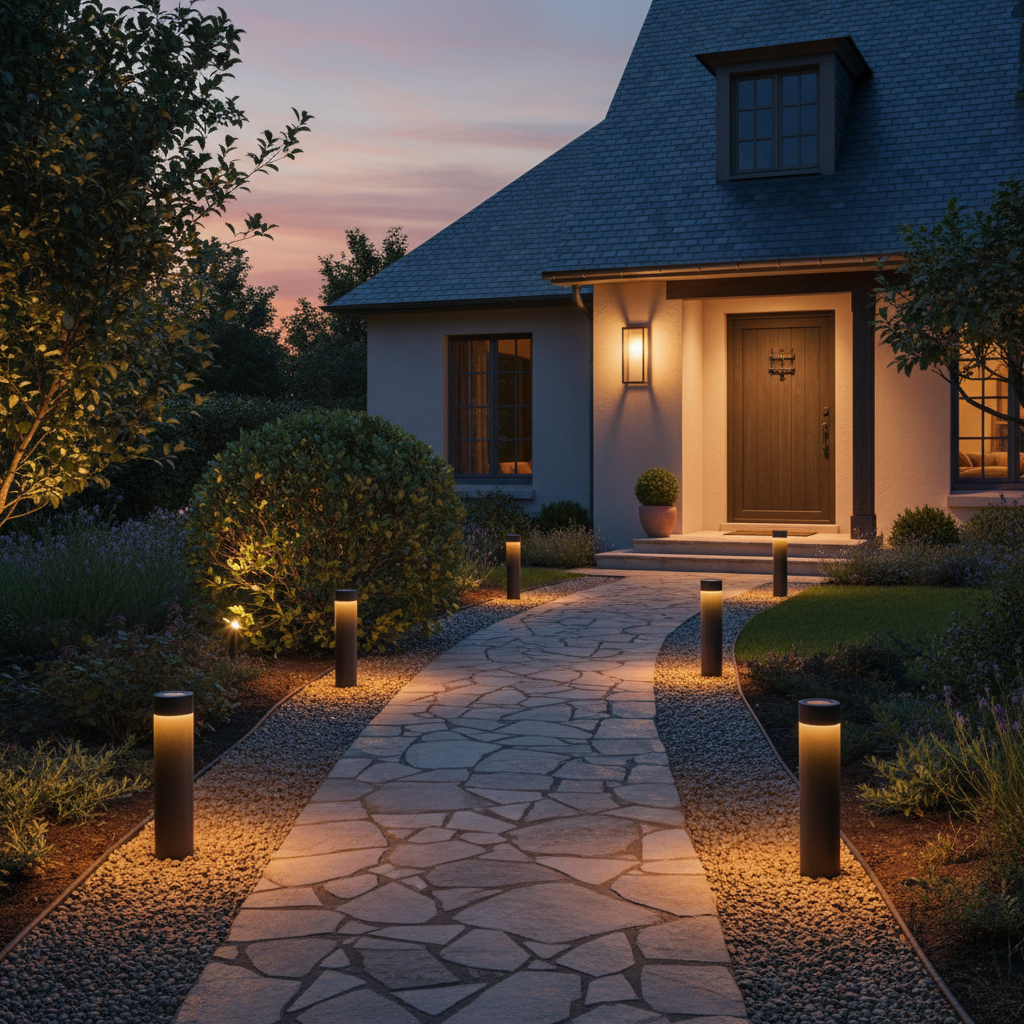
Want to light up your yard, patio, or driveway without hiring an electrician? Good news: outdoor solar lighting has come a long way. Forget those cheap solar lights that die after 20 minutes when the sky gets cloudy. Today's serious models last all night, turn on automatically, and install in under five minutes.
But here's the problem: there are dozens of different types on the market, and choosing the wrong product for the wrong use is a recipe for disappointment. A garden path light to illuminate a house entrance? Insufficient. A 1200-lumen floodlight to mark a pathway? Overkill.
This guide introduces each category of outdoor solar lighting, its real-world use, and the three technical criteria to check before buying: actual lumens, battery capacity in mAh, and solar panel surface area. These three numbers tell you everything.
Top 3 Technical Criteria to Know Before Buying
Many people get fooled by marketing numbers. A manufacturer might claim "800 lumens" as a peak for a one-second flash, while the actual continuous light output is two to three times lower. Here's how to honestly read a product spec sheet.
Actual Lumens: Not Just Peak Numbers
Lumens measure the amount of light produced. A typical desk lamp is around 400-600 lumens. Effective security lighting for a house entrance needs at least 800-1000 lumens. When you see "3000 lumens" on a $15 solar floodlight, be wary: this is almost always the peak value for a fraction of a second, not the sustained actual output.
Always look for products that list lumens in normal or continuous mode, not just flash mode.
Battery Capacity in mAh: The True Indicator of Runtime
The higher the mAh, the more solar energy the light can store to illuminate for longer after sunset. A 1000 mAh battery will give you a few hours in continuous mode per night. A 4000 mAh battery can last several consecutive nights, even without sun.
This criterion is especially important in regions where several consecutive cloudy days are common in fall and winter.
Solar Panel Surface Area: What Determines Recharging
A small solar panel integrated directly into a lamp's housing won't capture much during the day. Serious models use larger panels, sometimes remote, that absorb more energy even on partially cloudy days. The combination of a large panel + large battery allows a light to continue working for several days without direct sunlight.
Now that we have the basics, here's how to choose based on your actual needs.
Solar Wall Sconces: Ideal for Entrances and Facades
A solar wall sconce mounts directly to a wall, facade, or pillar. It's the natural choice for a house entrance, gate, or along a patio. It illuminates downwards or sideways, creates ambiance, and can include a motion sensor for security.
When to Choose a Sconce Over a Floodlight?
A sconce is suitable when you want both functional light and a decorative effect. A floodlight, on the other hand, is adjustable and designed to illuminate a specific area, but it's often less aesthetic on a facade. If your home's entrance is also an area you want to highlight, a sconce is more appropriate.
For entrances requiring serious security lighting, some sconces integrate motion sensors with an 26-foot (8-meter) range and sufficient brightness to deter. This is exactly what the Lumic SolarGlow does: 1200 lumens, two 180° sensors to cover a wide area, and 20 days of autonomy without solar recharge thanks to its high-capacity battery. It installs wirelessly (adhesive included) or with two screws, depending on your preference. For more on choosing solar wall sconces, we've written a dedicated guide.
What Wired Installation Would Have Cost You
Standard outdoor electrical wiring involves an electrician, a trench to protect wires, and materials. In practice, you're easily looking at $400 to $800 for a wired outdoor light point, not to mention service delays. Solar completely eliminates this cost: no wires, no trench, no electrician. You mount it, set it, and it's lit up the same evening.
Solar Floodlights: For Security and Large Areas
A solar floodlight is designed for powerful illumination over a specific area. It's the right tool for monitoring a gate, access road, house corner, or garage. It typically produces the highest number of lumens among all types of solar lighting.
What Lumen Level is Needed for True Security Lighting?
For a floodlight to be truly deterrent and useful at night, you need at least 800 to 1000 lumens in real-world conditions. Below that, the light is too weak to truly illuminate a scene or create a sense of security. Good models go up to 1200 lumens and beyond. Combined with a wide-range motion sensor, a properly sized solar floodlight is a great alternative to a classic wired spotlight.
To choose the right model for your setup, check out our guide on outdoor solar floodlight solutions.
Motion Sensor or Continuous Lighting: Which to Choose?
Motion detection mode is largely preferable for a security floodlight. First, because it saves battery: the light only turns on when someone passes by. Second, because the element of surprise is more deterrent than a constant light that everyone eventually ignores. Continuous mode is useful for lighting a patio or living space in the evening, but it consumes much more battery.
If you want to delve into solar lights with motion sensors, we have a comprehensive guide covering ranges, detection angles, and settings.
Solar Path Lights: Marking Driveways and Paths
Solar path lights are small illuminated pillars that you stake into the ground or mount on a surface. Their role isn't to illuminate intensely, but to guide and delineate: a garden path, a walkway, the edges of a patio, or the sides of outdoor stairs. They are elements of ambiance as much as security.
How Many Solar Path Lights for a Driveway?
The general rule is to space path lights 5 to 6.5 feet (1.5 to 2 meters) apart at most for consistent marking. For a 33-foot (10-meter) driveway, plan for 6 to 8 path lights, arranged staggered on each side or in a line depending on the desired effect. Below 6 lights for this length, the shadow areas between each light become too large to be functional at night.
Autonomous Solar Path Lights or Remote Panel?
Path lights with integrated panels in the cap are the most common and easiest to install. Models with a remote solar panel (connected by a cable) allow you to orient the panel south even if the path is shaded, which significantly improves performance. If your path is under trees or shaded for much of the day, opt for the latter.
For more, our guide on solar path lights for driveways details selection criteria based on your garden's configuration.
Solar Spotlights: Highlighting Flowerbeds and Plants
Adjustable solar spotlights are designed for accent lighting: a shrub, a flowerbed, a tree, a statue, a stone wall. They produce an oriented and concentrated beam that creates elaborate light and shadow effects in a garden.
What Color Temperature for Garden Spotlights?
For planted areas, warm white (around 2700-3000K) is generally the most pleasant: it gives a warm, natural effect that beautifully highlights foliage and flowers. Cool white (5000-6500K) is more suitable for functional or security lighting, but on plants, it gives a more artificial and less appealing look. For stone facades or wooden walls, both temperatures can work depending on the desired ambiance.
Stake-Mounted Solar Spotlights or Screw-Mounted?
Stake-mounted spotlights go directly into the ground and can be freely oriented. They are ideal for lighting a flowerbed, with the ability to change arrangement seasonally. Screw-mounted spotlights are more fixed but more stable, suitable for permanent installation on a low facade, a low wall, or a ledge. In practice, stake-mounted spotlights are the most versatile for a garden.
Solar String Lights and Decorative Lighting
Solar string lights have a different use than other categories: they don't illuminate, but create an atmosphere. A patio, a pergola, a balcony, tree branches... they transform an outdoor space into a pleasant living area in the evening.
Do Solar String Lights Last All Night?
Entry-level string lights last 4 to 6 hours after a sunny day. Models with a more generous battery can last 8 to 10 hours. In practice, for regular evening use on a patio, you need a model with at least 2000 mAh of battery. Below that, cloudy nights will often leave your patio in the dark earlier than expected.
For concrete installation ideas and ambiance creation, our article on solar patio lighting offers many options depending on the space's configuration.
What Makes the Difference Between a Good and Bad Solar Light
Let's go back to basics, but with a more concrete framework now that you know the different types.
| Criterion | Low-End | Mid-Range | High-End |
|---|---|---|---|
| Actual Lumens | 50-200 lm | 300-800 lm | 800-1500+ lm |
| Battery | 600-1000 mAh | 1500-2500 mAh | 3000-5000 mAh |
| Water Resistance | IP44 or unspecified | IP44-IP54 | IP65 and + |
| Autonomy without Sun | 1-3 days | 5-10 days | 15-30 days |
| Estimated Lifespan | 1-2 seasons | 2-3 years | 5 years and + |
The table above illustrates why a $10 solar light often ends up costing more than a $40-$60 model: it's replaced two or three times where the latter lasts several years.
The IP Rating: What You Really Need to Check
The IP (Ingress Protection) rating measures resistance to solid and liquid intrusions. For outdoor use, the serious minimum is IP65: protects against rain, snow, and water jets from all directions. IP44 protects against splashes but not against prolonged direct rain. This is often insufficient for harsh winters.
Does a Solar Light Work in Winter?
Yes, but not all of them. Low-end models with small panels and small batteries will quickly run out during cloudy weeks from November to February. Serious models with generous panels and high-capacity batteries continue to function even with little sunlight. Our dedicated article on solar light performance in winter goes into detail on this topic.
Which Solar Light to Choose for Your Needs: Summary
Here's a quick summary to guide your choice without getting lost in details:
- House entrance, gate, facade: Solar wall sconce with motion sensor, minimum 800 lumens, IP65
- Security, garage, area to monitor: Adjustable solar floodlight, minimum 1000 lumens, 2000+ mAh battery
- Driveway, path, border: Solar path lights spaced 5-6.5 feet (1.5-2 m) apart, IP65, remote panel if shaded area
- Flowerbeds, plants, accent lighting: Stake-mounted adjustable solar spotlights, warm white 3000K
- Patio, pergola, ambiance: Solar string lights, 2000+ mAh battery to last all night
For a direct comparison of the best models on the market in each category, our comparison of the best solar lights objectively sorts them out.
And if you want to explore all types of powerful garden solar lights with detailed power criteria, it's over here.
What Outdoor Solar Lighting Actually Changes
Beyond the numbers and categories, here's what it changes daily:
- You come home in the evening, and the driveway is automatically lit, without you doing anything.
- Your guests no longer have to fumble in the dark.
- You no longer have that dark corner of your house that made you uneasy.
- Your garden is highlighted in the evening instead of disappearing into darkness.
- And all this without wires, without an electrician, without an extra electricity bill.
Well-chosen outdoor solar lighting is an installation that takes 10 minutes on the weekend and then works autonomously for years. The only real effort is choosing the right product from the start, with the right criteria. This guide is here for that.