Looking to install one or more solar spotlights in your yard or on your patio? The outdoor lighting aisle can be overwhelming. In-ground, stake, wall-mounted... these three types serve very different needs. Choosing the wrong one can lead to a light that doesn't last through winter or an unusable setup because you overlooked the IP rating. This guide gives you the keys to making the right choice.
The Three Types of Outdoor Solar Spotlights: What Does Each Do?
Before comparing models, first ask yourself: where do you want to install your solar spotlight and what do you expect from it? The ambient lighting for a flower bed is completely different from securing an entryway or highlighting a paved patio.
In-Ground Solar Spotlights: For Patios and Walkways
In-ground spotlights are installed directly into the ground, patio pavers, or along a pathway. They shine upwards, creating a refined architectural ambiance, and disappear into the surface during the day. This is the most aesthetic option for paved patios, outdoor stairs, or path borders. But be warned: an in-ground spotlight absolutely must have an IP67 rating minimum. Not IP44, not IP65 — IP67, which guarantees temporary immersion up to 3.3 feet (1 meter) deep. Because a patio collects standing water, not just rain. Models with IP54 or IP65 ratings will quickly degrade in this environment: internal condensation, gradual failure, blackening LEDs. If the product you're looking at doesn't clearly state IP67, that's a red flag. The other limitation of in-ground solar spotlights: the solar panel is often very small (integrated into the top surface), which reduces battery life. Some models overcome this with a cable connecting the spotlight to a remote panel, but this complicates installation.
Stake Solar Spotlights: For Flower Beds and Green Spaces
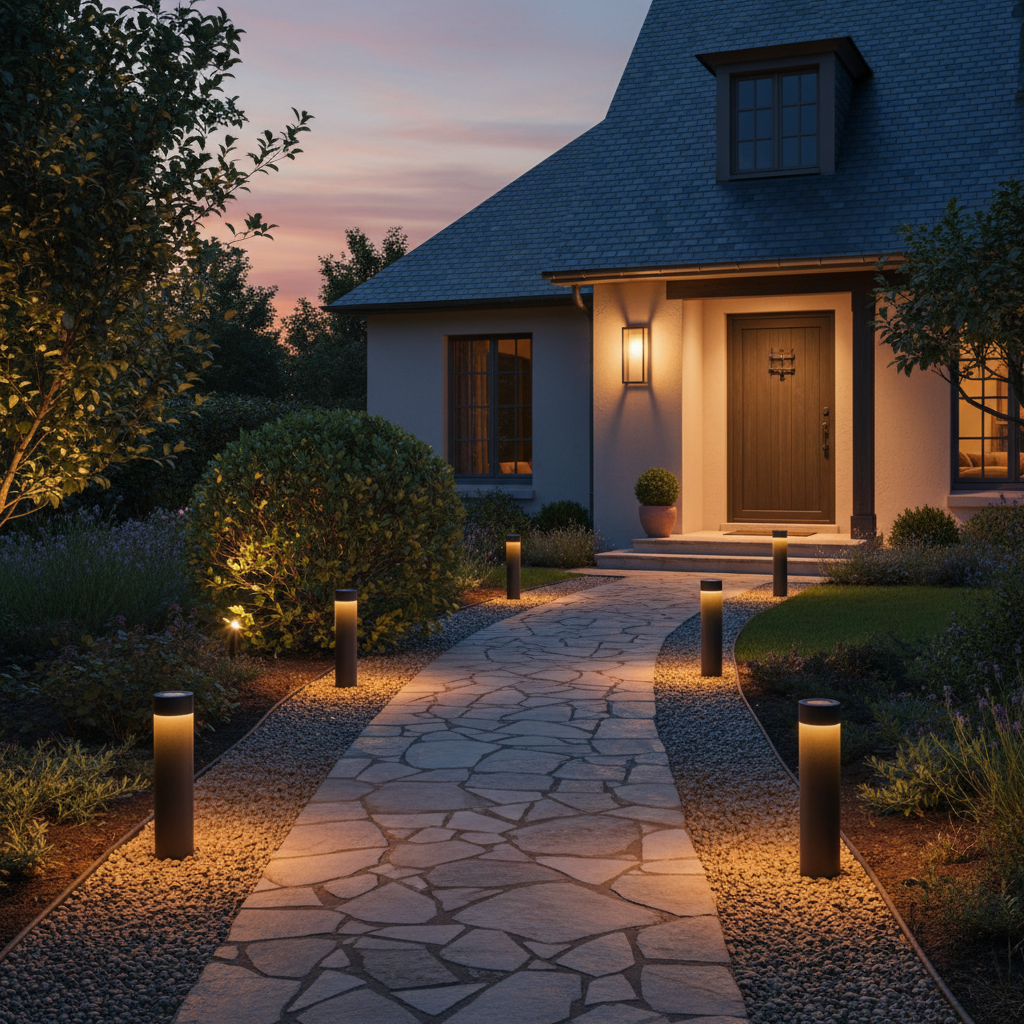
This is the classic garden spotlight — planted directly into the soil, in the middle of a flower bed or along an unpaved path. Installation is super simple: just stake it, aim it, and you're done. The integrated or remote solar panel captures daylight, the battery stores energy, and the light automatically turns on at dusk. It's the ideal solution for flower beds, lawn borders, ornamental gardens, or gravel paths. It requires no permanent fixing and can be moved seasonally. The main drawback: low-end stake spotlights often have small battery capacities. In winter, with short days and low sun, they struggle to last all night. If you want powerful solar garden lights that really turn on even in December, check that the battery capacity exceeds 1200 mAh and that the solar panel is large enough for partial recharging even on cloudy days. The lumen level of a stake spotlight is generally moderate — it's designed for ambiance, not security or entryway visibility.
Wall-Mounted Solar Spotlights: For Facades, Entryways, and Garages
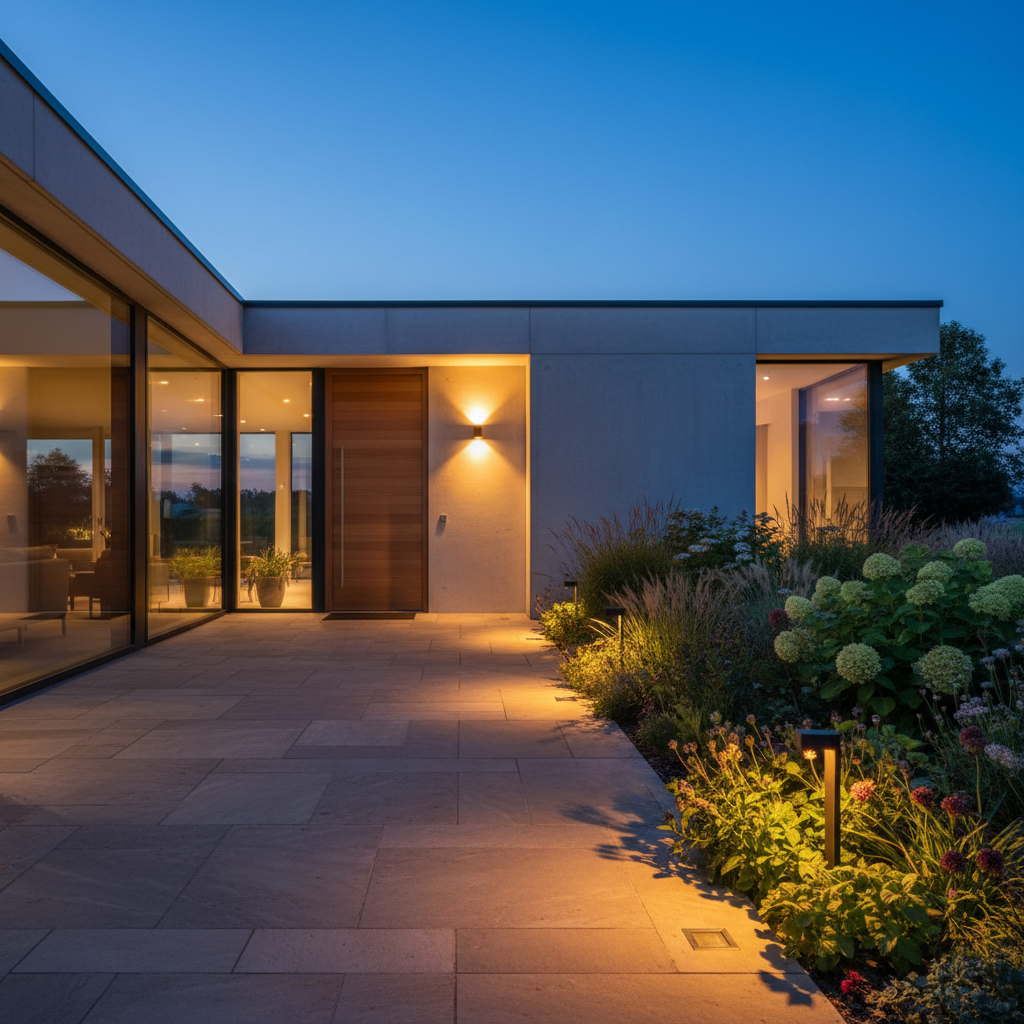
Wall-mounted spotlights attach to a facade, fence wall, or above a door. They shine downwards or sideways, marking an entryway, securing an outdoor corridor, or illuminating a patio. This type of solar spotlight requires the most attention when buying, as quality differences are most apparent here. To understand all the nuances of this format, our article on outdoor wall-mounted solar lights details the essential criteria. Here are the key takeaways.
Technical Criteria for Choosing a Wall-Mounted Solar Spotlight
A wall-mounted solar spotlight is often the most strategic purchase in an outdoor lighting project. It must provide clear visibility (entryway, gate, garage), withstand weather, and last several nights without optimal solar recharging. Here's what you really need to look for.
Actual Lumens: The Metric That Doesn't Lie
First instinct: check the advertised lumens. But beware of misleading claims — some manufacturers list a "peak" value reached only during the initial flash of the motion sensor, not during continuous lighting. A wall-mounted solar spotlight designed to secure an entryway should provide at least 800 to 1200 actual lumens in normal operation. Below that, the lighting will be insufficient once it's dark. For comparison: an indoor hallway light is around 400 lumens. For outdoors, with shadows, dark surfaces, and distance, you need at least double that.
Detection Angle: What You Rarely Read on the Product Sheet
If your wall-mounted spotlight has a motion sensor — which most high-performance models do — the detection angle is crucial. A 90° angle will be insufficient if you want to cover a wide entryway. A 180° angle covers almost the entire field of vision in front of the wall. Range is also important: a sensor that activates at 10 feet (3 meters) will be too late for an entrance path. Look for a range of at least 23-26 feet (7-8 meters) if you're securing an access point. Models with two motion sensors offer wider coverage and fewer blind spots.
Battery Capacity: The Decisive Factor for Winter Performance
This is probably the most underestimated criterion when buying an outdoor solar spotlight. In summer, almost anything works — days are long, the sun is high. In winter, it's a different story: 8 hours of daylight, a low sun hitting the panel obliquely, sometimes 3 consecutive days without direct sunlight. A solar spotlight with a 1000 mAh battery might not last a full night under these conditions. Quality models offer batteries of 2000 mAh and more, sometimes paired with large solar panels to maximize recharging even on cloudy days. This panel/battery ratio determines whether your lighting will be reliable 12 months a year or only from May to September.
Low-End Wall-Mounted Solar Spotlights: A False Friend
The market for outdoor solar spotlights is flooded with models sold for $10-$20 on general marketplaces. They work. For a few weeks. Then the battery loses capacity, the seal degrades, the solar sensor yellows. After two seasons, the spotlight is dead. And you buy another one.
Honestly ask yourself: how many low-end wall spotlights will you replace before matching the price of a single reliable model with a 5-year warranty? If a quality model costs 3 times more but lasts 5 to 7 years, you're saving money by the third season. And in the meantime, you won't have had to climb a ladder in January rain to replace a faulty light.
For intensive use — main entrance, gate, garage — a powerful solar floodlight might be more suitable than a simple wall spotlight, offering much higher light output and a remote solar panel.
How to Position Your Solar Panel for Maximum Recharging
The solar panel's placement is as crucial to performance as its technical specs. Even the best solar spotlight will disappoint if the panel is poorly oriented.
What Orientation for Maximum Energy Capture?
In the US/Canada, the sun is in the south. The solar panel should ideally face due south, or between southeast and southwest. A north orientation drastically reduces performance, sometimes by over 60%. If your entryway wall faces north, a wall-mounted solar spotlight will rarely be a good idea. Either choose a model with a remote panel (which can be oriented independently), or opt for another lighting solution.
Panel Tilt: Often Overlooked
A perfectly vertical solar panel captures less sunlight than one tilted at 30-45°. In winter, the sun is low on the horizon — a tilted panel captures it much better than a vertical one. This is one reason why wall spotlights with integrated vertical panels perform worse in winter than those with adjustable panels. If installing on a facade, check if the model allows adjusting the panel's tilt.
Obstacles to Avoid Around the Panel
Foliage, roof overhangs, other panels... even partial shade for a few hours can significantly reduce recharging. Always install the panel in a clear area, without obstacles between 9 AM and 5 PM. A simple check: observe the shadow cast on the intended location midday. If it's in the shade, find another spot.
Comparison Table: Which Solar Spotlight for Which Use?
| Spotlight Type | Ideal Use | Minimum IP Rating Required | Light Level | Installation |
|---|---|---|---|---|
| In-Ground | Paved patio, pathway, stairs | IP67 | Ambient (low to medium) | Medium (cutting into ground) |
| Stake | Flower bed, lawn, gravel path | IP44 minimum | Ambient (low to medium) | Very simple (stake into ground) |
| Wall-Mounted | Facade, entryway, gate, garage | IP65 minimum | Functional to powerful | Simple (wall mounting) |
Lumic's SolarGlow: A Serious Wall-Mounted Option
If you're looking for a wall-mounted solar spotlight with real power and long-term reliability, Lumic's SolarGlow is worth considering.
What it does: 1200 lumens, two motion sensors with a 180° angle and a range of about 26 feet (8 meters). IP65 resistance — rain, snow, frost. A battery life of 20 days without solar recharge in detection mode, or 36 hours in continuous mode. Cable-free, no electrician needed installation.
What it doesn't do: it's not an in-ground light and doesn't stake into the ground. If you need those uses, this isn't the right product. We're upfront about this because we want you to make the right choice, not a bad purchase.
What many customers appreciate (4.5/5 on over 2200 Trustpilot reviews): its robustness in winter thanks to a solar panel and battery designed to last even on cloudy days, and the 5-year warranty with a 90-day satisfaction guarantee. This is exactly what we discussed earlier — a model you install once and don't replace after two seasons.
To explore all patio lighting options beyond spotlights, our guide on solar patio lighting will give you complementary ideas to create a true ambiance.
How to Start: The 3-Step Method for Choosing Your Solar Spotlight
You now have the basics. Here's how to apply them to your situation.
Step 1: Identify Each Area to Light
Walk around your yard and list exactly where you want lighting: entryway path, left-side flower bed, patio, garage wall, gate. Don't think in terms of "spotlights" but in terms of areas and uses. Each area might require a different type of spotlight. It's normal to have a mix of solutions for the same yard.
Step 2: For Each Area, Check Sunlight Exposure
Before buying anything, observe each intended location for a full day. How many hours of direct sun? Are there any obstacles? A north-facing flower bed with a tree overhead will receive too little light to properly power a solar spotlight. In this case, the solar option might be best avoided for that specific spot.
Step 3: Define Priority — Ambiance or Security
This is the key question for correctly sizing the power. If you want to create ambiance in a flower bed, stake spotlights of 200 to 400 lumens are sufficient. If you want to secure an entryway or see clearly when you come home at night, you need at least 800 to 1200 lumens, ideally with a motion sensor to save battery. For areas that need both (like a patio you use for dinner in the evening), consult our guide on solar garden lighting solutions zone by zone.
Common Mistakes to Avoid When Buying an Outdoor Solar Spotlight
Finally, some common pitfalls many people fall into — and which are easily avoidable.
- Buying without checking the IP rating: For an in-ground spotlight, this is the first thing to check. IP67 minimum, not IP65, not IP44.
- Relying solely on "peak" lumens: Some manufacturers inflate figures with a value reached only when the sensor activates. Look for lumens in normal operation.
- Ignoring wall orientation: A north-facing wall is generally a deal-breaker for a wall-mounted solar spotlight. Check before buying.
- Underestimating battery for winter: What works in August can be disappointing in December. Prioritize models with large battery capacity if you want reliable lighting all year round.
- Buying too many low-quality spotlights: Two well-placed quality spotlights are better than ten cheap ones scattered everywhere. Short-term savings don't last.
To further your research and compare different product families, our article on types of solar garden spotlights will help you refine your choice before purchasing. And if you specifically need a light with a motion sensor, our dedicated guide to solar lights with motion sensors covers all criteria in detail.