Your Ceiling Light Perfectly Illuminates... Your Neck
The problem is simple and obvious: when you stand at your countertop to chop, peel, or prepare a meal, you position yourself exactly between the light source and the surface you want to illuminate. Your body casts a shadow over your work area.
It's not because your ceiling light is too dim. Even with a powerful fixture, the result will be the same. It's a positioning problem, not a power problem. The light comes from the ceiling, behind you — and you block everything. Result: you've been cooking in your own shadow for years, without really realizing it.
This guide explains why kitchen countertop lighting deserves a dedicated light source, how to position it correctly, and what options are available to you based on your profile (renter, homeowner, DIY enthusiast or not).
Why Countertop Lighting Differs from General Lighting
In a kitchen, there are two distinct lighting needs that many people confuse. General lighting (the ceiling fixture, overhead spotlights) provides overall ambient light for the room. Task lighting, however, targets a specific area to perform a concrete action — and in a kitchen, the main task is cooking on the countertop.
Why Recessed Spotlights Aren't Enough Either?
Even with well-positioned spotlights, the problem of cast shadows remains as soon as you work standing up. Light shines diagonally from the ceiling, and your shoulders create a shadow zone 12 to 16 inches (30 to 40 cm) in front of you. That's precisely where you place your cutting board.
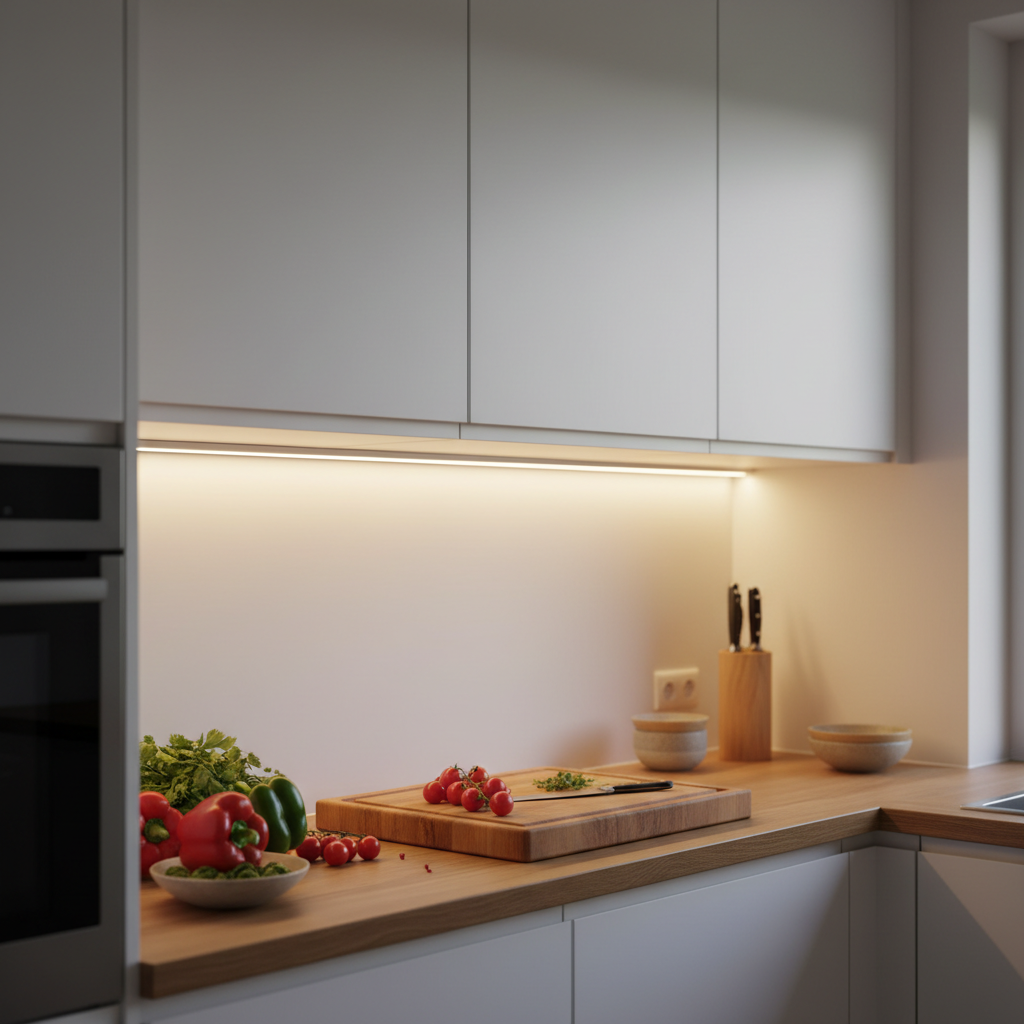
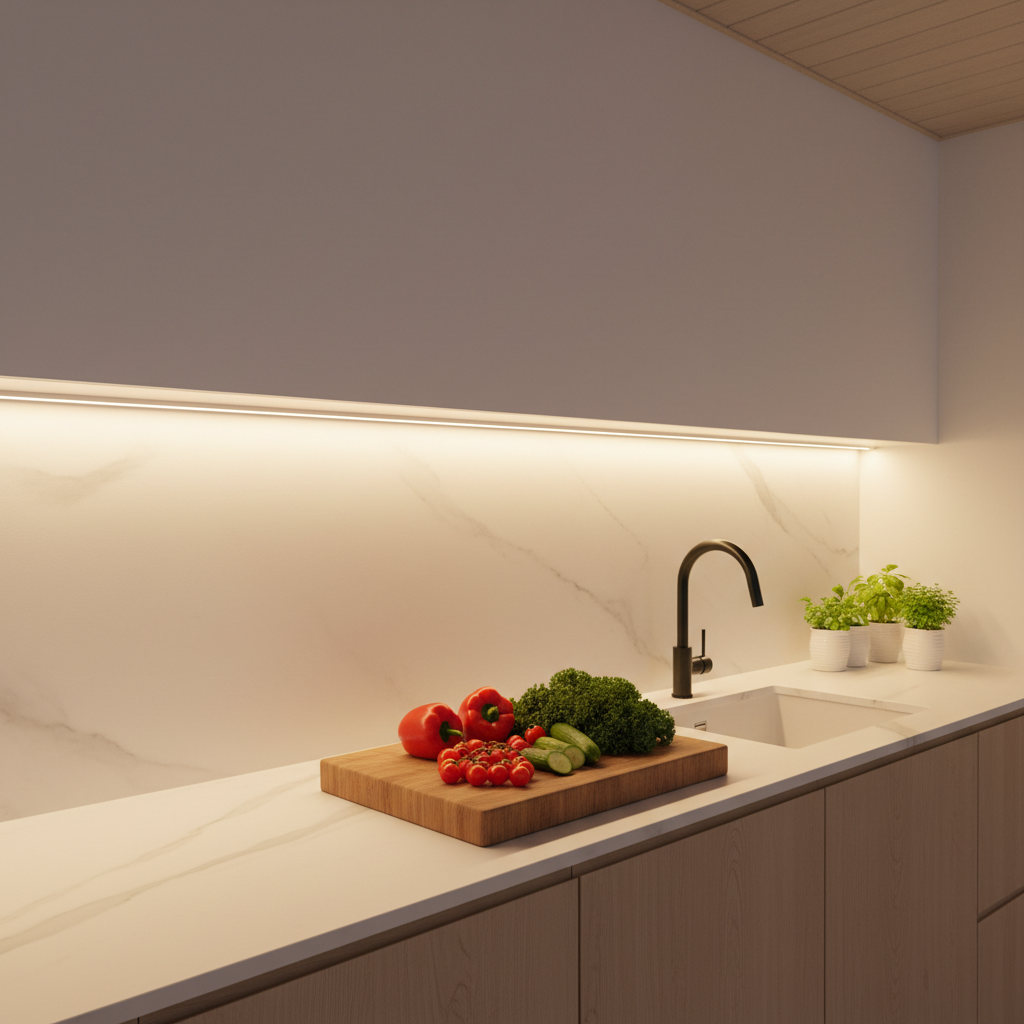
The only way to physically solve this problem is to place a light source below eye level, directed downwards, on the side of the upper cabinets. In other words: underneath the wall cabinets, above the countertop. This is the principle of under cabinet kitchen lighting.
What's the Ideal Height and Position?
The practical rule is to place the LED light bar two-thirds of the way forward under the upper cabinet, not flush against the wall. If you position it too far back, it mainly illuminates the backsplash and leaves the front edge of the counter in shadow. Two-thirds forward: the light falls directly onto the prep area. Often, a difference of a few inches changes everything.
For more on this topic, our complete guide to LED countertop lighting details recommended distances, angles, and color temperatures based on your kitchen's configuration.
Solutions for Lighting Your Countertop
Several ways exist to add dedicated light under your upper cabinets. Each has its advantages, constraints, and suits different profiles. Here's an honest overview.
Wired: Powerful, but Complex to Install
A wired LED light bar offers consistent power, without battery concerns. This is the most suitable solution if you cook several hours a day or want continuous, always-on lighting. For pure brightness, nothing beats wired for intensive, permanent use.
The downside: you need an outlet near the upper cabinets, or an electrician to install a dedicated circuit. Depending on your kitchen's setup, this can cost between $150 and $300 for labor, not including materials. And if you're a renter, it's often not an option.
Check out our article on wired vs. rechargeable LED light bars for your countertop to weigh both options in detail.
Wireless Rechargeable: The Quick, No-Renovation Solution
USB-rechargeable LED light bars attach in seconds under a cabinet, no drilling, no wires, no electrician needed. You stick on an adhesive mount or use a magnetic system, and it's installed. If the first spot doesn't work, you move it. No extra cost, no holes to patch.
This is the ideal solution for renters, for testing a position before permanent installation, or simply to avoid paying an electrician for a few inches of cable. Wireless lighting solutions for your kitchen have advanced significantly in recent years — battery life, brightness, and light quality are now top-notch.
The honest limitation: if you cook continuously for several hours daily, a rechargeable light bar will need more frequent recharging. In motion sensor mode (which turns on when you approach and off when you leave), battery life extends considerably.
LED Strip Lights: Flexible, but More Technical
LED strip lights can illuminate the entire length of a cabinet seamlessly, with very uniform light output. It's aesthetic and adaptable to any length. However, installation requires some preparation: measuring, cutting, adhering, connecting to a power supply.
If you're considering this option, our article on using an LED strip light to enhance your countertop will give you all the necessary information before you start.
Comparison of Kitchen Countertop Lighting Solutions
| Criterion | Wired LED Light Bar | Wireless Rechargeable LED Light Bar | LED Strip Light |
|---|---|---|---|
| Installation | Electrician often needed | 30 seconds, no tools | Preparation + power supply |
| Installation Cost | $150-$300 (labor) | None | Low to moderate |
| Intensive Continuous Use | Ideal | Good (USB recharge) | Ideal (wired) |
| Renter-Friendly | No | Yes | Often no |
| Repositionable | No | Yes (magnetic) | No |
| Motion Sensor | Rare | Often integrated | No |
What Color Temperature to Choose for Cooking?
This is a question many overlook, yet it's important — especially for cooking. Color temperature determines the hue of the light, from warm orange-white to very cool blue-white.
Warm White (3000K): Ambiance, but Less Precise
Warm white provides a soft, cozy, pleasant light in the evening. It's standard for living rooms and bedrooms. In a kitchen, it can create a nice ambiance, but it slightly alters the perception of food colors — meat might appear pinker than it actually is, for example.
Neutral White (4000K): The Best Compromise for Cooking
For active culinary use, 4000K is the benchmark. This temperature faithfully renders colors without turning industrial cool. You see food as it is, distinguish textures better, and the light remains comfortable for your eyes over time. This is the recommended choice for a kitchen countertop.
Cool White (6000K): Avoid in a Home Kitchen
Cool white provides very bright light, similar to natural midday light. It's useful in professional environments (labs, restaurant kitchens), but in a home kitchen, it creates a cold and uninviting atmosphere. Avoid it unless you have a very specific need.
How to Correctly Position Your Under Cabinet Light Bar
We mentioned it earlier, but it deserves a dedicated section because this is often where success lies. A poorly positioned light bar can create the exact same problem as the ceiling light: shadows in the wrong place.
Step 1: Measure Your Upper Cabinet Depth
Before installing anything, measure the depth of your upper cabinet. Most are between 12 and 14 inches (30 and 35 cm). Also note the length of the countertop to be illuminated to choose the right size light bar.
Step 2: Place the Light Bar Two-Thirds Forward
If your cabinet is 12 inches (30 cm) deep, the light bar should be about 8 inches (20 cm) from the front edge (and therefore 4 inches (10 cm) from the wall). This position projects light directly onto the cutting area, not onto the backsplash behind you.
Step 3: Test Before Final Installation
With a magnetic light bar, this is the key advantage: place it in the intended spot, turn it on, and stand in your working position. Can you see your counter clearly? Are you still casting a shadow? If so, move the light bar slightly forward. Adjust until you find the sweet spot, then attach the adhesive mount in that precise location.
This trial-and-error process, impossible with a wired installation without disassembling the entire system, is precisely what makes magnetic systems so practical for initial setup.
The Movement 3.0: A Serious Wireless Option
If you're looking for a reliable rechargeable LED light bar for everyday kitchen countertop lighting, the Movement 3.0 by Lumic is worth a closer look.
It's available in two lengths: 9 inches (23 cm) (approx. 150 lumens) and 16 inches (40 cm) (approx. 320 lumens). For a standard countertop, the 16-inch model is generally the most suitable. It offers the three color temperatures mentioned above (3000K, 4000K, 6000K), with adjustable brightness — handy for switching from intense prep lighting to a softer evening ambiance.
The 3000 mAh battery recharges via USB. In motion sensor mode (it turns on when you approach, off when you leave), battery life reaches approximately 5 to 6 weeks for the 16-inch model. In continuous mode, expect about 8 hours. Installation is magnetic: the mount adheres once, and the light bar attaches/removes in one motion — making it repositionable at will if you change your mind about the placement.
It comes with a 5-year warranty, 90-day satisfaction guarantee, and a Trustpilot rating of 4.5/5 from over 2200 reviews. If you want to compare different light bars available on the market before deciding, our guide to choosing the best LED light bar for your kitchen will give you a complete overview.
Key Takeaways for Kitchen Countertop Lighting
Shadows in the kitchen are not inevitable. They have a precise cause (the position of the ceiling light relative to you) and a precise solution (a light source under the upper cabinets, two-thirds forward). Once you understand this, the rest is a matter of practical choice.
- If you cook intensely and have access to an outlet under your cabinets: a wired LED light bar will be more suitable for continuous use without worrying about recharging.
- If you're a renter, or want to test without commitment: a repositionable rechargeable LED light bar is the simplest and most cost-effective solution for installation.
- Recommended temperature for cooking: 4000K (neutral white), to see food in its true colors.
- Ideal position: two-thirds forward under the upper cabinet, not against the wall.
To go further, also discover our ideas and trends for modern kitchen lighting if you want to consider your entire kitchen lighting project. And if you're still undecided on the product type, our comparison of LED light bars specifically designed for the kitchen will give you all the keys to decide.