Covered Patios and Lighting: Why It's Trickier Than It Looks
You have a pergola, awning, or open sunroom, and you want to light it without digging trenches or calling an electrician. Good news: it's totally possible. Bad news: most people make a beginner's mistake that ruins their project from the start.
Here's the real problem. A covered patio blocks sunlight. That's precisely what makes it pleasant in summer — but it also complicates solar lighting. Placing a solar light directly under a roof dooms its panel to permanent shade. The battery won't charge, and the light won't turn on. This isn't a product quality issue; it's a placement issue.
This guide provides real solutions for covered patio lighting based on your setup: pergola with pillars, wall-mounted awning, or partially enclosed sunroom. Each time, we'll give you the method that actually works.
The 3 Types of Covered Patios — and How They Affect Lighting
Before choosing a solution, you need to understand your setup. Not all covered patios are alike, and lighting constraints vary greatly between types.
The Pergola with Free-Standing Pillars
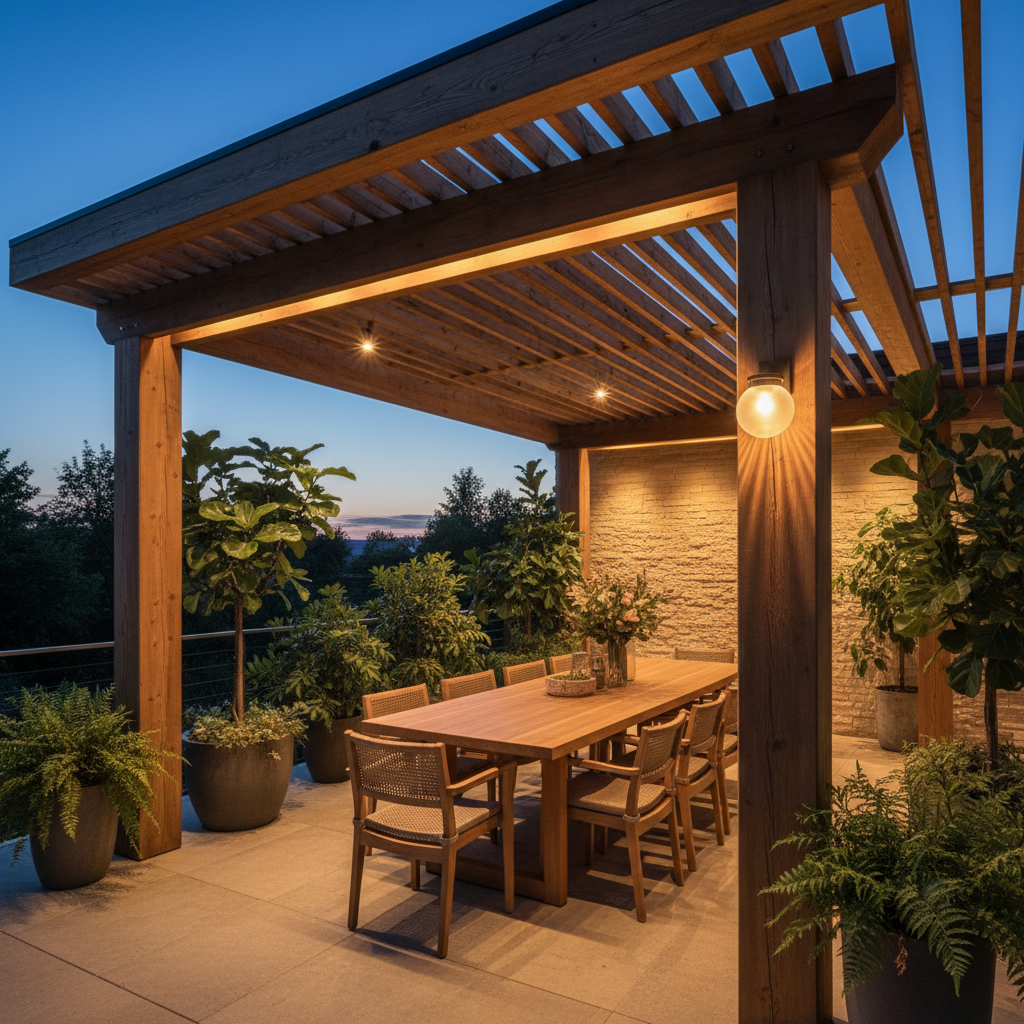
This is the most favorable scenario. The pergola rests on pillars extending from the ground, and these pillars are accessible from all sides. You can mount a light on the outer pillar, high up, so the solar panel slightly extends beyond the roof and captures direct light. This is the ideal setup for a solar pergola light, provided you choose the right location.
The rule: the solar panel must see the sky. If you mount the light halfway up a north-facing pillar, you'll limit the charge. Placing it at the top of a south-facing pillar, slightly angled upwards, makes all the difference.
The Wall-Mounted or Ceiling-Mounted Awning
Patio awning, overhanging roof, open sunroom roof... In this case, the structure is often attached to the house. Pillars are less common, and the roof extends directly overhead. This is where under awning solar lighting becomes tricky: the panel is inevitably under the roof.
The solution: either a USB rechargeable light (we'll get back to that), or a light with a cable connecting the panel and the light body — but these models are still rare and often expensive. For most awning situations, USB recharging is the most reliable answer.
The Enclosed or Partially Glazed Sunroom
Let's be direct: if your patio is an entirely enclosed sunroom with glass, solar power won't work correctly. Standard solar panels don't charge through glass — or not sufficiently to keep a battery charged. In this case, USB rechargeable lighting is the only viable wireless alternative, or you'll need to consider traditional electrical wiring.
The #1 Mistake to Never Make with a Solar Light Under a Pergola
Mounting a solar light directly under a pergola roof is the most common — and most frustrating — mistake. The light turns on for the first few days (the battery is factory-charged), then gradually dims until it stops working. Many people then assume the product is defective. In reality, the solar panel is in the shade all day and cannot do its job.
For pergola lighting that actually works, there's no secret: the panel must receive direct sunlight for several hours a day. This means placing it out of the roof's shadow, typically on a pillar, high enough for the panel to emerge above the cover.
To delve deeper into this specific topic, our article solar pergola lighting details exactly how to position your light according to your pergola's structure.
Practical Solutions for Lighting a Covered Patio Without Wires
Several approaches exist depending on your setup. Here are the most effective, with their honest pros and cons.
Option 1: Solar Light Mounted on the Outer Pergola Pillar
This is the best solution for a pergola with pillars. The principle: you mount the light not under the roof, but on the outer face of a pillar, high enough so the solar panel is clear of the roofline. The light projects its illumination into the patio, and the panel freely captures sunlight.
Things to check before buying:
- The light must have adjustable orientation — panel towards the sky, light towards the patio.
- The light's IP rating must be suitable for outdoor use (IP65 minimum to resist rain and frost).
- The motion sensor's range must cover your entire patio area from the pillar.
This is precisely what Lumic's SolarGlow offers: an outdoor solar light with 1200 lumens, two 180° sensors, and a range of about 26 feet (8 meters). Its solar panel, 3 times larger than low-end lights, allows it to charge even in winter or on cloudy days. Mounted on the outer pillar, it illuminates the entire patio without ever being in the roof's shadow.
If you want to understand how this type of motion sensor solar lighting works, we've detailed everything in a dedicated guide.
Option 2: USB Rechargeable LED Light Bar for Under Awning Lighting
When solar isn't practical — low awning, structure without accessible pillars, or sunroom — the USB rechargeable light bar is your best friend. You plug it into a charger about once a month, and it provides light without wires or electrical installation.
The advantage for a covered patio: you mount it exactly where you want, without solar panel constraints. Under the awning, along a beam, or at the ceiling edge. The motion sensor does the rest.
For a more versatile wireless patio, you can combine both: a SolarGlow on the pillar for main and security lighting, and one or two rechargeable light bars for ambient lighting around seating areas. This creates a cohesive result without any electrical installation.
Option 3: Solar or Rechargeable String Lights
For ambiance, string lights remain a popular option. Solar models work well if you can place the panel in a sunny area — attached to a post outside the roof's shadow, placed on the garden-facing railing, or on top of a pillar. Rechargeable string lights eliminate this constraint but require periodic recharging.
Their limitation: they provide ambiance but little functional light. It's difficult to read, cook, or see clearly with string lights alone. They combine well with a main solution like a motion-sensing light.
Option 4: Wired Lighting — When It's the Right Answer
If you already have an electrical outlet on or near your patio, wired lighting remains a reliable option. Adjustable spotlights, wall sconces, LED strips recessed into the structure... The possibilities are numerous, and the result can be very high-quality. The constraint: it often requires an electrician, and outdoor cables must be protected.
For many people, wireless remains more practical and less expensive — especially for renters or those who want to avoid renovation work.
Comparative Table of Lighting Solutions for Covered Patios
| Solution | Pergola Pillars | Wall Awning | Enclosed Sunroom | Installation | Maintenance |
|---|---|---|---|---|---|
| Solar light on pillar | ✅ Ideal | ⚠️ Tricky | ❌ Impossible | Wireless, no-drill required | None (solar recharge) |
| USB LED light bar | ✅ Works | ✅ Ideal | ✅ Works | Adhesive / magnetic | USB recharge ~1x/month |
| Solar string lights | ✅ If panel clear | ⚠️ Depends on config | ❌ No | Simple | Minimal |
| Wired spotlights | ✅ Works | ✅ Works | ✅ Works | Electrician often required | None |
How to Choose the Right Location for a Solar Pergola Light
Placement is everything. Two identical lights can yield radically different results depending on where you mount them. Here are the criteria to check before drilling anything.
What Exposure for the Solar Panel?
South orientation remains the standard in North America. A south-facing panel receives maximum sunlight throughout the year, including in winter when the sun is low. East or west work but reduce daily charge. North should be avoided at all costs.
Tilt also matters. A flat panel captures less effectively than a panel slightly angled towards the sun. If your light allows you to adjust the panel's angle independently of the light head, take advantage of it.
For periods of low sunlight, consult our article on high-performance solar lights even in winter — it provides precise advice on optimizing charging in all seasons.
How High to Mount the Light on the Pillar?
In practice, mounting the light between 7.2 and 9.2 feet (2.20 m and 2.80 m) high generally yields the best results. High enough for the panel to clear the pergola's roofline (depending on its height), and low enough for the motion sensor to effectively cover the traffic area.
If your pergola roof is particularly high, you may need to mount the light just below the roof/pillar junction, with the panel slightly above the roof level. A few inches of clearance are often sufficient.
How to Check if the Panel Will Get Enough Sun?
A simple method: observe the shadow cast on the pillar around 1 PM in mid-summer. If the pillar is in shadow, the roof is too wide for the panel to be clear at that height. Move it higher or choose another more exposed pillar.
In winter, the sun is lower in the sky. The shadow of a pergola roof at noon in January can be significantly longer than in July. This is a factor to anticipate if you live in northern regions or if your pergola is unfavorably oriented.
Covered Patio Lighting: Balancing Light Output
A covered patio isn't a parking lot to be lit with 5000 lumens. The goal is often to combine safety (seeing where you walk), comfort (reading, eating, chatting), and ambiance (a pleasant evening). These three uses don't have the same needs.
What Light Output for a Standard Covered Patio?
For a partially covered patio of 160 to 320 sq ft (15 to 30 m²), a light between 800 and 1200 lumens is generally sufficient for functional lighting in motion detection mode. This is equivalent to a good household bulb, concentrated where you need it.
If you also want to create ambiance for evenings, consider supplementing with lower-intensity accent lighting: string lights, LED candles, or dimmable light bars. Wireless patio lighting also offers many combination ideas for different moods.
Motion Detection Mode or Continuous Mode: Which to Choose for a Patio?
Motion detection mode is suitable for security lighting and pathways: the light turns on when you arrive, and turns off a few seconds later. Practical, economical, discreet.
Continuous mode is useful when you're relaxing on the patio for an extended evening. The light stays on without you having to wave your arms to reactivate it. Some lights offer both modes with a simple button press.
For mixed use (nighttime security + evening comfort), the best option is a light that offers both easily switchable modes.
What No One Tells You About Solar Lighting on a Covered Patio
Some practical realities often omitted in commercial guides.
Partial shading degrades more than you think. An hour of direct shade on a solar panel in the middle of the day can reduce daily charge much more than proportionally. If your pillar is in shade from 11 AM to 2 PM, you're missing the heart of the peak charging period.
Snow and dirt matter. In winter, a panel covered with snow or leaves won't charge. This is especially true for panels with a shallow angle. Choose a light with an adjustable panel that's easily accessible for an occasional wipe-down.
Battery capacity makes a difference in winter. In summer, even a small battery recharges easily every day. In winter, with less sun and longer nights, a large-capacity battery truly makes a difference. This is one of the concrete advantages of a light like the SolarGlow, whose battery is designed to last 20 days without solar recharge in motion detection mode — leaving ample margin even on cloudy days.
To understand why battery capacity is often overlooked by low-cost manufacturers, the article optimizing your solar light's battery gets straight to the point.
For Renters: Lighting Your Covered Patio Without Renovation Permits
Are you renting and have a covered patio? Good news: wireless and no-drill solutions are perfectly suited to your situation. No cables, no trenches, no holes in the walls.
Industrial adhesive or magnetic mounting is sufficient for most modern lights and light bars. You install it, and remove it at the end of your lease without leaving a trace. This is one of the most frequently cited arguments by users of these solutions.
The only limit: if your landlord has restrictions on modifying facades or pillars, check your contract terms. For a simple light mounted with adhesive, it's usually not a problem — but it's worth checking.
To explore all wireless outdoor lighting solutions adapted to different configurations, we've prepared a dedicated guide comparing the main options.
Summary: Which Solution to Choose for Your Covered Patio
Before we finish, a quick summary to guide your choice:
- Pergola with accessible, south-facing pillars: Solar light on the outer pillar, panel oriented towards the sky. This is the most autonomous and least restrictive long-term solution.
- Wall-mounted awning, little sun on supports: USB rechargeable LED light bar. Monthly recharge, no placement constraints.
- Fully enclosed sunroom: Solar won't work. USB rechargeable light bar or wired solution. Don't be swayed by solar lights in this case.
- Ambiance + security mix: Combine a main motion-sensing light (SolarGlow or similar) and rechargeable ambient lights. Cohesive results without any wires.
Covered patio lighting without wires is feasible and comfortable — provided you understand one simple rule: the solar panel needs to see the sky. The rest is a matter of placement and choosing the right product for your structure.
To go even further in your thinking about autonomous solar lighting and its possibilities beyond the patio, this guide covers the topic.