You pull a navy jacket from your closet, put it on, and arrive at the office only to be told you're wearing black. Or worse: you think you're matching two gray pieces, and daylight reveals one has a beige tint. This isn't a problem of light quantity. It's a problem of light quality.
A poorly lit closet isn't necessarily a dark closet. It's often a closet with the wrong light source — one that distorts colors rather than rendering them accurately. And no closet with 500 lumens from an overly warm bulb can fix that.
This guide gives you the real criteria for choosing your closet lighting: color temperature first, practical constraints second, and why most solutions sold at big-box stores completely miss the mark.
Why You Choose the Wrong Clothes in the Morning
The answer lies in one number: 3000K. This is the color temperature of most "warm white" LED bulbs installed in closets and wardrobes. And it's precisely what distorts your color perception.
What an Overly Warm Light Actually Does to Your Clothes
A 3000K light tints everything it illuminates with a yellow-orange cast. Your brain adapts indoors, but your eyes no longer see true colors. The concrete result: a navy blue looks almost black, a pearl gray turns beige, a burgundy looks brown, an off-white appears creamy.
You don't see wrong because your vision is bad. You see wrong because the light illuminating your clothes distorts their actual color. It's physics, not optional.
Why Cool White (6000K) Isn't the Solution Either
The opposite mistake is common: trying to correct the yellow problem, some install very cool LEDs (5500-6500K). The rendering of dark colors is better, but the ambiance becomes cold, almost clinical. In an intimate space like a closet, this is unpleasant for daily living.
And most importantly, the blue cast of a 6000K light can distort warm tones: a salmon appears duller, a camel loses its warmth. You fix one problem, you create another.
The Only Color Temperature That Faithfully Renders Colors: 4000K
Neutral white at 4000K is the sweet spot. Neither too warm nor too cool. This color temperature is used in textile alteration workshops, high-end fitting rooms, and spaces where color fidelity is a requirement. For a closet, it's the same principle.
What Does This Mean for Your Daily Life?
Under 4000K light, navy blue stays navy blue. Gray stays gray. The nuances between deep black and charcoal become clear. You can see if your socks match, if your brown belt goes with your camel ankle boots, if your jacket creates a harmonious blend or a mismatched contrast with your pants.
This isn't a style detail. This is the lighting that allows you to dress with confidence, without double-checking under the stairwell light before heading out.
What's the Point of a Closet Light Without 4000K?
That's the frank question to ask. A 3000K LED light bar in a closet is like a slightly distorted mirror: it provides partial service, but it betrays you on the details that matter. If you spend time choosing your outfits, investing in the right color temperature is non-negotiable.
4000K should be your number one criterion, before lumens, before design, even before price.
Other Criteria for Choosing Your Closet Lighting
Once the color temperature is validated, other parameters remain to be considered. Here's how to prioritize them.
Light Quantity: How Many Lumens for a Closet?
A standard closet (between 20 and 65 sq ft) needs sufficient lighting to leave no shadows on clothes. In practice, it's generally recommended to light hangers and shelves directly rather than relying on a central ceiling light that casts shadows on clothes.
For a wardrobe panel 30 to 40 inches wide, a strip light of 150 to 320 lumens is usually sufficient if positioned above or on the front of the furniture. The goal: direct light on what you want to see, not diffuse light in the room.
Installation: What Type of Mounting for a Closet?
This is where many closet lighting projects become unnecessarily complicated. Recessed spotlights and electrical tracks require an electrician, construction, and often modification of the ceiling or furniture structure. For a built-in closet or wardrobe, this is rarely practical without damage.
Wireless, adhesive, or magnetic mounting solutions address this challenge: installation in under a minute, repositionable, no electrical constraints. They are particularly suitable for renters, but also for homeowners who don't want to undertake renovations for an uncertain final result. To delve deeper into this point, our article on wireless closet lighting details the advantages of this approach.
Battery Life and Charging: Battery or USB?
If you opt for a wireless LED strip light, battery is a key criterion. Battery-powered models offer availability but the disadvantage of recurrent replacement — and used batteries pose an ecological problem. USB rechargeable models offer much better long-term savings and eliminate the chore of batteries.
To go further on this topic, our complete guide on rechargeable LED light bars will help you make the right choice for your use.
Automatic Closet: Why Motion Detection is the Perfect Use Case
Ask yourself this question: how many times a day do you enter your closet? Twice? Five times? And each time, you look for the switch, turn it on, leave, turn it off. Or you forget to turn it off.
The closet is one of the few spaces in the house where motion detection provides an immediate and daily benefit. You approach, the light turns on. You leave, it turns off. No switch, no forgetting, no light running all day.
How Does a Motion Sensor Work in an Enclosed Space Like a Closet?
A PIR (passive infrared) sensor detects moving body heat within its detection angle. In an open closet, it works as soon as you approach. In a closed closet (wardrobe with doors), it activates upon opening, which is the ideal behavior: the light turns on exactly when you need it.
The best systems combine two sensors: a motion sensor and an ambient light sensor. This second sensor prevents automatic activation in broad daylight if the room is already well-lit — a real energy saving, without hassle. To understand the details of how it works, consult our article on motion sensor lighting.
What Battery Life to Expect from a Strip Light with Motion Detection?
In detection mode (the strip light only turns on when it detects motion), battery life is significantly longer than in continuous mode. For closet use — a few passages per day for a few minutes — a well-sized battery can last several weeks without recharging.
This is very different from continuous mode where the battery drains in a few hours. The motion sensor is therefore not only practical: it is also what makes a wireless strip light technically viable in the long run.
Comparison of Closet Lighting Types in 2026
Here's an objective overview of the available options, with their real advantages and constraints:
| Lighting Type | Installation | 4000K Available | Motion Detection | Renter-Friendly |
|---|---|---|---|---|
| Wired LED Light Bar | Electrician Required | Often Yes | Rarely Integrated | No |
| Recessed Ceiling Spotlights | Construction Needed | Yes (depending on bulb) | No | No |
| Battery-Powered LED Light Bar | Adhesive, 1 min | Rare | Sometimes | Yes |
| USB Rechargeable LED Light Bar with Detection | Magnetic/Adhesive, <1 min | Yes (if 4000K chosen) | Yes, Integrated | Yes |
The conclusion is quite clear: the rechargeable LED light bar with motion detection and adjustable temperature is the solution that checks the most boxes for closet use. No construction, no batteries, and the ability to select 4000K.
To explore other options suitable for closets, you can consult our comparison of closet lighting solutions, which covers variants from least to most effective.
Properly Positioning Your Closet Lighting
Color temperature and bulb quality aren't enough if the light is poorly placed. Placement determines the effectiveness of your lighting as much as technical specs.
Where to Install the Strip Light in an Open or Semi-Open Closet?
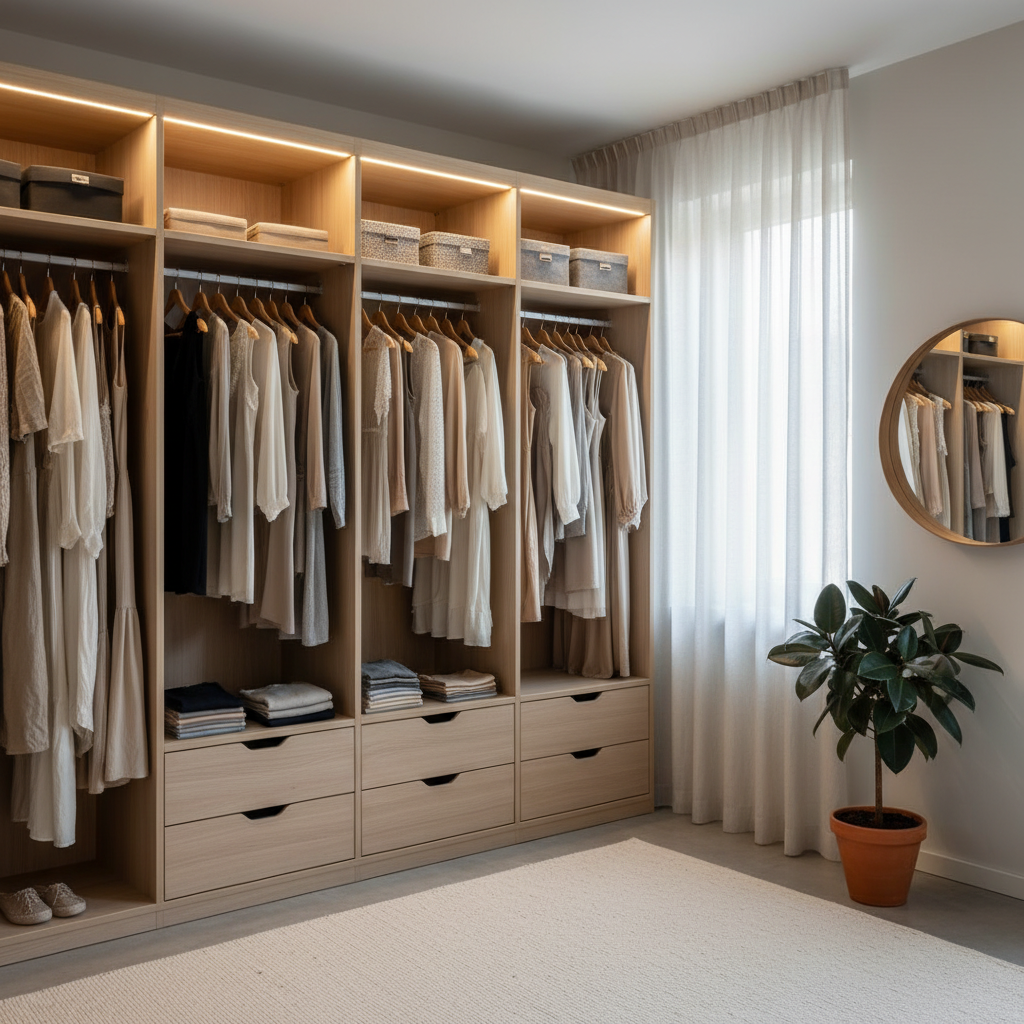
In an open closet (without doors), the strip light should be positioned at the top front of each section, angled downwards. The goal is to directly illuminate hanging clothes and shelves, not the ceiling or floor. A strip light fixed inside the furniture, just above the rod, gives the best results for hanging sections.
If your closet has shelves, each column benefits from having its own light source. A single central light point inevitably creates shadows in the corners.
Should a Closet with Sliding Doors Be Lit Differently?
With sliding doors, front lighting makes no sense: it's obscured by the doors. The solution is to place the strip lights inside the furniture, at the top of each compartment. The advantage: when you open the door, the light is already there, deep inside the furniture. The motion sensor activates upon opening, which is perfectly suited for this type of closet.
For a closet with an integrated mirror, also consider side lighting at face level: this is the most flattering and accurate lighting for evaluating a complete look.
What You're Often Wrongly Sold for a Closet
Some common misconceptions about closet lighting:
- "The brighter, the better" — False. Overly intense and poorly placed light creates glare and harsh shadows. Quality trumps quantity.
- "Warm white is more pleasant" — For a living room, perhaps. For a closet where you need to distinguish colors, it's counterproductive. Visual comfort doesn't replace color fidelity.
- "A 6000K bulb is like daylight" — Daylight in the shade is around 6500K, yes, but in direct sunlight it's closer to 5500K. And neither is ideal in a living space. 4000K mimics balanced, indoor daylight, without excessive color casts.
- "A single ceiling light is enough" — It illuminates your head, not the furniture. And the shadow cast by doors or the closet structure neutralizes much of the light produced.
Movement 3.0 in a Closet: Why It Works
If you're looking for a rechargeable LED light bar with motion detection and the ability to select 4000K, Lumic's Movement 3.0 is a concrete option to consider.
It's available in two sizes (9 inches and 16 inches), allowing it to adapt to different compartment widths. The 3000 mAh battery, larger than what's typically found on the market, ensures a battery life of approximately 4 to 6 weeks in detection mode for standard closet use. The mounting is magnetic on an adhesive backing, repositionable, with no drilling required.
What's particularly relevant for a closet: the combination of the motion sensor and the ambient light sensor. The light only turns on if the room is dark AND you pass in front of it. No accidental activation in broad daylight if your closet is in a bright room.
The three available color temperatures (3000K, 4000K, 6000K) allow you to choose 4000K upon purchase. And the brightness is adjustable if you want a softer intensity in the evening.
5-year warranty, 90-day returns, premium European design. Over 2200 reviews on Trustpilot with a 4.5/5 rating. If you want to delve into closet automation, our guide on automatic closet lighting covers all parameters in detail.
Key Takeaways for Truly Useful Closet Lighting
Effective closet lighting isn't just about "adding light." Key criteria not to overlook:
- 4000K first: this is the only temperature that faithfully renders your clothes' colors. It's non-negotiable.
- Avoid 3000K: visually comfortable, but it distorts dark colors and nuances.
- Avoid 6000K: better for dark tones, but unpleasant for daily use and bad for warm tones.
- Position the light inside the furniture, not on the ceiling: direct lighting of clothes is a thousand times better than a central ceiling light.
- Prefer a USB rechargeable battery over disposable batteries: more economical, more ecological, and battery life in detection mode is more than sufficient.
- Motion detection is ideal for a closet: you never need permanent light, and automation eliminates the hassle of a switch.
If you want to explore different LED closet light options to find the one that matches your setup, we also have a dedicated guide.