Ever seen a solar garden light stay on all night... only to die out at the first cloud? The problem isn't solar power itself. It's the operating mode. And most people don't realize this when buying.
A well-configured solar outdoor light with an integrated motion sensor can last for several weeks without seeing the sun. Poorly set up, its battery will be dead in a few hours. This guide explains why and how to avoid common mistakes before you buy.
What "Solar with Motion Sensor" Really Means
A solar motion sensor light integrates everything into a single unit: the solar panel, battery, motion sensor, and light source. No cables between the panel and the light, no separate box to plug in, no complex settings to adjust on two distinct devices.
That's the advantage of all-in-one: you install the light, point it south (or towards the sky), and it works. Zero wiring, zero electrician needed, zero switches to find at night.
Why Integrating the Sensor Changes Everything for Battery Life
Without a sensor, a solar light turns on at sunset and off at sunrise. Result: it continuously drains its battery all night, whether someone is present or not. With a motion sensor, it only turns on when it detects presence. The difference in battery life is huge: it goes from a few hours to several weeks.
This is the main reason why detection mode is the most relevant for outdoor solar lighting. If you want to understand in detail how motion sensors work and the technologies used (PIR in particular), we've prepared a comprehensive article on the subject.
Where to Install a Solar Light with Motion Sensor?
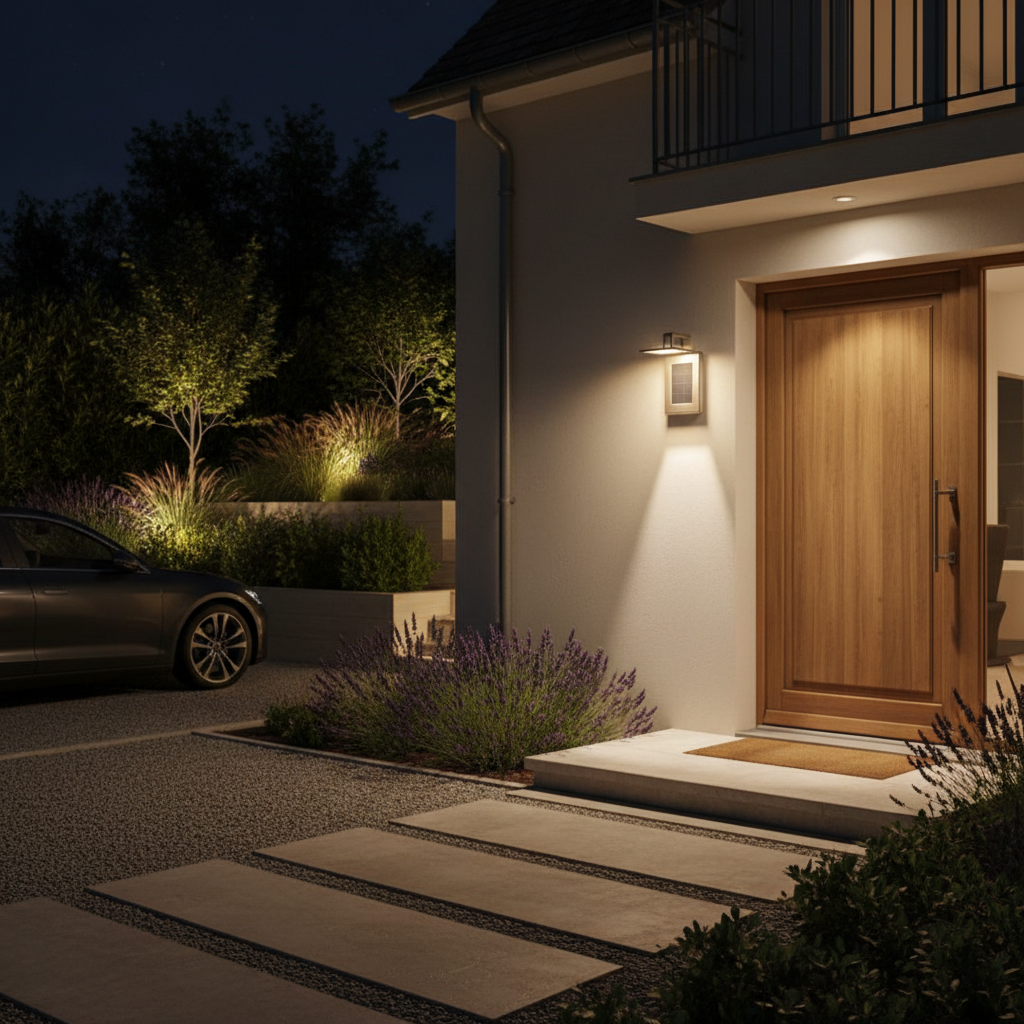
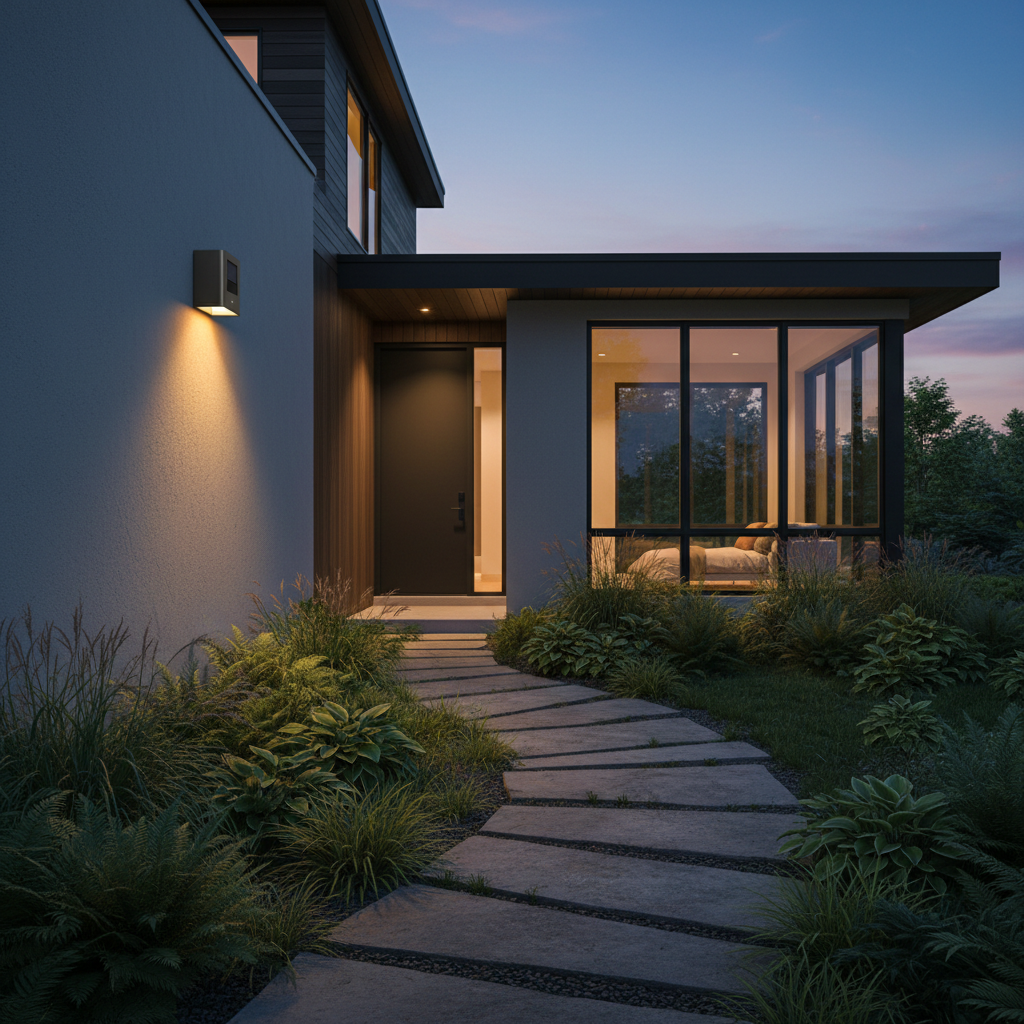
Common uses include driveways, gates, patios, house facades, garages, and garden sheds. Anywhere you need automatic light at night but don't want to run cables. It's also the ideal solution for renters: no permanent modifications, no drilling holes in masonry.
The 3 Operating Modes: Which One to Choose?
Before buying a solar light with a motion sensor, this is the most important point to understand. Most models offer several modes, and choosing the wrong one will drain your battery in a single night.
Detection-Only Mode: The Most Energy-Efficient
The light remains off by default. It only turns on when the sensor detects movement, for a predefined duration (often 15 to 30 seconds), then automatically turns off. This is the most energy-efficient mode: the battery is only used intermittently.
In practice, this is the only mode that truly makes sense for outdoor solar lighting. A light that turns on 20 to 30 times a night for a few seconds each time will consume a fraction of what it would in continuous mode. Result: battery life measured in weeks, not hours.
Low Permanent + Detection Boost Mode: For Security
In this mode, the light emits a low light continuously (to indicate presence, mark a path), and switches to full power when the sensor detects movement. This is a good compromise for driveways or entrances where you always want a minimum of visible light.
The downside: low standby consumption is continuous. For a 10-hour night, that's 10 hours of permanent consumption, even if reduced. In winter or during cloudy periods, this can drain the battery faster than expected. Reserve this for locations with good sun exposure.
Full Permanent Mode: Avoid for Solar
Some models offer a continuous full-power lighting mode. In practice, this mode drains a solar battery in 4 to 5 hours maximum. After the first night with little sun the day before, the light will turn off before dawn. This mode only makes sense if you have access to wired electrical power. For solar, it's a design flaw to avoid.
What Really Impacts Battery Life in Winter
The battery life of a solar light with a motion sensor depends on two main factors: battery capacity and solar panel quality. In summer, with daily sunshine, even a small battery is sufficient. In winter or during a cloudy week, it's a different story.
The Battery: The Often Underestimated Element
Most entry-level solar lights come with low-capacity batteries, sized to work only with regular sunshine. As soon as bad weather occurs, they turn off after two nights.
A larger battery means an energy reserve accumulated on sunny days to last through sunless days. This is the most distinguishing criterion between a light that lasts all year and one that only helps out in summer. To understand everything about this topic, our article on choosing the battery for your solar lighting details the concrete differences.
The Solar Panel: Surface Area and Orientation
A small solar panel integrated into the light body (compact, horizontal format) captures less light than a larger or adjustable panel. In winter, with a low sun on the horizon, a panel that's too small may not recharge the battery enough in one day.
This is not a reason to avoid solar, but a reason to choose a model with a panel sized for your region's winter conditions. Serious models advertise battery life in days without sunshine, not just in hours of operation per night.
Sensor Range and Sensitivity
An overly sensitive sensor will trigger for branches moving in the wind or the neighbor's cats. A not-sensitive-enough sensor won't detect someone approaching from 15 feet (5 meters). The advertised range and detection angle are data to check before buying. Generally, a range of 25 to 30 feet (8 to 10 meters) and an angle of 120 to 180° adequately cover a driveway or facade.
Concrete Criteria for Comparing Models
Faced with a plethora of options (Amazon, Home Depot, Lowe's, IKEA all offer solar lights with motion sensors), here are the criteria that distinguish what lasts from what disappoints after two weeks of use.
| Criterion | Entry-Level | What to Aim For |
|---|---|---|
| Battery Capacity | Low, not specified | High capacity, clearly stated |
| Battery Life Without Sun | 2 to 3 nights maximum | 10 days and more |
| IP Rating | IP44 (light rain) | IP65 (heavy rain, snow, frost) |
| Sensor Range | 10 to 16 feet (3 to 5 meters) | 25 feet (8 meters) and more |
| Detection Angle | 90° (narrow field) | 120 to 180° (wide coverage) |
| Available Modes | Often only one | At least 2 (detection + mixed) |
| Warranty | 1 year | 3 to 5 years |
If you want to delve deeper into buying criteria, we've compiled everything you need to know in our guide on how to choose your solar light with motion sensor.
The IP Rating: What Weather Resistance Really Means
Outdoors, a solar light is exposed to rain, frost, condensation, and UV rays. The IP (Ingress Protection) rating is the only standardized indicator for evaluating this resistance. It consists of two digits: the first indicates protection against dust, the second against water.
IP44 vs. IP65: What's the Practical Difference?
IP44 means the light is protected against water splashes from all directions but not against a direct jet of water or heavy rain. IP65 guarantees total protection against dust and low-pressure water jets. In practice, IP65 is the minimum recommended for a permanent outdoor installation all year round, especially if you are in a region prone to heavy rainfall or frost.
Frost and Freezing Temperatures: A Real Challenge for the Battery
Lithium batteries (the most common in quality solar lights) see their performance decrease in cold weather. A model designed to operate in all seasons will include a battery sized to compensate for this loss of capacity in winter. This is a detail rarely mentioned in low-end product descriptions, but it explains many winter disappointments.
Detection Mode and Lumens: Finding the Right Balance
The number of lumens indicates the light intensity produced. But in detection mode, the question isn't just "how many lumens?" but also "for how many seconds?" and "to cover what area?"
How Many Lumens for a Driveway or Facade?
To mark a driveway or indicate passage, 200 to 400 lumens are often sufficient. To illuminate a garage entrance, secure a gate, or replace a wired light, aim for 800 to 1500 lumens. Very bright models consume more energy per trigger, which is acceptable in detection mode (short durations) but problematic in continuous mode.
Trigger Duration: An Often Overlooked Setting
Most solar lights with motion sensors allow you to adjust the illumination duration after detection: 10 seconds, 30 seconds, 1 minute, sometimes more. A short setting (15 to 20 seconds) is sufficient to indicate presence and consumes little. A long setting (several minutes) puts much more strain on the battery, especially if the light triggers frequently. This parameter should be adapted to your actual use.
What Lumic's SolarGlow Does Differently
If you're looking for solar outdoor lighting with a motion sensor that truly lasts through winter, without worrying about complicated settings, Lumic's SolarGlow deserves to be on your comparison list.
Its strong point is battery life: up to 20 days without solar recharge in detection mode. This is made possible by a battery 4 times larger than low-end alternatives and a solar panel 3 times more generous. Concretely: even after a week of cloudy skies, the light continues to function.
The two motion sensors cover 180° with a range of 25 feet (8 meters). The IP65 rating guarantees all-season use, including rain, snow, and frost. And since the entire system is integrated into a single unit, installation is as simple as screwing or adhering a mount: zero cables, zero electricity bills, zero switches.
It comes with a 5-year warranty and 90-day returns if it doesn't suit you. Trustpilot rating of 4.5/5 from over 2200 reviews, with customer support that responds in less than 24 hours.
To delve deeper into comparing product types, our complete guide to solar outdoor lighting covers all available categories based on use.
Summary: What to Remember Before Buying
Solar outdoor lighting with a motion sensor is a viable year-round solution, provided you avoid common pitfalls. Here are the key points to keep in mind:
- Detection mode is the only one truly suitable for solar: it makes the battery last weeks instead of a few hours. This is the number one criterion.
- Battery capacity determines resistance to bad weather periods: a large battery stores energy on sunny days to last through cloudy days.
- An IP65 rating is the minimum for a permanent outdoor installation: below that, you risk issues during the first rainy season.
- The sensor's range and angle must match your space: a 25-foot (8-meter) range and 120 to 180° angle cover most common configurations.
- Beware of models that don't state their battery life without sun: this often indicates that this information is embarrassing for the manufacturer.
To refine your thinking on the specifics of solar with detection, you can consult our guide on optimizing solar motion detection lighting, which elaborates on the technical points discussed here.
Good solar outdoor lighting with a motion sensor is an investment you make once, forget about, and it just works. All without touching any electrical installation.