The Real Problem with Solar Floodlights on the Market
You've probably seen solar floodlights advertised as "2000 lumens" or "5000 lumens" on Amazon or at big box stores. The packaging looks good, the price is attractive, and the reviews seem positive. You order it. You install it. And two days later, you realize your driveway is barely brighter than with a nightlight.
This isn't a coincidence. It's a systemic issue in the solar floodlight market: advertised lumens almost always correspond to the theoretical maximum of the LEDs — never to what the lamp actually delivers, installed, after 20 or 30 minutes of operation. If you want to understand why the numbers lie so often, this article on the pitfalls of powerful solar lighting will save you a lot of unpleasant surprises.
This guide gives you concrete criteria to evaluate an outdoor solar floodlight before buying — no marketing, no promises, just verifiable facts.
Why Advertised Lumens Are Rarely Real Lumens
How Manufacturers Inflate Their Numbers
The vast majority of cheap solar floodlight manufacturers measure their lumens under ideal conditions: cold LEDs, full battery, continuously powered solar panel. In real-world conditions — battery at 60%, heated LEDs, winter with less sun — the light output can drop by 60% to 70%.
A solar floodlight advertised at "1000 lumens" might therefore deliver only 200 to 350 lumens in actual use. That's the difference between lighting a parking lot and barely lighting an entryway.
How to Spot Inflated Lumens Before Buying
Some warning signs to look for:
- No independent or lab tests mentioned: A serious manufacturer can justify their numbers.
- A huge discrepancy between price and promise: A truly powerful solar floodlight doesn't cost $15.
- Battery too small to power the advertised lumens: Physically impossible to last a night with 800 mAh and "3000 lumens."
- Customer reviews mention disappointment after a few weeks: The first few nights seem fine, then the battery ages and reality sets in.
To delve deeper into this topic, our article on Amazon solar floodlight reviews dissects what online ratings don't always reveal.
The 5 Criteria for a Truly Powerful Solar Floodlight
1. Real Lumens, Not Peak Lumens
This is the number one criterion. A powerful and honest solar floodlight indicates its lumens under real or stabilized conditions. In practice, to properly light an entryway, driveway, or facade, aim for at least 800 real lumens. For a parking lot or large area, 1000 to 1500 real lumens are necessary.
2. Solar Panel Size
The solar panel determines how quickly the battery recharges. A panel that's too small cannot compensate for a long night or several consecutive cloudy days. Cheap solar floodlights systematically skimp on panel surface area to cut costs. An oversized panel relative to the battery is a sign of a product designed for durability.
3. Battery Capacity
The battery is the reservoir. The larger it is, the longer the floodlight can operate without sun. Below 1500 mAh, be very wary for year-round outdoor use. A battery of 2000 mAh or more gives you the necessary margin for winter nights or overcast days. It's also an indicator of overall product quality: manufacturers who invest in the battery invest in the rest.
4. Motion Sensor and Configuration
A solar floodlight with a motion sensor only turns on when someone passes by. This allows it to last all night on a single charge, even with a modest battery. But not all sensors are equal: check the range (ideally 20-33 feet / 6-10 meters), the detection angle (120° to 180° for an entryway), and the ability to adjust sensitivity. A sensor that's too sensitive will turn on for a cat or a falling leaf — which is annoying.
If you're still unsure which type of sensor to choose, our guide on solar floodlights with motion sensors will give you the right benchmarks.
5. Real Weather Resistance
The IP rating is the standard that measures waterproofing. For outdoor use in the US/Canada, with rain, frost, and temperature variations, a minimum of IP65 is required. IP65 means: resistant to water jets from all directions. Below that, the lifespan will be very short, especially in winter or humid regions.
Comparison Table: What You Get for Your Budget
| Price Range | Typical Advertised Lumens | Estimated Real Lumens | Battery | Durability |
|---|---|---|---|---|
| Under $20 | 800 - 2000 lm | 150 - 300 lm | 500 - 800 mAh | Low (6-12 months) |
| $20 - $50 | 1000 - 3000 lm | 300 - 600 lm | 1000 - 1500 mAh | Fair (1-2 years) |
| $50 - $100 | 800 - 1500 real lm | 700 - 1200 lm | 2000 mAh and up | Good (3-5 years) |
| Wired (electrician installed) | 800 - 2000 stable lm | 800 - 2000 lm | Grid power | Very Good (10+ years) |
Wired floodlights remain the benchmark for stability and constant power. But installation costs between $300 and $600 with an electrician — not including long-term electricity consumption. Solar is relevant if wired installation is complicated or costly, provided you don't sacrifice quality.
Outdoor Solar Floodlight: Usage Areas and Requirements
Entryway and Gate: The Most Common Area
For a house entryway or gate, 600 to 800 real lumens are sufficient in most cases. A motion sensor is essential here: it extends battery life and avoids dazzling visitors. Orient the solar panel south, install the lamp 8-10 feet (2.5-3 meters) high for optimal coverage.
Driveway and Parking Lot: Need for Power and Range
To cover a 16-33 foot (5-10 meter) driveway or a small parking lot, you need a minimum of 1000 real lumens, with a wide detection angle (160° to 180°). If the space is very large, it's better to plan for two well-positioned solar floodlights rather than one that's overworked.
Facade and Security: Visibility and Deterrence
For security use (deterring intrusion, securing a facade), sensor responsiveness is as important as power. A fast trigger time (less than 0.5 seconds) and a detection range of 26-33 feet (8-10 meters) are criteria to check. The light output must be sufficient for a person to be clearly visible.
What Lumic's SolarGlow Is — and What It Isn't
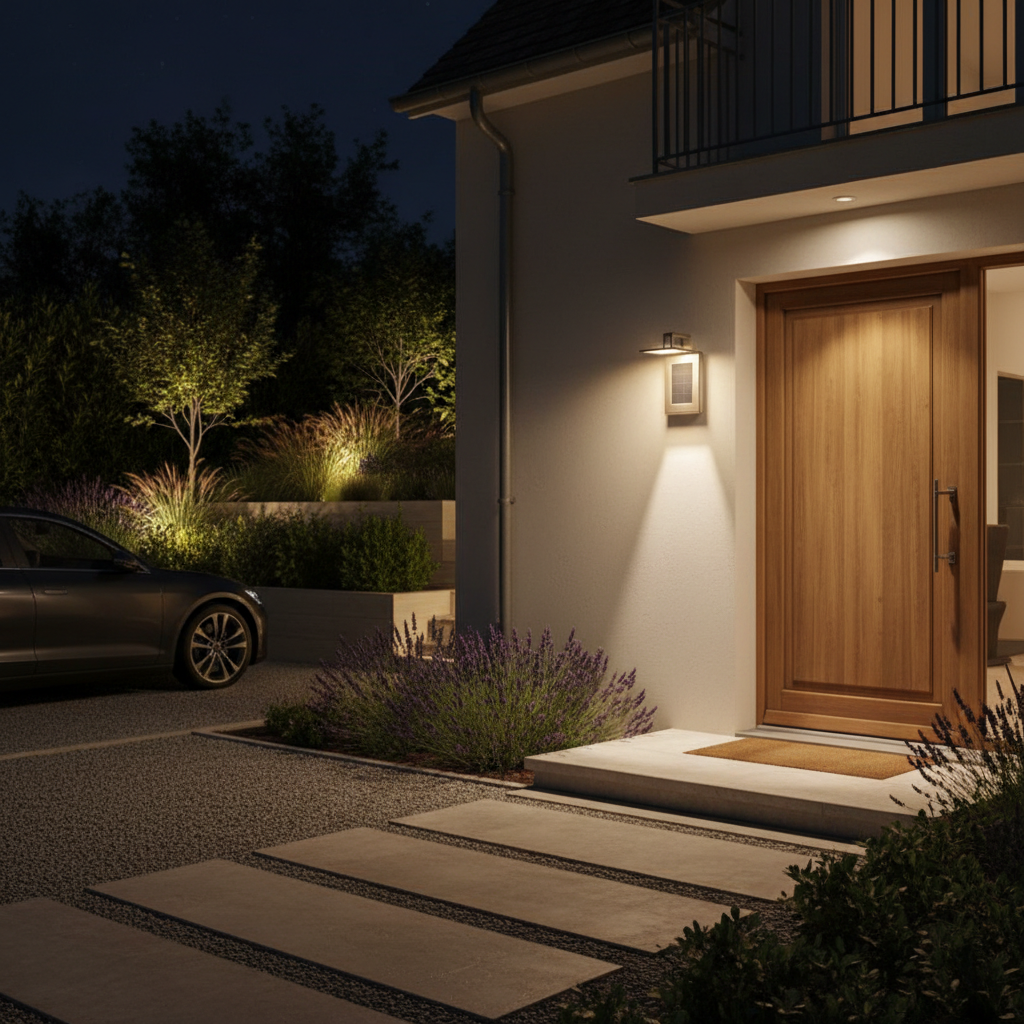
Let's be honest. Lumic's SolarGlow isn't a solar floodlight in the strict sense. It's a solar wall sconce — a different format, designed to integrate cleanly on a facade or entryway.
But here's what sets it apart: 1200 real lumens. Not peak lumens, not theoretical lumens. This figure is backed by a 5-year warranty. When a brand states 1200 real lumens and commits to a 5-year warranty, they can't cheat: if the product doesn't deliver on its promises, customer support pays the price.
Other concrete points:
- 2 motion sensors at 180°, range approximately 26 feet (8 meters)
- IP65: resistant to rain, snow, frost
- Up to 20 days without sun in detection mode
- Wireless installation, no electrician, no complex drilling
- 5-year warranty + 90-day satisfaction guarantee
For an entryway, gate, or facade where you want power without major work, this is a serious option. Not a replacement for a stadium floodlight. But for 95% of residential uses, 1200 real lumens get the job done.
If you want to understand in detail what distinguishes real solar floodlights from imitations, our article on what makes a powerful and reliable solar floodlight goes deeper into the technical analysis.
Mistakes to Avoid When Buying a Solar Floodlight
Relying Solely on Amazon Reviews
Reviews on sales platforms can be biased — sometimes by incentivized reviews, sometimes simply because early users leave a positive review before the battery degrades. A product rated 4.3/5 with 800 reviews can still be disappointing after 6 months. Look for independent tests or long-term customer feedback.
Installing the Panel in a Shaded Area
This is the number one mistake in the field. A solar floodlight installed under an awning, behind a shutter, or in a shaded area in the afternoon will never recharge properly. The panel needs 4 to 6 hours of direct sunlight daily to properly recharge the battery. In winter, it's even more critical: optimize the panel's tilt angle towards the south.
Buying Too Small for the Area to Cover
A 300 real lumen solar floodlight to illuminate a 538 sq ft (50 m²) parking lot — that won't work. Calculate the area to be lit before buying. A simple rule: 500 to 600 lumens are enough for a small space (entryway, outdoor hallway), 800 to 1200 lumens for a driveway or facade; beyond that, you need multiple sources or wired lighting.
Ignoring the Warranty and Customer Support
A solar floodlight exposed to the elements year-round will experience thermal shocks, humidity, and vibrations. Without a serious warranty, the slightest problem means replacement. A 2 to 5-year warranty with accessible customer support is a real indicator of trust — not just a marketing argument.
How to Choose the Best Solar Floodlight for Your Needs
There is no universal best solar floodlight. But here's a simple decision matrix:
- You want to light an entryway or gate, with no major work: A solar wall sconce with 1000+ real lumens and a motion sensor will suffice. Compact format, quick installation, proven effectiveness.
- You want to cover a parking lot or a large driveway: Opt for a true adjustable solar floodlight, 1000-1500 real lumens, minimum 2000 mAh battery, 180° detection angle.
- You want constant power without relying on the sun: Wired remains the most reliable solution. Budget $300 to $600 including installation.
- You are a renter or want no work at all: Wireless solar is for you, provided you choose a product that delivers on its lumen promises.
To go further in your decision, consult our complete guide to outdoor solar floodlights — it covers selection criteria in detail with concrete use cases.
What to Remember Before Buying
The solar floodlight market is full of products that over-promise and under-deliver. The good news: by knowing exactly what to look for, you can quickly sort through them.
Three points never to ignore: real lumens (not peak), battery capacity (minimum 2000 mAh for serious use), and the warranty offered. A manufacturer who commits to 5 years with accessible customer support knows their product is reliable. A manufacturer who offers no warranty or a 3-month warranty tells you everything you need to know.
Investing in a good outdoor solar floodlight means $50 to $100 well spent rather than $15 renewed every year. Over 3 years, the difference is real — both in dollars and peace of mind.