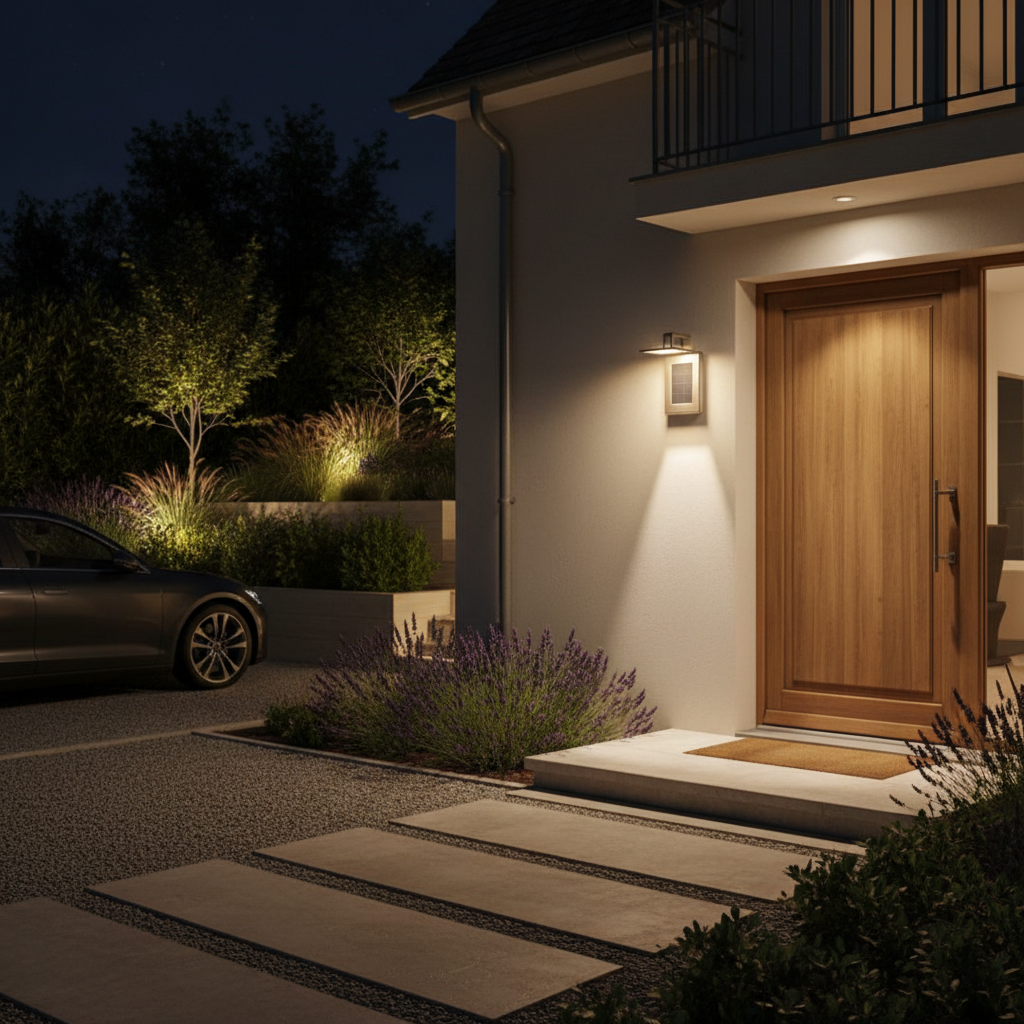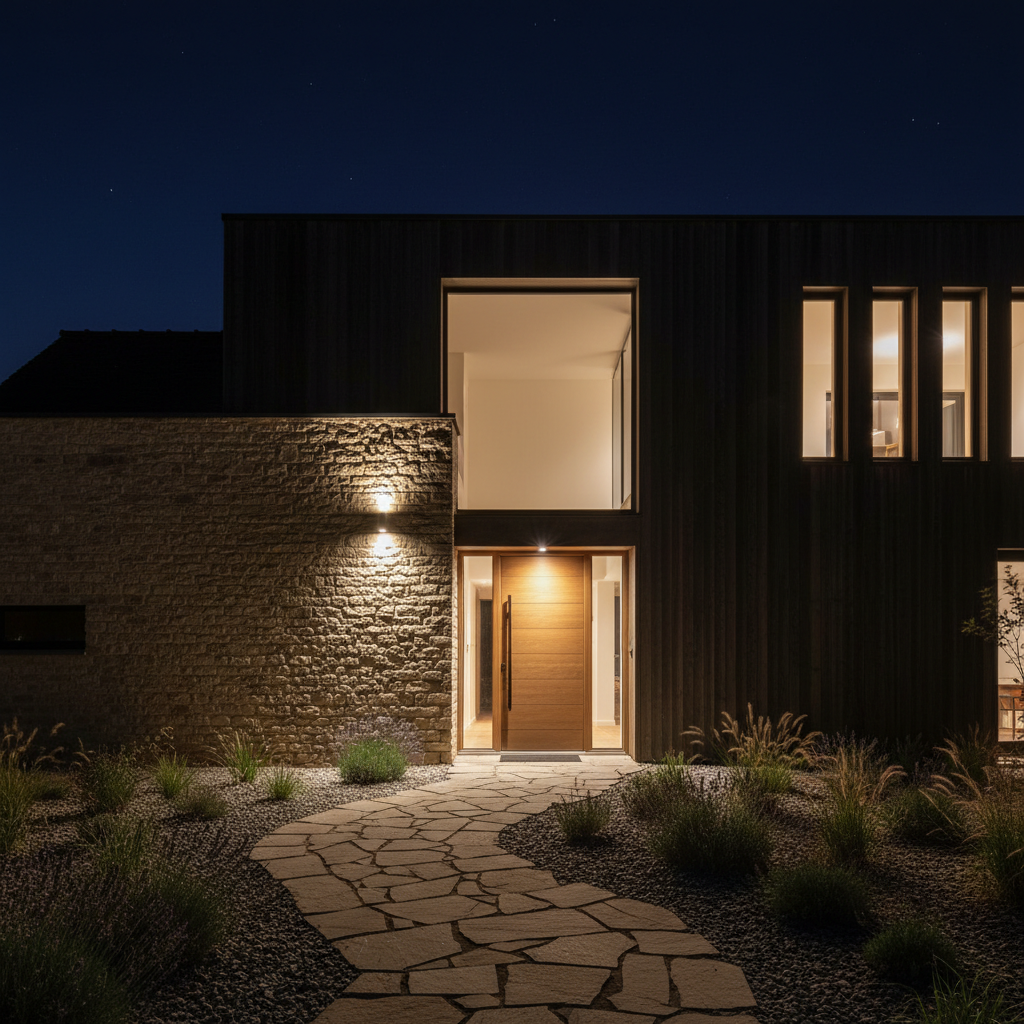

You want to light up your driveway with solar pathway lights and spend hours comparing models on Amazon or Home Depot. The problem is, most people who buy outdoor solar pathway lights expect real illumination — and end up disappointed. Not because the product is bad, but because a pathway light doesn't do the same job as a spotlight.
Before choosing, you need to understand what you're really looking for: marking a path so it's visible at night, or illuminating an area for clear visibility? These are not the same product. This guide gives you concrete criteria to make the right choice.
What an Outdoor Solar Pathway Light Really Does
An outdoor solar pathway light is a marker light, not a spotlight. Its role is to define a path, driveway, or patio edge — so people can see where they're walking, without glare.
How Bright Should a Solar Garden Pathway Light Be?
Between 20 and 50 lumens for a low, soft ambiance. Between 100 and 200 lumens for more visible, functional marking. Beyond that, it's no longer a garden pathway light but a low-end spotlight.
For comparison: a candle emits about 12 lumens. A 40W bulb radiates around 450 lumens. A solar pathway light is not meant to replace street lighting. It guides. It defines. It creates an atmosphere.
This is the classic mistake: buying an outdoor solar pathway light thinking you'll illuminate your yard like a parking lot. The result? The light works fine, but it doesn't meet the actual need. Understanding this before buying saves you time and money.
What is an Outdoor Solar Pathway Light Used for?
An outdoor solar pathway light visually marks a path at night. It outlines a walkway, protects plants from accidental trampling, and creates a decorative lighting effect in the garden. It doesn't replace functional lighting if you want to read, find your keys, or clearly see an entire area.
For a 33-foot (10-meter) driveway, you'll need 4 to 6 lights spaced 6.5 to 10 feet (2 to 3 meters) apart — no more, no less. Too close, the effect is cluttered. Too far apart, the marking loses its purpose. To learn all about different types and how to arrange them, check out our article on types of solar garden pathway lights.
The Criteria That Truly Make a Difference
Not all products sold as "powerful outdoor solar pathway lights" are equal. Here's what to look for before buying.
Height: A Detail That Changes Everything
Pathway lights generally range from 8 to 32 inches (20 to 80 cm) in height. Shorter models (8-12 inches / 20-30 cm) integrate well into flowerbeds or along a lawn. Taller models (20-32 inches / 50-80 cm) have more visual presence and mark pedestrian paths more clearly.
Practical tip: if you want the light to remain visible from your patio or a window, choose at least 16 inches (40 cm). Below that, they disappear in the grass as soon as the lawn grows a bit.
Material: Stainless Steel or Plastic?
This is where many make a budget mistake they regret after one winter. Plastic costs less upfront, but it yellows, becomes brittle in freezing temperatures, and loses its luster in two seasons. Stainless steel or aluminum holds up much better over time, especially in regions with significant temperature fluctuations.
For lights exposed to rain, frost, and UV rays, look for at least an IP44 rating (resistant to water splashes). IP65 is even better for highly exposed areas.
Solar Panel: The Real Limit of Low-End Lights
An outdoor solar pathway light only works if its panel properly recharges the battery during the day. Cheaper models have tiny cells that don't recharge enough in winter or on cloudy days — and the light simply won't turn on.
Check if the panel is angled and facing the sky (not flat on top of the light, which is less efficient). The integrated battery capacity is also an indicator: the larger it is, the longer the light will last for several consecutive nights without sun. To delve deeper into this topic, our article on powerful solar pathway lights details what you can truly expect in terms of performance.
Comparison Table: Which Type of Pathway Light for Which Use?
| Use | Recommended Brightness | Suggested Height | Ideal Material | Spacing |
|---|---|---|---|---|
| Garden Path Marking (Ambiance) | 20-50 lumens | 8-16 inches (20-40 cm) | Stainless Steel or Aluminum | 6.5 to 10 feet (2 to 3 m) |
| Pedestrian Path Marking (Functional) | 100-200 lumens | 16-24 inches (40-60 cm) | Aluminum | 6.5 to 10 feet (2 to 3 m) |
| Flowerbed Definition | 20-30 lumens | 6-10 inches (15-25 cm) | Stainless Steel, Treated Metal | 3 to 6.5 feet (1 to 2 m) |
| Patio / Pool Surround | 50-100 lumens | 12-20 inches (30-50 cm) | Stainless Steel, Tempered Glass | 5 to 8 feet (1.5 to 2.5 m) |
| Entrance / Gate (Visible from Afar) | 150-200 lumens | 24-32 inches (60-80 cm) | Robust Aluminum | 2 symmetrical lights |
This table is a guide, not an absolute rule. The key is to align your expectations with what the pathway light can actually produce. For an overview of all types of solar lighting, consult our complete guide to outdoor solar lighting.
Wired vs. Solar Pathway Lights: The Hidden Cost Question
Sometimes solar pathway lights are compared to wired lights connected to the mains. The latter often offer more power and more stable light. But their installation involves digging a trench in your garden, laying an electrical cable, and hiring an electrician.
How Much Does Wired Pathway Light Installation Cost?
In practice, a wired installation to light a driveway often costs between $1,000 and $2,000, depending on the length of the driveway, the terrain configuration, and the electrician's rates. Not to mention the cost of restoring the ground after cable installation.
Outdoor solar pathway lights are simply pushed into the ground with no cables or trenches. Installation takes minutes, you can reposition them as needed, and there's no electrical connection. For a renter or someone who doesn't want to undertake heavy work, this is often the only sensible choice.
Do Solar Pathway Lights Really Work in Winter?
This is a legitimate question many ask. The honest answer: it depends on the model. Low-end lights with small solar cells struggle to recharge properly in November-February in less sunny regions. More serious models, with a decent-sized panel and sufficient battery capacity, continue to work even on cloudy days — but with potentially reduced lighting duration.
If winter use is important to you, this is a criterion to explicitly consider in your search rather than assuming all products are equal.
The Mistake Most Buyers Make
The classic mistake: buying outdoor solar pathway lights expecting to illuminate your garden like a commercial street. It doesn't work that way — and it's not designed for that.
Pathway lights mark. They guide the eye, define contours, and create a nighttime ambiance in the garden. But if you want to clearly see who's at your door or light up your parking area when you come home late, you need a different type of fixture: a motion-sensor spotlight.
The Combo That Really Works: Pathway Lights + Motion Sensor
The most effective setup for an entrance or driveway is a combination of both. Solar pathway lights along the path to guide steps and create ambiance, plus a powerful motion sensor spotlight at the entrance or gate to truly illuminate when someone arrives.
Pathway lights guide. Spotlights illuminate. These two functions are complementary, not interchangeable. Our article on outdoor path lighting elaborates on this logic with concrete configurations.
The SolarGlow by Lumic serves as that powerful entrance sensor: 1,200 lumens, two 180° sensors with a 26-foot (8-meter) range, IP65 rated for all weather, and no cables to install. It's not a pathway light — it truly illuminates when needed, then turns off to save energy. 5-year warranty, 90-day satisfaction guarantee.
What We Often See in Customer Feedback
User feedback on solar pathway lights reveals some recurring trends.
Common Positive Feedback
Easy installation is consistently mentioned. Planting a pathway light in the ground takes seconds. No tools, no cables, no electrician needed. The freedom to reposition lights according to seasons or garden projects is also highly appreciated.
The visual effect at night is often described positively, even for mid-range models. A driveway marked with 6 well-spaced lights genuinely transforms the ambiance of a garden at night.
Disappointments That Could Have Been Avoided
Brightness is the most common source of dissatisfaction — but almost always because initial expectations were not calibrated. "I expected something brighter" is frequent feedback from buyers who confused marking with illumination.
The durability of plastic models is the other point of contention. After one or two winters, yellowing and fragility of low-end casings become visible. Investing a bit more in a metal or stainless steel model avoids this inconvenience.
How to Choose Your Outdoor Solar Pathway Light: 5 Key Questions
Before ordering, ask yourself these five questions in order.
1. Do I want to mark or illuminate? If marking: pathway lights. If illuminating: spotlight or motion-sensor light. If both: pathway lights + motion sensor at the entrance.
2. What length of driveway or path needs marking? Multiply by 0.4 to estimate the minimum number of lights (one light every 8 feet / 2.5 meters on average).
3. What material based on my exposure? Rainy region, frequent frost, direct UV exposure all day: high-quality stainless steel or aluminum.
4. What is my usual sun exposure? If you're in a region often cloudy in winter, choose a light with a visible panel and adequate battery capacity.
5. What visual ambiance do I want to create? Warm white light (2,700-3,000 K) for a soft, welcoming ambiance. Neutral white light (4,000 K) for a more contemporary effect. Avoid cool white for a residential garden; the effect is often stark and unflattering.
For advice on other products that complement pathway lighting, our articles on powerful solar garden lights and solar patio lighting delve deeper into these themes.
What Pathway Lights Will Never Do — And That's OK
An outdoor solar pathway light will never replace powerful security lighting. It won't deter an intrusion like a 1,000-lumen spotlight suddenly turning on in the night. It won't provide enough light for manual activities outdoors.
But that's not its role. Its role is to transform your driveway into a welcoming path, to give your garden a soft and warm presence at night, to guide your guests without them having to search their way. It's a specific use, and when understood before buying, satisfaction is guaranteed.
To choose reliable outdoor solar lights that combine aesthetics and durability, take the time to compare materials, IP ratings, and brand reputation before ordering.
Summary: What to Remember Before Buying
- Solar pathway light = marking, not illumination. Calibrate your expectations accordingly.
- 20-50 lumens for a soft ambiance, 100-200 lumens for more functional marking.
- Space lights every 6.5 to 10 feet (2 to 3 meters) for a cohesive visual effect.
- Prefer stainless steel or aluminum over plastic for durability.
- Check solar panel size and battery capacity for winter use.
- For additional illumination: combine marking lights + powerful motion sensor at the entrance.
- Wired installation costs an extra $1,000 to $2,000 — solar avoids this expense.
With these basics in mind, you can compare market models with a much sharper eye. And if you're still unsure what you truly need, a look at our article on choosing the right outdoor solar light can help clarify the overall picture.