You've measured. You want exactly 24 inches (60 cm). Now you're faced with a plethora of options, and no one clearly tells you what works or what doesn't. This article does just that: it honestly compares the available options for a 24-inch (60 cm) light bar, without selling you a dream.
A quick, useful clarification from the start: an exact 24-inch (60 cm) length isn't universal across all product lines. Some light bars come close but aren't precisely that length. We'll clarify this.
Why is 24 inches (60 cm) such a common measurement?
The 24-inch (60 cm) LED light bar has become a de facto standard, especially in kitchens. Kitchen base and wall cabinets are often manufactured in 24-inch (60 cm) modules, making this length ideal for illuminating a countertop section by section. It's also a common length under bathroom cabinets, in closets, or hallways.
Where are 24-inch (60 cm) light bars installed?
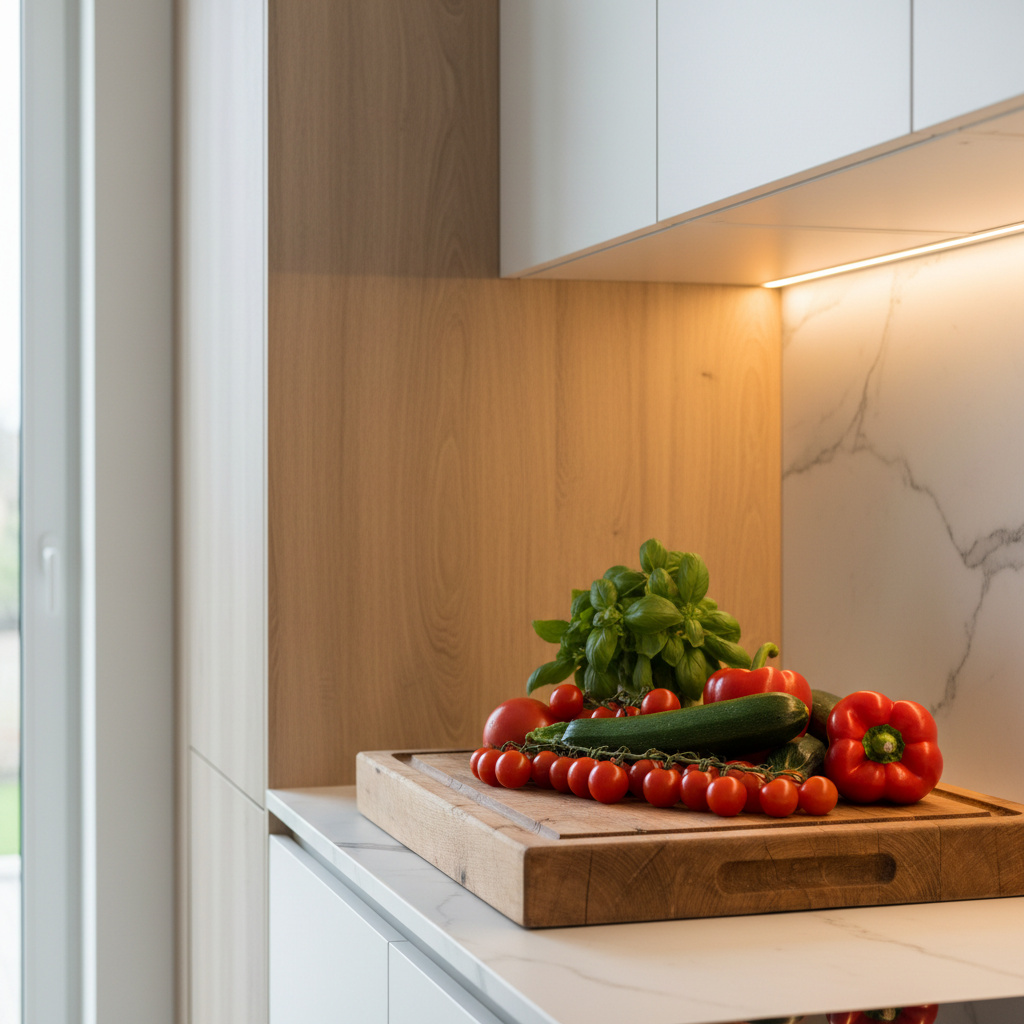
The most frequent answer: under kitchen wall cabinets, above the countertop. A standard kitchen cabinet module is 24 inches (60 cm) wide, so a light bar of the same length fits perfectly without overhanging. It's also used under bathroom cabinets or in storage closets.
For more on specific kitchen criteria, our article on LED kitchen lighting details the best practices for your space's configuration.
Are all light bars exactly 24 inches (60 cm)?
No, and this point is often poorly explained. Many products in stores or online advertise "24 inches (60 cm)" when the actual length of the light module is slightly shorter (21.5 inches / 55 cm, 22.8 inches / 58 cm) to account for mounting hardware. Always check the length of the light body, not just the advertised total dimensions.
Wired 24-inch (60 cm) Options: What's Really Available
Wired 24-inch (60 cm) LED light bars are the most common. You can find them everywhere: Home Depot, Lowe's, IKEA, Amazon. Here's an objective comparison of the main categories.
| Type | Actual Length | Estimated Price | Installation | Motion Sensor | Battery Life |
|---|---|---|---|---|---|
| Basic Wired Light Bar (Home Depot / Lexman) | ~22.8-24 inches (~58-60 cm) | $15-$30 | Wall outlet or hardwired | No | AC powered |
| Wired Light Bar with Sensor (Amazon / Philips) | ~24 inches (~60 cm) | $25-$50 | Wall outlet or hardwired | Yes (infrared) | AC powered |
| Wireless LED Light Bar 15.7 inches (40 cm) (e.g., Movement 3.0) | 15.7 inches (40 cm) | See trylumic.com | Magnetic + adhesive, no-drill | Yes (integrated) | ~5-6 weeks (sensor mode) |
| Combo 9 inches (23 cm) + 15.7 inches (40 cm) (Movement 3.0 x2) | 24.8 inches (63 cm) (side-by-side) | 2 x unit price | Magnetic + adhesive, no-drill | Yes (integrated) | ~4-5 weeks |
This table highlights an important point: if you want exactly 24 inches (60 cm) wired, you need either a nearby outlet or an electrician. And if you don't have an outlet under the cabinet, the true cost quickly escalates.
What's the True Cost of Installing a Wired 24-inch (60 cm) Light Bar?
The product itself costs between $15 and $50. But if you don't have an outlet nearby under your kitchen cabinet, you'll need an electrician to create a connection point. Depending on the region and the complexity of the job, this typically costs between $150 and $300 for labor. This cost is never displayed on the product box, but it's very real.
Which Wired Models Are Worth It, According to User Reviews?
Lexman lines at Home Depot receive good reviews for finish quality and brightness. Philips Hue wired models are powerful but expensive and sometimes require an additional smart home bridge. For tight budgets, Amazon options (tier 2 brands) work but with inconsistent durability across batches.
The Honest Question: Can a 15.7-inch (40 cm) Light Bar Be Enough?
This is a question few articles frankly ask. Yet, it's legitimate. Before focusing on 24 inches (60 cm), ask yourself: what area do I really need to illuminate?
A 24-inch (60 cm) wide countertop isn't fully utilized at all times. If you primarily prepare meals in the center or to the right of that counter, a 15.7-inch (40 cm) light bar precisely positioned there illuminates exactly what you need, with no visible compromise.
In Which Cases is 15.7 inches (40 cm) Truly Sufficient?
Specifically, 15.7 inches (40 cm) adequately covers:
- A standard cutting board (typically 12-15.7 inches / 30-40 cm wide)
- An active workspace under a single wall cabinet
- A hallway or entryway (motion detection is enough, no need to cover the entire width)
- A 24-inch (60 cm) closet if the contents are centered
However, if you want uniform lighting across the entire length of a 24-inch (60 cm) cabinet (e.g., for an open-plan kitchen where aesthetics matter), a light bar of the same length makes more visual sense.
The Combo Solution: Two Light Bars Side-by-Side for 24.8 inches (63 cm)
This is a practical trick. By combining a 9-inch (23 cm) and a 15.7-inch (40 cm) light bar, you get approximately 24.8 inches (63 cm) of light coverage. Each light bar operates independently with its own motion sensor. The advantage: you can adjust the light output and position exactly to your setup. The drawback: two batteries to recharge separately, and a slight visual discontinuity between the two modules.
To choose between these formats and other important criteria, our article How to Choose an LED Light Bar helps you prioritize based on your real needs.
Wireless vs. Wired for a 24-inch (60 cm) Light Bar: The Real Comparison
This is often presented as a simple choice. In reality, it depends on your starting situation.
| Criterion | Wired 24 inches (60 cm) | Wireless (e.g., Movement 3.0) |
|---|---|---|
| Product Cost | $15-$50 | See trylumic.com |
| Total Installation Cost | $15-$350 depending on outlet availability | $0 (magnetic + adhesive) |
| Installation Time | 15 min to several hours | Less than one minute |
| Battery Life | Unlimited (AC powered) | 4-6 weeks in sensor mode |
| Motion Sensor | Optional (+ cost) | Integrated |
| Max Brightness | Variable (often 300-600 lumens) | 150 lumens (9 inches / 23 cm) / 320 lumens (15.7 inches / 40 cm) |
| Available Length | Exactly 24 inches (60 cm) possible | Max 9 inches (23 cm) or 15.7 inches (40 cm) |
| Suitable for Renters | No (hardwiring) | Yes (no traces) |
This table clearly illustrates the real trade-off: if you have an outlet nearby and no installation constraints, a wired 24-inch (60 cm) light bar is a clean and economical solution. If you don't have an outlet and don't want renovations, wireless options, with their size limitations, remain more practical.
For everything about wireless light bars and selection criteria, our guide on wireless LED light bars goes into more detail.
What the Movement 3.0 Does (and Doesn't Do) at 15.7 inches (40 cm)
Let's be direct: Lumic's Movement 3.0 doesn't come in 24 inches (60 cm). The largest model is 15.7 inches (40 cm). This isn't a flaw; it's a reality to be aware of before buying.
What it offers at 15.7 inches (40 cm):
- 320 lumens: sufficient for an active workspace or a nighttime hallway
- Integrated motion sensor with ambient light sensor: it won't turn on in broad daylight
- 3000 mAh rechargeable USB battery: approximately 5 to 6 weeks in sensor mode, without changing a single battery
- Magnetic mounting: reposition it in seconds if you reorganize your kitchen
- 3 color temperatures (3000K, 4000K, 6000K) and adjustable brightness for different uses
What it doesn't do: visually cover the full 24 inches (60 cm) of a kitchen cabinet if you're looking for uniform lighting across that entire length. For this, a wired 24-inch (60 cm) light bar would be more suitable.
On trylumic.com, the Movement 3.0 comes with a 5-year warranty and a 90-day return policy. Customer support is based in the US, with responses typically within 24 hours, according to customer feedback (Trustpilot rating: 4.5/5 from over 2200 reviews).
If your need is for a closet rather than a countertop, our article on LED closet lights will provide additional benchmarks.
Color Temperatures: Warm White or Cool White for a 24-inch (60 cm) Kitchen?
The length of the light bar has nothing to do with color temperature, but it's a common question when choosing kitchen lighting. Here are some useful guidelines.
Which Temperature to Choose for Countertop Lighting?
For an active countertop where you're cutting, cooking, and assembling dishes, a neutral white around 4000K is generally the most practical. It renders colors accurately without being harsh. Warm white (3000K) is more pleasant for ambiance but can make some precision tasks slightly less comfortable. Cool white (6000K) suits highly functional spaces but can appear clinical in a kitchen with a warm atmosphere.
Should the Entire Kitchen Have the Same Temperature?
Not necessarily. Some prefer a warm white for general ambiance (ceiling light) and a neutral white for the countertop. Mixing can work if the temperatures aren't too far apart (e.g., 3000K + 4000K). However, mixing 3000K and 6000K in the same space often results in a visually inconsistent look.
Key Takeaways Before Buying a 24-inch (60 cm) Light Bar
Here's the practical summary, no beating around the bush:
- If you have an available outlet under the cabinet and want exactly 24 inches (60 cm): a classic wired light bar (Home Depot, Lowe's, Philips) does the job for $20-$40.
- If you don't have an outlet and refuse renovations: calculate the true cost (product + electrician), then compare it with a wireless solution.
- If 15.7 inches (40 cm) is sufficient for your active workspace: the Movement 3.0 offers immediate installation, integrated motion sensing, and zero batteries to change.
- If you want to cover approximately 24 inches (60 cm) wirelessly: the 9-inch (23 cm) + 15.7-inch (40 cm) combo works, with two independent batteries to manage.
- The ideal 24-inch (60 cm) LED light bar doesn't universally exist: it depends on your setup, your total budget (product + installation), and your tolerance for recharging constraints.
For all cable-free kitchen lighting options, our article Wireless Kitchen Lighting: The Real Solution in 2026 compares current solutions available in the US and Canada.