Looking to upgrade your bathroom lighting but unsure which LED light bar to choose? Or if the one you've spotted is truly suitable? That's a smart question to ask. In a bathroom, picking the wrong IP rating can, at best, lead to a light bar burning out in a few months, and at worst, pose a real electrical hazard.
This article explains how regulatory zones define the right choice, what the famous IP rating truly means, and which solution fits each location — without unnecessary jargon.
Why the Bathroom is Different from Other Rooms
The bathroom is the only room in your home where electricity and water coexist so closely. US/Canadian regulations (like the NEC in the US and CEC in Canada) define distinct zones, each with specific requirements for electrical fixture water resistance.
Ignoring these zones can lead to overspending on unnecessary protection or, worse, endangering your family. Both are avoidable if you understand the basics.
What Exactly is an IP Rating?
IP (Ingress Protection) measures a device's resistance to solids and liquids. The first digit concerns dust, the second concerns water. For bathrooms, the second digit is crucial.
- IP X0: No water protection
- IP X4: Protected against splashing water from any direction
- IP X5: Protected against water jets
- IP X7: Withstands temporary immersion
In practice: a bathroom LED light bar with an IP44 rating tolerates water splashes. An IP67 can be submerged. An IP20, however, has no business near a shower.
The Three Regulatory Zones You Need to Know
Regulations define three zones in a bathroom:
| Zone | Location | Minimum IP Required |
|---|---|---|
| Zone 0 | Inside the bathtub or shower tray | IP67 minimum |
| Zone 1 | Above the tub/shower (up to 7.4 feet (2.25 m) high) | IP44 minimum |
| Zone 2 | 24 inches (60 cm) around Zone 1 | IP44 minimum |
| Outside Zones | Rest of the room (facing the sink, cabinets, etc.) | IP20 sufficient |
This table is fundamental. Want to install a bathroom LED light bar above your mirror, facing the sink, far from any splashes? IP20 might suffice. A light inside the shower tray? IP67 is mandatory.
Which Bathroom LED Light Bar for Each Location?
Now that we've covered the regulatory basics, here's how it translates into practice depending on where you want to install your lighting.
Above the Mirror or Sink (Outside Zones)
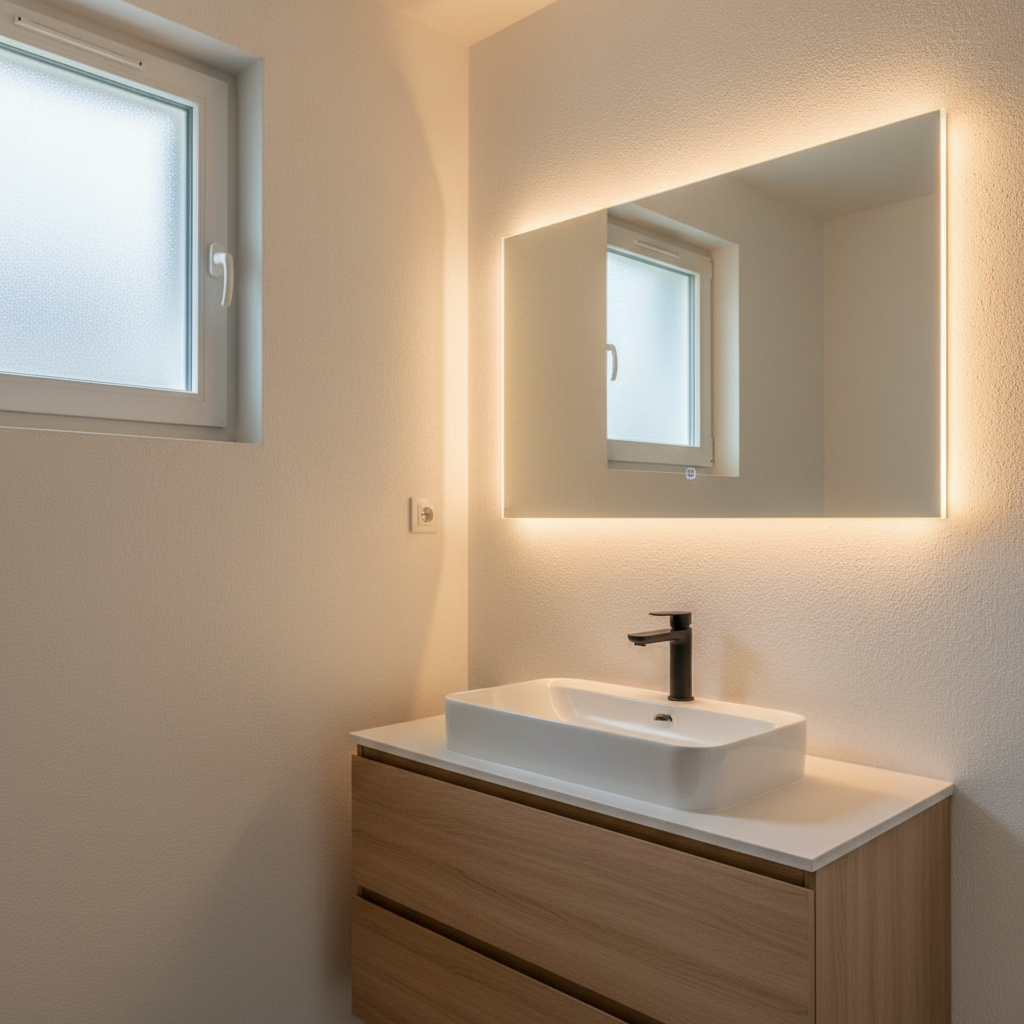
This is the most common location for a bathroom LED light bar. You're in an outside zone, so technically an IP20 is allowed — but in a bathroom, even far from the shower, ambient humidity is present. Aiming for an IP44 is still a good idea for durability, even if not strictly required.
This is where most light bars sold at Home Depot or Lowe's are designed for: above the mirror, connected to the dedicated bathroom circuit, with light directed towards the face for a natural look. For this use, choose a color temperature around 4000K (neutral white): it renders colors well for makeup or shaving without being harsh.
In Zone 1 or 2 (Shower/Bathtub Area)
Here, no compromises: IP44 minimum, and preferably IP65 if you're unsure. These zones are directly exposed to splashes and steam. An unsuitable LED light bar in this zone can cause a short circuit or, worse, an electric shock.
Beware: an IP65 bathroom LED light bar in a dry cabinet is wasted money. But the same IP65 above your shower is the reasonable minimum. Do not under-protect wet areas, and do not over-protect dry areas.
In a Bathroom Cabinet or Vanity
Here, the logic completely changes. A bathroom cabinet — even in this room — is often a dry, outside-zone area. No direct steam, no splashes. An IP20 does the job, and you don't need an electrician to install it.
It's precisely for these situations that a wireless, rechargeable LED light bar becomes incredibly practical. No wiring, no drilling, and installation takes less than a minute. We'll get back to this shortly.
Choosing the Right Color Temperature for the Bathroom
IP is about safety. Color temperature is about daily comfort. And in a bathroom, the right choice depends on the primary use of the space.
Warm White (3000K): Relaxation and Spa Ambiance
Warm white provides a golden light, similar to a candle or living room lighting. It's ideal for a bathroom used in the evening to relax in a hot bath. However, for applying makeup or seeing fine details, the light is too warm and can distort color perception.
Neutral White (4000K): The Best Compromise
4000K is the safe bet for bathrooms. It faithfully renders colors — practical for makeup, shaving, and skincare — without feeling like an office or hospital. This is the temperature we recommend if you only have one bathroom LED light bar and want it to serve all purposes.
Cool White (6000K): Use Sparingly
Cool white is very bright and high-contrast. Some appreciate it for a sleek, modern bathroom, but it can appear harsh in the morning or create an unflattering bluish tint. If you opt for 6000K, make sure you also have an indirect lighting source to soften the overall effect.
To delve deeper into the durability of your lighting and what you can reasonably expect, check out our article on LED Light Bar Lifespan.
What Labels Don't Always Tell You
You browse the aisles of a big box store or scroll through Amazon, and you see bathroom LED light bars advertised as IP44 at very different price points. What truly justifies the price difference?
Internal Electronics Quality
A low-end IP44 light bar might last a few months before humidity seeps in despite the protective seal. Seals age, crack, and that's when problems begin. A premium European design light bar will have a better-finished casing, more durable seals, and better-protected electronics. This isn't visible to the naked eye, hence the importance of checking customer reviews for long-term performance.
Actual vs. Advertised Luminous Flux (Lumens)
Some manufacturers advertise generous lumen counts, but in real bathroom conditions (reflective surfaces, lighting angle), the result is disappointing. Be wary of very cheap models with very high numbers: advertised lumens rarely match the actual perceived brightness.
Mounting and Installation
In a bathroom, installing a wired light bar requires a dedicated electrical circuit. If you don't have a circuit planned for that spot, you'll need to call an electrician — or opt for a wireless solution where possible.
To help you make the right choice for your situation, our complete guide to choosing your LED light bar details all the criteria to consider before buying.
Special Case: Lighting a Bathroom Cabinet or Vanity Without Major Work
Many people look for a bathroom LED light bar not for the mirror or shower, but to solve a very specific problem: a dark under-sink cabinet, a storage unit where nothing can be found, or an unlit wall niche.
These locations are dry areas, outside regulatory wet zones. And that's where a wireless rechargeable LED light bar truly makes a difference.
Why a Wireless Light Bar is Often the Best Solution Here
In a bathroom cabinet, there's no outlet or dedicated circuit nearby. Installing a wired light bar requires either wiring from another circuit (major work) or running a visible cable (not very aesthetic). A USB rechargeable light bar, attached in seconds with industrial adhesive or a magnetic mount, solves the problem immediately — no drilling, no electrician, no installation costs.
The Lumic Movement 3.0 is designed precisely for this type of use. It turns on automatically when you open the cabinet (motion sensor + ambient light sensor) and turns off by itself. Its 3000 mAh battery — three times larger than most alternatives on the market — lasts approximately four to six weeks depending on the model and usage, without recharging. It installs in less than a minute via its magnetic system and industrial adhesive, and it's available in 9 inches (23 cm) (approx. 150 lumens) or 16 inches (40 cm) (approx. 320 lumens) depending on the area to be lit.
What it's not: It's not designed for wet areas or installation above a shower. For those uses, you need a wired light bar with the correct IP rating. The Movement 3.0 is a dry zone solution — cabinet, furniture, hallway, entryway — and it excels in that role.
To choose the right wireless model for your needs, consult our article dedicated to choosing a wireless LED light bar.
Summary: Which Bathroom LED Light Bar for Your Situation
To summarize unambiguously:
| Location | Recommended IP | Solution Type |
|---|---|---|
| Inside shower / bathtub (Zone 0) | IP67 minimum | Wired only, UL listed |
| Above shower/bathtub (Zone 1-2) | IP44 minimum | Wired with dedicated circuit |
| Facing mirror, sink (Outside Zones) | IP44 recommended | Wired or suitable ceiling fixture |
| Bathroom cabinet / vanity (Dry zone) | IP20 sufficient | Wired or wireless rechargeable |
The logic is simple: match the protection level to the actual water exposure. No less, no more. IP65 in a dry cabinet? That's wasted money. IP20 above a shower? That's dangerous.
What if You Need to Choose Without Doing Major Work?
If you're a renter or your budget doesn't allow for an electrician, the dry areas of your bathroom (cabinets, upper furniture, niches) can be lit without any wiring. For wet areas, a wired solution remains the only safe option — and in that case, professional intervention is necessary.
For installing an LED light bar in a tricky situation, consult our article on simple solutions for LED light bar installation.
Key Takeaways for Bathroom LED Light Bars
Choosing a bathroom LED light bar isn't just about style or price. It's primarily about understanding where you're installing it, what water exposure that location entails, and what IP rating matches that reality.
- Zone 0 (inside shower): IP67 minimum, wired only
- Zone 1 and 2 (around shower): IP44 minimum, wired mandatory
- Outside Zones (sink, mirror): IP44 recommended, standard wired
- Dry zone (cabinet, furniture): IP20 sufficient, wireless possible
And if your main problem is a dark cabinet or a bathroom vanity without light, a rechargeable motion sensor light bar solves it without major work, without an electrician, and without modifying anything in the room. It's often the quickest and most practical solution — provided it's not installed where it's not intended.