Want to light up a hallway at night, a closet, or a bedroom, but there's no outlet nearby? And you don't want to install an electrical circuit just for a night light. Good news: wireless solutions have significantly improved in recent years, and some are truly impressive.
However, not all wireless night lights are created equal. Between battery-powered options, USB-rechargeable ones, and those with motion sensors, the differences are significant, especially regarding real long-term cost, daily convenience, and battery life.
This guide provides the keys to choosing based on your actual needs, without selling you a dream.
The 3 Types of Wireless Night Lights That Really Exist
The first question to ask yourself is about power. This determines your comfort, your long-term budget, and the maintenance effort you're willing to accept.
Battery-Powered Night Lights: Convenient Short-Term, Costly Long-Term
This is the most common and affordable solution upfront. No cables, no recharging; just pop in batteries, and you're good to go. In theory.
In practice, batteries run out, often at the worst possible time. For a night light used every night, you can easily spend between $15 and $30 on batteries annually, sometimes more if the brightness is high. Over two years, that's $30 to $60 spent on batteries, not to mention the environmental impact of disposable batteries.
This is an acceptable option if you need a temporary backup solution or only use the night light very rarely. For daily use, there are better alternatives.
Rechargeable LED Night Light: The Best Value for Cost/Convenience
The principle is simple: an integrated battery that you recharge via USB, just like your phone. No batteries to buy, no waste to manage. The electricity cost is almost zero.
The only thing to keep in mind: you have to remember to recharge it. Depending on the model's battery life, this can range from once a week to once a month. Some models have a battery indicator, while others leave you guessing until the light dims.
For a rechargeable night light used every night, opt for a generous battery. The larger it is, the less you'll have to worry about it.
Motion Sensor Strip Light: The Truly Smart Version
This is where it gets interesting for nighttime use. A strip light with a motion sensor turns on when you pass by and turns off automatically a few seconds later. It only consumes power when you're present. And if the room is already lit, it won't turn on, thanks to the integrated ambient light sensor.
The result: much longer battery life than a continuous-mode night light, and no switch to fumble for at 3 AM.
For a hallway, stairs, or bathroom access at night, this is clearly the most practical setup. And unlike a bright ambient lamp, it won't shock your eyes with aggressive light. Provided you choose the right color temperature.
Nighttime Color Temperature: Why 3000K is Essential
If you want a night light that won't disrupt your sleep, color temperature is the most underestimated criterion. Yet, it's the most important for nighttime use.
Cool White vs. Warm White: What's the Concrete Difference?
Cool light (6000K or higher) mimics daylight. It stimulates wakefulness, increases alertness, and disrupts melatonin production, the sleep hormone. If your night light is cool white, you might have trouble falling back asleep after waking up at night.
Warm white, around 3000K, emits an amber light, similar to a candle. It doesn't stimulate wakefulness, doesn't strain your eyes in the dark, and allows you to move around at night without disrupting your sleep cycle.
For a night light in a hallway, bedroom, or stairs, 3000K is the only right choice. 4000K (neutral white) might be suitable for a bathroom or kitchen, but it's still too stimulating for use in the middle of the night.
Is Adjustable Brightness Useful for a Night Light?
Yes, absolutely. Being able to dim the light allows you to adapt the night light to the situation: brighter in the evening when you're still moving around, dimmer in the middle of the night if you just want to avoid bumping into things. Models with adjustable brightness offer flexibility that fixed night lights don't.
Where to Install a Wireless Night Light for Maximum Utility
A wireless LED night light can go almost anywhere. But not all locations have the same installation logic.
The Night Hallway: The Number One Location
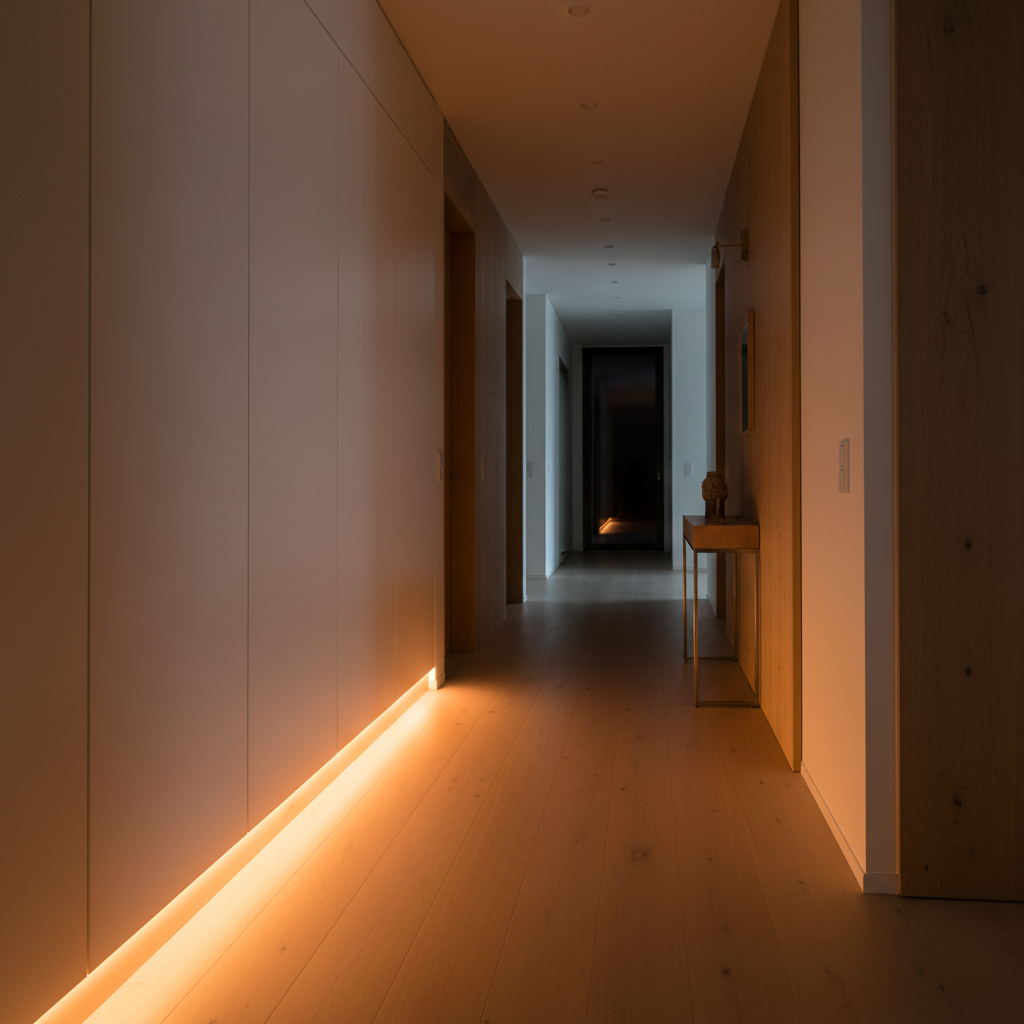
This is the most classic use and the one that best justifies a motion sensor solution. At night, you get up to go to the restroom or bathroom. You don't want to turn on the ceiling light and wake everyone up. A wireless night light placed at the bottom of the hallway or at mid-height discreetly turns on, guides you, and turns off by itself once you've passed.
For this type of use, check out our article dedicated to hallway night lights, which details optimal placements and recommended installation heights.
Stairs: Safety Lighting First and Foremost
Falls on stairs often happen at night. A night light placed on each landing or under the handrail radically improves safety. Wireless, no cables to run through the steps, no electrician needed.
For stairs, motion detection is even more relevant than elsewhere: you don't want a light on constantly; you want it there when you need it.
Closets and Cabinets: A Night Light or Functional Lighting?
For a closet, the question is different. An ambient night light might suffice if you just want to find your belongings without turning on the main light. But if you're looking for true functional closet lighting, with enough light to distinguish clothing colors, an LED light bar is more suitable. To delve deeper into this topic, our guide on automatic closet lighting will help you understand the difference.
Children's Bedroom: Pay Attention to the Ambiance
An important point to clarify upfront: for a child's bedroom, a small $10 night light is often enough. The child needs a soft, reassuring light, not functional lighting. Motion sensor solutions are less suitable here, as they can turn on with every movement of the child in bed and disrupt their sleep rather than reassure them. A fixed, low, 3000K night light remains the best option for toddlers.
How to Install a Wireless Night Light Without Damaging Walls
One of the big advantages of wireless is precisely avoiding drilling and wiring. But the mounting still needs to be truly solid and reversible.
Industrial Adhesive or Magnet: Which Mounting to Choose?
Both systems coexist, often combined in the best models. Industrial double-sided adhesive sticks to the surface and supports the light bar's weight without shifting over time. The magnet allows you to easily detach and reattach the light bar, for example, to recharge it without removing the mounting.
This is the ideal combination for renters: the mounting stays on the wall (discreet, no holes), the light bar removes in two seconds for recharging, and reattaches in two seconds. No marks, no damage.
What Surfaces Accept Night Light Adhesives Well?
Smooth, clean surfaces work perfectly: tile, varnished wood, metal, smooth plastic. On textured surfaces (raw concrete, stucco, thick wallpaper), adhesion is less reliable, and it's better to opt for screw or anchor mounting if the installation allows. For a hallway with wallpaper, testing the adhesive in an inconspicuous spot before final installation is a simple precaution.
The True Cost of a Wireless Night Light Over 2 Years
This is where the numbers speak for themselves. Many people buy a battery-powered night light because it's cheaper upfront, without calculating its long-term cost.
| Night Light Type | Annual Battery/Energy Cost | Cost Over 2 Years | Maintenance Requirement |
|---|---|---|---|
| Battery-Powered Night Light | $15 to $30 | $30 to $60 | Regular battery changes |
| Rechargeable (USB) Night Light | Almost $0 | Almost $0 | Recharge 1 to 4 times per month |
| Rechargeable Motion Sensor Strip Light | Almost $0 | Almost $0 | Recharge every 4 to 6 weeks |
The math is simple. Over two years, a battery-powered night light costs you between $30 and $60 just in consumables, in addition to the purchase price. A rechargeable one costs zero. And a motion sensor strip light costs zero and requires even fewer recharges because it only turns on when needed.
The Motion Sensor LED Light Bar: More Than Just a Night Light
When you're looking for an adult night light for a hallway, stairs, or entryway, the LED light bar with a motion sensor changes categories. It's no longer truly a night light in the classic sense; it's automatic functional lighting.
How is it Different from a Classic Night Light?
A classic night light provides continuous, low-intensity illumination to help you see obstacles. It's useful but limited. A motion sensor light bar does something else: it detects your presence and provides sufficient light for safe movement, then turns off by itself. And if the room is already lit, it won't turn on. This is what we call automatic hallway lighting: a much more suitable approach for adult nighttime use than a simple accent night light.
This type of solution also includes fine-tuned battery management: the battery only drains during illumination, not continuously all night. That's why battery life can reach several weeks in detection mode, whereas a classic night light lasts only a few days in continuous mode.
Can This Type of Lamp Really Last All Year Without Recharging?
No, and it would be dishonest to claim otherwise. Recharging is still necessary, but the interval directly depends on the battery size and frequency of use. For a night hallway with 3 to 5 passages per night, a 3000 mAh battery generally allows for several weeks between recharges. For more details on this type of product, our comparison of indoor motion sensor lights will give you a complete overview of the market.
Lumic's Movement 3.0: Beyond a Night Light
If you're looking for a rechargeable motion sensor solution, in 3000K, that installs without drilling and recharges via USB, Lumic's Movement 3.0 checks all these boxes. Its 3000 mAh battery is three times larger than most alternatives, which translates to approximately one month of battery life in detection mode for the 9-inch (23 cm) model, and five to six weeks for the 15.7-inch (40 cm) model.
It's available in 3000K (warm white, the right choice for night), with adjustable brightness, and installs in less than a minute thanks to the magnetic plus adhesive mounting. The result: more than a night light, it's true hallway lighting that turns on when you get up and turns off by itself. 5-year warranty, 90-day satisfaction guarantee, US-based customer support within 24 hours. Trustpilot rating 4.5/5 from over 2200 reviews.
The Most Common Mistakes When Choosing a Wireless Night Light
Several pitfalls frequently appear in customer feedback and on home decor and DIY forums.
Choosing Too Cool a Color Temperature
This is the number one mistake. Many night lights sold at Home Depot/Lowe's or on marketplaces are 6000K or neutral white. It looks good in photos but is completely unsuitable for nighttime use. If you get up at night and your night light is cool white, you're very likely to have trouble falling back asleep. 3000K is non-negotiable for nighttime.
Underestimating the Importance of Battery Life
A rechargeable night light with a small battery needs to be recharged every week. If you forget, you'll find yourself without light at 2 AM. Before buying, always check the battery capacity (in mAh) and the charging method. USB-C is a plus, as it avoids needing a specific cable.
Installing the Night Light Too High or Too Low
For a hallway or stairs, installation height makes all the difference. Too high, the night light illuminates the ceiling and doesn't guide your gaze to the floor. Too low, it might be obscured by furniture. Between 24 and 36 inches (60 and 90 cm) from the floor is generally the ideal zone for effective guidance without glare.
Forgetting to Check Surface Compatibility for Adhesive
Industrial adhesive on stucco or matte wallpaper will hold for a few days and then fall off, sometimes taking a piece of paint with it. Always test on a small, inconspicuous area, or opt for screw mounting if the surface is too rough. To learn more about available lighting solutions without outlets, our guide on lighting without electricity also covers this point in detail.
What You Need to Remember Before Buying
A well-chosen wireless night light is a purchase you make once and then forget about. The wrong choice is one you regret the first night because the light is too cool, or in six months because you've spent more on batteries than the night light is worth.
Here are the criteria in order of importance for adult nighttime use:
- Color Temperature: 3000K only for nighttime use
- Power Source: USB rechargeable rather than batteries, for zero long-term cost
- Motion Sensor: Highly recommended for hallways or stairs
- Battery: The larger it is, the less you'll have to worry about it
- Mounting: Magnetic + adhesive for no-drill installation and easy recharging
- Adjustable Brightness: Useful for adapting intensity to the moment
For a night light in a hallway or stairs, a rechargeable LED light bar with a motion sensor in 3000K is the solution that offers the best convenience, the lowest long-term cost, and the least maintenance. If you also want to compare more stylish wireless wall light options for your home, our dedicated guide will provide additional references.