Looking for a kitchen LED spot light to better illuminate your countertop? That's a good idea — but before you buy, there's a question to ask yourself: is a spot light truly what you need, or will you end up with shadows between each light point?
Because, yes, spot lights and strip lights don't do the same job. And in a kitchen, that's not a minor detail.
This guide explains the concrete difference, how it impacts your daily countertop use, and how to choose correctly.
What a Kitchen LED Spot Light Really Does
A kitchen LED spot light emits a focused, directional cone of light. It illuminates brightly within a precise radius — and much less effectively outside of it. This is exactly what makes it useful... or frustrating, depending on the application.
Where LED Spot Lights Excel
Spot lights shine (literally) in specific contexts:
- Highlighting an object: A beautiful plate on an open shelf, a wine bottle in a glass cabinet, a plant.
- Creating ambiance: Adjustable spot lights on a track, grazing light on a subway tile backsplash.
- General ceiling lighting: Recessed in the ceiling, multiple spot lights cover the entire room.
Why Spot Lights Are Problematic Under Kitchen Cabinets
This is where it gets tricky. Under a kitchen cabinet, a recessed spot light illuminates a circle about 12 to 16 inches (30 to 40 cm) in diameter. Between two spot lights, there's almost always a shadow zone. Not critical if you have space for 4 or 5 regularly spaced spot lights — but very noticeable if your cabinet is 24 inches (60 cm) wide and you're cutting or peeling in the same spot every day.
In practice, many people install 3 under-cabinet spot lights and end up with two well-lit areas and a much dimmer area in the middle. This isn't a quality defect of the spot lights; it's simply their nature.
Recessed Kitchen Spot Light Under Cabinet: What It Really Entails
The recessed kitchen spot light under cabinet is probably the most requested format — and the most underestimated in terms of implementation.
Can You Install Under-Cabinet Spot Lights Yourself?
Technically, yes. But practically, it involves:
- Drilling precise holes in the bottom of the cabinet (typically 2.4 to 2.8 inches / 60 to 70 mm in diameter depending on the model)
- Running cables inside or behind the cabinet
- Connecting each spot light to the electrical circuit — which may require an electrician, depending on the setup
- Planning for a transformer if the spot lights operate at 12V
In a new kitchen with pre-planned conduits, it's manageable. In an existing kitchen, it's often more complicated than it seems. Easily budget between $200 and $400 for a professional installation of 3 to 4 under-cabinet spot lights, excluding the cost of the spot lights themselves.
What About Renters?
Recessed spot lights are practically inaccessible for renters. Drilling into cabinets in a rental property can cost you your security deposit. Not to mention electrical modifications.
If you're a renter and want better kitchen lighting, wireless lighting solutions for countertops are much more suitable for your situation.
Spot Light or Strip Light: The Real Difference for a Countertop
Here's the core of the matter. If you want to illuminate a countertop uniformly without shadows, the strip light clearly outperforms spot lights. Here's why.
How Light Is Distributed Differently
| Criterion | Kitchen LED Spot Light | Kitchen LED Strip Light |
|---|---|---|
| Light Type | Focused, directional | Diffuse, continuous along the entire length |
| Shadow Zones | Yes, between spot lights | No, uniform coverage |
| Ideal For | Highlighting, ambiance | Countertop, cutting, prep work |
| Under-Cabinet Installation | Drilling + wiring required | Adhesive or magnetic, no wiring |
| Accessible to Renters | No | Yes |
| Typical Installation Cost | $200-$400 with electrician | DIY installation in under 30 seconds |
What It Changes Daily
Imagine: you're preparing dinner in the evening, cutting vegetables. With two spot lights under the cabinet, you have a lit circle on the left, another on the right, and your cutting board right in the middle is in shadow. You adapt, you move the board, you squint slightly.
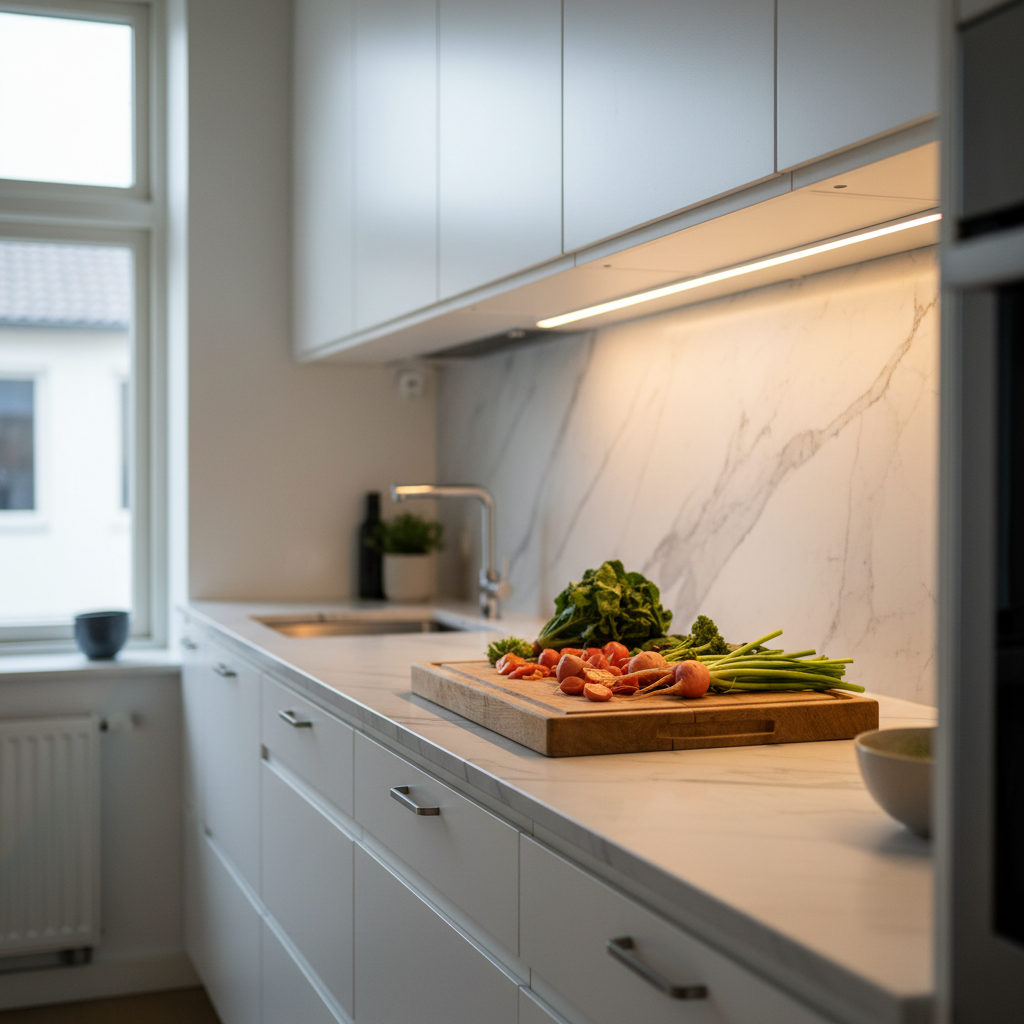
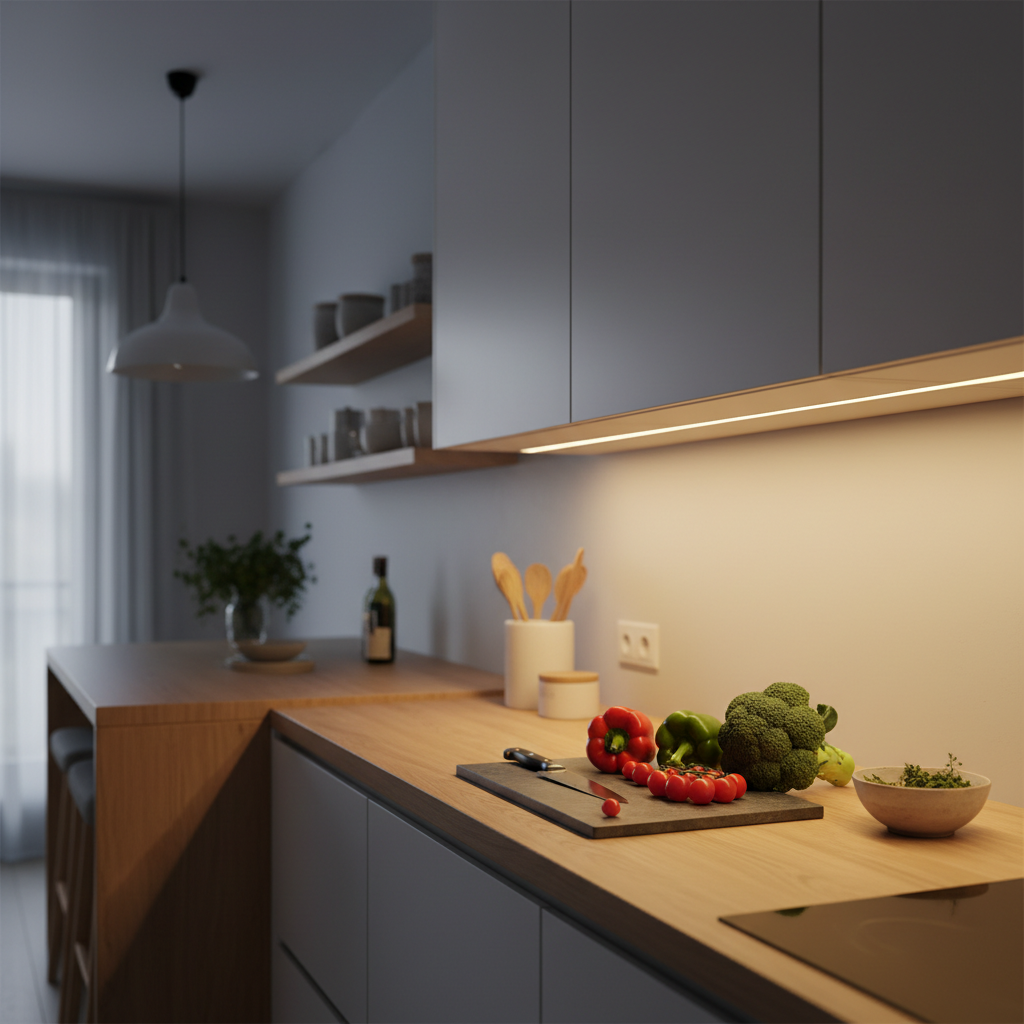
With a strip light that covers the entire length of the cabinet, the light is uniform from left edge to right edge. You place your board anywhere. You see what you're doing. It's that simple.
This isn't a marketing argument; it's physics. A linear light source over 16 inches (40 cm) distributes light differently than a point source. For a work surface, the linear format is more appropriate.
The Rechargeable LED Spot Light: An Intermediate Alternative
There's a hybrid format worth mentioning: the rechargeable kitchen spot light. These are small, battery-powered spot lights, without wiring, usually attached with adhesive or a suction cup.
Its Strengths
- No cables, no electrician needed
- Easily repositionable
- Useful for accent lighting a specific area (a nook, a niche)
Its Limitations for a Countertop
For a countertop, the same problems as recessed spot lights arise: focused light, inevitable shadows if you don't place many. Battery life is also often shorter than larger rechargeable strip lights. If you're interested in this format, check out our article on choosing the right rechargeable LED spot light to evaluate important criteria.
The rechargeable spot light remains relevant for targeted uses — a shelf, a dark corner in a cabinet — but less so for daily countertop lighting.
What Color Temperature for a Kitchen Spot Light?
Whether you choose a spot light or a strip light, color temperature is an often underestimated criterion. In the kitchen, it truly changes the atmosphere and visual comfort.
Warm White (3000K): Evening Ambiance
Warm white provides a golden light, similar to an incandescent bulb. It's pleasant in the evening, creating a cozy ambiance. Its weakness: it can slightly distort food colors. You might not perceive as well if meat is cooked through or if a salad is fresh.
Neutral White (4000K): The Best Balance for Cooking
Neutral white is often recommended for workspaces. It's close to natural light, doesn't strain the eyes, and allows for good distinction of food colors. Many professional chefs work under this temperature. It's often the most versatile choice for a kitchen.
Cool White (6000K): Effective but Cold
Cool white is very bright and gives an impression of cleanliness. It's well-suited for highly functional spaces. In a kitchen, it can seem too clinical, especially if you want the space to remain inviting. More suitable for a commercial kitchen than a family kitchen.
If you want to adjust according to the time of day (bright in the morning for visibility, warmer in the evening for dining), the ideal is to opt for lighting with adjustable color temperature.
What Lumic's Movement 3.0 Offers as an Alternative to Spot Lights
If you landed on this article looking for a kitchen LED spot light and are starting to think a strip light might be better for your countertop, here's a concrete option to know about.
The Movement 3.0 by Lumic is a wireless LED strip light with motion detection. It has no cables, no drilling required, no electrician needed. Installation is done with industrial adhesive and a magnetic system — it takes less than 30 seconds.
What it concretely does:
- Diffuse, continuous light along its entire length (9 inches / 23 cm or 16 inches / 40 cm depending on the model), with no shadow zones
- Motion sensor: it turns on when you pass by, turns off automatically — no wasted energy
- Ambient light sensor: it won't turn on in broad daylight if not needed
- 3 available temperatures: 3000K, 4000K, or 6000K — adjustable brightness
- 3000 mAh rechargeable battery via USB, no batteries to change
- Detection mode (battery life up to 4-5 weeks depending on the model) or continuous mode
- Aluminum casing, 5-year warranty, 90-day returns
For a kitchen countertop, the 16-inch (40 cm) model with its 320 lumens covers a decent work surface. Two units placed under the upper cabinet are often sufficient for a standard kitchen.
This is the kind of solution you might not think of when you type "kitchen LED spot light" into Google — yet, in many cases, it's exactly what you need. To learn more about the strip light format and its benefits, check out our complete guide to LED strip lights for kitchens.
When a Spot Light Remains the Right Choice
To be completely honest: spot lights have their place in a kitchen. It's not a bad product — it's a product for a specific use.
Choose a kitchen LED spot light if:
- You want to highlight open shelves or a glass cabinet
- You have a ceiling track lighting system and want to aim spot lights at different areas
- You're looking for an ambiance effect or accent lighting
- You're renovating and can plan the wiring in advance
In these cases, spot lights do exactly what they were designed for. The problem isn't the product — it's the expectation sometimes placed on it, especially for uniform countertop lighting that a spot light can't truly provide.
And if you want to explore all available options for your kitchen, our article on wireless kitchen lighting solutions covers existing formats.
What to Remember Before Buying a Kitchen LED Spot Light
One last recap to ensure you leave with clear ideas:
- A kitchen LED spot light is perfect for highlighting and ambiance, not for uniform countertop lighting.
- Recessed under-cabinet spot lights require drilling, wiring, and often an electrician (budget $200-$400).
- Rechargeable spot lights are more flexible but are still limited by focused light.
- For a countertop, a strip light offers continuous light without shadows — it's better suited for food prep.
- The ideal color temperature for cooking is generally neutral white at 4000K.
- If you're a renter or don't want to do renovations, magnetic/adhesive solutions are your only realistic option.
The right kitchen lighting isn't always what you initially searched for. If you're still undecided between formats, our guide to choosing the best LED strip light for your kitchen can help you decide.