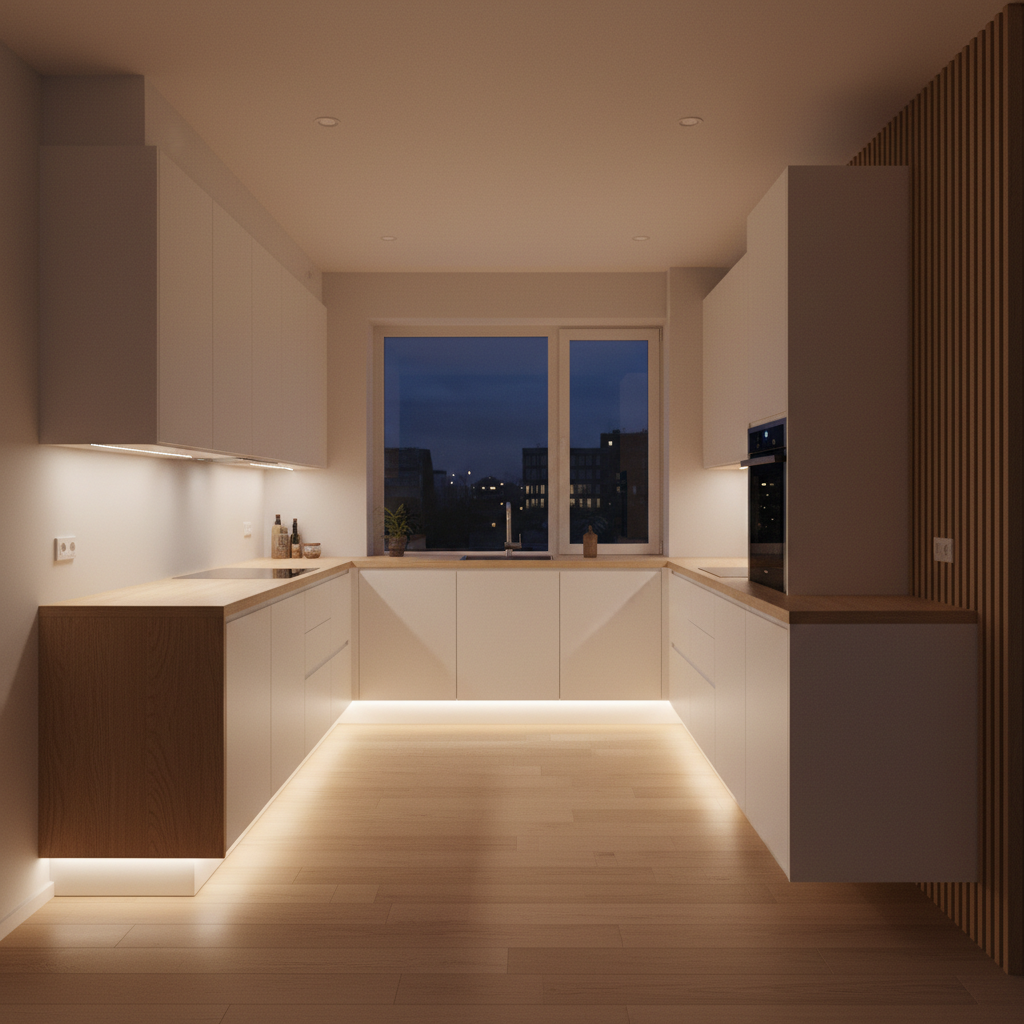
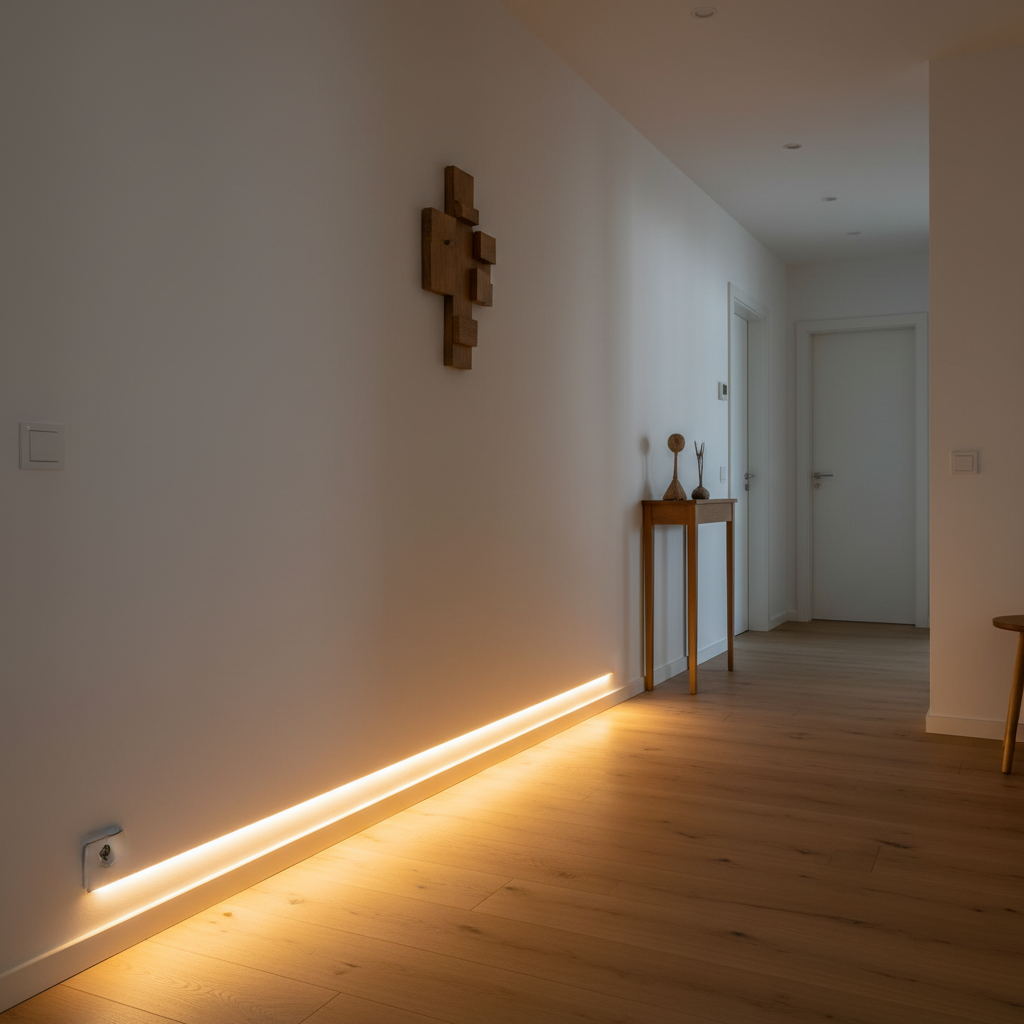
A dark hallway at night is the perfect recipe for tripping, waking everyone up searching for a light switch, or missing the bathroom at 3 AM. It's a common problem, but one that can have serious consequences—especially for seniors or families with young children. A good hallway night light discreetly solves this, without turning your night into day.
This guide compares the three main solutions on the market, explains why color temperature is the #1 criterion (not brightness), and gives you concrete benchmarks to choose correctly.
Why a Hallway at Night Truly Deserves Special Attention
The hallway is the ultimate nighttime thoroughfare. Bathroom trips, a glass of water, a crying baby, taking medication: we cross it multiple times a night, half-asleep, without turning on the main light to avoid fully waking up.
What are the Risks of a Poorly Lit Hallway at Night?
Nighttime falls are a leading cause of serious household accidents, particularly among people over 65. A slippery floor, a furniture corner, a forgotten step in the dark: in seconds, a peaceful night can go wrong. Seniors are most at risk—their vision adapts slower to darkness, their balance is more fragile, and reaction time is longer. A well-placed hallway night light is concrete protection, not a gadget.
For families, there's also the issue of a crying baby or young child. Checking on them without turning on the overhead light prevents waking them (and yourself) further. And for everyone, getting out of bed in complete darkness is simply uncomfortable, regardless of age.
Why Not Just Turn on the Main Light?
The cool white light of a standard overhead fixture, even for a few seconds, disrupts your melatonin—the sleep hormone. You lie back down, but your brain is on alert. It takes 20 to 30 minutes to fall back asleep. Multiplied over several nights, this degrades sleep quality over time. An appropriate night light avoids this: enough light to guide you, not enough to wake you.
Color Temperature: The Criterion Nobody Mentions
This is the most important point in this guide, and the most often overlooked. The color temperature of an LED hallway night light determines whether it helps you stay drowsy or activates your brain like an alarm clock.
What Color Temperature to Choose for a Night Light?
The rule is simple: 3000K maximum for any nighttime lighting. At 3000K (warm white), the light is soft, orange-toned, similar to an incandescent bulb. It doesn't stimulate the retina like cooler light would. Above 4000K (neutral white or cool white), you start disrupting your circadian rhythm—exactly what we want to avoid at 2 AM.
6000K night lights sold on some platforms (very white, almost blue light) should be completely avoided for nighttime use in a hallway. They are designed for workspaces or garages, not for guiding you to the bathroom without waking you up.
Remember this: warm white 3000K = peaceful night. Cool white = bad idea.
What Light Intensity is Sufficient for a Hallway at Night?
Unlike a kitchen or office, a nighttime hallway doesn't need many lumens. The goal isn't to see perfectly—it's to see enough not to fall. In practice, 30 to 150 lumens are ample for a 6.5 to 13-foot (2 to 4-meter) hallway. Too much light creates the same problem as an overhead fixture: it wakes you up.
The 3 Hallway Night Light Solutions, Honestly Compared
There are three main categories of hallway night lights. Each has its real advantages and real limitations. Here's what you need to know before choosing.
Plug-in Night Light: Simple, Accessible, Always On
This is the most common and cheapest solution. You plug it into a wall outlet, and it emits a soft, continuous light. Some models have a light sensor (it turns off during the day, turns on automatically in the evening).
Pros: Very low entry price ($5 to $15), no installation, no batteries to manage, widely available.
Cons: It consumes power 24/7 if it doesn't have a sensor. Even if the individual consumption is low, over a year and across multiple outlets in the home, it adds up. It also requires an available outlet in the right spot in the hallway—which isn't always the case. And if the outlet is high, the light illuminates the wall more than the floor, where you really need to see.
Plug-in Night Light with Motion Sensor: The Smart Intermediate
Same principle as the previous one, but it only turns on when it detects motion (and often, only when it's dark). No standby consumption, or almost none.
Pros: Consumes significantly less, adapts automatically, good option if you have an outlet in the right spot in the hallway.
Cons: Detection range varies greatly between models. Some turn on too late (you've already passed the sensor), others stay on too long. Sensor quality makes all the difference. For how to choose your indoor motion sensor light, adjusting the illumination duration and sensor sensitivity are the priority criteria to check.
Wireless LED Light Bar with Motion Sensor: More Powerful, More Flexible
This is the most versatile solution. A self-contained LED light bar (rechargeable battery), with an integrated motion sensor, that installs without cables or drilling—using adhesive or a magnetic system. It can be placed under a low cabinet, on the wall at mid-height, or at the top of a staircase.
Pros: No electrical outlet constraints, flexible installation, adjustable lighting depending on the space, sufficient brightness for a hallway or entryway, precise motion detection. It only consumes power when you pass by—the rest of the time, it's off.
Cons: Higher price than a plug-in night light, battery needs periodic recharging. It's a long-term investment, not an impulsive $5 purchase. The battery life of an LED light bar is a key criterion to check before buying.
Comparative Table of the 3 Hallway Night Light Solutions
| Criterion | Plug-in Night Light (Fixed) | Plug-in Night Light + Motion Sensor | Wireless LED Light Bar |
|---|---|---|---|
| Indicative Price | $5 to $15 | $10 to $25 | $30 to $60 |
| Installation | Outlet required | Outlet required | No outlet, no-drill |
| Consumption | Continuous (24/7) | Low (on detection) | Very low (on detection) |
| Flexible Placement | No | No | Yes |
| Light Output | Low (night light) | Low (night light) | Low to medium (150-320 lm) |
| Ideal For | Outlet available at floor level | Short hallway | Hallway, stairs, closet |
| Renters | Yes | Yes | Yes (no-drill) |
Hallway Night Light and Seniors: A Priority, Not an Option
This point deserves its own section. For a healthy young adult, a dark hallway at night is an inconvenience. For someone 70 or older, it's a real risk of a serious fall.
What Features to Prioritize for Securing a Senior's Hallway?
Several elements are particularly important for this demographic:
- Placement Height: A night light at floor level or mid-height (16 to 31 inches / 40 to 80 cm) illuminates where feet land, not the ceiling. This is what prevents tripping.
- Sensor Responsiveness: The sensor should turn on before the person is already in the hallway. A wide sensor (90 to 120°) with good range is preferable to a narrow, slow sensor.
- Sufficient Brightness: A simple 5-lumen night light may not be enough for someone whose night vision is less effective. Aim for at least 80 to 150 lumens for a 10-foot (3-meter) hallway.
- No Nighttime Manipulation: No switch to find, no battery to change urgently. Automatic operation is essential for this profile.
Automatic hallway lighting with a motion sensor is often the best-suited solution: no action needed, it turns on by itself, turns off by itself, and only operates when useful.
Power Consumption: What a Plug-in Night Light Really Costs You
The purchase price of a plug-in night light is tempting. But you need to consider the long term. A hallway night light left on permanently (even at low consumption) runs 365 days a year, every night—and often during the day too if it doesn't have a light sensor.
Permanent Night Light vs. Motion Detection: What's the Difference in Your Bill?
A plug-in night light consumes between 0.5 and 2W continuously. Over a year, that's between 4 and 17 kWh—a modest sum in dollars, but multiplied by 3 or 4 night lights in a home, and over several years, it becomes noticeable on the bill. Consulting our article on energy savings with LED lighting will give you a more complete picture of the overall impact.
A light bar with a sensor, on the other hand, only consumes power when you pass by. In nighttime detection mode, with 4 to 8 passages per night of 20 seconds each, annual consumption is tiny—a few tens of minutes of actual use. Over a year, the difference in consumption between a permanent night light and a motion-sensing light bar can indeed offset part of the light bar's cost. And rechargeable LED lights generally have a much longer lifespan than traditional bulbs.
Where to Place Your Hallway Night Light for Optimal Results
Placement is often more important than the chosen model. An excellent night light poorly placed is useless.
What Height to Install a Night Light in a Hallway?
The ideal height depends on the objective. To guide steps and prevent falls, a height of 12 to 31 inches (30 to 80 cm) is best: the light illuminates the floor and obstacles at foot level. To light an entire hallway from a central point, a height of 3.3 to 4 feet (1 to 1.2 m) allows light to spread in both directions. Avoid: placing the night light above 5 feet (1.5 m)—it illuminates your head but not the floor.
How Many Night Lights for a Standard Hallway?
For a 10 to 13-foot (3 to 4-meter) hallway, a single well-placed night light in the center is usually sufficient. For an L-shaped, T-shaped, or longer than 16-foot (5-meter) hallway, two light points are more effective—one at each end. The rule: no blind spots in high-traffic areas. Stairs, however, require at least one light point at the bottom and one at the top.
Can an LED Light Bar Be Used as a Hallway Night Light?
Yes, and it's often the most effective solution for long hallways or those without available outlets. The Movement 3.0 by Lumic, for example, comes in 3000K (warm white)—it installs in seconds thanks to its magnetic adhesive system, no-drill, and only turns on when motion is detected, combined with an ambient light sensor. The result: a soft light that appears exactly when you need it, and turns off by itself. Its 3000 mAh battery allows for several weeks of use in detection mode between USB recharges. For those seeking easy installation of automatic lighting, this is probably the shortest path from problem to solution.
Key Takeaways for Choosing Your Hallway Night Light
Here are the essential benchmarks before buying:
- 3000K is mandatory to avoid disturbing sleep. This is non-negotiable.
- A permanent plug-in night light is suitable if you have a low outlet available and a limited budget—but it consumes power continuously.
- A plug-in night light with motion detection is a good compromise if your hallway is short and well-configured.
- A wireless LED light bar with motion detection is the most flexible, most economical, and most effective solution—especially for long hallways, stairs, or spaces without available outlets.
- For seniors or people with reduced mobility: prioritize placement height, sensor responsiveness, and full automation.
- Don't overlook the best indoor motion sensor light adapted to your hallway—a good sensor makes all the difference in the nighttime experience.
Hallway lighting at night is not a luxury. It's a matter of comfort, sleep quality, and sometimes physical safety. Taking 5 minutes to choose the right night light means more peaceful nights for the whole family—and a safer home for all its occupants.