Looking for a waterproof LED light bar? But do you really need one? "Waterproof" means different things depending on where you install it, and waterproofing comes at a cost. Paying 20-30% more for an IP65 light bar in a dry closet is wasted money. Conversely, installing a standard light bar above your sink or in a damp garage is an unnecessary risk.
This guide helps you make the right choice: understand what IP ratings mean, identify areas that truly require a waterproof light bar, and those where a standard model will do just fine.
What an LED Light Bar's IP Rating Means
The IP (Ingress Protection) rating is an international standard indicating a device's protection level against solids (dust) and liquids (water). It consists of two digits.
How to Read an IP Rating
The first digit, from 0 to 6, indicates protection against solid objects — dust, particles. The second digit, from 0 to 9, denotes protection against water: splashes, sprays, immersion.
Here are the most common IP ratings for LED light bars:
| IP Rating | Protection Against Solids | Protection Against Water | Typical Use |
|---|---|---|---|
| IP20 | Fingers (objects > 0.5 inches) | None | Dry closet, under cabinet, hallway |
| IP44 | Solid objects > 0.04 inches | Splashes from all directions | Bathroom (zones 2 and 3) |
| IP65 | Dust-tight | Low-pressure water jets | Garage, sheltered outdoor area, above sink |
| IP67 | Dust-tight | Temporary immersion (3.3 feet, 30 min) | Exposed outdoor areas, very humid zones |
IP44 vs. IP65: What's the Real Difference?
An IP44 resists water splashes but not direct jets. This is sufficient for a bathroom outside the shower area, where ambient humidity is high but water doesn't directly spray on the fixture. An IP65 resists low-pressure water jets — this is the minimum for a garage with jet cleaning, an outdoor facade, or the area above a kitchen sink.
IP67 is for extreme conditions: flood-prone areas, high-pressure cleaning, fully exposed outdoors. In a standard residential context, it's rarely necessary.
Areas That Absolutely Require a Waterproof LED Light Bar
Some locations leave no room for doubt. In these areas, a light bar without an appropriate IP rating poses a real electrical risk, and in some cases, non-compliance with electrical standards (like the UL listing in the US/Canada).
The Bathroom: Regulated Zones
The bathroom is the most regulated space for lighting. Standards define three risk zones:
- Zone 0: Inside the bathtub or shower. Only IPX7 minimum devices are allowed. In practice, no LED light bar is installed here.
- Zone 1: Above the bathtub/shower (up to 7.4 feet high). Minimum IPX4 required.
- Zone 2: Around the bathtub for 2 feet, and the area next to the shower. Minimum IPX4 required.
- Zone 3 (outside zones 0, 1, 2): Rest of the bathroom. IP20 is legally sufficient, but IP44 is still recommended due to ambient humidity.
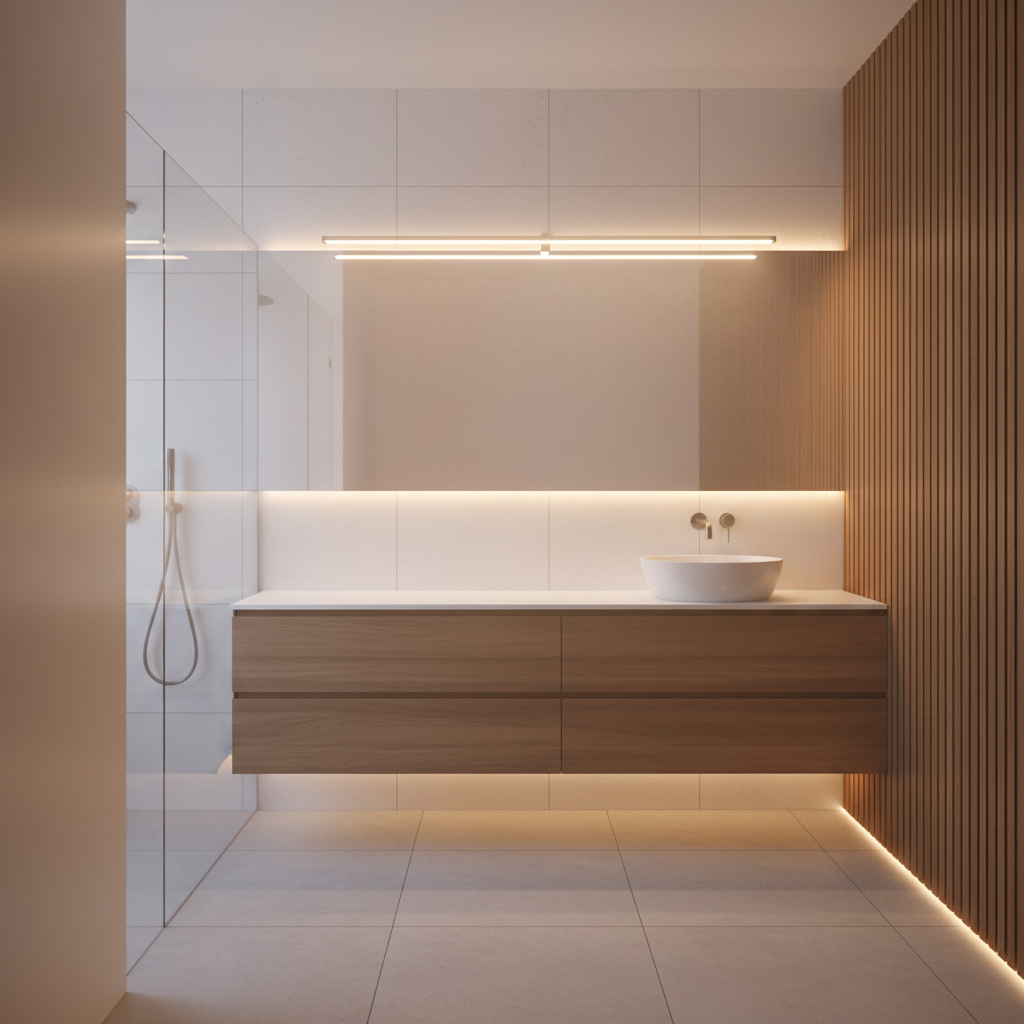
For an LED light bar above the mirror (in zone 2 or 3), an IP44 minimum is the correct approach. To learn more about specific zones, check out our article on bathroom LED light bars and IP ratings.
The Garage: Dust + Humidity, an Aggressive Duo
The garage is often underestimated. We think of it as a dry space — but in reality, it's one of the most hostile environments for electrical devices: variable humidity depending on seasons, grinding or sanding dust, sometimes floor cleaning with a water jet.
An IP65 light bar is common sense here. It resists fine dust (first digit 6 = totally dust-tight) and direct water splashes. If you use a high-pressure washer in your garage, go for IP65 minimum — and ensure the light bar is oriented to avoid direct jets.
If you're looking to light a garage without touching existing wiring, take a look at our guide on garage lighting without electricity.
Outdoors: IP65 is the Bare Minimum
For any outdoor installation — driveway, patio, gate, facade — IP65 is the starting point. Rain, dew, significant temperature variations between day and night: these conditions quickly degrade an unprotected device.
If the light bar is in a sheltered area (under an awning, carport), IP65 is still recommended, but IP44 may suffice in the most protected cases. If it's fully exposed to the elements, IP65 is non-negotiable. For wireless solutions, our guide on wireless outdoor lighting explores available options.
Above the Kitchen Sink
The kitchen is often overlooked in lists of humid areas. However, the space directly above a sink is subject to regular splashes — cooking steam, splatters. A light bar installed less than 20 inches from a sink deserves an IP44 minimum, especially if it's under-cabinet and thus relatively close to the water source.
Areas Where You Don't Need to Pay for the Waterproof Option
This is where many people get it wrong: they buy an IP65 light bar for an unjustified use, or they let a salesperson convince them by playing on fear of risk.
Under Kitchen Wall Cabinets (Dry Side)
The countertop on the prep side — where you chop vegetables, place cutting boards — is a dry area. It doesn't receive water splashes. A standard IP20 LED light bar is perfectly suitable here, and often easier to install without wires or drilling.
Inside Closets and Wardrobes
Bedroom closets, wardrobes, hallway cabinets: these spaces have no contact with humidity. An IP20 is largely sufficient. Choosing an IP65 here brings you absolutely no benefit, except a higher bill.
Hallways and Indoor Entrances
A hallway, an entrance, under stairs: these are all places where automatic lighting makes sense (you're carrying things, it's nighttime), but where humidity is absent. IP20 = more than enough.
For these dry uses — closets, under-cabinets, hallways, countertops without a sink — a rechargeable wireless light bar with a motion sensor like the Lumic Movement 3.0 does exactly the job: magnetic no-drill installation, USB charging, automatic activation. It's designed for dry interiors only — IP20, not waterproof — making it lightweight, simple, and perfect for these areas. No need to pay for the waterproof option for a closet.
IP44 vs. IP65 vs. IP67: Which Rating for Which Location?
To simply summarize the choices to make based on location:
| Location | Recommended Rating | Why |
|---|---|---|
| Closet, wardrobe, hallway | IP20 | No humidity, no risk |
| Under kitchen cabinet (dry side) | IP20 | No direct splashes |
| Bathroom zone 2-3 (mirror, outside shower) | IP44 | Ambient humidity, indirect splashes |
| Above kitchen sink | IP44 minimum | Regular splashes and steam |
| Garage | IP65 | Dust + variable humidity |
| Sheltered outdoor area (awning) | IP44 to IP65 | Ambient humidity, no direct rain |
| Exposed outdoor area (facade, driveway) | IP65 | Rain, dew, frost |
| Very exposed area or high-pressure cleaning | IP67 | Resistance to powerful jets |
Can an IP65 Replace an IP44 Everywhere?
Technically yes — an IP65 offers superior protection to IP44. But in practice, IP65 light bars are often heavier, less aesthetically pleasing, and more expensive. For a bathroom zone 2, paying for IP65 brings no concrete benefit. Choose the IP rating that matches your actual need, not the highest by default.
And IP67, Is It Useful in Residential Settings?
Rarely. IP67 is designed for industrial environments or very exposed installations. In residential use, you'll mostly find it on fully exposed patios or professional garages with daily high-pressure cleaning. For the vast majority of homes, IP65 is the useful ceiling.
Waterproof LED Light Bar: Criteria to Check Before Buying
The IP rating is the first criterion — but not the only one. Here's what really matters when selecting a waterproof LED light bar.
Light Source: Wired or Wireless?
A wired waterproof light bar requires appropriate electrical installation — conduit, protected cable, potentially an electrician. If you want to avoid work, rechargeable options exist for certain uses, but they are generally designed for dry spaces. For a garage with an existing electrical outlet, wired is simpler in the long run. For a garage without an outlet, our guide on LED light bars with motion sensors for garages details installation options.
Color Temperature: Warm White or Cool White?
In a garage or technical space, a neutral to cool white (4000-6000K) improves visibility and precision. In a bathroom, a warm white (3000K) or neutral (4000K) is more pleasant for daily use — especially in front of a mirror where light influences the perception of your skin tone and makeup colors.
Motion Sensor: Useful But Not Always Necessary
For a hallway or garage where you arrive with your hands full, a motion sensor is very practical. In a bathroom, it can be annoying (the light turns off while you're still in the shower). Some light bars offer both modes — motion detection or continuous — providing more flexibility depending on use.
Housing Durability
For a waterproof light bar, prefer an aluminum or UV-resistant polycarbonate housing for outdoor use. Aluminum dissipates LED heat better in the long run — an important criterion for light bars continuously on in a garage.
Common Mistakes to Avoid
After clarifying needs and IP ratings, here are the most frequent pitfalls — and how to avoid them.
Buying Waterproof "Just to Be Safe" in a Dry Space
This is the main mistake. People think paying a little more for an IP65 in a closet is "safer." In reality, you're paying for unnecessary protection and ending up with a light bar that's often bulkier and less practical. If the space is dry, IP20 is sufficient — period.
Confusing Water Resistance with Condensation Resistance
An IP65 device resists water jets, but not necessarily prolonged condensation cycles in a very cold then very hot space. In an unheated garage, checking that the light bar can withstand freezing temperatures is as important as the IP rating.
Ignoring Mounting in a Humid Area
In a humid space, mounting quality matters as much as the housing. Screws that rust, adhesive that fails with humidity: the fixture can fall even if its housing is IP65. In a bathroom or garage, opt for stainless steel or resistant plastic screws + anchors, and avoid adhesive alone on a potentially damp wall.
Neglecting Outdoor Wiring
An outdoor IP65 light bar is useless if the power cable itself isn't protected. For a wired outdoor installation, the cable must be in an appropriate IP-rated conduit, buried or fixed to the facade with dedicated accessories. The light bar's waterproofing doesn't protect a bare cable exposed to rain.
What Lumic Offers — and For Whom
The Lumic Movement 3.0 is not a waterproof light bar — and that's intentional. It's designed for dry spaces: under kitchen cabinets (countertop side, not sink), closets, wardrobes, hallways, entrances, indoor stairs. Its aluminum housing, magnetic mounting, and USB charging make it a particularly effective solution for uses where waterproofing isn't needed.
Its 3000 mAh battery offers about 4 weeks of battery life in motion detection mode for the 9-inch model, and 5-6 weeks for the 16-inch model. Installation takes less than a minute, no drilling, no electrician. If you're looking to better light these dry spaces, it's a consistent option — also noteworthy: 5-year warranty and 90-day money-back guarantee. (Note: Lumic is a premium European design brand, not a French brand in the US/Canada market).
For waterproof needs (bathroom, garage, outdoors), you'll need to look for wired IP44 or IP65 light bars suitable for those specific environments. Honesty about uses is what allows you to make the right choice the first time. To compare different types of LED light bars according to your needs, consult our guide on how to choose an LED light bar.
Summary: How to Choose Your Waterproof LED Light Bar
A simple table to make the right decision without getting lost in details:
- Identify the exact location — dry closet, above sink, bathroom, garage, outdoors.
- Check for water contact — direct splashes, regular steam, exposure to elements.
- Choose the appropriate IP rating — IP20 for dry, IP44 for ambient humidity, IP65 for splashes and outdoors.
- Decide between wired and wireless — wireless is convenient for dry spaces, wired is often more suitable for humid areas.
- Check mounting and wiring — in humid areas, mounting and cable must be as resistant as the housing.
If you have doubts about the type of rechargeable LED light bars that fit your installation, we also summarize the selection criteria for these specific models.
In summary: a waterproof LED light bar is only necessary where there's actual humidity. No more, no less. Knowing the distinction saves you money and helps you choose a light bar that will truly last in its environment.