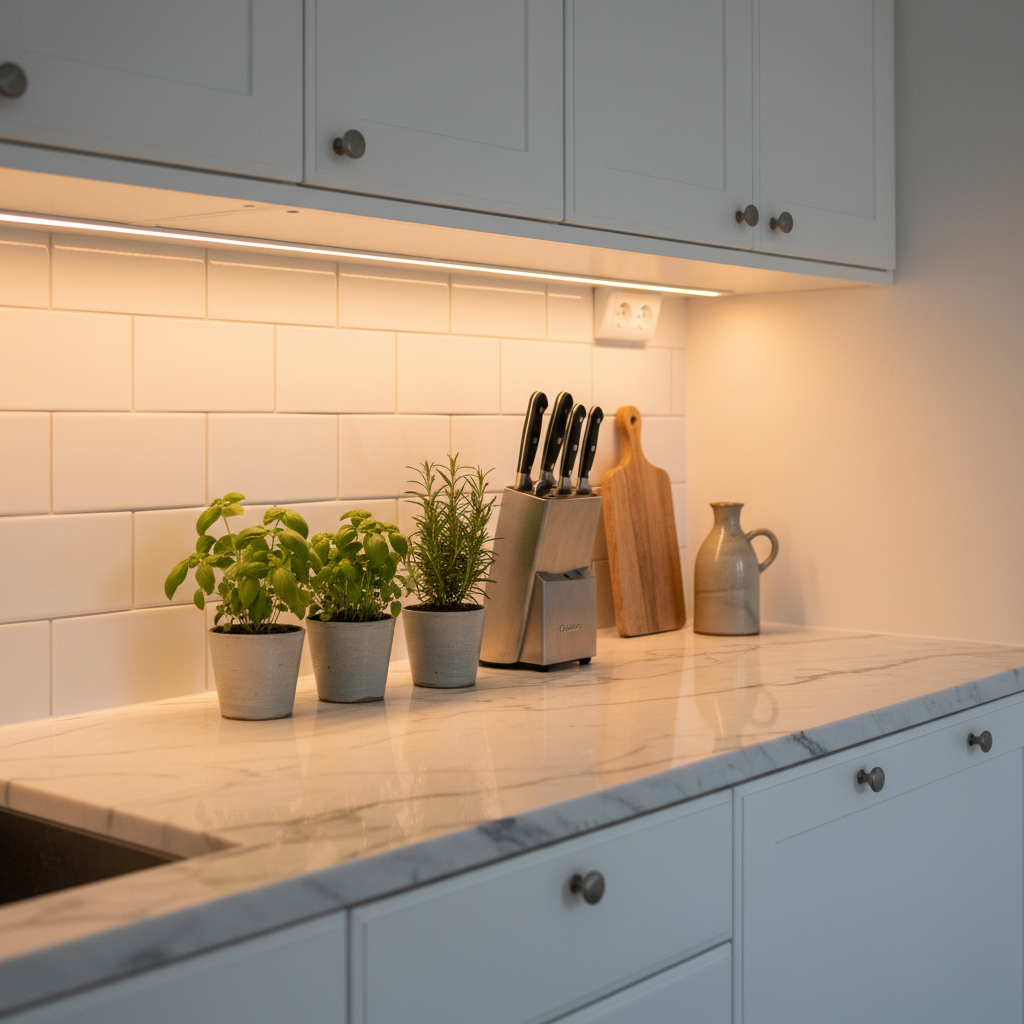
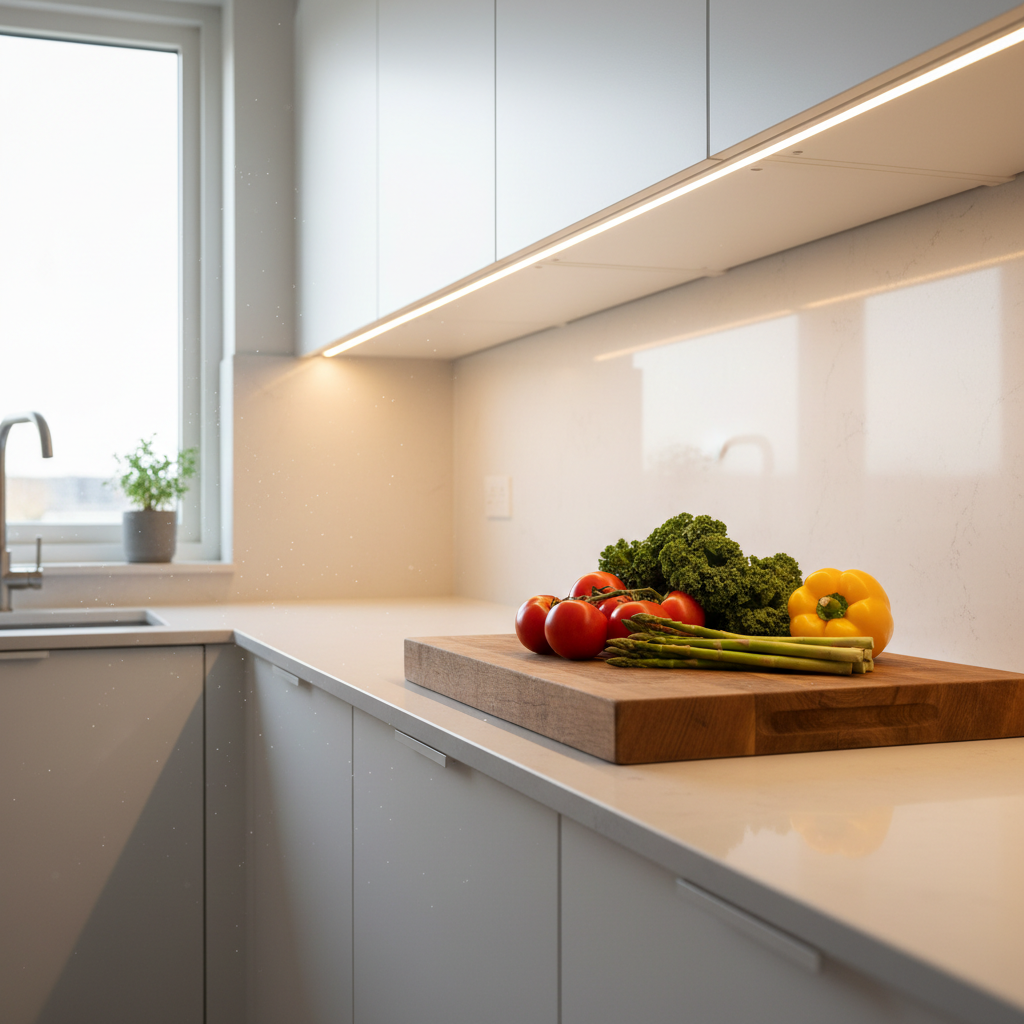
You're cooking at night, bending over to see what you're cutting. The ceiling light illuminates your forehead, not your countertop. This is the classic problem of under cabinet kitchen lighting: everyone knows it's missing, but no one really knows how to fix it.
There are three ways to light under your upper cabinets. Each has its true strengths and limitations. This article honestly explains them so you can choose correctly.
Why Under Cabinet Lighting Often Fails
Most kitchens come with only one ceiling light. It's functional for moving around, but not for cooking. When you stand at your countertop, your own body casts a shadow on the surface. The result: you light the room but not where you need it.
Under cabinet lighting solves this directly: light comes from the bottom of the upper cabinets and shines exactly where you're working. It's simple in theory. In practice, the options vary depending on your profile, usage, and constraints.
How far should upper cabinets be from the countertop?
Most standard kitchens place upper cabinets between 16 and 22 inches (40 and 55 cm) above the countertop. This is enough for effective LED under cabinet lighting without glare. If your cabinets are particularly high (over 24 inches / 60 cm), plan for a more powerful light source or adjustable spotlights.
How much light output is needed to properly illuminate a countertop?
For comfortable kitchen use, 150 to 400 lumens per linear foot (meter) of countertop is generally recommended. A 6.5-foot (2-meter) counter therefore requires several light bars or a sufficiently powerful source to cover the area without shadows.
Option 1: Wired Lighting, the Most Powerful
Wired under cabinet kitchen lighting is the brightest and most permanent solution. Under cabinet spotlights or light bars connected directly to the electrical grid offer constant power, no battery management, and a lifespan measured in years.
What are the concrete advantages of wired under cabinet lighting?
Wired means uncompromising power. You set the intensity, then forget about it. No battery, no recharging, no interruptions. For someone who cooks a lot, morning and night, using the lighting for long periods (more than 4-5 hours a day), wired remains the gold standard. It's also the most visually discreet because cables can be hidden in the wall or along the cabinet.
What are the disadvantages of a wired under cabinet kitchen installation?
The main problem is installation. You need to drill through the back or bottom of the cabinet for cables, plan for an outlet or dedicated circuit at the right height, and often call an electrician. The average cost of electrical work for this type of installation is between $150 and $300, depending on complexity. Add the price of the light bar or spotlights: you quickly exceed $200 for a single area.
And if you change your mind about your kitchen layout, or if you're a renter, this is an installation you can't take with you. The holes are there, the cables are there.
To learn more about choosing between spotlights and light bars, check out our comparison Kitchen LED Spot Light: Spot or Strip Light, Which to Choose? which details the criteria based on kitchen and cabinet type.
Option 2: LED Strip Light, Flexibility... at the Cost of Complexity
The kitchen LED strip light appeals with its low purchase price and flexible shape. You cut it to the desired length, stick it under the cabinet, and it illuminates the entire surface continuously and uniformly. On paper, it's the ideal solution. In practice, it's often more complicated than it seems.
Why does LED strip light seem simple but requires technical skill?
The strip itself is simple, but what goes around it isn't. You need a transformer (12V or 24V power supply), corner connectors if you need to turn, aluminum profiles for homogeneous light diffusion and to protect the strip, and sometimes a dimmer. If you buy everything separately, the budget quickly adds up, and installation requires time and precision. A poorly made cut, a badly inserted connector, and only part of the strip lights up.
Does LED strip light really stick well under a kitchen cabinet?
The double-sided tape supplied with low-end strips lasts a few weeks in a dry atmosphere, but kitchens combine humidity, heat, and greasy vapors. After a few months, the strip may partially peel off. Aluminum profiles with clips or screws solve this problem but add an installation step. For a clean and durable finish, a well-installed LED strip in a profile gives excellent results. But it's a full-fledged project, not a 20-minute job.
If this option interests you, our complete guide on LED Strip Light for Kitchen: Everything You Need to Know Before You Start explains everything you need to know before you start: transformer choice, cutting, connectors, and mounting.
Option 3: Rechargeable LED Light Bar, Freedom Without DIY
The rechargeable under cabinet light bar is the third way. It requires no cables, no outlets, and no electrician. It attaches in seconds with adhesive or a magnetic system and runs on an integrated battery. This solution has made the most technical progress in recent years.
Is a rechargeable light bar's battery life sufficient for daily use?
This is the real question. And the honest answer: it depends on the battery. Light bars with small batteries (500 to 1000 mAh) can die after a week. It's the annoying gadget everyone talks about with disappointment. The practical comfort threshold is around 3000 mAh. With this capacity, in motion sensor mode (the light bar turns on when you pass, turns off by itself), you can get up to a month without recharging. This is the difference between a practical light bar and one that ends up being taken down and forgotten in a drawer.
Does an adhesive under cabinet light bar hold up over time?
Quality industrial adhesive holds well on smooth surfaces (melamine, laminate, painted metal) for years without issue. The surface must be clean and degreased before application. On raw wood or rough surfaces, adhesion is less guaranteed. The real advantage of a magnetic system is being able to remove and reattach the light bar without damaging the surface, which is useful for recharging or if you move.
Is a wireless light bar suitable for use more than 4 hours a day?
Honestly, no. If you cook like a pro, and your light bar runs continuously for several hours a day, the battery won't keep up. For this intense usage profile, wired lighting remains superior. Rechargeable is designed for motion sensor use: you pass by, it turns on, it turns off. It's perfect for most household situations. For very intense continuous use, wired wins.
For Lumic's Movement 3.0, the 3000 mAh battery is three times larger than most wireless light bars on the market. In motion sensor mode, you get 4 weeks of battery life on the 9-inch (23 cm) model (~150 lumens), and 5 to 6 weeks on the 16-inch (40 cm) model (~320 lumens). In continuous mode: about 5 hours on the small model, 8 hours on the large. The mounting is magnetic, allowing you to detach it for USB recharging and then reattach it in a second. Three color temperatures available (3000K, 4000K, 6000K) and adjustable brightness. 5-year warranty.
If you want to explore all wireless options for the kitchen, our article on wireless kitchen countertop lighting covers all possible configurations.
Comparison of the 3 Solutions: The Honest Table
| Criterion | Wired | LED Strip Light | Rechargeable Light Bar |
|---|---|---|---|
| Ease of Installation | Difficult (electrician often required) | Medium (technical) | Very Easy (30 seconds) |
| Total Cost | $150-$300+ (materials + labor) | $30-$80 (all inclusive) | Price of light bar only |
| Suitable for Renters | No (drilling, cables) | Partially | Yes (no traces) |
| Light Output | Very High (unlimited) | High (depending on length) | Medium to Good (150-320 lm) |
| Maintenance | None | Minimal | Periodic recharging (USB) |
| Repositionable | No | No | Yes |
| Ideal for Intense Daily Use (8h+/day) | Yes | Yes | No |
The Calculation That Makes a Difference for Renters
Are you a renter and want under cabinet kitchen lighting without leaving any traces? The calculation is quite simple.
A clean wired installation: light bar or spotlights between $30 and $60, electrical work between $150 and $300 depending on your city, holes in cabinets or walls that will need repair when you move out. Minimum total: around $200, most of which you'll leave behind.
A quality rechargeable light bar with 3000 mAh: you install it in 30 seconds, reposition it if you change your kitchen layout, and take it with you when you move. Zero traces, zero loss.
It's not that one is absolutely better than the other. It's that depending on your situation (renter vs. owner, light vs. intensive use), the answer is different. For an owner who cooks 8 hours a week and wants to forget about lighting once installed, wired might be worth the investment. For everyone else, the rechargeable light bar does the job without the hassle.
To refine your choice based on your profile, our article on Kitchen LED Light Bar: Wired or Rechargeable? details the specific use cases for each option.
Choosing the Right Color Temperature for Your Countertop
Light color truly changes the feel of a kitchen. It's a choice many neglect and later regret.
Warm white, neutral, or cool: which temperature for the kitchen?
Warm white (3000K) creates a cozy and inviting ambiance. It's pleasant in the evening, but it can slightly distort the perception of food colors, which might be an issue during preparation. Neutral white (4000K) is often the best compromise for the kitchen: it illuminates clearly without being cold, makes color reading easier, and remains pleasant to the eye. Cool white (6000K) is the most visually precise but can make the atmosphere feel clinical. Suitable for a workshop or professional space, less so for a family kitchen.
If you can adjust the temperature according to the time of day (an option available on some light bars), prioritize neutral or cool for meal prep and warm for evenings. Adjustable brightness is also a true comfort you might not appreciate at first glance but quickly becomes indispensable.
Are different lumens needed depending on the countertop length?
Yes. A 3-foot (1-meter) counter is adequately lit by a 9-inch (23 cm) light bar (~150 lumens) placed in the center, or two placed at the ends. For a 6.5-foot (2-meter) counter, it's better to plan for two 16-inch (40 cm) light bars (~320 lumens each) to cover the surface without shadows. For even longer or L-shaped countertops, combining several light bars is the most flexible solution: you position them exactly where you need them.
Installation: What to Check Before Installing Anything
Regardless of the chosen solution, a few checks before installing your under cabinet lighting will prevent unpleasant surprises.
- Cabinet surface: Melamine, laminate, or metal? Most industrial adhesives hold well. On raw wood or textured surfaces, plan for a profile or screws.
- Presence of grease: The area under kitchen cabinets accumulates splatters. Thoroughly degrease the surface with isopropyl alcohol before any adhesive application.
- Cables and passages: If you're going wired, locate existing cable routes in the wall and your kitchen's technical duct before drilling.
- Upper cabinet depth: If your cabinets are shallow (less than 12 inches / 30 cm), ensure the light bar isn't visible from below when standing normally.
- Access for recharging: For a rechargeable light bar, position it so you can easily detach it for USB charging, even if a cable is permanently attached in a discreet spot.
For an even more comprehensive overview of kitchen lighting solutions, our complete guide to LED kitchen light bars covers all possible scenarios.
What You Need to Remember Before Deciding
Under cabinet kitchen lighting has no universal solution. Here are the three most common situations and the right answer for each.
- You cook a lot, you own your home, you want to forget about lighting once installed: Wired is your best long-term option. Budget for an electrician, and you're set for 10 years.
- You want continuous, uniform light over a very long length, and you have patience for installation: An LED strip light in an aluminum profile is excellent. Plan a few hours and buy all necessary materials at once.
- You're a renter, you want flexibility, you don't cook 8 hours a day: The rechargeable light bar is clearly the right option. Just check the battery capacity before buying — below 3000 mAh, you'll regret your choice.