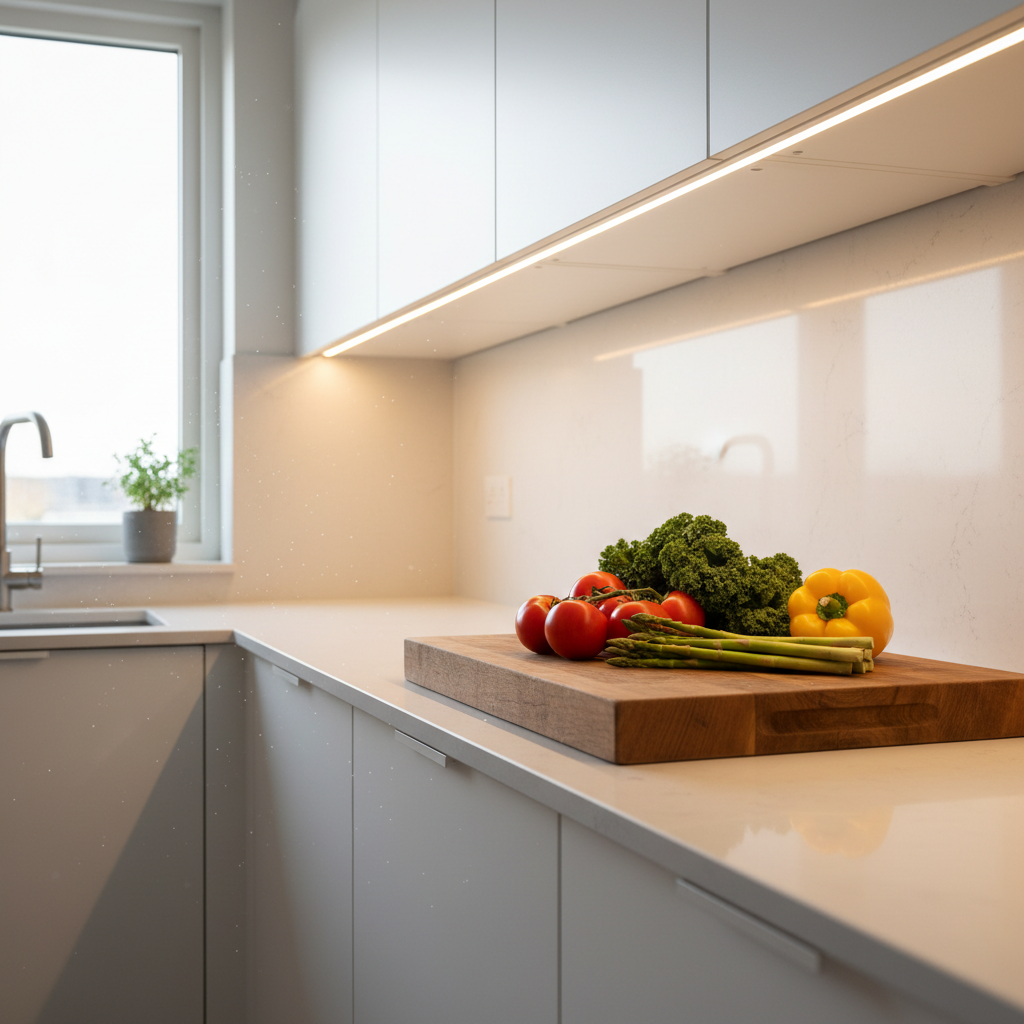
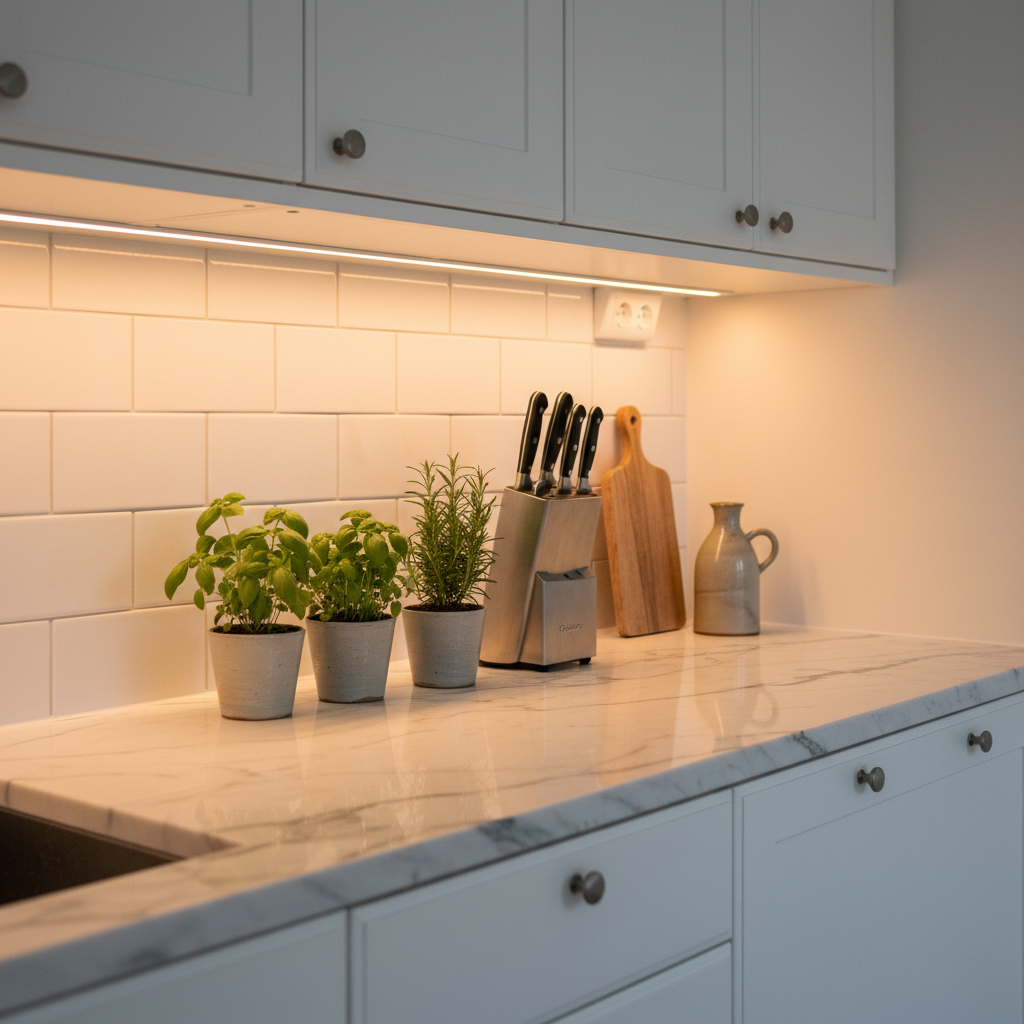
You've seen those gorgeous Pinterest photos: soft, continuous light running under kitchen cabinets, a clean, almost professional look. So you search "under cabinet LED strip light," find 16-foot (5-meter) rolls for $15, and think it's your next weekend DIY project.
Stop. Before you buy anything, read this. Because there are a few steps between the LED strip light in those photos and the one in your home that no one shows on Instagram.
This guide honestly compares the under cabinet LED strip light and the wireless LED light bar, based on 5 concrete criteria. The goal: help you choose what truly fits your needs, not just what looks best in a picture.
LED Strip Light, LED Tape Light, LED Ribbon Light... All the Same?
Yes, with a few nuances. An under cabinet LED strip light, LED tape light, LED ribbon light, or strip light is essentially the same thing: a flexible circuit board covered with small LEDs, sold in rolls, with adhesive on the back. Differences lie in the LED density per foot, power, moisture resistance (IP rating), and cut quality.
If you want to dive deeper, our guide on kitchen LED strip lights details the technical specifics before you start.
What is an IP rating and why is it important in the kitchen?
The IP (Ingress Protection) rating measures a product's resistance to dust and moisture. In the kitchen, especially near the sink or stovetop, you want at least an IP44 (splash-proof) or even IP65 (water jet resistant). A standard IP20 strip light is not suitable for a humid kitchen: it will deteriorate quickly and can pose safety issues.
Can you cut an LED strip light anywhere?
No. An LED strip light can only be cut at designated cutting points, marked by small lines or scissors printed on the circuit. These points are spaced every 1 to 2 inches (2.5 to 5 cm) depending on the model. If you cut between two points, you damage the circuit, and that section will no longer work. This is a major technical constraint to consider before purchasing.
Installing an Under Cabinet LED Strip Light: The Reality
Here's what no one clearly states in those 4-minute YouTube tutorials that make everything seem so simple.
Properly installing an under cabinet LED strip light involves several steps, each taking time.
Step 1: Measure and prepare the surface
Measure the space under your cabinets. Identify where you'll cut the strip (respecting the cutting points). Thoroughly clean the surface: grease, dust, moisture – all must be removed, or the adhesive won't stick. On painted or laminated wood, it's often recommended to add clips or clamps in addition to the adhesive. Allow 20 to 30 minutes for this phase alone.
Step 2: Choose and install the power supply
This is where it gets tricky. An LED strip light operates on 12V or 24V, not directly on your home's 120V outlet. You need a transformer (LED driver) suited to the total power of your installation. Calculation: multiply the power per foot (e.g., 1.5W/ft) by the total length, and choose a transformer with a 20% margin. This transformer must be connected to an outlet. And you need to integrate it somewhere: inside a cabinet, behind a facade. It's often visible.
Step 3: Connect and solder (or use connectors)
You have two options to connect your LED strip sections or connect them to the power supply. The first, and cleanest: soldering. This requires a soldering iron, solder, and some experience to avoid burning the LEDs. The second: solderless "click" connectors. More accessible, but the result is less reliable over time, especially if the strip vibrates or is subject to temperature variations. A poorly made connection = a section that stops lighting up six months later.
In total, a clean installation of an under cabinet LED strip light can easily take 2 hours. And that's if you don't need to run cables through cabinets or modify your electrical outlet.
Real Cost of an Under Cabinet LED Strip Light
This is the point that surprises most people who only budget based on the roll price advertised online.
| Item | Estimated Range |
|---|---|
| LED Strip Light 6.5-10 feet (2-3 meters) (IP44, good quality) | $15 to $30 |
| Compatible transformer/driver | $10 to $25 |
| Connectors, clips, accessories | $5 to $15 |
| Aluminum channel (optional, for a clean look) | $10 to $20 |
| Estimated Total | $40 to $90 |
And this table doesn't account for time spent or additional purchases if you mess up a cut or a connector. That $12 LED strip light on an online store is rarely the final installation cost.
If you're interested in budget and power supply comparisons for different formats, our article on wired vs. rechargeable kitchen LED light bars offers useful complementary insights.
LED Strip Light vs. LED Light Bar: Honest Comparison on 5 Criteria
To help you choose, here's a direct comparison between an under cabinet LED strip light and a wireless LED light bar. Unbiased, with both advantages AND disadvantages.
| Criterion | LED Strip Light | Wireless LED Light Bar |
|---|---|---|
| Installation | 2 hours minimum, transformer, connectors | 30 seconds, magnetic + adhesive |
| Visual Appeal | Very continuous, customizable | Clean, uniform, slightly segmented |
| Total Budget | $40 to $90 (with accessories) | Single price, no additional purchases |
| Power Supply | Permanent cable, wall outlet | Rechargeable USB battery, no cable |
| Maintenance | Delicate cleaning, adhesive may peel | Rechargeable, magnetic (repositionable) |
| Technical Skill Required | Intermediate to advanced | None |
| Suitable for Renters | Less so (visible wiring, potential drilling) | Yes, zero damage |
Which offers better light output: a strip light or a light bar?
An LED strip light provides a more "flowing" look, with light appearing continuous across the entire cabinet length. This makes it so photogenic. A light bar produces a more structured and targeted illumination, ideal for the countertop directly below. In daily use, both effectively illuminate. The difference is primarily aesthetic and most noticeable in corners and over long lengths. For a well-positioned kitchen LED light bar, the result is often indistinguishable in normal use.
How long does LED strip light adhesive last under a kitchen cabinet?
The adhesive strength of an under cabinet LED strip light largely depends on the surface, temperature, and humidity. On lacquered or painted wood, standard double-sided adhesive often starts to peel after 6 to 18 months, especially if the area is near heat (stovetop, oven). Experienced DIYers use screwed aluminum channels to prevent this issue. If you plan to just stick the strip directly, have a backup plan.
Who is an Under Cabinet LED Strip Light Really For?
An LED strip light is a genuinely good solution in certain cases. Let's be clear about that.
An LED strip light is for you if:
- You're comfortable with electrical DIY (soldering, power calculations, transformer selection)
- You want to customize the length precisely down to the millimeter
- You seek a very continuous look over long lengths (10 feet / 3 meters and more)
- You have access to a discreet electrical outlet within your cabinets
- You own your home and can install channels if necessary
An LED strip light is probably not for you if:
- You want something operational in under an hour
- You're a renter and want to avoid any permanent modifications
- You don't have a soldering iron or low-voltage electrical knowledge
- You want a controlled budget without additional purchases
The Tool-Free Alternative: The Rechargeable LED Light Bar
If you identify with the second profile, the adhesive LED light bar is a direct answer to your constraints. And specifically, Lumic's Movement 3.0 is one of the most comprehensive options on the market for this use.
Here's what it offers: magnetic attachment to an industrial adhesive mount (no-drill installation), USB recharging like a phone, a motion sensor that automatically turns it on when you approach, and an ambient light sensor that turns it off when the room is already lit. It installs in under 30 seconds and removes without leaving marks if you move.
It's available in two lengths: 9 inches (23 cm, approximately 150 lumens) and 16 inches (40 cm, approximately 320 lumens). Three color temperatures to choose from: warm white at 3000K for a cozy kitchen ambiance, neutral white at 4000K for more precise task lighting on the countertop, or cool white at 6000K. Brightness is adjustable. The 3000 mAh battery (3 times larger than typical in this category) lasts about 4 to 6 weeks in motion sensor mode depending on usage, or 5 to 8 hours in continuous mode.
5-year warranty. 90-day satisfaction guarantee. Premium European design customer support.
To compare options in this category, our guide on adhesive LED light bars for the kitchen covers the criteria to check before buying.
5 Mistakes to Avoid When Installing an Under Cabinet LED Strip Light
If you still opt for an LED strip light after all this, here are the most common pitfalls people encounter.
Buying a strip light without checking power supply compatibility
A 24V strip light connected to a 12V transformer won't work. Or will work poorly. Before buying, check the voltage of both the strip and the transformer. This is fundamental, yet it's the number one mistake on DIY forums. Also, note the total power needed (W/ft x length) to choose the right transformer.
Ignoring the IP rating in the kitchen
An IP20 strip light in a kitchen, especially near the sink or cooking steam, is a bad idea in the medium term. Aim for at least IP44, and IP65 if installing very close to water sources. Moisture resistance is not a minor detail in the kitchen.
Sticking without preparing the surface
The adhesive of an under cabinet LED strip light poorly adheres to greasy, matte-painted, or slightly damp wood. Clean with isopropyl alcohol before installation. If the surface is uneven, consider a screwed aluminum channel: it costs a bit more, but it lasts for years.
Underestimating connection cable length
The transformer must be placed somewhere accessible (for plugging in and replacement if needed), but discreet. The cables connecting the transformer to the strip will be visible if not hidden within cabinets or behind cable raceways. Plan the cable route before sticking everything down.
Choosing solely based on price
An $8 strip light for 16 feet (5 meters) exists. But the quality of the LEDs, color consistency, adhesive durability, and cutting point precision vary enormously. In the kitchen, where you'll look at this lighting every day, a low-quality strip light with flickering LEDs or uneven color will be a real source of irritation. The difference between an entry-level strip and a decent model is evident when you turn it on.
Strip Light or Light Bar: Key Takeaways
The under cabinet LED strip light is a genuine lighting solution. The look is beautiful, customization is possible, and for a DIYer comfortable with low-voltage electricity, it might be the best visual choice.
But installation requires time, equipment, and a minimum of know-how. The total budget often exceeds $50 to $80 if you do things correctly. And in the long run, the adhesive, connectors, and transformer are all points of fragility to monitor.
If you want a better-lit countertop without pulling out a soldering iron, calculating transformers, or spending your Saturday following a 45-minute tutorial, a rechargeable magnetic light bar does the same functional job in seconds.
And if you're still unsure which format suits you, our article on wireless kitchen countertop lighting will help you decide based on your actual setup.
The right lighting is the one you actually install and that lasts. Whatever your choice.