Looking to light your pool with solar power? Great idea! No cables in a water-prone area means significantly more safety. But before you buy anything, one crucial point needs clarification: solar pool lighting isn't a one-size-fits-all solution. It differs whether you want to light INSIDE the water or AROUND it. This distinction changes everything.
In this article, we'll explain what solar can truly do for your pool, what its limitations are, and how to choose the right setup for both ambiance and safety – without a single cable to install.
In-Pool vs. Around-Pool Lighting: Two Different Worlds
Can You Put Solar Lighting Directly in the Water?
Floating solar lights exist, yes. These are decorative items, often spherical or globe-shaped, that drift on the water's surface. They run on solar energy and require no wiring. If you're just looking for a soft visual ambiance on a summer evening, they do the job well.
But be warned: these are not structural lights. For submerged spotlights fixed into the pool walls, you absolutely need wired lighting with waterproof cables, a low-voltage transformer, and a minimum UL listed IP68 rating. This type of installation requires a qualified electrician and cannot be reliably powered by a solar panel. Solar simply isn't suitable for this use case.
Around the Pool Lighting: Where Solar Reigns Supreme
However, for everything related to the pool surrounds – the perimeter, patio, access path, and nearby landscaping – solar is truly the best option. And not just for convenience.
Installing electrical cables in an area where water spreads on the ground, where children run barefoot, where humidity is constant... that's a major technical constraint and a risk you can easily avoid. With solar, there's no power supply needed: each light is self-contained. You can install them wherever you want, whenever you want, without an electrician. That's why solar pool lighting is gaining popularity among homeowners who want to do things right without turning their patio into a construction site.
To explore other possible configurations, check out our overview of solar outdoor lighting solutions based on different needs.
What to Really Look for Before Buying Solar Pool Lights
Light Output: How Many Lumens for a Pool Area?
Around a pool, you don't need stadium-level lighting. The goal is to mark pathways, make the pool edge visible at night, and create ambiance. In practice, a light with 800 to 1200 lumens is ample to cover an area of several square feet. If you combine several spotlights distributed around the perimeter, you'll get homogeneous and pleasant lighting without needing a single super-powerful lamp.
For large patios or long access paths, solar outdoor spotlights can be an excellent alternative if you need to cover larger areas.
IP Rating: A Non-Negotiable Criterion
Near a pool, water splashes are inevitable. When children play, splashes can easily reach 6 to 10 feet. So, ensure your solar lights are certified IP65 minimum: this guarantees they can withstand pressurized water jets, rain, and ambient humidity. IP65 is the basic standard for any outdoor lighting installed near a water source. To understand what these numbers mean exactly, consult our article dedicated to the IP rating (e.g., IP65) and when it truly matters.
Battery and Autonomy: Will It Last All Night?
This is the weakness of many entry-level solar lights: a battery that's too small and drains in 3 or 4 hours. For summer pool use, you often turn on the lights in the evening and want them to last until 11 PM or midnight without dimming. Always check the battery capacity (in mAh) and the autonomy data provided by the manufacturer.
Low-end solar lights often have batteries of 800 to 1200 mAh. A battery 4x larger, like those found in more serious models, makes all the difference on a long summer night. To help you make the right choice, our guide to choosing the ideal outdoor solar light details these criteria in depth.
Solar Panel: Size and Orientation
In summer, recharging is rarely an issue. In fall or winter, it's a different story. A small solar panel (like those on $15 Amazon lights) doesn't capture enough energy on cloudy days or with low sunlight. The panel size directly affects winter autonomy. If you want your solar pool lighting to work on spring weekends or September evenings, this is a decisive factor. Opt for models with a noticeable panel – this is always what differentiates lights that last from those that end up in a closet after two summers.
Motion Detection Around a Pool: The Safety Argument
Why Motion Sensors Change Everything Near a Pool
We often think of motion detection for securing an entrance or deterring intruders. But around a pool, this argument takes on a much greater dimension: accident prevention.
A child who goes out at night and approaches the pool. An adult returning from an evening out and walking along the edge. An animal wandering nearby. In all these cases, a light that immediately turns on with a 26-foot range can make the difference between a fall and a sudden stop. This isn't a metaphor – it's literally how prevention works.
A strip light or spotlight with motion detection around a pool means lighting that costs you nothing in energy (it stays off otherwise) but is there precisely when needed. That's why a sensor that lights up as soon as someone approaches the pool at night is probably the best safety investment you can make – even before a fence or alarm.
What Detection Range to Cover Pool Surrounds?
The motion sensor's range is an often underestimated criterion. For a standard pool, the perimeter measures between 50 and 100 feet. A single spotlight placed in a strategic corner (patio corner, garden entrance, side access) with a range of 26 feet can cover almost the entire risk area.
Lumic's SolarGlow features two 180° motion sensors with a 26-foot range. A single light placed in the corner of your patio is enough to detect any movement across the width of a standard pool. It turns on in less than a second, without any action from you. UL listed IP65, it resists splashes, rain, and frost. And since it's 100% solar, there are no cables to lay along the edge – which is exactly what you want in a wet area.
To learn more about how this type of product works, consult our article on solar pool spotlights: ambiance and safety without cables.
How to Arrange Your Lighting Around a Pool: 4 Key Areas
The Immediate Pool Perimeter
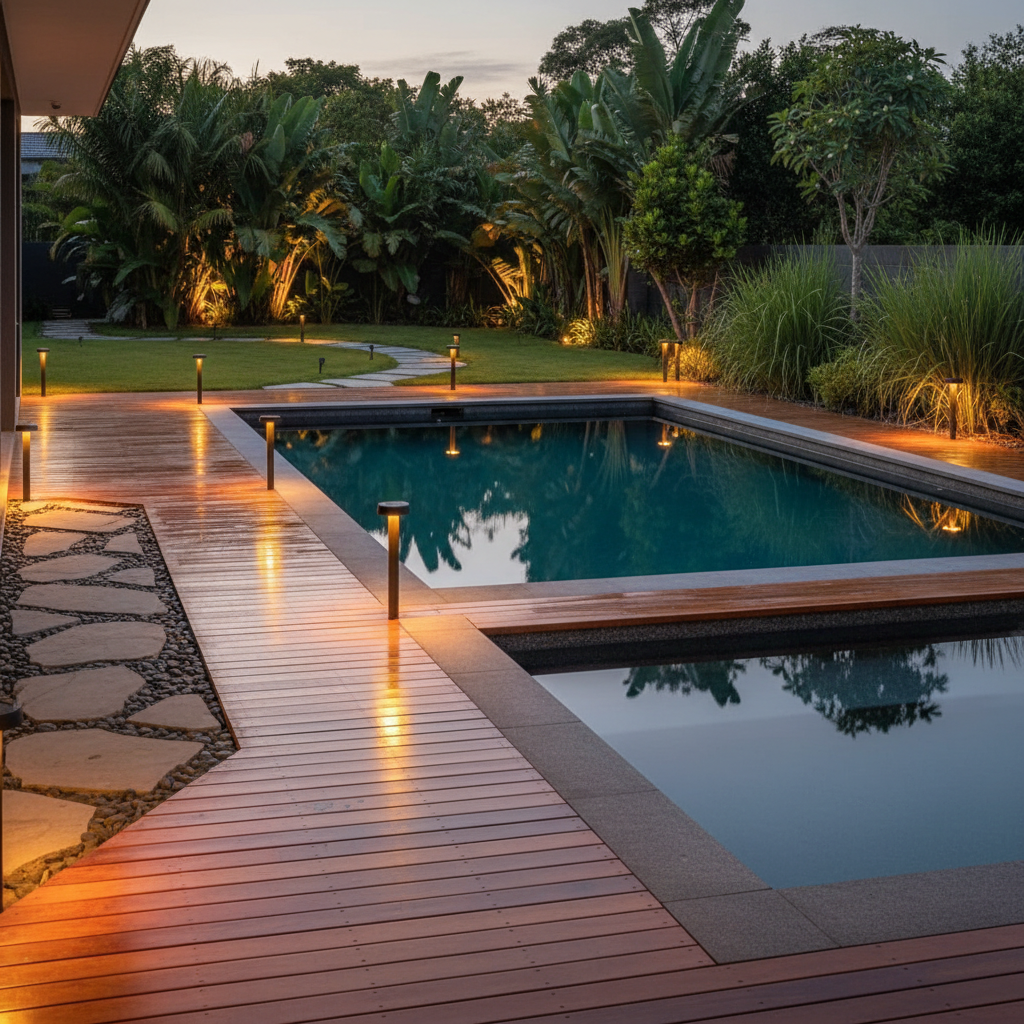
This is the most important area to light, and often the most neglected. The pool edge must be visible at night. Not for ambiance – to avoid falling in. Low solar bollard lights placed every 6 to 10 feet along the perimeter do the job. They mark the boundary without glare and without cables. If you prefer something invisible during the day, recessed solar ground lights can work – but double-check the IP certification.
The Patio and Relaxation Areas
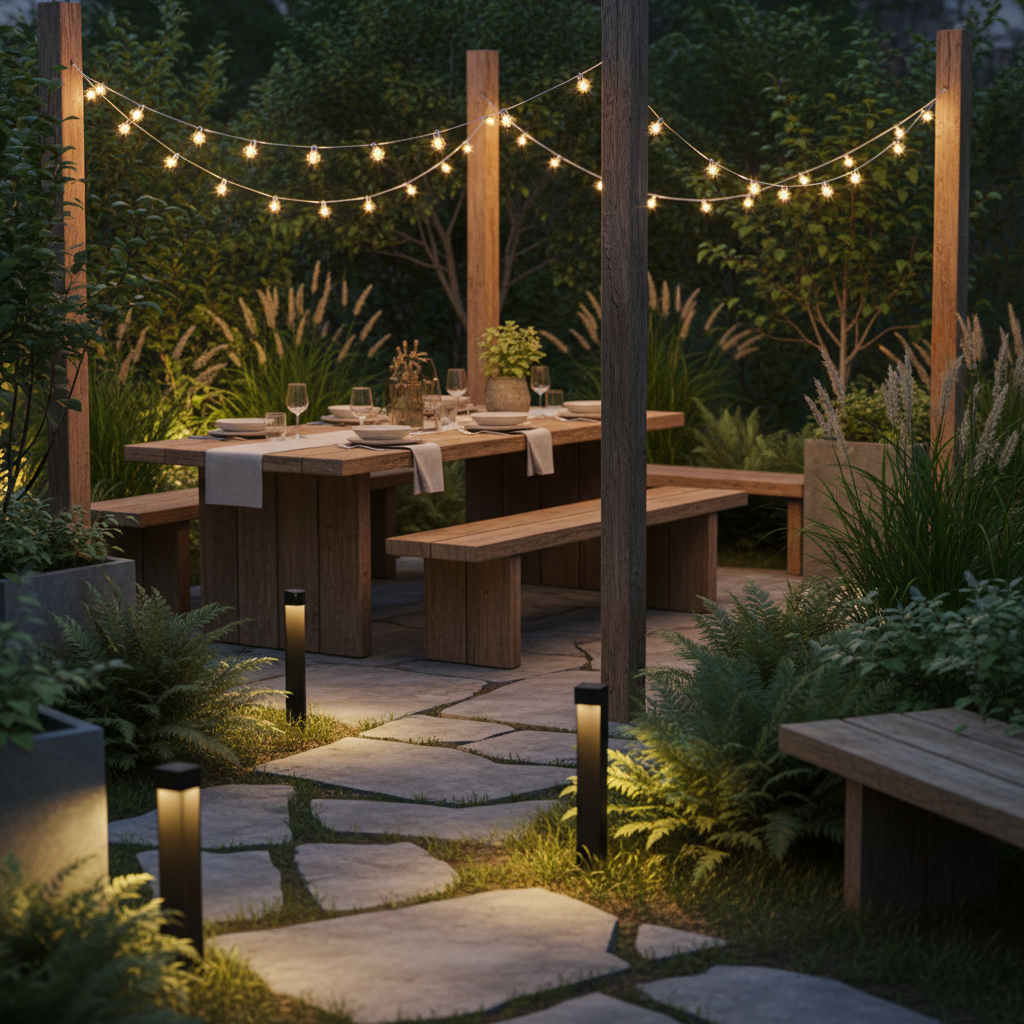
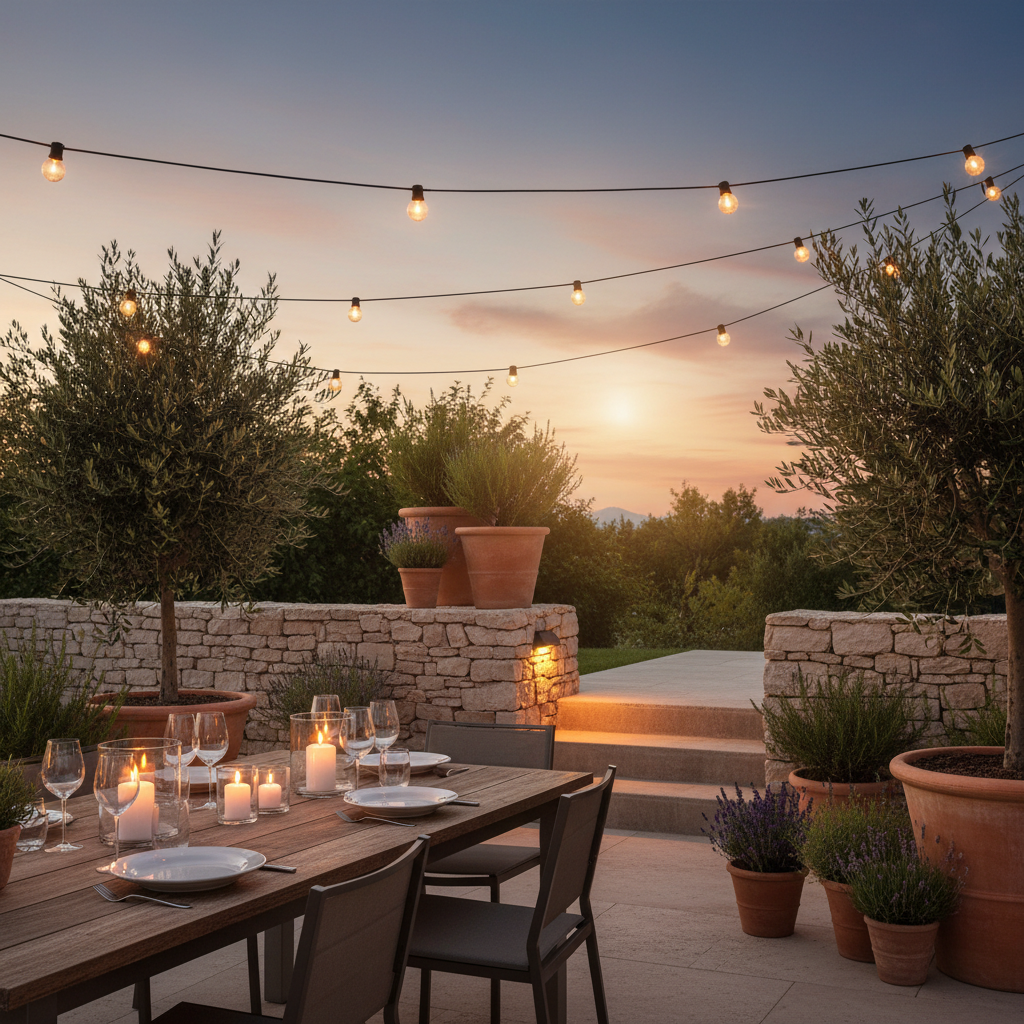
Around the patio, the goal is twofold: ambiance and practicality. Wall lights, sconces, or adjustable spotlights can illuminate the table, lounge chairs, and pathways. Recommended color temperature: warm white at 3000K for a relaxing atmosphere. Cool white (6000K) is too harsh for a summer evening.
The Pool Access Path
The path connecting the house to the pool is often dark and slippery at night, especially when the ground is wet. This is where adult falls most often occur – not in the water, but on the way. Motion-sensing spotlights placed along the path turn on as soon as someone approaches and turn off automatically. Result: zero consumption when no one is passing, maximum safety when someone is moving.
The Equipment Room and Pump
Often overlooked: the technical area (pump room, filter, water inlet). This is where you go at night when something is wrong. A motion-sensing light in this specific spot automatically illuminates the area as you approach to work on the equipment. Practical, simple, and no extra cables to run.
Comparison Table: Solar Pool Lighting by Use
| Usage | Product Type | Solar Possible? | Minimum IP | Priority |
|---|---|---|---|---|
| Pool Edge (marking) | Low bollards or ground spotlights | Yes | IP65 | High (safety) |
| In-Water (fixed submerged) | Wired IP68 spotlight | No — wired mandatory | IP68 | Installation dependent |
| Surface (decorative) | Floating solar light | Yes (decoration only) | Surface waterproof | Low (ambiance) |
| Patio / Relaxation Area | Sconce or wall spotlight | Yes | IP65 | High (ambiance + comfort) |
| Access Path | Motion-sensing spotlight | Yes | IP65 | High (safety) |
Common Mistakes to Avoid with Solar Pool Lighting
Buying a Solar Light Without Checking the IP Rating
This is the most common mistake. A solar light sold as "outdoor" isn't necessarily resistant to water splashes. Some low-end models are only certified IP44 or IP54 – sufficient for light rain, but not for pool splashes. Always check the technical specifications. If the IP isn't clearly mentioned, move on.
Placing All Lights on the Same Side
If the solar panel is integrated into the light, south-facing orientation is essential for efficient recharging. As a result, many people place all their lights on the sunny side and leave the rest of the pool in the dark. Solution: choose models with a remote solar panel (separate from the light fixture), or plan for several lights at different strategic points.
Forgetting About Winter Shading
In summer, even an entry-level solar light works well – the sun is out, days are long. The problem comes in September, October: nights get longer, and the sun is lower. Lights with small batteries no longer last all night. Investing in a model with a large battery from the start ensures reliable lighting 12 months a year.
Neglecting Installation Height and Angle
A spotlight placed too low risks being obstructed by vegetation or patio furniture. Too high, the beam won't cover the desired area well. Generally, to effectively cover pool surrounds, a height of 6.5 to 8 feet with a downward-facing adjustable beam yields the best results. And if you opt for a model with two 180° sensors, a single light placed in a corner can cover the entire width of the pool.
Practical Questions About Installing Solar Lighting Around the Pool
Do You Need an Electrician to Install Solar Pool Lighting?
No. This is precisely one of the great advantages of solar: installation requires no electrical skills. No wiring, no connection to the grid, no junction box. You mount the light (screws, adhesive, or stake depending on the model), ensure the panel is well-oriented south, and that's it. For renters, this is particularly appealing: no impact on the property, reversible installation in five minutes.
Does Solar Lighting Work on Cloudy Days?
Yes, but to a lesser extent. A solar panel also captures diffuse energy on cloudy days – it recharges, just slower. The impact primarily depends on the panel size and battery capacity. A model with a large battery (4000 mAh and up) can last several consecutive nights without direct sunlight if it was well-charged beforehand. For less sunny regions or year-round use, prioritize models with the largest available panels.
How Many Solar Spotlights Do You Need for an 26 x 13-foot Pool?
For a typical 26 x 13-foot pool, you generally need:
- 2 motion-sensing spotlights in the corners to cover access points
- 4 to 6 low bollards to mark the pool perimeter
- 1 or 2 lights for the adjacent patio
In total, between 6 and 10 fixtures depending on the configuration. That's less than you might imagine, and much less expensive than a wired installation with cables and an electrician. To learn more about available options, consult our complete guide to solar pool lighting with detailed selection criteria.
What Solar Cannot Replace Around a Pool
Let's be honest: solar has its limits. For submerged lighting in the pool walls (recessed spotlights in the shell), wired and low-voltage is mandatory. This type of installation requires a professional and wiring compliant with safety standards (safety zones around a pool). No solar panel can reliably power a submerged spotlight 5 feet underwater.
Similarly, if you want very powerful continuous lighting all night long (patio with large dinners until 2 AM every summer night), mid-range solar lights may reach their limits on the longest nights. In this case, a wired installation on the patio, combined with solar in access areas, is the best compromise.
But for the vast majority of uses around a pool – perimeter marking, path lighting, motion detection at access points – solar performs perfectly, with a real safety advantage over wired solutions in a wet area.
In Summary: Key Takeaways for Solar Pool Lighting
Solar lighting is clearly the best option for pool surrounds: no cables in a wet area, installation in minutes, reliable autonomy if you choose the right models. For in-water lighting, however, it's wired and professional – no exceptions.
The two non-negotiable criteria to check: minimum IP65 (splash resistance) and a battery large enough to last all summer night. And if you have children or if nighttime safety is a priority, a motion-sensing spotlight with a 26-foot range positioned at pool access points is probably the best investment you can make around your pool.