It's 9 PM. You're still at the table, drink in hand. Dusk settles, candles barely illuminate your guests' faces. Your patio, however, disappears into darkness. That night, you decided you needed a solution. No major renovations, no electrician, no cables running through the living room.
The good news: a well-chosen solar patio light does exactly that job, without any fuss. And if you still think solar means ugly white light and intrusive motion sensors, this article will change your mind.
Why Ambiance Comes First
When we talk about patio lighting, the classic reflex is to think safety first. Wrong approach. What transforms an ordinary patio into a space where you want to linger is the lighting ambiance. Safety, we'll get back to it — but it comes second.
What Light Does for a Patio at Night
Light changes everything about how an outdoor space is perceived. A well-lit patio at 2700-3000K (warm white) feels larger, more inviting, and more intimate all at once. This is the exact color temperature you find in restaurants and hotels that make you want to stay.
Conversely, a cold white light at 6000K makes it feel like a parking lot. The brain associates this with utility, not relaxation. The color of your light is probably the most important decision you'll make for your patio.
The Most Common Mistake with Solar Patio Lighting
Buying a single central light source. Whether it's a floodlight in the middle of the ceiling or a lamp placed in a corner, a single source creates harsh shadows and flat lighting. The result: it looks like a construction site, not a pleasant patio.
The real trick is layering sources at different heights — just like professional lighting designers do for outdoor restaurants. We'll revisit this in the next section.
The Combo That Truly Transforms a Patio at Night
The guiding principle: 80% of the ambiance comes from diffused, warm light, 20% from functional lighting points. Here's how to build this combo without cables, drilling, or an electrician.
First Layer: Solar String Lights to Create Atmosphere
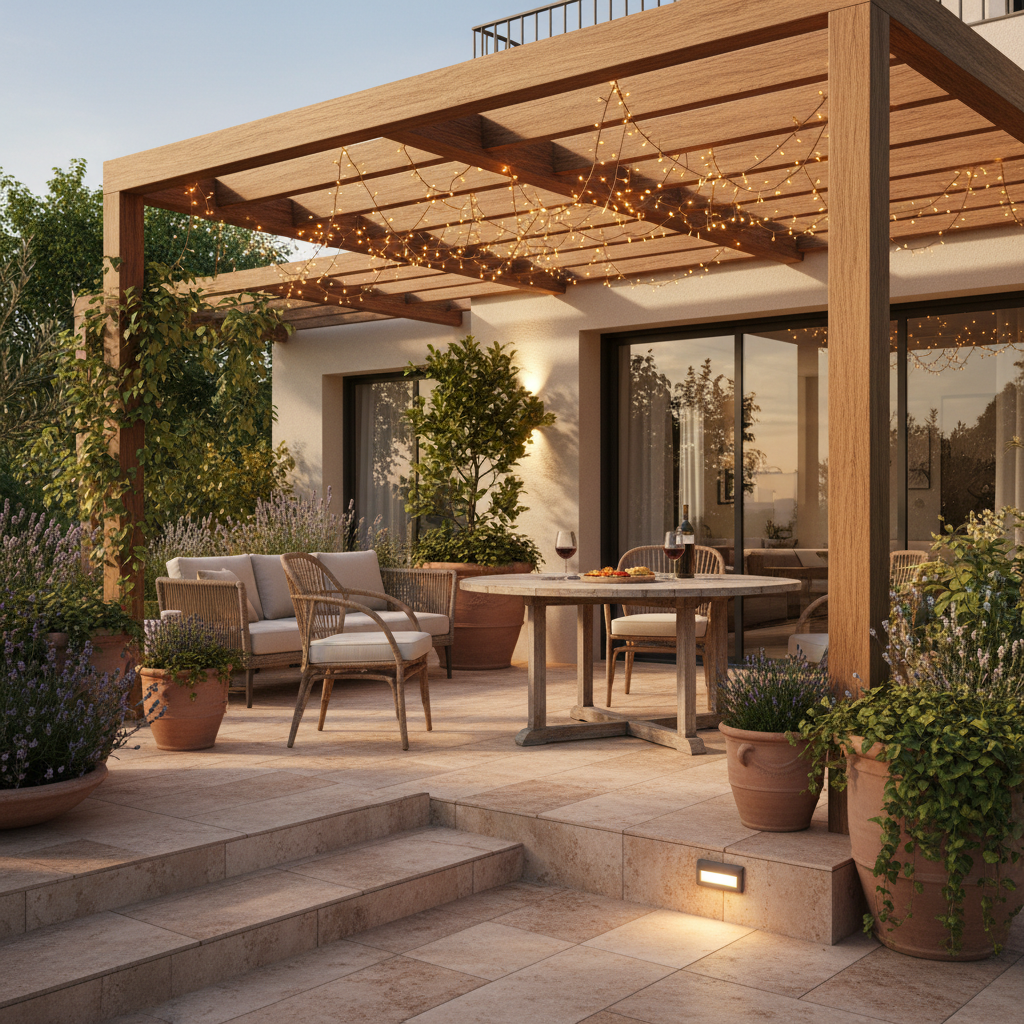
Solar string lights remain the undisputed queen of patio ambiance. Strung between two walls, draped along a pergola, or wrapped around wooden posts, they create a canopy of light that immediately transforms the space.
A few rules to keep them beautiful, not kitschy:
- Opt for glass globe bulbs, not plastic. The diffusion quality is not the same.
- Choose warm white exclusively (2700K-3000K). Multi-colored string lights are for carnivals.
- Allow for some slack in the tension: a perfectly taut string loses its charm. Gentle curves add movement.
- Layer two levels if your pergola or facade allows — guaranteed cozy effect.
Most quality solar string lights charge in 6 to 8 hours of sunlight for 8 to 12 hours of illumination. On a patio with good sun exposure, this easily covers an entire evening.
If you want to explore more cable-free lighting options, this article on wireless patio lighting for every ambiance will give you concrete ideas based on your space.
Second Layer: Lanterns and LED Candles on the Ground
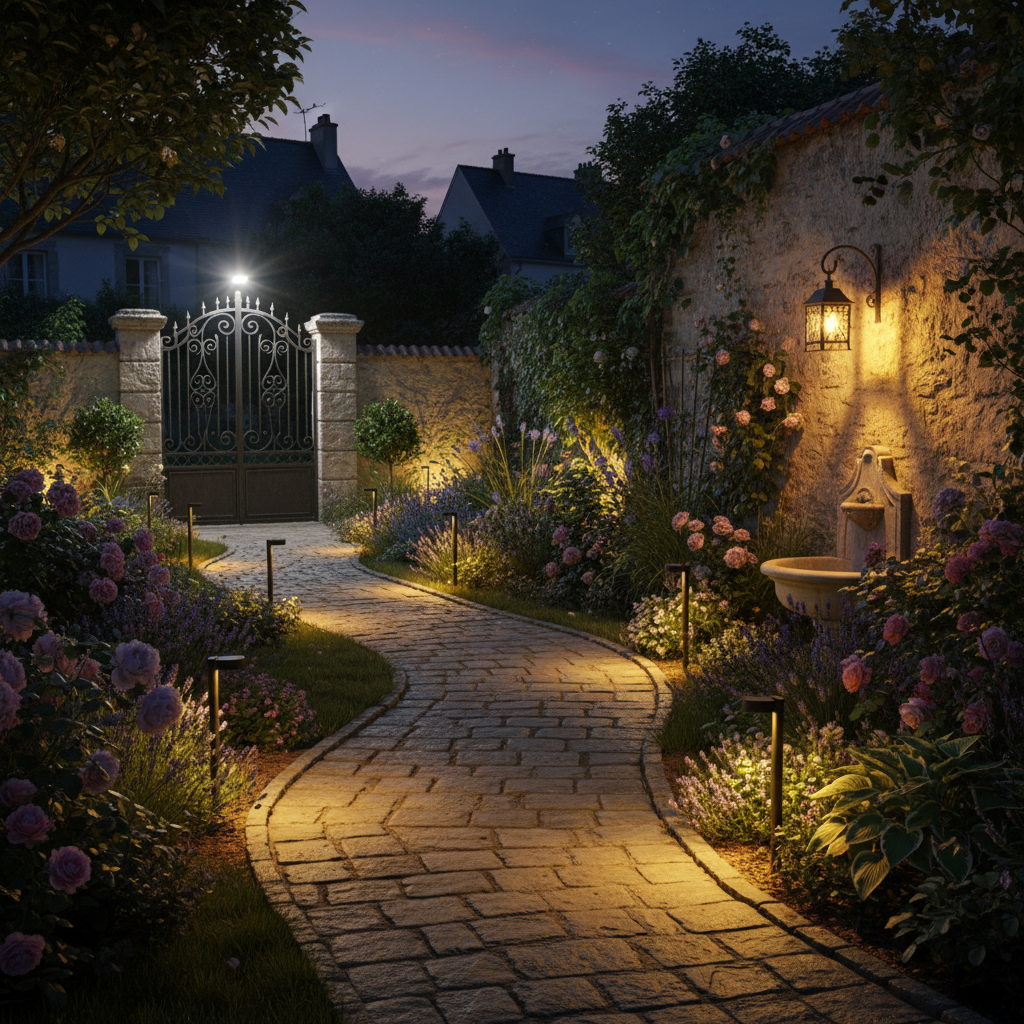
At ground level, solar lanterns placed on steps, around a coffee table, or bordering a garden path add a third dimension to the space. They visually warm the lower areas and add depth.
The secret: place them in odd numbers (3, 5, 7) and vary their height slightly. A group of identical lanterns placed in a straight line is too geometric. An organic grouping looks like true decor.
Combined with flickering LED candles (safe, no maintenance), they create an ambiance that even wired spotlights struggle to replicate.
Third Layer: Adjustable Spotlights to Highlight Details
A patio is also a garden to showcase. A small solar spotlight aimed at a shrub, a stone wall, or a fountain creates what's called accent lighting — lighting that adds character to a space.
These spotlights can remain fixed or have a slight motion sensor to save battery. The important thing: aim them at an object, not at people's faces. Light in the eyes immediately kills the mood.
To better understand what distinguishes a truly high-performance solar lamp from others, you can consult our article on what makes the difference in a powerful outdoor solar lamp.
Safety Without Sacrificing Ambiance
Here we are. And this is where many people make a design mistake: they put a large, highly visible motion-sensing floodlight on the facade. The result: when someone passes by, the patio turns into a blinding theatrical scene. Everyone squints. The ambiance is dead.
How to Place Security Lighting Without Killing the Mood
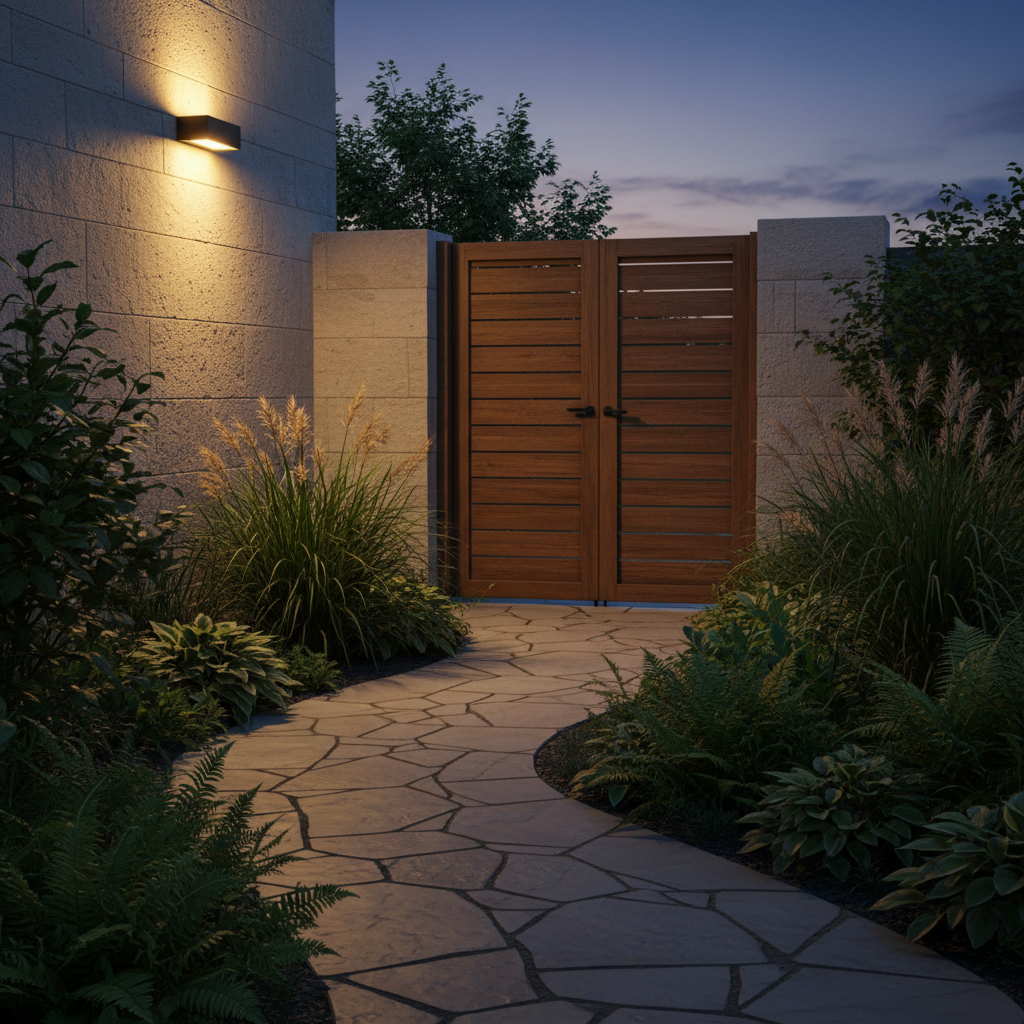
The rule is simple: security lighting should be positioned low and directed towards the ground, not towards the eyes. On patio steps, the edge of a pathway, or a door frame, downward-facing lighting guides without dazzling.
This is especially important when you have guests. Guests stumbling in the dark on their way home is a real concern. Guests blinded by a 1200-lumen floodlight when they get up from the table is also a bad experience.
The Right Place for a Motion Sensor Light
Think about transition points: where you move from the patio's lighting to something less illuminated. Typically:
- Steps leading down from the patio level to the garden
- The frame of a side entrance door
- The gate or garage access from the patio
- An outdoor hallway or path running alongside the house
These areas only need light when someone passes through. A well-calibrated motion sensor is exactly what's needed here. The light turns on when you need it, and turns off when you don't. Zero distraction during the rest of the evening.
Solar for Security: What It Actually Changes
Running an electrical cable to light patio steps or gate access requires an electrician. Expect to pay between $300 and $500 depending on accessibility and cable length, not including any masonry work to run conduits.
A solar light with a motion sensor is a 10 to 15-minute installation, no drilling in inaccessible areas, no visible cables. The SolarGlow by Lumic is designed exactly for this use case: 1200 adjustable lumens, two 180° motion sensors with an approximate 26-foot (8-meter) range, and a battery that lasts up to 20 days without solar recharge in detection mode. UL listed IP65, it handles winter without issues — rain, snow, and frost included.
You get up from the table to go inside. The steps light up. Your guests do too. No one stumbles. The patio remains in its beautiful golden light.
Want to delve deeper into solar lights with motion sensors? We have a complete guide detailing the criteria to consider before buying.
Can Solar Really Be as Beautiful as Wired?
The question comes up often. And it's legitimate. For a long time, low-end solar lights flooding the market gave the entire category a bad reputation: dim light, dead batteries in 6 months, yellowed plastic casings.
What Has Changed in Quality Solar Lights
Advances in solar panels and lithium-ion batteries have completely changed the game. Where an entry-level solar light relied on a tiny panel and an undersized battery, quality products now feature significantly larger panels for efficient charging even on cloudy days, and substantial batteries to last several consecutive nights without sun.
The SolarGlow, for example, can operate for up to 20 days without any solar recharge in motion detection mode. In short: even a week of bad weather in fall won't leave you in the dark.
Design: Why It Matters as Much as Technology
Successful patio lighting is also lighting you don't see — in the sense that the fixtures themselves blend in discreetly. An anthracite gray or off-white aluminum casing disappears on a facade. A generic shiny plastic, however, remains visible and looks 'cheap' even when off.
This detail matters as much during the day as at night. Your patio is also a living space during the day. The fixtures you choose are an integral part of it.
For an overview of available options, the comparison of the best outdoor solar lights will give you a solid basis for objectively comparing products on the market.
The 5 Details That Make a Patio Truly Successful at Night
To summarize what people with beautiful nighttime patios do differently:
- They layer light sources at different heights rather than having just one.
- They consistently choose warm white (2700-3000K) for ambiance and only use neutral white for functional areas.
- They keep security lights discreet and aimed at the ground, not at eyes.
- They use timers or sensors so security lighting remains invisible during evenings and active when truly needed.
- They consider daytime aesthetics: fixtures that look good when off still look good when on.
The patio you envision for your evenings exists. It doesn't require renovations, cables, or an electrician. It just requires thinking about light the way you think about decor: in layers, with intention, and with the right products.
To go further in designing your outdoor lighting, our article dedicated to optimizing your patio's solar lighting details concrete configurations based on space size and style.