Ever bought a solar light that stopped working after three weeks? Or worse, barely lit up in winter? Many people have. The solar light market is flooded with products promising 2000 lumens on the box but delivering barely enough to light a nightstand.
Before choosing, the real question is: what will it be used for? A light for securing an entrance is different from a bollard for marking a pathway or string lights for a patio. Yet, many people buy the first solar light they see without asking this question.
This article is designed to help you avoid that. We'll review each major type of outdoor solar light, what each offers, and the criteria most people overlook before buying.
The 3 Criteria No One Checks Before Buying
Before discussing light types, let's talk numbers. Not the ones on the packaging — the ones that truly matter.
Real Lumens vs. Marketing Lumens
An unscrupulous manufacturer measures their LED's lumens cold, at maximum power, for a fraction of a second. Result: they can claim 800 lumens for a light that produces 250 in normal use. The lumen value that matters is the one under real-world conditions — battery at 50%, after a few hours of operation, on a cloudy day. If a manufacturer doesn't specify how they measure lumens, it's often a bad sign.
Battery Capacity in mAh
This is your light's fuel tank. The higher the number, the more energy it can store during solar charging and release at night. Entry-level lights often hover around 800 to 1200 mAh — enough for one to two nights of maximum autonomy. A 3000 to 4000 mAh battery gives you real leeway, even during bad weather.
Solar Panel Surface Area
This is probably the most overlooked criterion. A small 0.6 square inch (4 cm²) panel will struggle to charge a large battery, even in full sun. The panel's surface area determines the amount of energy collected daily. A panel 3 times larger collects 3 times more energy under the same conditions. When specifications don't mention panel size, ask yourself why.
These three criteria — real lumens, battery capacity, panel surface area — are the basic filter. Now, let's see which type of solar light suits which use.
Solar Wall Sconces: Security and Entrance Lighting
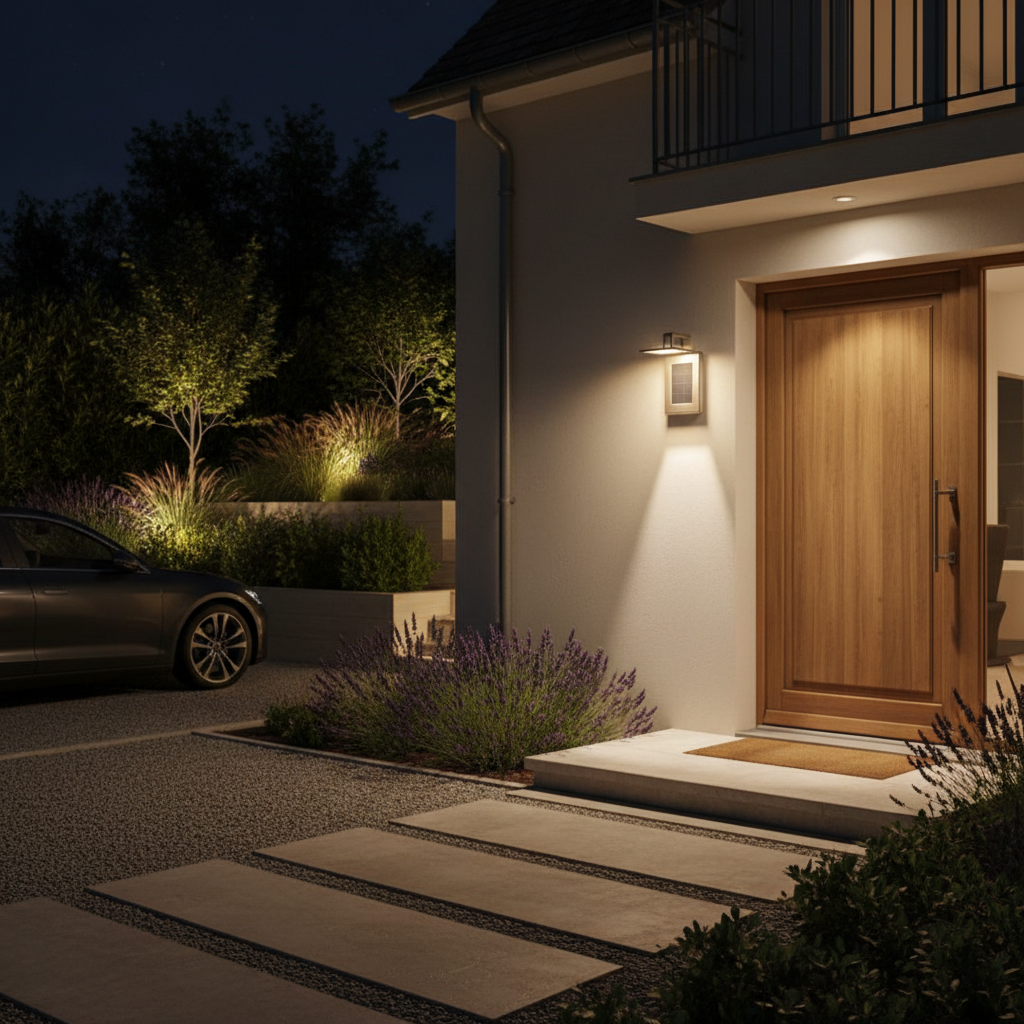
A solar wall sconce installs on an exterior wall — facade, garage, house entrance, gate side. It's the most versatile type and probably the most useful for daily life.
What Is It For?
Mainly two cases: functional entrance lighting (you come home at night, you want to see where you're stepping) and security (deterring intruders, motion detection). In both cases, the minimum recommended power is 600 lumens for a standard entrance, and preferably 1000 lumens or more for a large gate or exposed facade.
With or Without Motion Sensor?
For a wall sconce, a motion sensor is almost always the right option. It saves battery by only turning on when needed — at night when you pass by, or when someone approaches. Without a sensor, a light that stays on all night will drain its battery in a few hours. If you want to delve deeper into this topic, our article on solar lights with motion sensors details the criteria to look for.
The Cost of Wired Installations
Installing a wired wall sconce with a motion sensor generally involves an outdoor trench, electrical cable, and an electrician's intervention. In practice, this type of installation often costs between $400 and $800, depending on the distance and complexity of the job — not including ground restoration work. A quality solar sconce, even at $80-$100, quickly pays for itself compared to this cost.
The SolarGlow by Lumic is a motion-sensor solar wall sconce designed for this type of use. It delivers 1200 real lumens, with two motion sensors covering 180° over a range of about 26 feet (8 meters). Its solar panel is significantly larger than those found on low-end models, and its battery supports approximately 20 days without solar recharge in detection mode. UL listed (rain, snow, frost), 5-year warranty. When a brand advertises real lumens and offers a 5-year warranty, it means they don't need to inflate their numbers. For details, check our article on outdoor solar wall lights.
Solar Floodlights: For Large Areas
A solar floodlight differs from a sconce by its concentrated and adjustable light beam. It's designed to illuminate a precise area from a greater distance.
What Is It For?
Sports fields in the backyard, house facades to be lit from the ground, large parking lots, loading zones for a garage or outdoor workshop. Floodlights meet a need for raw power and range. We're talking 800 to 2000+ lumens here, depending on the area to cover.
What Else to Check
The beam angle (expressed in degrees) determines if the beam is narrow and intense or wide and diffuse. A 30° floodlight illuminates far but over a narrow area. A 120° floodlight covers a wide area but less intensely. Many manufacturers don't indicate this angle — it's crucial to check. Also: the ability to separate the solar panel from the floodlight (with a cable between them) allows you to orient the panel south independently of the floodlight's orientation.
Price Range
Entry-level solar floodlights start around $20-$30 on Amazon or at big box stores like Home Depot or Lowe's. Reliable models with a decent battery and panel are typically between $60 and $150. Below $30, be wary of the advertised numbers.
To learn more about comparing real power, our guide on powerful solar garden lights gets straight to the point.
Solar Bollards: Marking a Pathway or Walkway
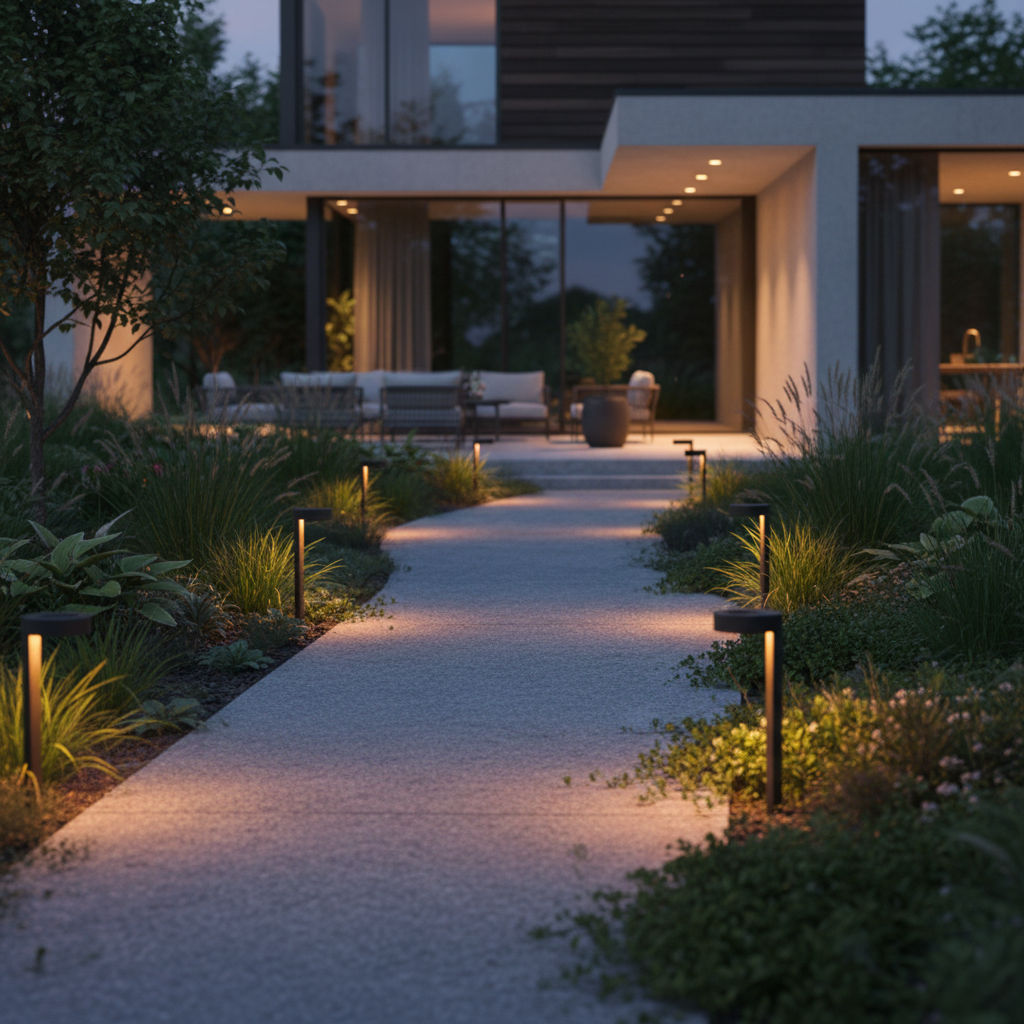
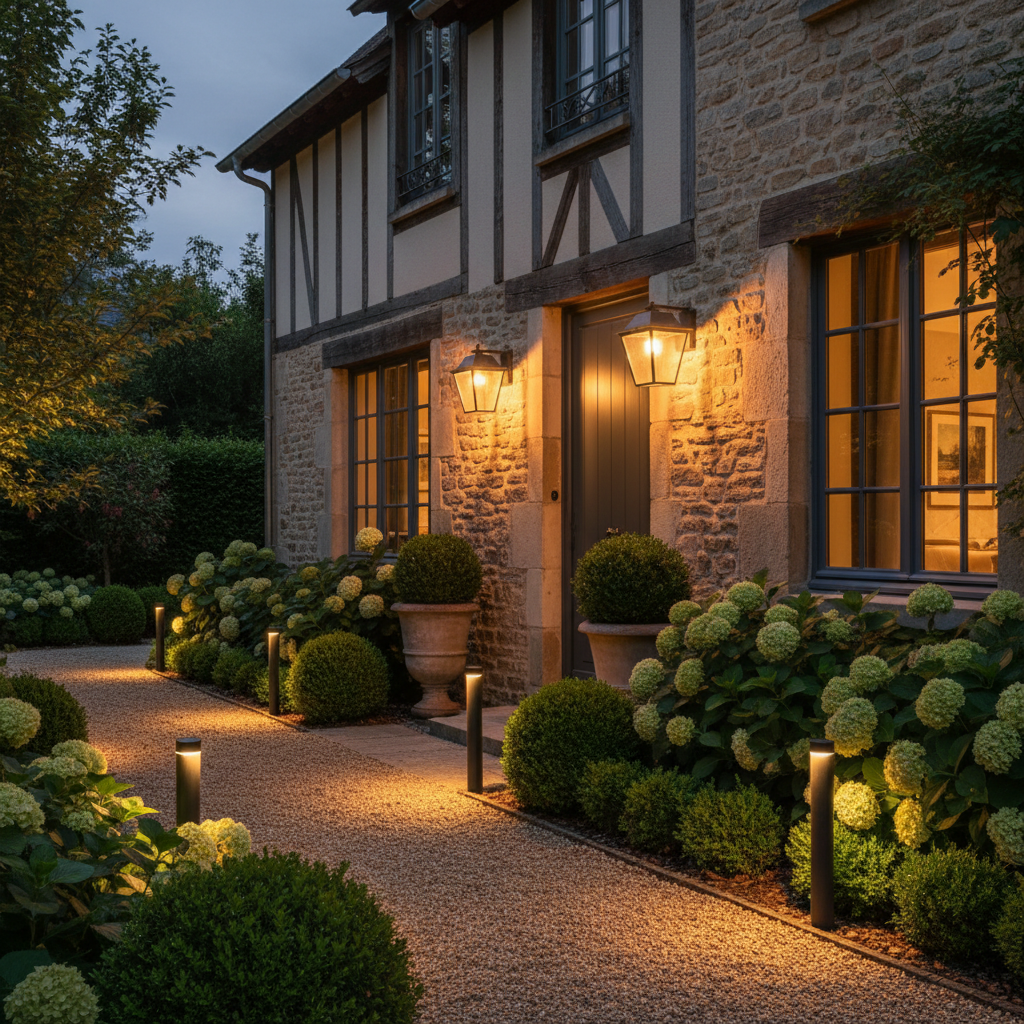
A solar bollard (or garden bollard) is a freestanding light, staked into the ground or placed on a surface, that illuminates sideways or downwards. Its primary role is to mark, not to illuminate.
What Is It For?
Garden paths, walkways leading to a secondary entrance, patio edges, pond perimeters. Solar bollards create a visual guide and add a decorative touch. Light intensity is deliberately low — between 50 and 200 lumens generally — because the goal is not to light an area but to indicate a path.
What to Check
Waterproofing is the first criterion: a bollard planted in the ground will be exposed to humidity, rainwater splashes, and sometimes snow. An IP65 rating is the minimum. The second criterion is stability: a too-light bollard in soft ground will tilt. Prefer models with a sufficiently long stake and a wide base.
Price Range
Between $15 and $60 per unit depending on materials (plastic, stainless steel, aluminum). Often sold in packs of 4 to 6. Beware of "10 bollards for $20" offers — the battery is usually tiny and the lumens negligible.
Solar Spike Spotlights: For Flowerbeds
A spike spotlight is different from a bollard: it directs a beam towards a plant, a tree, or a garden sculpture. This is about creating illuminated scenes.
What Is It For?
Highlighting a shrub, a stone facade, a garden fountain. The "spotlight" effect creates relief and depth in a garden at night. In terms of security, their effectiveness is limited — that's not their primary function.
What to Check
The spotlight's orientation angle (is it adjustable?), light color (warm white for plants, neutral white for stone), and solar panel power. Many spike spotlights have very small panels integrated into the spike itself — which severely limits recharging, especially if the spotlight is in a shaded flowerbed. Some models offer a detachable panel, which solves this problem.
Price Range
Between $20 and $80 depending on quality. Models with a cable between the panel and the spotlight cost a bit more but are much more versatile in gardens with a lot of ground shade.
Solar String Lights: Outdoor Ambient Lighting
Solar string lights are the most accessible and easiest type to install. No wall mounting, no stakes — you hang them, wrap them, or lay them down.
What Is It For?
Patio, pergola, hedge, balcony, garden fence. String lights create a warm atmosphere in the evening. They have no security or functional purpose — they are purely ambient light.
What to Check
The cable length between the solar panel and the first bulb: if the string lights are under a covered pergola, the panel must be able to be positioned out of the shade. Many cheap string lights have a panel integrated directly into the housing, without a separate cable. Result: if you hang the string lights in the shade, they won't charge. Also check the number of modes (steady, flashing, programmable) and the total length based on your area.
Price Range
Between $10 and $50. String lights under $15 rarely last a full season. Prefer models with at least an IP44 rated housing and a cable between the panel and the string lights.
How to Properly Position Your Solar Light (Regardless of Type)
The best product in the world won't work correctly if the solar panel is in the shade. This is the primary cause of disappointment with solar lights. Here are the basic rules.
Panel Orientation
In the US/Canada, the sun is generally to the south. The panel should ideally face south, with an inclination of about 30 to 45 degrees to capture maximum energy. Facing due east or west, you lose about 30 to 40% of charging capacity. Facing due north should be avoided except in summer.
Shaded Areas and Obstacles
A tree, an overhang, another building: even partial shade can halve or more the panel's production. Ensure the panel is in direct sunlight for at least 6 hours a day, ideally in the middle of the day (between 10 AM and 3 PM).
What About Winter?
Daylight hours decrease, and sun angles are lower. If you want a functional solar light in winter in the US/Canada, prioritize a high-capacity battery and a large panel — this is where the difference between entry-level and quality products is most visible. Our guide on functional solar lights in winter covers this topic in detail.
Comparison Table: Which Light Type for Which Need?
| Type | Main Use | Useful Lumens | Sensor? | Price Range |
|---|---|---|---|---|
| Wall Sconce | Entrance, facade, security | 600 to 1200+ | Recommended | $50 to $120 |
| Floodlight | Large area, facade | 800 to 2000+ | Optional | $60 to $150 |
| Garden Bollard | Pathway marking, walkway | 50 to 200 | No | $15 to $60 / unit |
| Spike Spotlight | Highlighting plants | 100 to 400 | No | $20 to $80 |
| String Lights | Patio, pergola ambiance | Low (decorative) | No | $15 to $50 |
Where to Start, Practically?
If you're only buying one solar light, start with a motion-sensor wall sconce. It offers the most daily value: security, convenience, energy savings. Choose one with a minimum of 600 real lumens, a battery of at least 2000 mAh, and a solar panel large enough to compensate for cloudy days.
If you want to cover multiple areas of your yard, our article on adapted solar garden lights helps you prioritize zones. And if you want a structured comparison of models available in 2026, check out our selection of the best solar lights currently available.
The highest-rated solar light is rarely the most expensive. It's the one that does exactly what it promises, consistently, without requiring constant monitoring. Start with the right criteria, and the choice becomes simple.