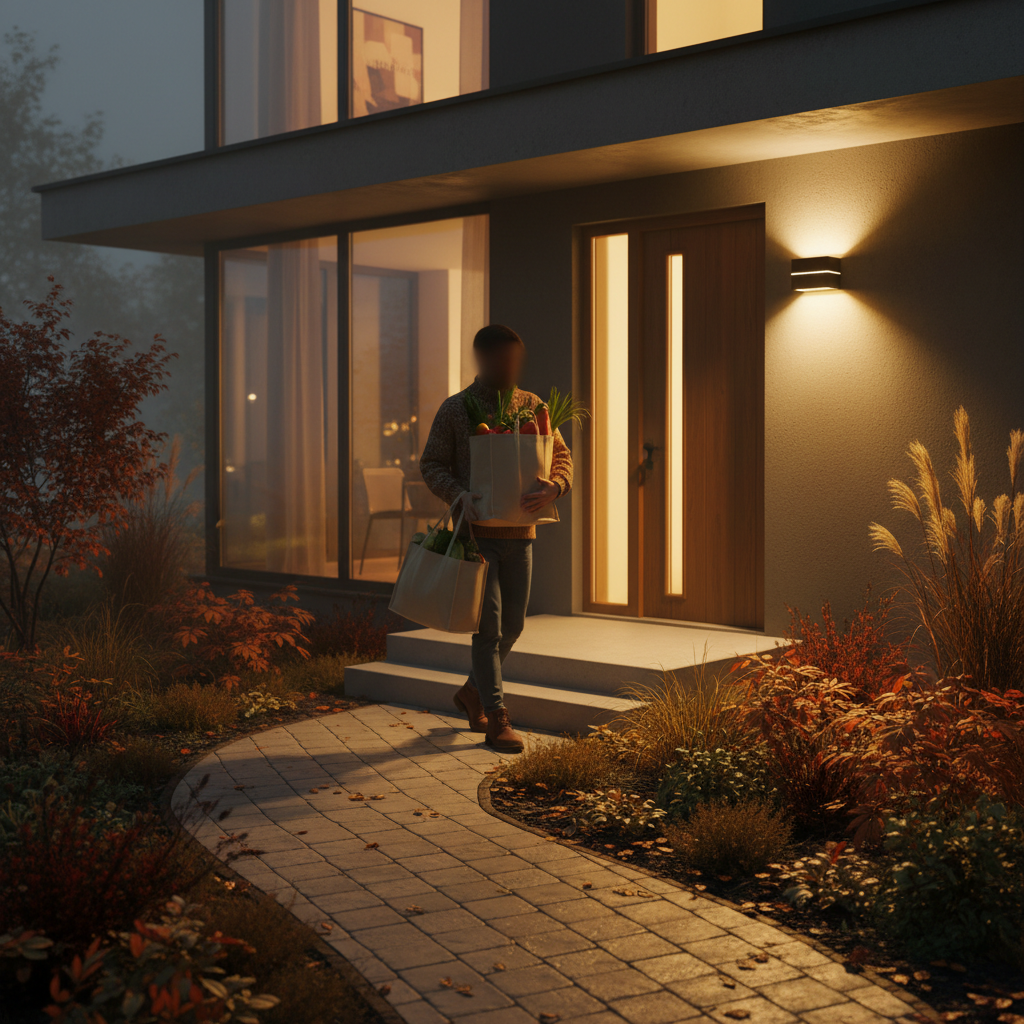
You're coming home, arms full of groceries. It's dark. Key in your pocket, heavy bag, and the entrance is pitch black. Then, the light turns on by itself, just before you step onto the porch.
That's what a truly effective solar light with motion sensor does. It's not just another security gadget—it's something that simplifies three or four annoying little moments in your week, without you even having to think about it.
This guide isn't about lux, watts, or beam angles. It's about the concrete difference it makes in your daily life. And how to choose an automatic solar light that delivers on its promises, winter and summer. For more technical criteria, check out our guide on choosing your solar light with motion sensor.
Why a Motion Sensor Truly Changes Daily Life
Most people install a solar light for security. They stay for the convenience. That's no accident.
Coming Home with Groceries: The Most Common Scenario
You grocery shop two or three times a week. In winter, it gets dark by 5 PM. You pull into the driveway, hands full, and still have to find the lock, avoid tripping on the curb, or manage kids and pets.
A solar light with motion sensor solves this problem once and for all. As soon as you approach—around 26 feet (8 meters) for reliable models—the light turns on. You don't have to do anything. It turns off by itself afterward. No electricity bill, no switch to fumble for in the dark.
That moment, multiplied by 150 evenings a year, is real convenience. Not a luxury.
Taking Out the Trash: No One Thinks About It Until They Live It
Taking out the trash always happens in the evening. Often in pajamas. And the path to the bin rarely has quality lighting.
With a well-placed automatic solar light at the end of the driveway or on the side of the house, you won't need to turn on the entire house's outdoor light just to walk 30 feet (10 meters). The motion sensor light does the job: it turns on when you pass, turns off when you go back inside. Discreet, autonomous, efficient.
This kind of detail is especially noticeable in winter—when it's cold, dark, and you really don't want to linger outside.
Guests Arriving: The Unexpectedly Appreciated Effect
When someone rings your doorbell and the driveway automatically illuminates as they approach, the effect is immediate. It's both welcoming and reassuring for them.
No need to leave the light on all evening "just in case." The solar light with motion sensor handles it. It turns on when guests arrive, stays on long enough for them to enter, then turns off. And repeats when they leave.
Result: the exterior is always well-lit when needed, and the battery isn't unnecessarily drained. To better understand how this type of system manages triggers, our article on how motion sensors really work explains the mechanisms in detail.
What a Good Solar Motion Sensor Light Should Really Do
The market for solar lights with motion sensors is saturated with products that work perfectly in July and fail by November. Before choosing, here's what truly matters.
Last Through Winter, Not Just Summer
This is the criterion that eliminates 80% of cheap lights. In winter, days are short, the sun is low, and undersized solar panels don't recharge sufficiently. Result: the light turns on twice in the evening, then not at all.
A reliable automatic solar light for all seasons must have a solar panel and battery sized sufficiently to store energy for several days of bad weather. Specifically, look for a stated autonomy of at least 15 to 20 days without solar recharge in motion detection mode—this is the threshold that separates real lights from garden decorations.
Lumic's SolarGlow lasts up to 20 days without sun in detection mode, thanks to a significantly larger battery and solar panel than typically found at this price point. It is IP65 certified—resistant to rain, snow, and frost—making it usable year-round, even in regions with harsh winters.
Detector Range: Why 26 feet (8 meters) Changes Everything
A too-short detector (10-13 feet / 3-4 meters) means the light turns on at the last minute—when you've already arrived. Its usefulness is close to zero.
A good outdoor solar light motion sensor should cover between 20-33 feet (6-10 meters). This gives you enough time to arrive comfortably, hands-free or loaded, without rushing for the light.
The detection angle also matters. Two 180° sensors give you total coverage in front of the light—no blind spots, no unnoticed passages. This is important if you install the light on a gate post or at the end of a driveway.
Brightness: How Much You Really Need
For a driveway or entrance, a useful range is generally between 800 and 1500 lumens. Below that, it's insufficient to clearly see where you're stepping. Above 1500 lumens, it becomes blinding and not very useful for residential use.
1200 lumens is the right balance for lighting an entrance, gate, or garden path without dazzling neighbors or wasting battery. This is also the stated value for the SolarGlow.
| Criterion | Low-End Lights | SolarGlow (Lumic) |
|---|---|---|
| Autonomy without sun | 3 to 5 days | 20 days (detection mode) |
| Detector range | 10-16 ft (3-5 m) | ~26 ft (8 m) |
| Brightness | 200 to 600 lumens | 1200 lumens |
| Weather resistance | Often IP44 | IP65 (rain, snow, frost) |
| Detection angle | 90 to 120° | 2 x 180° |
| Warranty | 6 to 12 months | 5 years |
Where to Install a Solar Light with Motion Sensor for Maximum Impact
The right location often makes the difference between a light you love and one you end up disabling because it triggers for no reason.
Entrance and Gate: Priority Number One
This is where the detector adds the most value. Mounted 8-10 feet (2.5-3 meters) high on a wall or gate pillar, an automatic solar light illuminates the entire access area upon approach. It guides visitors, secures the area, and prevents falls on steps or poorly visible curbs.
Pay attention to the solar panel's orientation: south-facing if possible, without shadows from a tree or roof at midday. This is often where people make mistakes during installation.
Garden Path or Driveway
A path that is 30-50 feet (10-15 meters) long may require two lights, placed alternately on each side. A single light with a 26-foot (8-meter) range won't cover the entire path if it's winding.
For a straight driveway, however, a good solar motion sensor light placed at the end of the path is often enough to illuminate the entire route. Our guide on powerful solar garden lights compares options based on yard size.
Side of the House and Blind Spots
Side passages, access to trash cans, unlit patio corners: these are areas where permanent lighting isn't installed because electrical wiring would be too cumbersome. A solar light with motion sensor is ideal here—no cables, no electrician, installation in minutes.
If you have a garage or shed without electrical power, an automatic solar light is often the simplest solution. To explore other options in this scenario, our article on garage lighting without electricity reviews all available alternatives.
Common Mistakes That Ruin the Experience
A solar light that triggers for no reason, doesn't last through winter, or doesn't turn on early enough—it's not inevitable. It's often an avoidable mistake during installation or purchase.
Incorrect Solar Panel Orientation
This is the number one mistake. A panel in the shade or facing east won't capture enough energy to recharge properly. South or southwest is the optimal orientation. Before permanently fixing it, place the light in the intended location and observe when shadows fall on it.
Installation Height Too Low
A sensor installed at 5 feet (1.5 meters) will trigger for the neighbor's cat, a fox, or a moving branch. At 8-10 feet (2.5-3 meters) high, the detection angle covers the driveway well while reducing false positives.
Choosing a Light Based Solely on Price
Solar lights under $15 exist, often work during the summer, and consistently disappoint as soon as days get shorter. The real cost is annual replacement—not to mention the frustration. A more robust light, with a proper battery and a panel sized for winter, costs more upfront but proves less expensive in the long run.
Not Adjusting Detector Sensitivity
Most solar lights with motion sensors offer sensitivity and illumination duration settings. If you don't adjust them, you risk either constant triggering (neighbor walking on the sidewalk) or a light that turns off too quickly. Take five minutes to set these two parameters during installation.
Detection Mode vs. Continuous Mode: Which to Choose Based on Use
Almost all solar lights with motion sensors offer two modes. Understanding which to use will help you preserve battery life without sacrificing convenience.
Detection Mode: For Daily Use
This is the default mode for an entrance or driveway. The light only turns on when someone (or something) passes within the detection zone, then turns off after an adjustable delay. This mode best preserves the battery—and thus guarantees maximum autonomy for several weeks without sun.
Continuous Mode: For Evenings and Events
If you're hosting a barbecue on the patio and need stable lighting for a few hours, continuous mode keeps the light on permanently until you manually deactivate it or the battery reaches a critical threshold.
The downside: autonomy drops sharply. Use this mode occasionally, and switch back to detection mode for daily use. For a comprehensive approach to solar outdoor lighting systems, our complete guide to solar outdoor lighting compares different types of solutions based on your needs.
The Winter Question: Can a Solar Motion Sensor Light Really Work in December?
This is the legitimate question everyone asks. And the honest answer is: it depends entirely on the quality of the battery and the solar panel.
Why Cheap Lights Fail in Winter
In December, there are about 8 hours of daylight—much of it with low sunlight. A poor-quality or undersized solar panel doesn't capture enough energy to compensate for long nights. The battery gradually drains, and after a week of cloudy skies, it's dead.
What "20 Days Without Sun" Means
A light that claims 20 days of autonomy in detection mode means a fully charged battery can power the light for 20 days of normal use without receiving any solar energy. In practice, even the darkest winters are rarely 20 consecutive days without any recharge. Such autonomy ensures near-continuous operation all year round.
This is the spec you should look for if you want a reliable automatic solar light in winter. Below 10 days, you risk disappointment from November to February. For more on choosing a solar motion sensor suitable for all seasons, our 2026 guide covers available technologies.
What Users Say After a Few Weeks
Customer reviews for SolarGlow on Trustpilot (4.5/5, over 2200 reviews) often mention the same things: ease of installation (no cables, no tools), quick detector reaction upon approach, and the fact that the light still works correctly in January, which they didn't expect.
What we also hear: the surprise of not having to think about it anymore. No switch, no timer to program, no batteries to change. The thing just works, summer and winter.
The SolarGlow comes with a 5-year warranty and a 90-day return policy if it doesn't meet your expectations. Customer support is based in the US with a 24-hour response time—which truly makes a difference if you have a question during installation or a problem months later.
Summary: What to Remember Before Buying
A solar light with motion sensor that truly changes your daily life is one that:
- Turns on before you arrive, not when you're already there (min. 20-26 ft / 6-8 m range)
- Still works in December (min. 15-20 days autonomy without sun)
- Is resistant to rain and frost (minimum IP65)
- Installs without cables or an electrician in minutes
- Doesn't trigger for no reason (correct installation height and sensitivity settings)
The motion sensor is not a security gadget. It's what makes outdoor lighting truly smart: it's there when you need it, invisible when you don't, and costs nothing to operate. To compare all your options based on your outdoor space, check out our article on outdoor motion sensor lights—it covers the most common use cases with concrete recommendations.