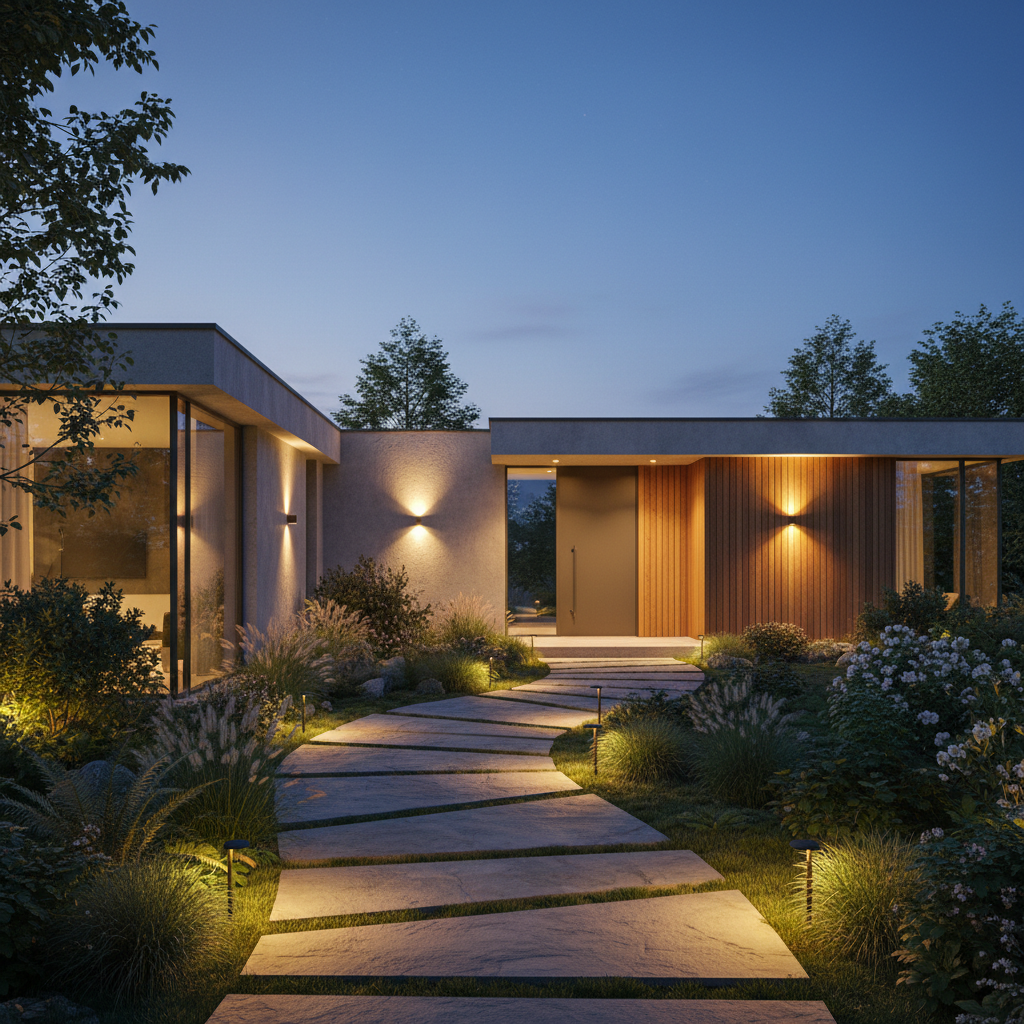
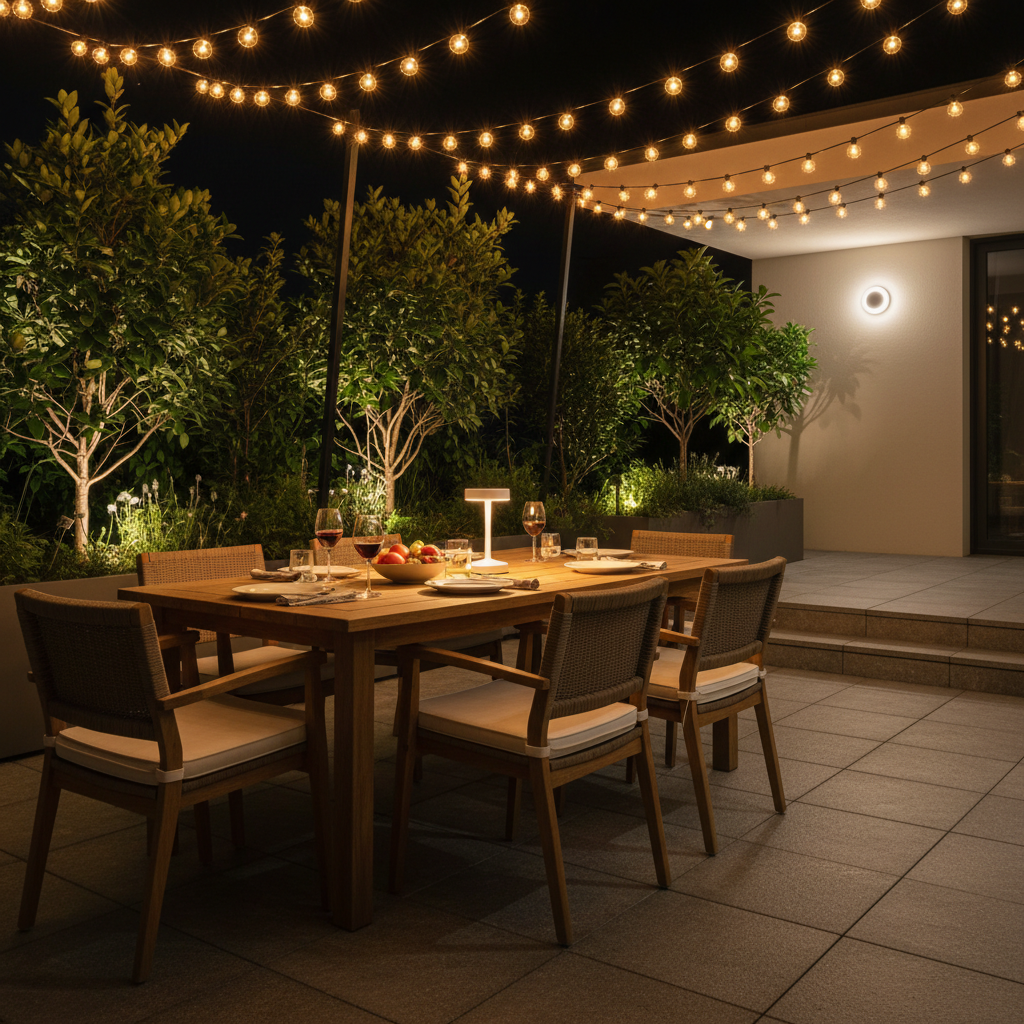
Picture this: a table outside, drinks with friends, the first stars appearing. But the living room light filtering through the patio door isn't enough, and turning on the halogen security floodlight instantly turns the ambiance into a supermarket parking lot.
Choosing the right outdoor patio lighting means understanding that there isn't one universal solution, but a combo of three lighting layers, each serving its purpose: ambiance, conviviality, and safety. In this article, we'll break down what truly works for summer evenings, without unnecessary wiring or breaking the bank.
Why Patio Lighting Should Be Layered
Successful patio lighting isn't just about a single bulb overhead. Just like indoors, outdoor spaces benefit from a layered approach: diffuse ambient light to set the mood, functional lighting for dining or reading, and discreet safety lighting that activates only when needed.
It's this last layer that most people forget, and we'll come back to it because that's where accidents really happen. But let's start with the basics: ambiance.
Ambient Light: The Foundation of Everything
Patio ambiance is primarily about color temperature and intensity. A warm white around 2700-3000K creates that golden glow that flatters faces, warms materials, and makes the evening feel like it could last forever.
Solar LED string lights have become the go-to solution for this ambient layer. They install in minutes, require no wiring, and turn on automatically at dusk. For an average-sized patio, a string of lights strung in a zigzag pattern above the table is enough to completely transform the space.
For more no-fuss design ideas, our article on wireless patio lighting solutions explores various configurations based on your space's shape and size.
How Many Lumens for an Outdoor Evening?
For a relaxed patio atmosphere, you're not trying to replicate office brightness. Effective ambient lighting for a table area is around 200 to 400 lumens. This is enough to see glasses and distinguish faces without creating harsh light that kills the mood as soon as you sit down to eat.
Well-chosen solar LED string lights typically offer this level of diffuse illumination. The advantage of solar here is clear: ambiance often turns on early in the evening and lasts for hours. No need for a large battery to power small LEDs.
The Rechargeable Table Lamp: The Often Underestimated Complement
String lights create poetry but not necessarily enough light to properly see your plate. That's where a rechargeable table lamp comes in.
These small wireless lamps, placed directly on the table, have literally changed how we experience outdoor dining. They recharge during the day (often via USB or a magnetic base), then emit a soft, direct light during evening meals. And when guests arrive with their chairs, you simply move the lamp with them.
What Battery Life to Expect from a Wireless Outdoor Table Lamp?
This is the legitimate question everyone asks. In practice, most quality rechargeable lamps last between 5 and 8 hours of continuous use at moderate intensity. This is more than enough for an evening, even a long one. Some models allow you to adjust the intensity to preserve battery life earlier in the evening.
A word of caution: ensure the lamp is genuinely designed for outdoor use (splash-resistant at a minimum) and not just an indoor lamp with an outdoor-inspired design.
Table Lamp vs. Rechargeable Candle: What's the Difference?
Rechargeable LED candles offer a very convincing simulated flame for an intimate ambiance, but their light is too dim for comfortable dining. A rechargeable table lamp, on the other hand, provides true directional lighting. In practice, the two complement each other well: the candle in the center of the table for aesthetics, the lamp slightly moved for visibility.
Solar Patio Lighting: What It Does Well, What It Does Less Well
Solar products have flooded the gardening aisles in recent years. And for good reason: zero cables, zero electricity bills, 5-minute installation. But not all are created equal, and solar patio lighting has its strengths and limitations.
It excels at diffuse ambiance and low power consumption: string lights, small garden path lights, decorative lanterns. These uses don't require much power, and even partial sunlight for a day is enough to power an entire evening.
It shows its limits for anything requiring constant power or long battery life in winter. A cheap solar security light bought for $15 on a marketplace will last two seasons and light up like a hallway nightlight. This is where the quality of the solar panel and battery makes all the difference.
If you want to understand how to maximize your outdoor solar setup, the article on solar patio lighting for creating a true ambiance details configurations that work daily.
Does a Solar Lamp Work in Winter or on Cloudy Days?
Yes, but with nuances. A quality solar lamp with a large photovoltaic panel and a high-capacity battery continues to function even with limited sunlight. In winter under a gray sky, one day might not be enough to fully charge the battery, but a well-sized battery retains enough energy in reserve to cover several nights.
Low-cost products with small panels and small batteries, however, turn off precisely when you need them most: in November, December, on cloudy days. This is often the primary reason people say, "solar doesn't work."
The Classic Mistake Almost Everyone Makes
You install string lights, a table lamp, creating a beautiful golden ambiance on your patio. The evening is perfect. At 11:00 PM, you get up to grab a bottle from inside, walk down the two patio steps in the dark... and twist your ankle.
This is the classic mistake: focusing on ambiance and completely forgetting about safety in high-traffic areas. Patio steps, raised patio edges, pathways to the garden at night. These areas don't require permanent, constant lighting that would ruin the mood, but reactive lighting that turns on when someone moves.
This is exactly the role of a strategically placed motion sensor floodlight. It doesn't turn on when you're sitting at the table. It turns on when you get up and need to see where you're going. The logic is undeniable.
For more on securing pathways, our guide to securing stair steps details options based on your configuration.
Where to Place a Motion Sensor Light on a Patio?
The rule is simple: place it where accidents can happen, not where it's most visible. Steps leading down to the garden, the edge of a raised patio, the path to the barbecue area. The orientation angle is key: the sensor should detect the movement of an adult getting up and moving, not trigger on tree foliage swaying in the wind. Sensitivity adjustment and precise orientation make all the difference.
Can an Outdoor Motion Sensor Stay On All Night if Desired?
Most quality motion sensor lights offer several modes: pure detection mode (turns on for 30 seconds to 2 minutes upon movement), continuous mode (always on), and sometimes a hybrid mode (dim light continuously, bright upon movement). For an evening patio, detection mode is most relevant: no impact on ambiance when everyone is seated, immediate visibility when someone moves.
The SolarGlow Near Steps: Why Solar Works Here
For this specific use, a solar motion sensor light is a particularly suitable solution. No wiring needed (imagine an electrician's quote to run a cable to patio steps: typically $400 to $800 for this type of intervention), installation in minutes, and such low power consumption in detection mode that even a modest battery is enough to last for weeks.
The Lumic SolarGlow is designed for this type of use. With 1200 lumens in detection mode (more than enough to light steps), two motion sensors covering 180° with a range of about 26 feet (8 meters), and an IP65 rating (resistant to rain, snow, frost), it meets the need exactly. Its oversized battery allows it to last up to 20 days without solar recharge in detection mode. This means a week of bad weather in October won't cause it to fail.
It installs without complex wiring or drilling, with a 5-year warranty and 90-day satisfaction guarantee. For steps that light up when you get up and turn off when you sit down, this is exactly what you need. No more, no less.
To compare available options on the market, our comparison of LED lighting solutions for outdoor stairs details the criteria to consider based on your budget and configuration.
Summary Table: Which Lighting for Which Patio Use
| Need | Recommended Solution | Solar Suitable? | Complexity Level |
|---|---|---|---|
| General Evening Ambiance | Warm White Solar LED String Lights | Yes, ideal | Very Simple |
| Dining / Meal Lighting | Rechargeable Table Lamp | No (USB recharge) | Very Simple |
| Steps / Pathways Safety | Motion Sensor Light | Yes, recommended | Simple |
| Perimeter / Gate Security | Powerful Solar Floodlight | Yes | Simple to Moderate |
| Permanent Covered Patio Lighting | Wired Wall Sconce or Recessed Spotlights | No | Electrician Needed |
How to Create an Evening Patio Ambiance Without Breaking the Bank
The good news: the three elements of the combo (solar string lights, table lamp, motion sensor light) are among the cheapest and easiest-to-install lighting solutions on the market. No trenching, no electrician, no electrical panel modifications.
Here's how to do it simply:
- Start with ambiance: Install your solar LED string lights first, test several configurations (strung high in a straight line for a contemporary effect, in a zigzag for more warmth). Ambient light sets the overall mood, adjust it before moving to the next step.
- Add the functional layer: Place your rechargeable table lamp where you'll be eating. Test the intensity at plate height, not face height.
- Secure pathways: Install your motion sensor light last, positioning it to cover steps and traffic areas without triggering on every rustle of vegetation.
For more on wireless configurations, our selection of solar lamps for patios presents options suitable for different configurations and budgets.
What is the Best Light Color for an Evening Patio?
Without hesitation: warm white between 2700K and 3000K. This color temperature replicates the late afternoon light, that of sunset. It naturally flatters skin tones, warms wood and stone materials, and creates an atmosphere that invites lingering. Neutral white (4000K) is more functional but less appealing in the evening. Cool white (6000K) should be completely avoided for patio ambiance: it creates a work zone feel, not a living space.
How to Prevent Neighbor's Lights from Ruining the Ambiance?
The height and orientation of your light sources matter as much as their intensity. High-strung string lights create a luminous ceiling that visually defines your space without glare. Lanterns placed on the ground create intimate pools of light. The idea is to direct light towards useful areas (table, pathways) and not towards the outside of the patio. Even a makeshift lampshade completely changes the perception.
The Details That Change Everything: Our Field Tips
Some practical observations to avoid common mistakes:
- Don't overdo the ambiance: three string lights are less effective than one well-placed one. Too many light sources create visual clutter that detracts from the atmosphere.
- Consider summer heat: some solar lamps see their performance decrease in very high heat (113°F / 45°C on an exposed patio). Orient your solar panel south, but avoid direct sun on the lamp itself if possible.
- Test the sensor position during the day: before nightfall, simulate walking past your sensor to ensure it activates in the right places and not when a cat passes or wind rustles the bushes.
- Have a backup charge for your table lamp: if you often host on Friday evenings after a busy week, you might forget to charge your table lamp. An external battery in a living room drawer solves the problem.
For patios with outdoor stairs, our dedicated guide on specific lighting solutions for outdoor steps and securing descents in the evening is a useful complementary read.
Key Takeaways for Lighting Your Patio at Night
Successful outdoor patio lighting relies on three complementary layers. Solar LED string lights set the mood, a rechargeable table lamp lets you see your plate, and a motion sensor light secures pathways without detracting from the overall atmosphere.
No wiring, no electrician, no major renovations needed. These three elements install in under an hour and permanently transform how you experience your patio after sunset. The only regret most people who make the switch have: not doing it sooner.
For an overview of outdoor motion sensor light systems and how to choose based on your needs, our 2026 guide provides a comprehensive review of market options.