A poorly lit outdoor staircase is an accident waiting to happen. It's not an inevitable tragedy, just a problem we postpone because installation seems complicated. Yet, depending on the solution you choose, it can take 10 minutes or require a team of electricians for a full day.
This article explains the 3 real options for outdoor LED stair lighting, what they actually involve, and how to choose correctly.
Why LED is the Only Technology Worth Considering for Outdoor Stairs
This isn't marketing. It's a matter of physics and practicality. An outdoor staircase is a harsh environment: rain, frost, significant temperature variations, frequent nighttime use. In this context, old halogen or incandescent bulbs pose three major problems.
Heat, the Enemy of Recessed Lighting
A recessed halogen light under a stair riser generates heat. Under a stone or wooden step, this heat can crack the material over time or cause problematic expansion. LEDs, however, remain cool to the touch even after hours of operation. This is a fundamental physical difference, not a sales pitch.
Lifespan, a Decisive Factor Outdoors
An outdoor fixture exposed to humidity and UV rays ages quickly. Changing a bulb in a recessed stair light might mean disassembling part of the structure. With LED, you won't touch it for years. LED technology is designed to last, which is especially valuable in hard-to-reach locations like risers.
Power Consumption, Especially if Left On
An outdoor staircase is used in the evening, at night, sometimes without thinking. If your system doesn't have a motion sensor, it runs continuously. With low-consumption LED, this is acceptable. With halogen, the electricity bill quickly adds up. Low-consumption outdoor LED stair lighting is designed for this.
The 3 Types of LED Lighting for Outdoor Stairs
There isn't just one way to light an outdoor staircase with LED. Each solution has its real advantages, honest drawbacks, and caters to a different profile. Here's an objective comparison.
| Criterion | Recessed Riser Light | LED Strip Light Under Nosing | LED Wall Sconce |
|---|---|---|---|
| Aesthetics | Excellent (discreet, integrated) | Very Good (grazing light) | Fair (visible) |
| Installation Difficulty | High (construction work) | Medium (wiring) | Low (2 screws or adhesive) |
| Water Infiltration Risk | High (drilling step) | Medium (cable along step) | None (on wall, not in step) |
| Approximate Budget | $500-$1500 installation | $200-$600 | Low (no electrician) |
| Suitable for Rentals | No | Difficult | Yes |
| Minimum Recommended IP | IP65 | IP65 | IP65 |
Recessed Riser Light: The Most Beautiful, by Far
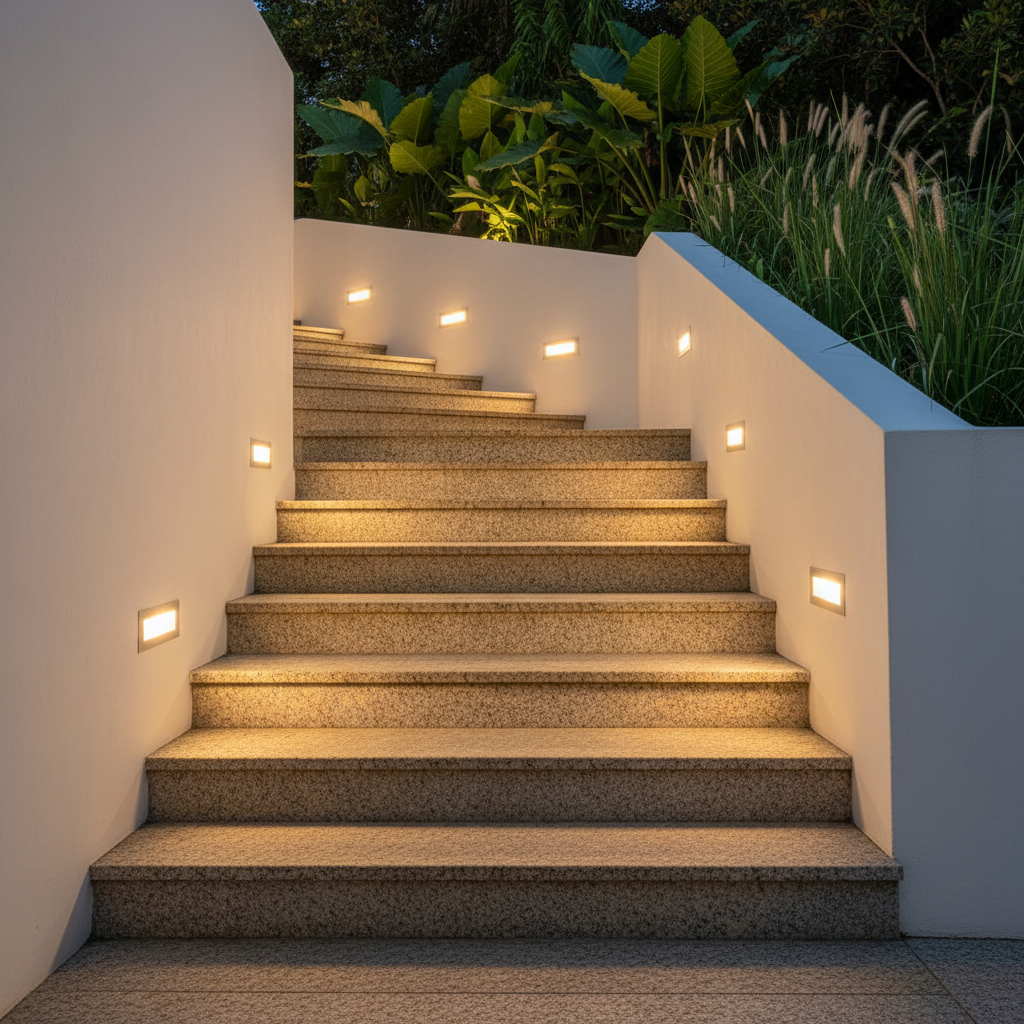
The recessed outdoor LED stair light in the riser is the most elegant option. The light is invisible from the front, illuminating each step from below, creating a continuous ribbon of light. On natural stone or polished concrete stairs, the effect is stunning.
But let's be honest: it's also the most demanding option. You need to drill into each riser, run electrical cables, and connect everything to a dedicated circuit. In practice, this requires an electrician, chases if cables run through a wall, and upfront planning for power supply. Installation costs can quickly reach $500 to $1500 for a 5 to 8-step staircase, excluding materials.
Another delicate point: drilling into the steps creates potential weak points. If the seal between the fixture and the step isn't perfect, water can infiltrate. On concrete, it's manageable. On wood, it's a source of long-term problems. A minimum IP65 rating is non-negotiable for these recessed lights.
LED Strip Light Under Nosing: The Semi-Pro Compromise
The outdoor LED stair strip light is an intermediate alternative. An aluminum profile is attached under the overhang of each step (the nosing), into which an LED strip is inserted. The cable then runs along the staircase structure and connects to a power supply.
The main advantage: no drilling into the steps. The cable remains on the surface, visible or concealed within a profile. The lighting effect is similar to recessed lights, with light grazing the surface of each step, making it visible without glare.
However, you still need to run cables and power the system. It's less intensive than recessed lighting, but not a plug-and-play solution. And on an existing staircase, installing profiles on each nosing requires care for a clean result. The LED strip light must also be outdoor-rated.
LED Wall Sconce: The No-Compromise Installation Solution
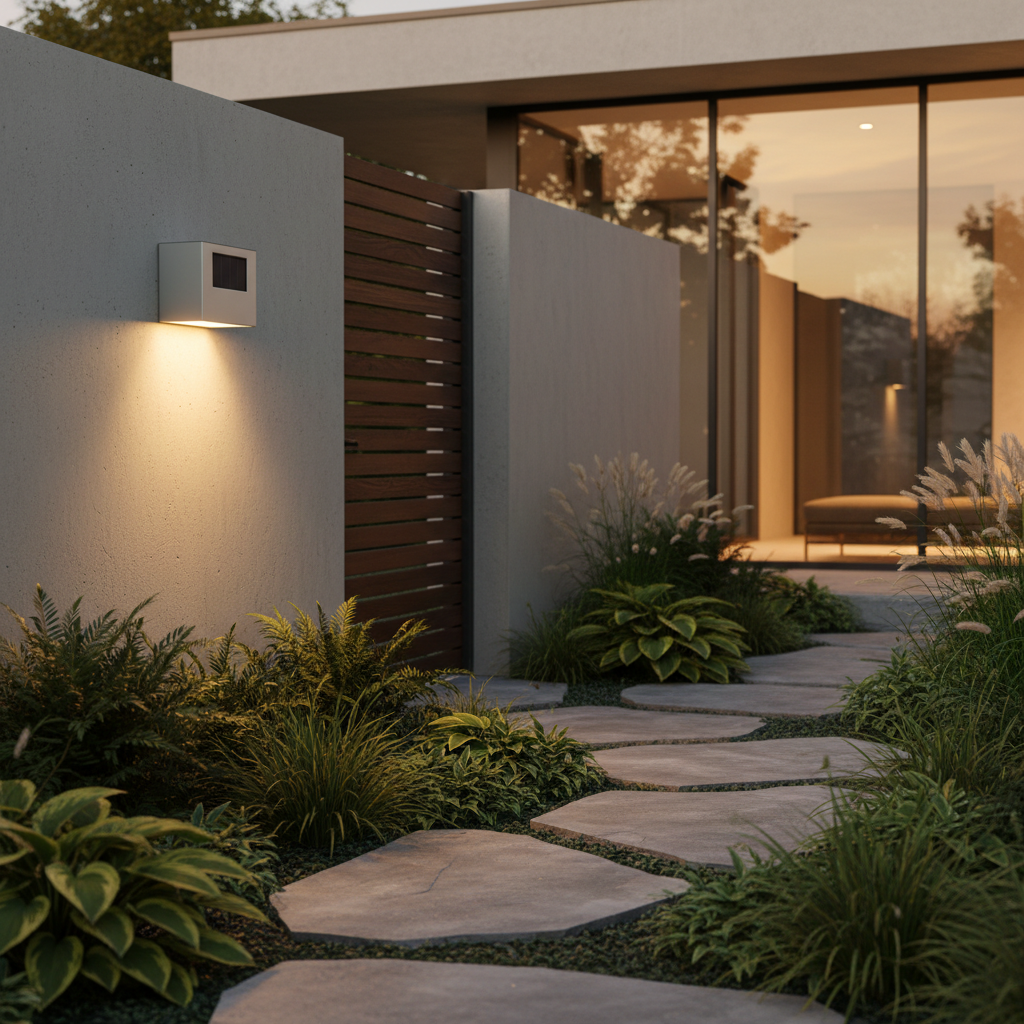
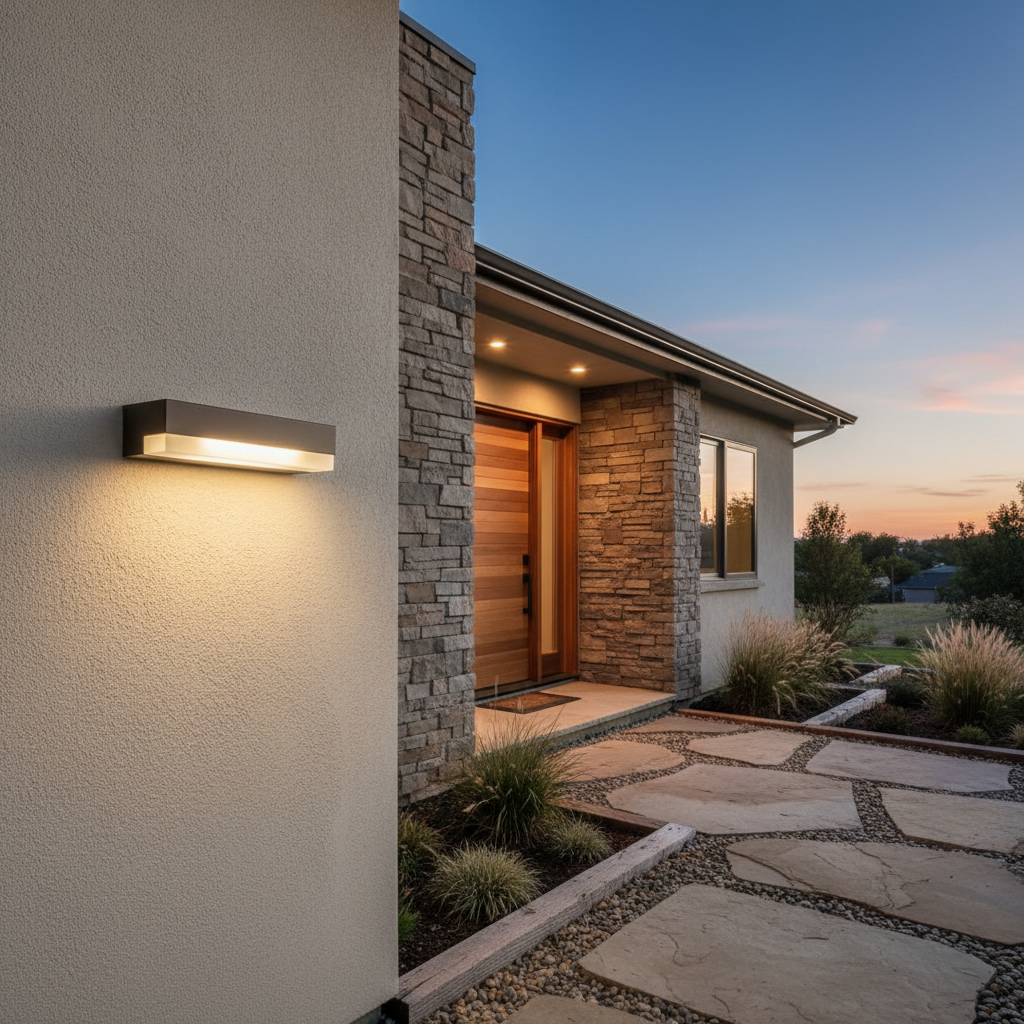
While the first two options require construction work, LED stair step lighting via wall sconces is a completely different story. One or more sconces are mounted on the wall alongside the staircase, illuminating the steps with lateral projection.
It's less visually spectacular than recessed lights. But it's incomparably simpler to install, and most importantly: no cables in the steps, no risk of water infiltration through the risers. For an existing staircase, or for a tenant who isn't allowed to drill into the steps, this is often the only realistic option.
And this is where a noteworthy variation comes in: the solar LED wall sconce. No cables at all. You screw in the bracket (or use industrial adhesive), and you're done. The solar panel recharges the battery during the day, and the motion sensor triggers the light at night.
Solar LED Stair Lighting: Does It Really Work?
A legitimate question. Entry-level solar lights have left many with mixed feelings: dim light, dead battery after 6 months, sensor triggering for no reason.
What Differentiates a Real Solar Light from a Low-End One
Two elements make all the difference: the size of the solar panel and the battery capacity. A solar light that works in winter in the US/Canada (low sunlight, short days) needs a larger panel to capture every available ray, and a battery large enough to store energy from sunny days for subsequent cloudy days.
Low-end models skimp on these two components. That's why they disappoint. Check out our article on powerful outdoor solar lighting to understand what they usually don't tell you about these products.
1200 Lumens on a Staircase: Is It Enough?
For a standard outdoor staircase (4 to 8 steps, normal width), 1200 lumens from a well-positioned wall sconce is more than enough to see where you're stepping. It's not stadium lighting; it's functional and safe lighting.
Lumic's SolarGlow produces exactly 1200 lumens in LED, with two 180° motion sensors and a range of about 26 feet (8 meters). Specifically: it detects someone approaching the staircase even before they step on the first stair. The battery lasts about 20 days without sun in detection mode. This autonomy covers a week of bad weather without a problem.
To learn more about wireless outdoor lighting solutions suitable for all contexts, we've prepared a complete comparison.
Practical Installation on an Outdoor Staircase
Wiring an outdoor staircase with recessed LEDs can cost between $500 and $1500 depending on the number of steps and access to the electrical grid. A solar LED wall sconce means 2 screws in the wall and 10 minutes of your time. No electrician, no trenching, no electrical certification needed from your landlord.
The IP65 rating of the SolarGlow guarantees resistance to rain, snow, and frost. This is the minimum requirement for any outdoor fixture. If you want to understand what IP65 concretely means, the linked article explains everything.
How to Correctly Position Lighting on an Outdoor Staircase
Stair lighting is as much about position as it is about power. A poorly placed sconce illuminates the wall rather than the steps. An overly powerful recessed light glares instead of illuminating.
Ideal Height for a Wall Sconce
To effectively light the steps from the wall, position the sconce 31-47 inches (80-120 cm) above the first step's ground (or the ground at the bottom of the stairs). At this height, the light beam covers all steps without dazzling someone descending the stairs facing the light.
If your staircase has more than 8 steps, consider two sconces: one at the bottom and one at the top (or in the middle). The simple rule: no step should remain in shadow.
Motion Sensor Orientation
A motion sensor on a staircase should detect approach, not just passage. Orient it towards the base of the staircase (when ascending) or towards the upper landing (if someone is descending). With a range of 26 feet (8 meters) and a 180° angle, a single well-oriented sensor usually covers the entire area.
The outdoor motion sensor deserves time to be properly adjusted. Too sensitive, it triggers for a cat. Not sensitive enough, you find yourself in the dark in the middle of the stairs.
Color Temperature on an Outdoor Staircase
This is a detail that greatly changes the experience. A cool white (6000K) on an outdoor staircase gives a clinical and unwelcoming appearance. In contrast, a neutral to warm white (3000K or 4000K) creates a warmer ambiance, while ensuring good visibility of the steps.
For a home staircase, 3000K (warm white) remains the most common and pleasant choice. For a commercial or apartment building staircase, 4000K (neutral white) is often preferred for its clarity.
What Technical Criteria to Check Before Buying
You now know: outdoor LED stair lighting involves a few essential checks before buying. Here's the quick checklist.
IP Rating: The First Non-Negotiable Criterion
For an outdoor staircase, the absolute minimum is IP65. This means: total protection against dust, resistance to water jets. IP67 or IP68 offers protection against immersion, useful if the staircase is exposed to heavy rain or water splashes (jet cleaning). For the vast majority of covered or semi-covered staircases, IP65 is sufficient.
A fixture sold without an IP rating has no place outdoors. This is non-negotiable.
Power Source and Battery Life
Three options: electrical grid (wired), rechargeable battery (USB or solar). Wired offers unlimited availability but requires installation by a qualified electrician. Solar offers variable autonomy depending on sunlight and battery size. USB rechargeable is an intermediate solution, practical for small spaces.
For modern wireless outdoor lighting solutions, battery life has significantly improved. A model with a battery 4x larger than entry-level ones can last 20 days without solar recharge in detection mode.
Mounting Type According to Surface
Cinder block or brick wall: screw and anchor mounting, quick. Natural stone wall: be careful, some stones cannot withstand drilling without fracturing. Wooden post: ensure the support is solid before screwing. Metal post: clamp or bracket mounting.
For solutions with industrial adhesive, ensure the surface is clean, dry, and not powdery. On unpainted raw concrete, adhesive holds very well. On crumbling plaster, screws are preferable.
The Cable-Free, No-Work Alternative for Existing Stairs
This is often the real situation: you have an outdoor staircase that's been there for 10 years, you don't want to dismantle it to run cables, and you don't want to spend $1000 on an electrician.
The solar LED wall sconce is the direct answer to this scenario. It installs on any wall adjacent to the staircase, without touching the steps, without pulling electrical cables, without risk of infiltration into the risers.
Lumic's SolarGlow is designed for this: 1200 lumens of LED, two 180° sensors (26 ft / 8 m range), IP65, 20-day battery life without sun in detection mode. For someone who wants to secure an outdoor staircase quickly, without installation costs, it's the shortest path from problem to solution.
You can find other similar approaches in our article on wireless patio lighting, if your staircase leads to a patio you also want to equip.
And if you're thinking about other areas to light wirelessly in your yard, our guide on solar garden lighting details what works zone by zone.
Key Takeaways on Outdoor LED Stair Lighting
LED is the only technology that truly holds up on an outdoor staircase: low power consumption, no heat, long lifespan. Three solutions exist, each with its own logic.
Recessed riser lighting is the most beautiful. It requires serious work and a significant budget. For new construction or a complete renovation, it's the right choice if the budget allows.
The LED strip light under the nosing is a good aesthetic compromise, with fewer installation constraints than recessed lighting but still requiring wiring.
The LED wall sconce, especially the solar version, is the most accessible solution, the quickest to install, and the only one truly suitable for existing stairs and tenants. 1200 lumens with automatic detection is enough to secure any residential outdoor staircase.
The real question isn't which solution is the most beautiful. It's which solution you will actually install this year. A perfect recessed LED that you've been postponing for two years is worth less than a solar sconce installed this weekend.