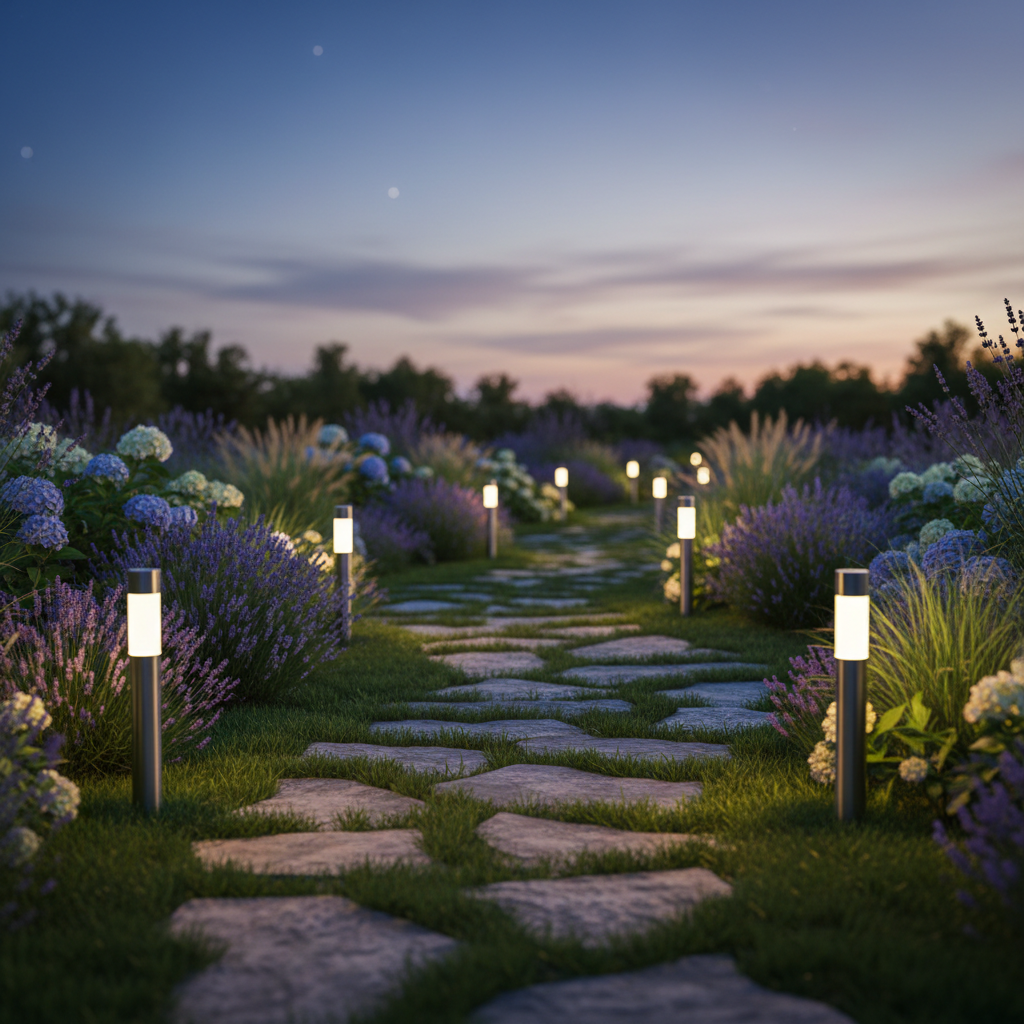

You've probably bought a garden solar light before, full of hope. And then the next night: a timid, barely visible glow that dies after 20 minutes. This isn't bad luck; it's a structural problem with most solar lights on the market.
A truly powerful outdoor solar light exists. But it's not like the $15 ones you find at big box stores. This guide will help you understand what makes the difference, what to really look for before buying, and why most buyers fall for misleading marketing claims.
Why Most Solar Lights Are Disappointing
Disappointment almost always stems from the same issue: manufacturers optimize for sales price, not nighttime performance. The result is a product that works fine in summer, on sunny days, with 8 hours of direct sunlight. But it fails as soon as conditions become realistic.
The Problem of Undersized Solar Panels
A panel that's too small can't store enough energy to last all night. In fall or winter, when the sky is overcast for several days in a row, the battery never fully recharges. You end up with a light that flickers dimly or turns off after a few minutes of use.
The basic rule: the larger the panel relative to the battery, the more autonomous the light will be, even on cloudy days. This is a physical reality that many manufacturers deliberately ignore to cut costs.
The Battery: The Real Autonomy Factor
Two lights can claim the same number of lumens on the box but have radically different runtimes. It all depends on the capacity of the integrated battery. A low-capacity battery will indeed light up the fixture, but for how long? In motion sensor mode, maybe one night. In continuous mode, sometimes less than an hour.
For serious outdoor use, you need a battery sized to last several consecutive nights without recharging, not just one night under ideal conditions. This is what distinguishes a premium product from an entry-level one.
Advertised Lumens vs. Real Lumens
This is the number one trap. A lamp claims 2000 lumens on the packaging. In reality, this figure corresponds to the theoretical maximum peak, measured under laboratory conditions, for a fraction of a second. In normal use, the actual light output is often two to three times lower.
For effective powerful outdoor solar lighting, it's better to have a product that delivers a verifiable 800 real lumens than one that boasts an unsubstantiated 3000 lumens. To further understand this topic, our article on powerful outdoor solar lamps thoroughly explains the features that ensure lasting performance.
Criteria for Choosing a Truly Powerful Outdoor Solar Light
Now that we know what's wrong, here's what to look for specifically. These criteria are ranked from most to least important to help you prioritize your purchasing decisions.
Light Output: Aim for at Least 800 Lumens
Below 800 lumens, you're in the category of decorative or ambient lights. Useful for marking a pathway or creating an atmosphere, but not for truly illuminating a patio, garage, or entrance.
To light an area of approximately 100 to 160 sq ft (10 to 15 m²), count on 800 to 1200 lumens. Beyond that, you enter the category of long-range floodlights, useful for securing large spaces like a parking lot or a large yard.
| Light Output | Recommended Use | Covered Area (approx.) |
|---|---|---|
| Less than 400 lumens | Ambiance, pathway lighting | 20 to 40 sq ft (2 to 4 m²) |
| 400 to 800 lumens | Pathway, outdoor corridor | 50 to 100 sq ft (5 to 10 m²) |
| 800 to 1200 lumens | Patio, entrance, gate | 100 to 200 sq ft (10 to 20 m²) |
| 1200 to 2000 lumens | Garage, parking lot, large yard | 200 to 400 sq ft (20 to 40 m²) |
| More than 2000 lumens | Professional use, large spaces | 400 sq ft (40 m²) and up |
IP Rating: Waterproofing Is Not Optional
An outdoor light that isn't waterproof is a light that will die in the first rain. The IP rating measures protection against solids (dust) and liquids (water). For serious outdoor use, you need at least an IP65 rating.
IP65 means: total protection against dust + resistance to direct water jets. In practice, rain, snow, frost: the light will function. This is the bare minimum for anything installed outdoors, regardless of the region.
Battery Capacity and Off-Sun Autonomy
Off-sun autonomy is the most revealing criterion. How many full nights can the light operate without solar recharging? A good solar light should last at least 10 days in motion sensor mode without sun. The best models can go up to 20 days.
This criterion is particularly important in winter, when periods of low sunlight can last several weeks. A light that only lasts 2 or 3 days without sun will be practically useless in January or February.
Motion Sensor Quality
A good motion sensor truly detects movement (not false alarms due to wind or heat), has sufficient range to cover the area, and adapts to ambient light to only turn on at night.
Range is a key criterion: 16 feet (5 meters) might seem adequate, but in practice, for an entrance or gate, 26 feet (8 meters) is more comfortable. The detection angle also matters: 180° covers a wide area without blind spots.
Materials: Aluminum vs. Plastic
Plastic degrades in the sun. After 1 or 2 years of UV exposure, it becomes brittle, yellows, and cracks. Aluminum, on the other hand, resists weather, UV, and time. For a light installed permanently outdoors, this is a criterion that makes all the difference in the product's durability.
An aluminum casing is also often a sign that the manufacturer has invested in the overall quality of the product, not just in marketing.
Solar vs. Wired Lighting: Knowing When One Is Better Than the Other
Let's be honest: if you need permanent lighting over 3000 lumens, for example, for a large workshop or professional parking lot, wired remains the most reliable solution. It offers constant power, without dependence on weather conditions, and without runtime limits.
But for the vast majority of residential uses, solar has a lot to offer:
- No wiring: no trenches to dig, no electrician, no damage to your patio or driveway
- Installation in minutes: just mount it, orient the panel, and you're good to go
- No electricity bill: energy is free once the product is purchased
- Ideal for renters: you can easily remove it and take it with you
To delve deeper into this topic, our article on powerful solar floodlights compares different options based on your power needs.
Design and Power: Why They Are Not Mutually Exclusive
For a long time, powerful solar lights were ugly. Cheap plastic casings, a visible panel from afar, a DIY look that clashed with the rest of the exterior. That era is over, but you need to know where to look.
What Design Truly Impacts
Brushed aluminum casing resists UV and temperature variations better than plastic. It retains its original appearance much longer. A refined design is often a sign of overall attention to product quality, not just aesthetics.
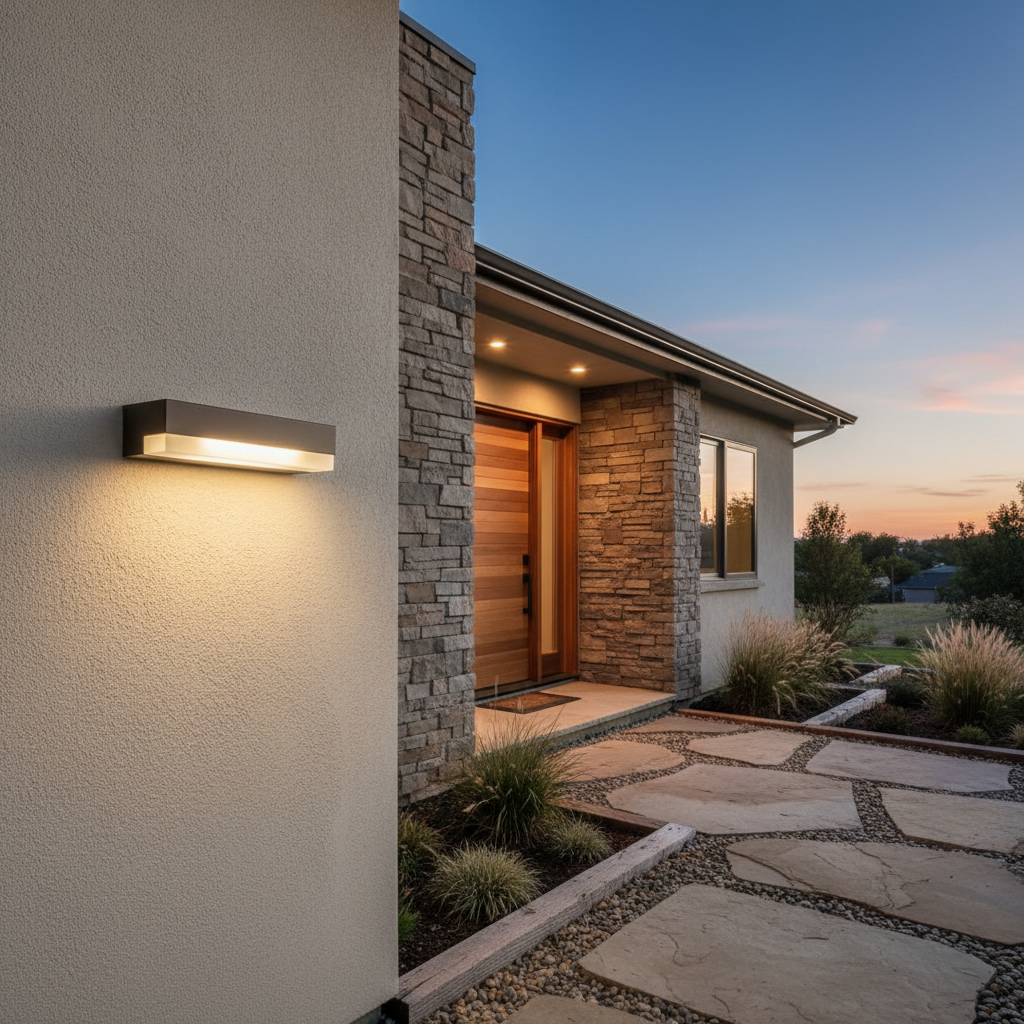
For patios, entrances, or facades, a discreet and elegant light complements the architecture instead of disrupting it. This is a criterion that people who meticulously maintain their outdoor spaces cannot ignore.
Integration into Different Outdoor Styles
A powerful solar light can adapt to very different contexts: a contemporary house with a light wood patio, an entrance with a wrought-iron gate, a garden with gravel paths. The key is to choose a minimalist design that doesn't 'pop' but integrates seamlessly.
To help you with this, our guide on choosing a beautiful and reliable outdoor solar light details how to combine aesthetics and long-term performance.
What We Know About Lumic's SolarGlow
If you're looking for a powerful outdoor solar light without compromising between performance and design, the SolarGlow deserves to be on your list.
What we can objectively say:
- 1200 real lumens: this is in the high range for a residential solar light, more than enough for a patio, entrance, or gate
- Solar panel 3x larger than entry-level models: it charges even on cloudy days, which makes all the difference in fall and winter
- High-capacity battery: 20 days of autonomy without solar recharging in motion sensor mode, 36 hours in continuous mode
- 2 x 180° motion sensors with a range of approximately 26 feet (8 meters): no blind spots in areas to monitor
- IP65 rated: rain, snow, frost, it holds up
- Aluminum casing: doesn't yellow or crack after 2 years in the sun
- Cable-free installation: just a few minutes
The 5-year warranty and 90-day satisfaction guarantee are also concrete arguments: it means Lumic stands behind the product's long-term durability.
Customer support is US-based with a response within 24 hours, which matters when you have a question or problem after installation.
For a comparison with other models available on the market, consult our comparison of the best outdoor solar lights.
Common Mistakes to Avoid When Buying
Before concluding, here are the most common pitfalls. We see them regularly in customer feedback and Trustpilot reviews, and almost all of them are avoidable with a little prior information.
Relying Solely on Price
A $12 solar light cannot physically deliver on its promises. The panel, battery, and LEDs have a minimum cost. Below a certain price, something has been sacrificed, and it's usually the battery or the panel, which determine real autonomy and performance.
Incorrectly Orienting the Solar Panel
In the US/Canada, to maximize solar exposure, the panel should be oriented south, with an inclination of approximately 30 to 45 degrees. A panel oriented in the shade or north will never charge properly, even on a beautiful sunny day.
Before installing, observe where the sun hits longest during the day in the area concerned. That's where the panel should be oriented, not necessarily where you want to position the light.
Choosing a Model Without Motion Detection
A solar light that stays on continuously all night will drain its battery in a few hours. Motion detection mode is essential for the battery to last several nights. If the model you're looking at doesn't have this mode, move on.
Underestimating Lumen Needs for the Area
Many people buy 400 lumens to light a 200 sq ft (20 m²) patio and are surprised by the result. Use the table earlier in this article to calibrate your actual needs before buying.
What You Need to Remember to Make the Right Choice
A powerful outdoor solar light that truly delivers on its promises is recognized by a few non-negotiable criteria: a light output of at least 800 lumens (verifiable), a well-sized solar panel, a high-capacity battery with several days of off-sun autonomy, a minimum IP65 rating, and an aluminum casing for durability.
The rest – color, style, mounting method – is a matter of preference and integration into your outdoor space. But without these solid technical foundations, you'll be disappointed, regardless of the brand.
If you want to dig deeper before deciding, our article on powerful outdoor solar lighting reveals what sellers don't necessarily tell you about these products.
The right solar light is one you install once, that works in winter and summer, and that you no longer think about because it quietly does its job. That's the standard you deserve.