Looking for discreet, cable-free lighting for your patio or pathway that's tough enough to withstand foot traffic? An in-ground solar spotlight is one of the most elegant solutions. But choosing the right one is crucial, because once it's installed, going back is a hassle.
This guide covers the truly important criteria, what to avoid, and why some popular solar products aren't suitable for this specific use.
Why Choose an In-Ground Solar Spotlight Over a Wired Model?
This question often comes up when renovating a patio or landscaping a pathway. Wired lighting is reliable, but it means digging trenches, running cables, and sometimes hiring an electrician. These constraints drive up costs and project time.
What Does an In-Ground Solar Spotlight Really Offer?
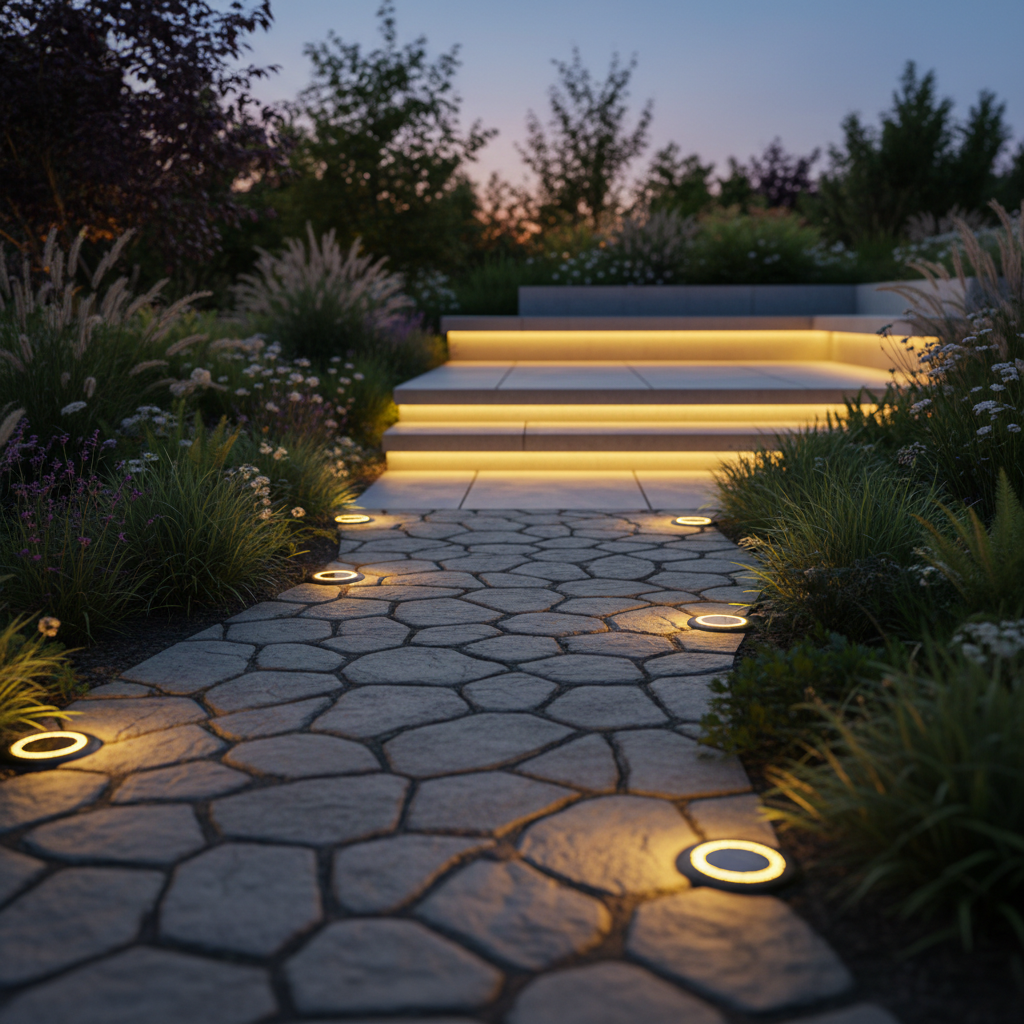
An in-ground solar spotlight integrates its own photovoltaic panel, battery, and LEDs into a housing designed to be flush with the ground or facade. The result: no cables to manage, no power outlets needed. You dig the spot, install the light, cover it with gravel or leave it exposed, and you're done.
In practice, it's a popular solution for:
- Gravel or paved garden paths
- Patio borders for accent lighting
- Outdoor stairs
- Pond or flowerbed perimeters
Discretion is its real strength: when the light is off, you barely see it. When it turns on, it creates a very clean, luminous accent effect, with no poles, no exposed cables, and no visible housing.
Limitations Few Sellers Mention
An in-ground solar spotlight is exposed to much harsher mechanical and climatic conditions than a wall-mounted fixture. The solar panel needs direct sunlight, but it's often horizontal on the ground, making it more prone to dirt (leaves, mud, plant shadows). Regular cleaning is essential to maintain performance.
Another point: the battery is buried. Temperature variations between summer and winter affect performance. A good in-ground solar spotlight compensates with a sufficient battery capacity, but not all models are equal here. To better understand the impact of battery on real-world performance, our article on choosing a solar light battery will give you concrete benchmarks.
Key Technical Criteria Not to Overlook Before Buying
This is where many people make mistakes. An in-ground spotlight is not the same as a garden light on a stake. The requirements are different, and compromises are unforgiving.
IP Rating: Why IP67 is the Minimum for Ground Installation
The IP (Ingress Protection) rating measures resistance to dust and water. For a ground-mounted light, you need to consider two factors: flowing water (rain, irrigation) AND stagnant water or capillary action when the ground is saturated.
An IP65 protects against water jets, but not prolonged immersion. In the ground, when it rains heavily and water accumulates around the light, an IP65 might suffice in some cases, but it's the bare minimum. An IP67 guarantees resistance to temporary immersion (typically 30 minutes at 3.3 feet (1 meter) depth). For ground installation, this is the recommended rating.
If the seller doesn't clearly state the IP rating, move on.
Weight Resistance: An Often-Forgotten Criterion
A spotlight embedded in a pathway will experience regular foot traffic: you, guests, maybe a garden cart. The light's casing must withstand mechanical load. Reputable models indicate a maximum supported load (often expressed in lbs or tons for road-grade models).
For pedestrian and gardening use, a stainless steel or reinforced ABS housing usually does the job. For vehicle use (driveway), the requirements are higher, and you need products specifically approved for that purpose.
Actual Light Output vs. Marketing Numbers
The lumens advertised for low-end solar spotlights are often... optimistic. An in-ground spotlight doesn't need to illuminate an entire patio; its primary role is accent and signaling. But it still needs noticeable light from a distance for effective guidance.
In practice, for ground accent lighting, 20 to 50 lumens per light can be enough if the lights are close together. If you're using fewer lights and want them to create an ambiance, aim for at least 100 lumens per unit. To understand how to assess your light output needs, our guide on powerful garden solar lights will give you a clear method.
Installing an In-Ground Solar Spotlight: What You Really Need to Do
Installation is more demanding than for any other solar light. But if you prepare well, it will go smoothly. Here's how to proceed.
Step 1: Choose and Prepare the Location
Before digging, assess the sun exposure of the area. This is the critical point for in-ground solar spotlights: the panel is horizontal, so it mainly captures overhead sunlight. If the location is shaded by a wall or tree during the day, recharging will be insufficient.
Practical rule: the location must receive at least 4 to 6 hours of direct sunlight during the day for the light to be autonomous year-round. In winter, the sun is lower, and recharging is reduced. Models with a high-capacity battery better compensate for less sunny days. If you have questions about winter performance, our article on solar lights that work in winter details this topic in depth.
Step 2: Dig to the Correct Depth
The embedding depth depends on the light's dimensions. Read the manufacturer's instructions, but generally, you'll need to dig a cylinder or square slightly larger than the housing to facilitate installation and future removal.
Some practical tips:
- Outline the light's shape on the ground before starting.
- Use a drill with a bit suitable for the material (concrete, wood, dirt, gravel).
- Leave a little clearance around the housing for easier retrieval later.
- If the ground is paved, shim the light with sand to ensure it's level.
Step 3: Placement and Verification
Before final installation, place the light in its housing and leave it in direct sunlight for 8 hours. Check that it lights up properly the following night. This is the time to adjust the panel's orientation if necessary, while it's still easily accessible.
Once verified, seal or fix according to the manufacturer's instructions. Some models screw into their housing, others are held in place by their own weight and the pressure of the surrounding soil.
Step 4: Space Lights Correctly for Consistent Illumination
Effective accent lighting relies on visual regularity. Generally, spacing lights 1.5 to 3 feet (50 cm to 1 meter) apart creates a clean effect on a pathway. If you want more subtle lighting with fewer lights, aim for a maximum of 2.5 to 4 feet (80 cm to 1.2 meters); beyond that, the effect becomes discontinuous and loses its elegance.
In-Ground Solar Spotlight: What Else You Can Do for Your Patio
The in-ground spotlight is often part of a larger setup. For a truly well-lit patio, it combines with other types of lighting depending on the areas and uses.
Complement with Other Types of Outdoor Lighting
In-ground spotlights create low-level accent lighting. It's beautiful, but it doesn't illuminate an outdoor countertop or dining table. For more versatile patio lighting, check out our wireless patio lighting ideas that combine several approaches depending on the desired ambiance.
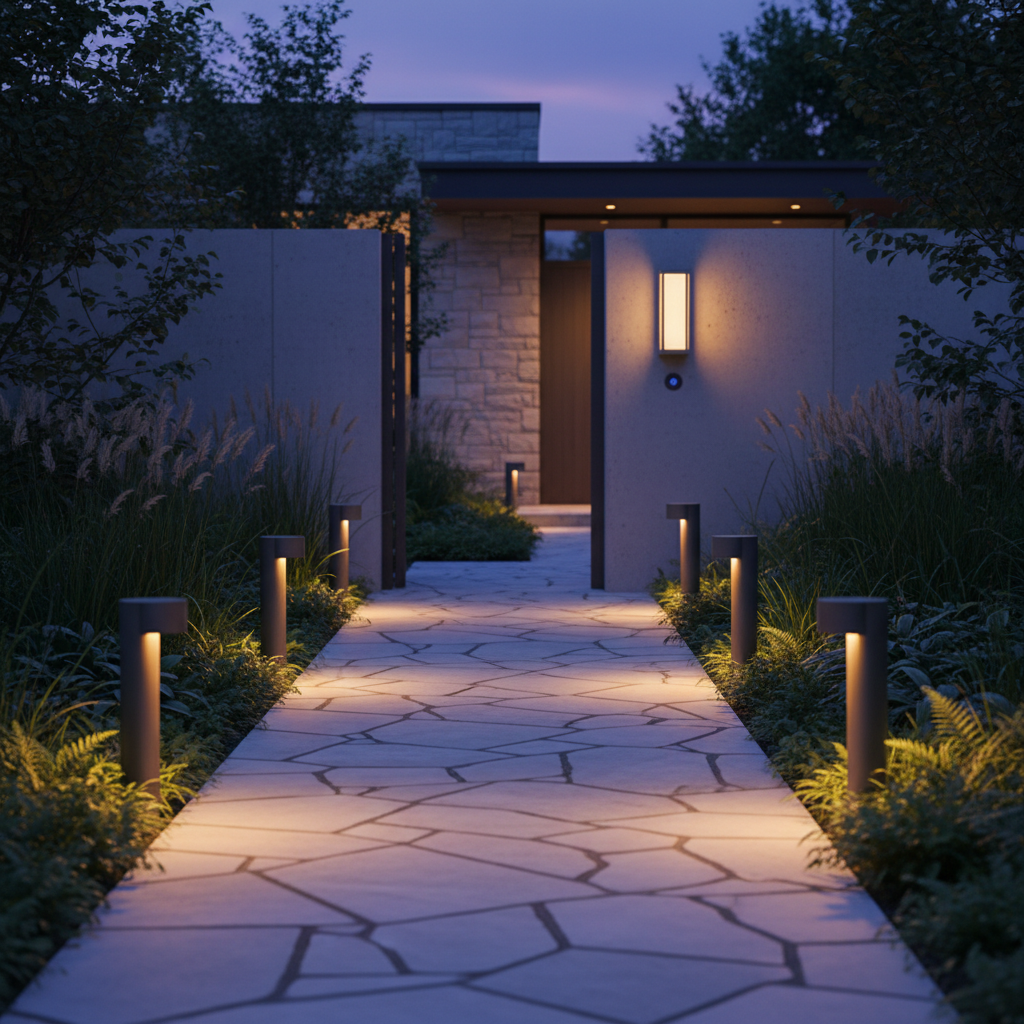
For longer pathways, garden bollards are an interesting alternative to in-ground spotlights: less discreet, but more visible from a distance and easier to move. Our comparison on solar garden bollards for accent lighting gives you an overview of available options.
Is Lumic's SolarGlow an In-Ground Spotlight?
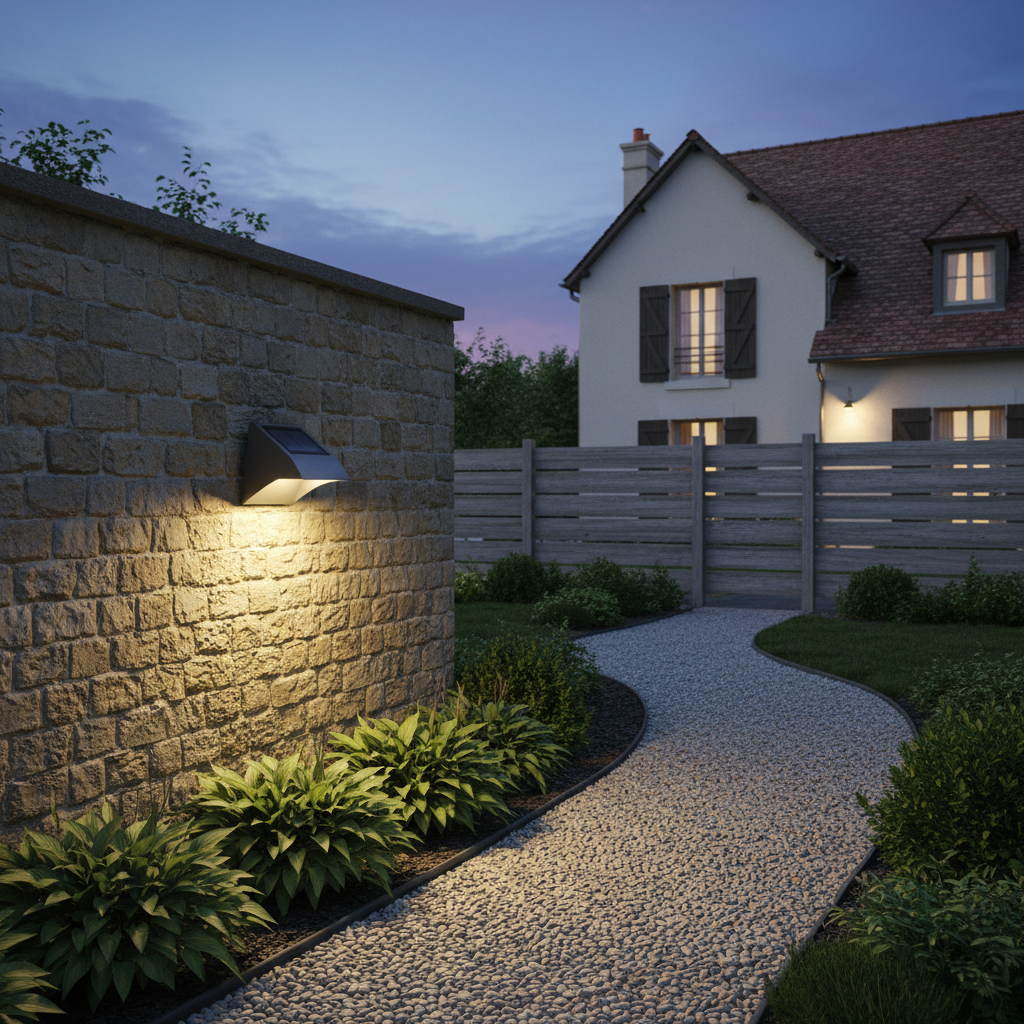
No, and we need to be direct about this: the SolarGlow is not an in-ground spotlight. It's a motion-sensing wall sconce designed to be installed on a wall, facade, or post. If you're looking for in-ground spotlights for your patio, the SolarGlow is not the answer to that specific need.
However, if you combine in-ground spotlights with security lighting at your patio entrance, the SolarGlow can perfectly play that complementary role: 1200 lumens, two 180° motion sensors with a range of about 26 feet (8 meters), resistant to rain, snow, and frost (IP65), and a 20-day autonomy without solar recharge in detection mode. It doesn't replace in-ground spotlights, but it enhances security lighting in a specific area like an entrance or gate.
If you're exploring the idea of motion-sensing solar lighting for your patio as a whole, this guide will give you a more complete view of available options.
Comparison Table: In-Ground Solar Spotlight vs. Other Outdoor Lighting Solutions
| Criterion | In-Ground Solar Spotlight | Solar Garden Bollard | Solar Wall Sconce | Wired In-Ground Spotlight |
|---|---|---|---|---|
| Installation | Dig / drill ground | Stake into ground | Screw onto wall | Dig + run cable |
| Visual Discretion | Excellent (flush with ground) | Medium (visible during day) | Good | Excellent |
| Power Source | Solar, 0 cables | Solar, 0 cables | Solar, 0 cables | Electrical grid |
| Winter Reliability | Variable (buried battery) | Variable | Good if large battery | Excellent |
| Mechanical Resistance | Essential (IP67+) | Generally good | IP65 sufficient | Variable |
| Average Cost | Medium to High | Low to Medium | Medium | High (labor) |
| Maintenance | Regular panel cleaning | Low | Low | Very low |
Common Mistakes to Absolutely Avoid
Many disappointments with in-ground solar spotlights come from poor purchasing or installation decisions. Here are the most frequent ones.
Buying Solely on Price Without Checking IP
Cheap in-ground spotlights (under $15) often have uncertified or insufficient IP ratings. In the first winter, water infiltration into the housing will blacken the LEDs or fry the battery. An in-ground light that needs replacing every two years is neither economical nor ecological. Aim for models with clearly documented IP67.
Installing in a Partially Shaded Location
This is the most common placement error. Under a leafy tree, behind a low wall, in the north corner of a patio: the panel won't recharge sufficiently, and the light will turn off in the middle of the night. Test the sun exposure of the location at different times of day before getting out the drill.
Neglecting Solar Panel Maintenance
A solar panel covered with a thin layer of dust or dead leaves can lose a significant portion of its efficiency. When the panel is on the ground, it gets dirty faster. Plan a monthly wipe-down with a damp cloth to maintain performance, especially in fall.
Spacing Lights Too Far Apart
Accent lighting with 5 lights every 6.5 feet (2 meters) over a 33-foot (10-meter) path looks more like an airport runway than a well-maintained garden. Reduce spacing to a maximum of 2.5 feet (80 cm) and use more lights rather than relying on the power of a few isolated units. The visual effect is infinitely more elegant.
How to Know if an In-Ground Solar Spotlight is Right for Your Project
A few quick questions to validate your choice before buying:
- Does the planned location receive at least 4 hours of direct sunlight during the day?
- Is the ground made of drillable material (concrete, wood, dirt, gravel)?
- Do you need decorative accent lighting or powerful functional lighting?
- Is there vehicle traffic in the area? (If yes, check the maximum supported load.)
- What is your overall budget for all the accent lighting?
If you answer yes to the first three questions and your budget allows, an in-ground solar spotlight is probably the right solution for you. If the location is too shaded or you need powerful lighting for an entire patio, you'll likely be better off with a combination of different lighting types. Our article on choosing an outdoor solar floodlight can help you explore alternatives if in-ground spotlights don't cover all your needs.
Key Takeaways Before You Start
The in-ground solar spotlight is an aesthetically flawless solution for accenting a pathway or patio without cables or an electrician. But it's a product that doesn't forgive poor choices: insufficient IP, a shaded location, or an undersized battery will lead to disappointing results from the first cold season.
Non-negotiable criteria: minimum IP67, sufficient battery capacity to last through long winter nights, a housing resistant to mechanical loads, and a location that truly receives direct sunlight. If these conditions are met, you'll have clean, discreet, automatic accent lighting, with no electricity bill.